
NCERT Solutions for Class 10 English First Flight Chapter 1
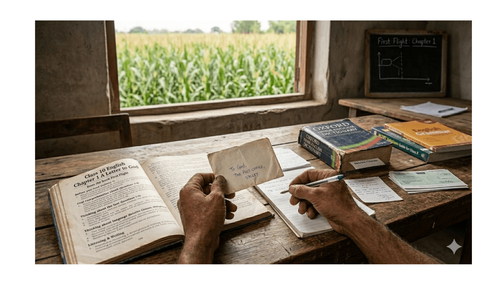

NCERT solutions for Class 10 English Chapter 1 A Letter to God – complete answers & explanations
Class 10 English Chapter 1 A Letter to God from the book First Flight is a touching story about faith, hope and human kindness. It shows how Lencho, a simple farmer, believes deeply in God and writes a letter asking for help after his crops are destroyed. This chapter helps students understand themes like faith, irony and human nature. In this blog, you will find complete NCERT solutions strictly based on the given worksheet, arranged in the exact order for easy learning and exam preparation.
What this NCERT chapter covers?
1. The story of Lencho and
his strong faith in God.
2. Themes such as hope, belief, irony and human values.
3. Understanding literary devices like metaphors and emphasis through negatives.
4. Grammar topics such as relative clauses and vocabulary related to storms.
5. Listening and writing skills through practical activities.
6. Poems “Dust of Snow” and “Fire and Ice” focusing on symbolism and poetic devices.
How to use these NCERT solutions?
1. First, read the chapter carefully and try answering the questions on your own.
2. Use these NCERT solutions to check your answers and correct mistakes.
3. Follow the answers in the exact worksheet order to avoid confusion.
4. For activities and creative tasks, understand the explanation given and complete your work accordingly.
5. Parents and teachers can guide students by discussing themes and meanings before checking answers.
Important tips & tricks for students
1. Focus on understanding Lencho’s character and the irony in the story.
2. Write answers clearly and to the point as per NCERT expectations.
3. Do not skip grammar sections like relative clauses and metaphors.
4. For listening and writing tasks, read the instructions carefully.
5. Revise the poems properly, especially symbolism and rhyme scheme, to score full marks.
NCERT solutions – complete answer key
Before you read
Activity 1
Explanation:
Students have to understand how a Money Order form is filled at the post office. They should identify the sender, receiver, acknowledgement section and the space for communication, and understand the purpose of each section. Now complete the following statements.
1. the receiver
2. the sender; receiver
3. writing a short message
4. three; two
Oral comprehension check
Explanation:
These questions test understanding of Lencho’s reaction after receiving the money.
1. Lencho hoped for rain.
2. He said the raindrops were like ‘new coins’ because the big drops were like ten-cent pieces and the little ones were like five-cent pieces.
3. The rain changed into a hailstorm. The hail destroyed the corn completely.
4. He was filled with sadness.
Oral comprehension check
Explanation:
These questions focus on Lencho’s faith and the reaction of the post office employees after reading the letter.
1. Lencho had faith in God. He wrote a letter to God asking for a hundred pesos.
2. The postmaster read the letter.
3. He decided to answer the letter. He collected money from his employees and friends and sent it to Lencho signed as ‘God’.
Oral comprehension check
Explanation:
These questions test understanding of Lencho’s reaction after receiving the money.
1. No, Lencho was not surprised to find a letter for him with money in it.
2. He became angry when he counted the money and found that it was less than what he had asked for.
Thinking about the text
Explanation:
These questions help students analyse the characters, irony, and conflicts in the story.
1. Lencho has complete faith in God. The sentences that show this are: “But in the hearts of all who lived in that solitary house in the middle of the valley, there was a single hope: help from God.” and “All through the night, Lencho thought only of his one hope: the help of God.”
2. The postmaster sends money to Lencho in order not to shake the writer’s faith in God. He signs the letter ‘God’ so that Lencho’s faith remains unshaken.
3. No, Lencho did not try to find out who had sent the money to him. He had complete faith that God had sent it.
4. Lencho thinks that the post office employees have taken the rest of the money. The irony is that the post office employees were the ones who collected money to help him, yet he calls them a bunch of crooks.
5. Yes, there are people like Lencho in the real world. He is naive, unquestioning and somewhat comical.
6. The conflict between humans and nature is shown through the hailstorm that destroys Lencho’s crops. The conflict between humans is shown when Lencho accuses the post office employees of stealing the money.
Thinking about language
There are different names in different parts of the world for storms, depending on their nature. Can you match the names in the box with their descriptions below, and fill in the blanks. You may use a dictionary to help you.
Explanation:
Students match different types of storms with their correct descriptions to understand vocabulary related to natural disasters.
1. cyclone
2. gale
3. typhoon
4. tornado
5. hurricane
6. whirlwind
II. Notice how the word ‘hope’ is used in these sentences from the story:
Explanation:
Students match the uses of the word ‘hope’ in different sentences with their correct meanings to understand its usage as a noun and verb.
1. wanting something to happen (and thinking it quite possible)
2. showing concern that what you say should not offend or disturb the other person: a way of being polite
3. a feeling that something good will probably happen
4. wishing for something to happen, although this is very unlikely
5. thinking that this would happen (It may or may not have happened.)
6. stopped believing that this good thing would happen
III. Relative clauses
Explanation:
Students join sentences using relative pronouns (who, whom, whose, which) to practise non-defining relative clauses.
1. I often go to Mumbai, which is the commercial capital of India.
2. My mother, who cooks very well, is going to host a TV show on cooking.
3. These sportspersons, whose performance has been excellent, are going to meet the President.
4. Lencho prayed to God, whose eyes see into our minds.
5. This man, whom I trusted, cheated me.
IV. Using negatives for emphasis
Explanation:
Students identify sentences from the story where negative words are used to emphasise an idea.
1. Not a leaf remained on the trees.
2. It was nothing less than a letter to God.
3. Never in his career as a postman had he known that address.
V. Metaphors
Explanation:
Students identify metaphors in the story and understand the qualities being compared.
1. Raindrops – new coins – their value and usefulness to the farmer
2. Hailstones – new silver coins – their size and appearance
3. Locusts – a plague of locusts – destruction of crops
4. An epidemic – an epidemic (a disease) that spreads very rapidly and leaves many people dead – widespread destruction
5. Lencho – an ox of a man – hardworking and strong
Listening
Listen to the letter (given under ‘In This Lesson’) read out by your teacher/on the audio tape. As you listen fill in the table given below.
Explanation:
Students listen to the letter and fill in details based on the information they hear.
1. she hasn’t written for a very long time.
2. because they have just moved house.
3. January 2006.
4. he hadn’t written for a very long time.
5. ‘Little Feet’.
6. Jaya is writing to Arti.
7. At Bangalore last year.
Writing
Lencho suffered first due to drought and then by floods. Our country is also facing such situations in the recent years. There is flood and there is drought. There is a need to save water through water harvesting. Design a poster for your area on how to save water during summer and when it is available in excess.
Explanation:
Students design a poster showing ways to save water during summer and how to store water when it is available in excess. The poster should include slogans and messages about water conservation and rainwater harvesting.
Dust of snow
Thinking about the poem
Explanation:
These questions help students understand the theme, symbolism and mood of the poem.
1. A “dust of snow” is the small particles of snow that fall from a tree. The falling of the dust of snow changed the poet’s mood. His mood changed from sadness to happiness.
2. Frost presents nature as a source of change and positivity.
(i) Birds usually named in poems are nightingales or beautiful birds. A crow is not often mentioned in poems. It usually brings to mind images of darkness or bad luck.
(ii) A hemlock tree is a poisonous plant. The poet uses it instead of a beautiful tree to show that even unpleasant things can bring a positive change.
(iii) The crow and hemlock represent sorrow. The dust of snow stands for a positive change or a moment of joy.
3. Answers may vary.
Fire and ice
Thinking about the poem
Explanation:
These questions help students understand symbolism and poetic devices used in the poem.
1. Answers may vary.
2. ‘Fire’ stands for desire, greed, avarice and lust. ‘Ice’ stands for hatred, coldness, intolerance and indifference.
3. The rhyme scheme of the poem is ABAABCBCB. It helps to emphasise the contrasting ideas of fire and ice in a balanced manner.
Why NCERT solutions help students?
NCERT solutions help students prepare confidently for exams by providing accurate, chapter-wise answers. They improve concept clarity and ensure that responses match NCERT standards. Regular practice with NCERT-aligned answers strengthens writing skills and boosts overall performance in Class 10 English.
Help your child master Class 10 English with structured, worksheet-aligned NCERT solutions and expert academic guidance.