
NCERT Solutions for Class 10 English Footprints without Feet Chapter 7
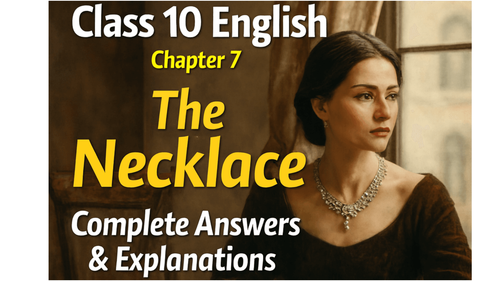

NCERT solutions for Class 10 English Chapter 7 The Necklace – complete answers & explanations
The chapter “The Necklace” from Class 10 English Footprints Without Feet is a powerful story by Guy de Maupassant that highlights themes of vanity, honesty, and contentment. It tells the tale of Mme Loisel, whose desire for wealth and luxury leads to years of hardship. This blog provides complete NCERT solutions strictly based on the worksheet, ensuring accuracy and alignment with the original content.
What this NCERT chapter covers?
1. The struggles of Mme Loisel and her husband after losing the necklace.
2. Themes of vanity, dishonesty, and irony in human life.
3. Lessons about honesty, contentment, and the dangers of greed.
4. Language skills such as comprehension, critical thinking, and moral reasoning.
5. How literature reflects social values and human nature.
How to use these NCERT solutions?
1. Attempt the worksheet questions independently before checking the answers.
2. Compare your responses with the solutions provided here.
3. Use the guidelines in the worksheet to refine your answers.
4. Teachers and parents can use these solutions to guide students in structured learning.
5. The answers follow the exact worksheet order for easy cross-checking.
Important tips & tricks for students
1. Avoid writing vague answers; always connect responses to the story.
2. NCERT expects clarity, honesty, and relevance in answers.
3. Highlight the irony and moral lessons in the story for better marks.
4. For “Talk about it” questions, relate answers to personal values and real-life situations.
5. Practice concise writing to score full marks.
NCERT solutions – complete answer key
READ AND FIND OUT
1. Mme Loisel is a pretty young woman who feels she was born for luxury and wealth. She is unhappy because she is married to a clerk and lives a modest life, which she constantly despises.
2. Her husband is a simple, caring, and content man. He tries to make his wife happy, sacrifices his own desires, and supports her in every possible way.
3. She feels distressed because she has no jewellery to wear with her new dress for the ball.
4. Her husband suggests she borrow jewellery from her friend Mme Forestier. Mme Loisel borrows a diamond necklace from her.
5. After losing the necklace, they search everywhere, contact the police, cab offices, and even advertise in newspapers. Finally, they decide to replace the necklace.
They buy a similar diamond necklace worth thirty-six thousand francs. Loisel uses his savings and borrows the rest from lenders.
THINK ABOUT IT
1 Sample Answer:
The necklace completely altered the Loisels' life. Losing it forced them into debt, hardship, and ten years of struggle. Mme Loisel lost her beauty and charm, while her husband aged prematurely. The necklace was the turning point that led to their ruin.
Guideline for Students:
- Begin by explaining how the necklace was lost.
- Describe the sacrifices they made to repay the debt.
- Highlight the irony revealed at the end.
2 Sample Answer:
Matilda's ruin was caused by her vanity, desire for wealth, and dishonesty. She could have avoided it by being honest with Mme Forestier about losing the necklace.
Guideline for Students:
- Identify her desire for luxury as the root cause.
- Show how dishonesty worsened her situation.
3 Sample Answer:
If Matilda had confessed, she would have learned that the necklace was fake and worth only five hundred francs. She could have avoided ten years of misery.
Guideline for Students:
- State the actual worth of the necklace.
- Compare the real outcome with the imagined one.
- Emphasise the importance of truthfulness.
4 Sample Answer:
I would have confessed the truth immediately to my friend. Honesty would have saved me from unnecessary suffering.
Guideline for Students:
- Relate the answer to personal values.
- Show how honesty prevents bigger problems.
TALK ABOUT IT
1 Sample Answer:
No, English is not the original language of the characters in the story. The story is set in France, and the characters are French. This is evident from the use of French words and titles such as *Monsieur (M.)* and *Madame (Mme)*. These clues clearly show that the characters must have been speaking French.
Explanation:
- Begin by stating whether English is the original language of the characters.
- Identify textual clues from the story (names, titles, currency, setting).
2 Sample Answer:
Yes, honesty is always the best policy. Matilda's dishonesty led to her ruin, while truth could have saved her.
Explanation / Guideline for Students:
- Relate the proverb to the story by describing Matilda's mistake.
- Show the consequences of dishonesty (ten years of struggle).
3 Sample Answer:
The story *The Necklace* teaches us that discontent can lead to misery. Matilda was unhappy with her modest life and longed for wealth and luxury. Her desire to appear rich at the ball made her borrow a necklace, which she later lost. This mistake forced her and her husband into ten years of hardship. If she had been content with her simple life, she would have avoided suffering. The story shows that contentment brings peace, while greed and dissatisfaction can ruin lives.
Explanation:
- Begin by explaining the meaning of the proverb "We should be content with what life gives us."
- Relate the proverb to Matilda's character and her desire for luxury.
SUGGESTED READING
Students are instructed to read the following works to explore similar themes of irony, human nature, and social values:
- *The Dowry* by Guy de Maupassant
- *A Cup of Tea* by Katherine Mansfield
- *The Bet* by Anton Chekov
Why NCERT solutions help students?
These NCERT solutions help students prepare effectively for exams by providing clarity of concepts and structured answers. They ensure alignment with NCERT expectations, build confidence, and make revision easier.
Help your child build strong English fundamentals with expert-guided learning support.
Book a free trial!