
NCERT Solutions for Class 10 English Suggested Readings 2 Chapter 5


NCERT solutions for Class 10 English Chapter As Far As the Human Eye Can See – complete answers & explanations
Mastering Class 10 English requires a thorough understanding of text structures, plot developments, and complex thematic elements found across the supplementary reader curriculum. In the Grade 10 English supplementary textbook Footprints without Feet, the Suggested Readings section features Chapter 5, titled As Far As the Human Eye Can See by Isaac Asimov. This captivating science fiction narrative introduces students to the tension of unchecked scientific ambition, exploring critical concepts like social isolation, the breakdown of ethics, and the psychological impact of power. Navigating these narratives helps students cultivate sharper critical analysis skills and build clear arguments for their examinations. To make your self-study routine highly structured and productive, you can download the worksheet and practice alongside solutions for better clarity. If you are looking for additional structured academic mentorship to improve your analytical skills, book a free trial now to get expert guidance.
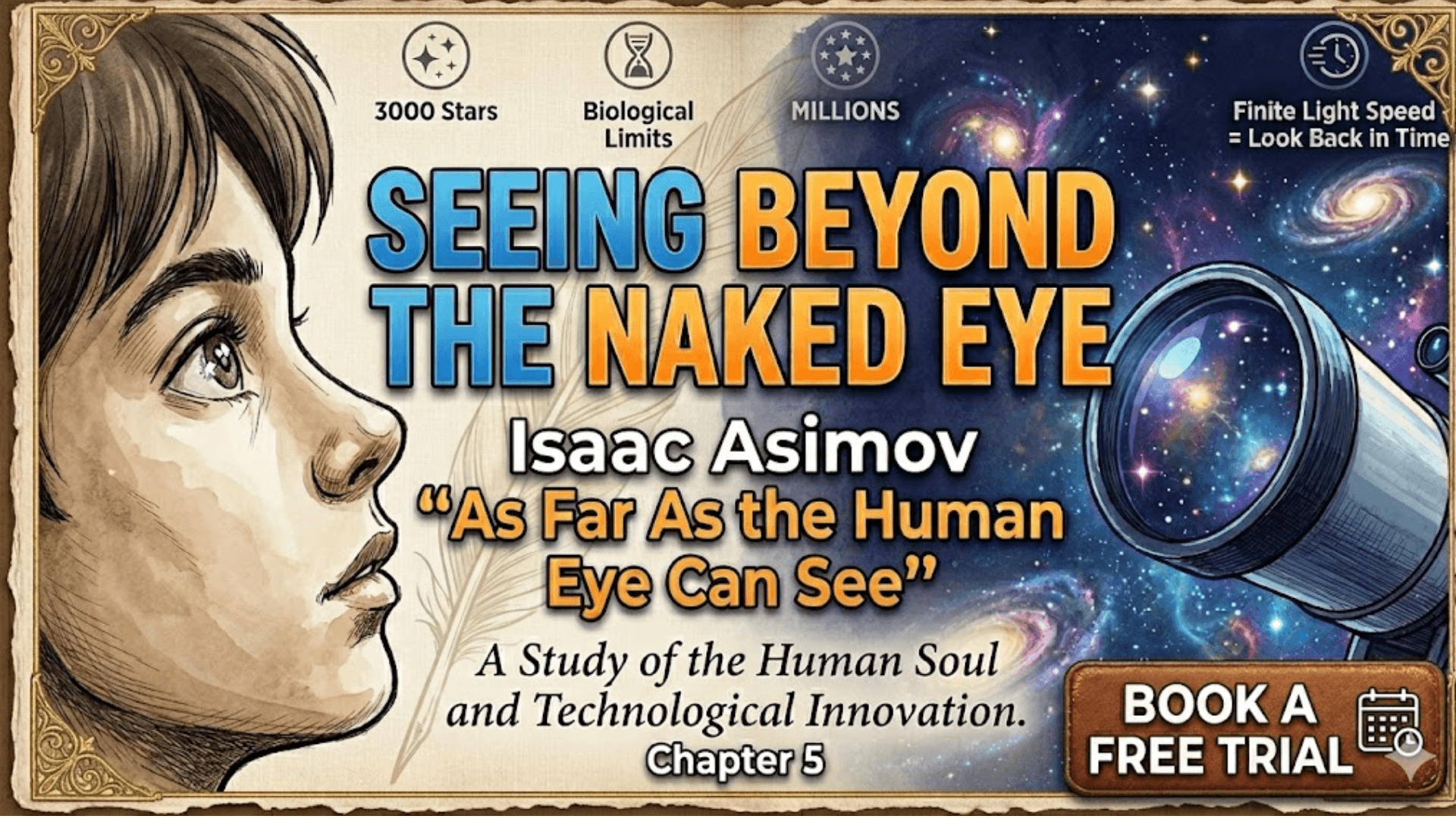
What this NCERT chapter covers?
1. The text introduces high school
students to an informative and thought-provoking scientific essay and cosmic commentary by Isaac Asimov.
2. It expands vocabulary knowledge by incorporating domain-specific terms from astronomy, optical enhancement, physics, and historical science.
3. The chapter explores how humankind transitioned from relying purely on biological naked-eye observations to inventing advanced telescopes and spectroscopes.
4. It helps students understand the mechanical framework of explaining complex cosmic scales, finite light speed, and scientific data simply.
5. The thematic focus challenges students to look deeply at human curiosity and how technological progress continuously expands our boundary of perception.
6. The narrative builds advanced comprehension skills by prompting students to trace chronological milestones in astronomical history.
7. It prepares students for analytical evaluation questions, ensuring they learn to frame responses with precise text-based inferences.
How to use these NCERT solutions?
1. Students should actively read through the essay regarding the biological limits and historical breakthroughs of stargazing on their own before looking at standard answers.
2. Attempt all short and long descriptive questions independently in your study notebook to gauge your initial grasp of the chapter.
3. Open these clear and reliable NCERT solutions to verify the structural format, accuracy, and depth of your written answers.
4. Pay attention to how analytical vocabulary related to astronomy and technological milestones is naturally woven into the model answers to maximize your writing proficiency.
5. Parents can use this direct answer key to easily evaluate their child's independent practice sheets and offer timely constructive feedback.
6. Review the sections systematically to follow the exact sequence of evaluation, helping you build a consistent methodology for your revisions.
Important tips & tricks for students
1. Avoid giving overly generalized descriptions when explaining astronomical limits; explicitly connect technological milestones to adjustments in human cosmic perspective.
2. Be highly precise when describing Asimov's core arguments, linking biological restrictions directly to the evolution of optical instruments.
3. Highlight the scientific concept that looking deeper into space physically means looking backward in time due to the finite speed of light waves.
4. Do not leave out the transition from early observational limits to modern space-based instruments, as this growth is essential to discussing the deeper literary themes.
5. Read formatting and question requirements carefully during practice to eliminate common language errors or incomplete situational summaries.
NCERT solutions – complete answer key
Section A Short answer questions
1. What baseline limitation does the naked human eye face when observing the night sky?
Answer: The naked human eye faces strict biological limitations in its light-gathering capacity, restricting a person to seeing only about three thousand stars at any single given time under perfect dark conditions.
2. How did the invention of the telescope fundamentally alter astronomy according to Asimov?
Answer: The telescope altered astronomy by functioning as an artificial, oversized eye that collected vastly more light, instantly expanding the boundaries of the visible universe to reveal millions of previously invisible stars and galaxies.
3. Why does the author emphasize that looking deeper into space means looking backward in time?
Answer: The author explains that because light travels at a finite speed, the images of stars and distant galaxies we see through advanced optics today actually represent how those objects looked millions of years ago when the light left them.
Section B Long answer questions
4. Analyze the central argument Isaac Asimov presents regarding the relationship between human biological limits and technological innovation.
Answer: In the essay, Asimov argues that human progress is defined by our ability to transcend our biological limitations through intellect and technological innovation. The human eye, while a marvelous biological organ, is physically constrained by its small aperture and sensitivity to light. For centuries, these limits confined human understanding of the universe to a small, localized bubble of stars. However, Asimov illustrates that human curiosity refuses to be restricted by physical boundaries. By inventing the telescope, spectroscope, and modern space-based optics, humankind effectively built artificial extensions of the human eye. This technological evolution did not just improve our vision; it fundamentally shifted our philosophical place in the cosmos, turning abstract mathematical theories into observable physical realities. Through this analysis, Asimov highlights that technology is the primary tool through which human consciousness expands its reach across the universe.
Section C Creative writing and open-ended tasks
5. Imagine you are an early astronomer looking through a telescope for the very first time. Draft a short diary entry describing the awe and cognitive shift you experience as you see the craters of the moon or distant stars.
Answer: Answers may vary.
Why NCERT solutions help students?
Utilizing aligned and systematic solutions provides a definitive guide for young learners facing complex evaluative parameters. It clarifies text-specific questions, removes conceptual ambiguity, and ensures students learn the correct approach to answering board-level questions. Consistent preparation with reliable tools helps students write with clarity, master timing, and enter assessments with immense self-assurance.
Help your child build strong Class 10 English fundamentals with expert-guided learning support.
Book a free trial!