
NCERT Solutions for Class 10 Mathematics Chapter 10

NCERT solutions for Class 10 Mathematics Chapter 10 Circles – complete answers & explanations
Understanding circles is an important part of Class 10 Mathematics, especially when it comes to concepts like tangents, radii, and their properties. Chapter 10 Circles helps students build a strong foundation in geometry by explaining how lines interact with circles and how different theorems are applied in problem-solving. This chapter is not only essential for exams but also improves logical thinking and mathematical reasoning. These NCERT solutions for Class 10 Mathematics Chapter Circles are designed to help students clearly understand each concept and verify their answers step by step. Download the worksheet and practice alongside solutions for better clarity. If you want deeper understanding and guided learning, Book a free trial now to get expert guidance.
What this NCERT chapter covers?
1. Understanding the basic concept of
a circle and its parts like radius, diameter, and chord.
2. Learning about tangents and their properties in relation to a circle.
3. Exploring the relationship between radius and tangent at the point of contact.
4. Understanding how many tangents can be drawn to a circle.
5. Identifying different types of lines such as secant and tangent.
6. Applying the Pythagoras theorem in circle-based problems.
7. Solving problems related to lengths of tangents from external points.
8. Understanding angles formed between tangents and radii.
9. Learning properties of parallel tangents and their geometric implications.
10. Exploring relationships in quadrilaterals formed by tangents.
11. Applying concepts to solve real exam-level questions.
12. Strengthening problem-solving skills using step-by-step geometry reasoning.
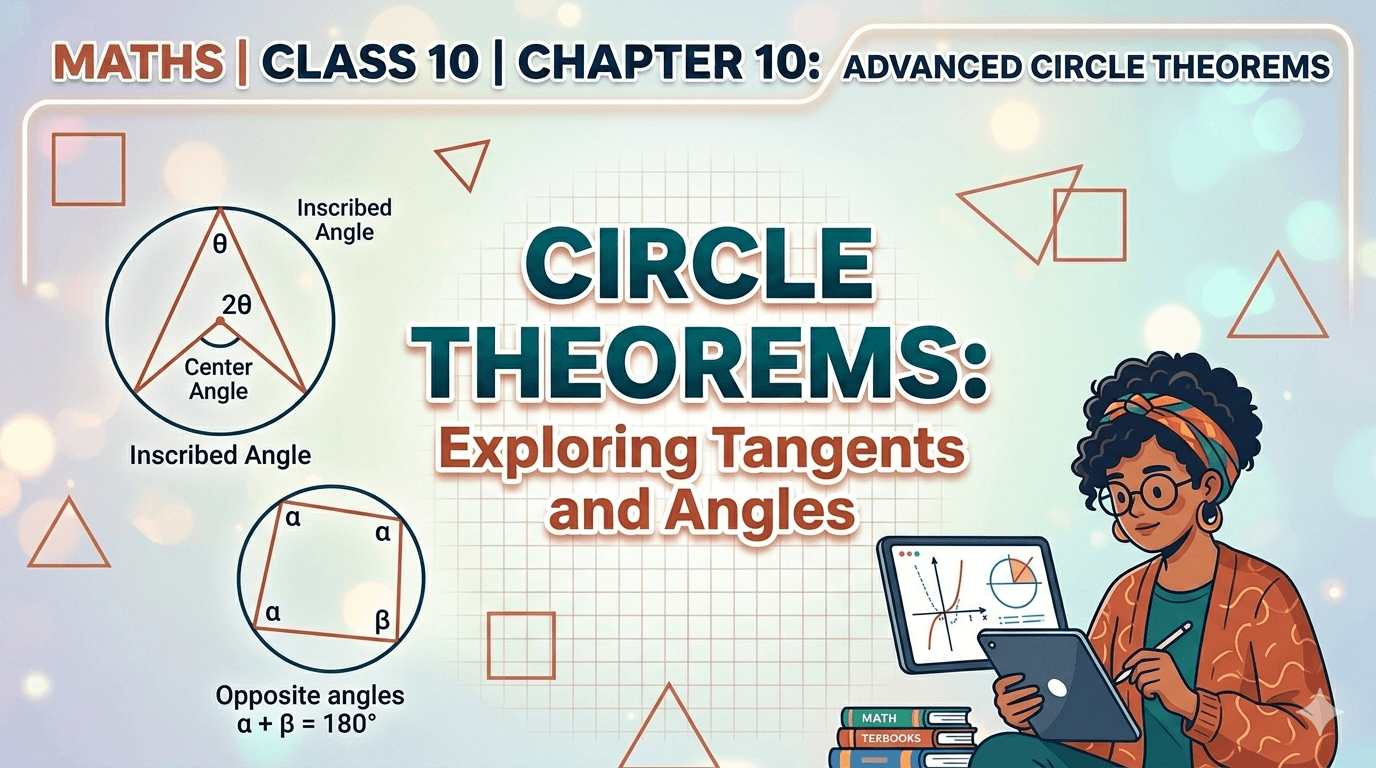
How to use these NCERT solutions?
1. First, attempt all the questions
from the worksheet on your own without referring to the answers.
2. Use these solutions only after attempting to check where you made mistakes.
3. Carefully compare your steps with the given answers to understand the correct approach.
4. Focus on understanding the method rather than just memorising the answer.
5. For numerical problems, verify each calculation step clearly.
6. Parents and teachers can guide students by discussing where errors occur.
7. Revise the concepts used in each question to strengthen understanding.
8. Practice similar questions to build confidence.
9. Follow the solutions in the exact order of the worksheet for better clarity.
10. Reattempt difficult questions after reviewing the solutions.
Important tips & tricks for students
1. Always remember that the radius is perpendicular to the tangent at the point of contact.
2. Do not confuse between secant and tangent lines.
3. Carefully apply the Pythagoras theorem in geometry-based questions.
4. Read each question properly before solving to avoid careless mistakes.
5. Draw neat diagrams wherever required for better understanding.
6. Revise key properties of circles before attempting the exercise.
7. Practice angle-based questions regularly to improve accuracy.
8. Avoid skipping steps while solving problems.
9. Double-check calculations to prevent errors.
10. Understand the logic behind each theorem instead of rote learning.
NCERT solutions – complete answer key
Exercise No. 10.1
A circle has infinitely many tangents (one at each point)
(i) 1
(ii) secant
(iii) 2
(iv) point of contact
(D) is the correct answer. Explanation:The radius drawn to the point of contact is perpendicular to the tangent. So, in right triangle OPQ: OQ² = OP² + PQ² 12² = 5² + PQ² 144 = 25 + PQ² PQ² = 119 PQ = √119 cm
Construction Steps:
Draw a circle with centre O.
Draw a line passing outside the circle → non-intersecting line
Draw a line cutting the circle at two points → secant
Draw a line touching the circle at exactly one point → tangent. { Fig. 1 could be used as reference}
Exercise No. 10.2
Given: Length of tangent from Q = 24 cm, OQ = 25 cm Using Pythagoras theorem: OQ² = radius² + tangent²
25² = r² + 24² 625 = r² + 576 r² = 49 r = 7 cm Correct option: (A)
Given: ∠POQ = 110° Angle between tangents: ∠PTQ = 180° − ∠POQ = 180° − 110° = 70° Correct option: (B)
Given: Angle between tangents = 80° Angle at centre: ∠POB = 180° − 80° = 100° Since triangle OAP is isosceles: ∠POA = 100° ÷ 2 = 50° Correct option: (A)
Given: AB is diameter, tangents at A and B OA ⟂ tangent at A OB ⟂ tangent at B Since OA and OB lie on the same straight line (diameter), both tangents are perpendicular to the same line. Hence, tangents are parallel.
Given: Tangent at point P Radius OP ⟂ tangent at P Thus, the perpendicular drawn at point P passes through O (centre). Hence proved.
Given: OA = 5 cm, tangent length = 4 cm Using Pythagoras: OA² = r² + tangent² 25 = r² + 16 r² = 9 r = 3 cm
Given: Radii = 5 cm and 3 cm Distance from centre to chord = 3 cm Half chord = √(5² − 3²) = √(25 − 9) = √16 = 4 Chord length = 2 × 4 = 8 cm
Let tangents from each vertex be equal: From A: AB = AD From B: BA = BC From C: CB = CD From D: DA = DC Adding: AB + CD = AD + BC Hence proved.
Given: Parallel tangents XY and X′Y′, tangent AB OA ⟂ XY OB ⟂ X′Y′ Thus, OA ⟂ OB ∠AOB = 90°
Why NCERT solutions help students?
NCERT solutions help students build a strong understanding of concepts, improve accuracy in exams, and develop confidence in solving problems independently. They also ensure that students follow the correct approach to answering questions as expected in exams.
Help your child build strong Mathematics fundamentals with expert-guided learning support.
Book a free trial!