
NCERT Solutions for Class 10 Mathematics Polynomials Chapter 2
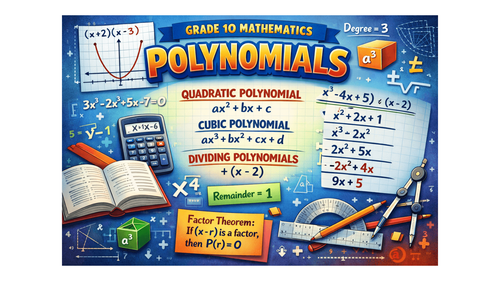

NCERT solutions for Class 10 Mathematics Chapter 2 Polynomials – complete answers & explanations
This blog provides clear and reliable NCERT solutions for Class 10 Mathematics Chapter Polynomials. This chapter introduces students to important concepts like zeroes of polynomials, their graphical representation, and relationships between zeroes and coefficients. It helps students build a strong foundation in algebra, which is essential for higher-level mathematics. Understanding polynomials also improves problem-solving and analytical thinking skills. In this blog, students will find structured and easy-to-follow NCERT solutions that help them learn the correct approach to solving questions. Download the worksheet and practice alongside solutions for better clarity. You can also book a free trial now to get expert guidance and strengthen your understanding of algebra concepts.
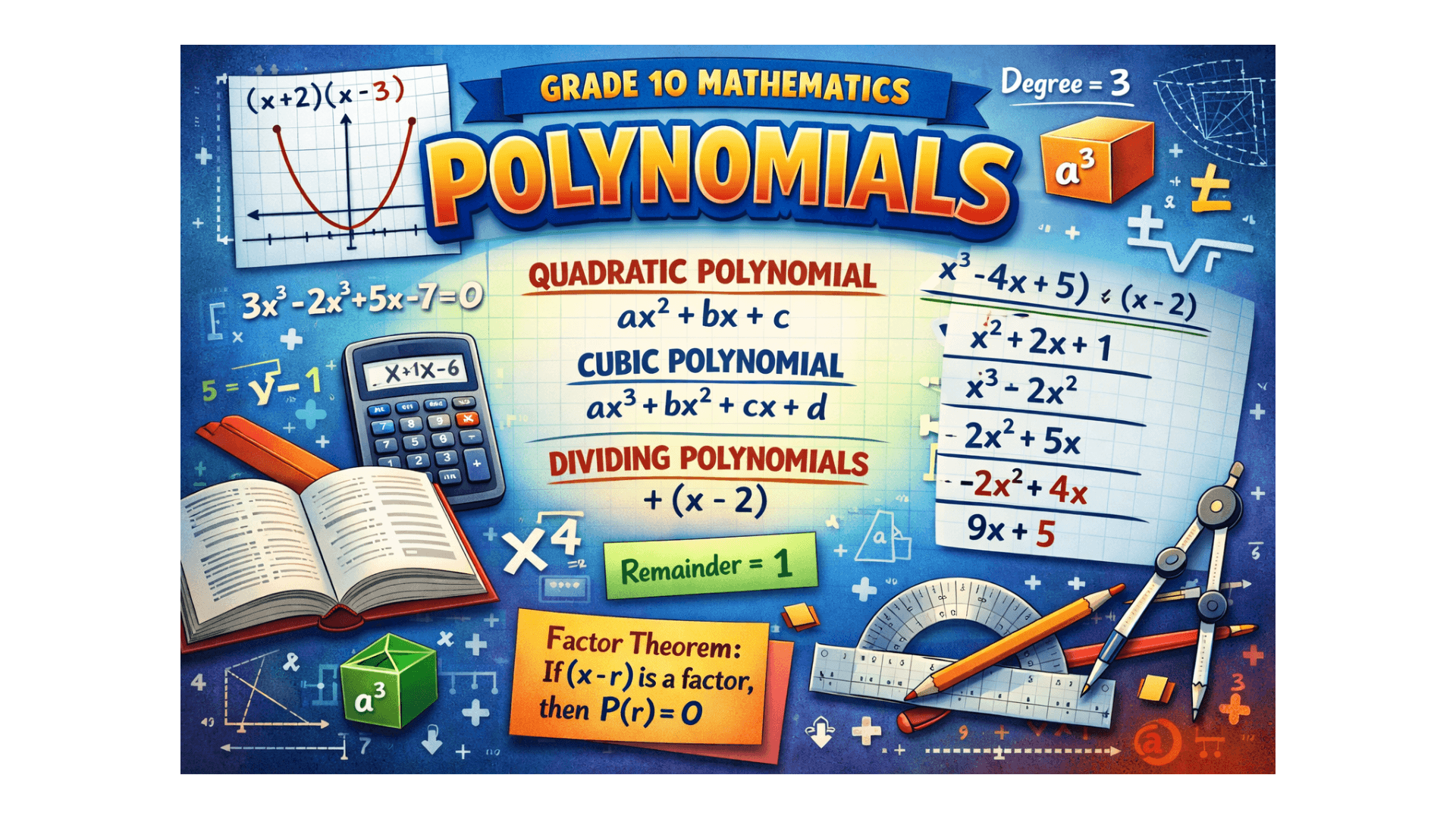
What this NCERT chapter covers?
1. The chapter explains the concept
of polynomials and their degrees in detail.
2. It introduces different types of polynomials such as linear, quadratic, and cubic.
3. Students learn how to find zeroes of polynomials using factorisation.
4. It explains the graphical meaning of zeroes of a polynomial.
5. The relationship between zeroes and coefficients is introduced and verified.
6. Students understand how graphs intersect the x-axis to represent zeroes.
7. The chapter develops skills to factorise quadratic expressions.
8. It teaches how to form polynomials using given conditions like sum and product of zeroes.
9. Students learn to analyse graphs to determine the number of zeroes.
10. The chapter strengthens algebraic manipulation and reasoning skills.
11. It builds a strong base for solving higher-level algebraic equations.
12. Overall, it enhances problem-solving and logical thinking abilities.
How to use these NCERT solutions?
1. Start by attempting each question
from the worksheet on your own.
2. Carefully read each question and identify the concept being tested.
3. Solve the problems step by step before checking the answers.
4. Use these NCERT solutions to verify your answers and correct mistakes.
5. Compare your steps with the given solutions to improve accuracy.
6. Focus on understanding the method used in factorisation and calculations.
7. Practice similar questions to strengthen your understanding.
8. Teachers and parents can guide students in understanding mistakes.
9. Follow the exact order of the worksheet for better exam preparation.
10. Use these solutions regularly to build confidence in mathematics.
Important tips & tricks for students
1. Always write steps clearly while solving polynomial problems.
2. Check calculations carefully to avoid mistakes in signs.
3. Learn standard factorisation techniques thoroughly.
4. Understand the relationship between zeroes and coefficients.
5. Practice graph-based questions regularly.
6. Avoid skipping steps while solving equations.
7. Revise formulas and identities frequently.
8. Focus on accuracy as well as speed.
9. Practice different types of questions for better understanding.
10. Review your answers after solving each question.
NCERT solutions – complete answer key
Exercise 2.1
Number of zeroes of p(x) in each graph:
(iv} 0
(ii) 1
(iii) 3
(v) 4
(vi) 3
(ii) 4s² – 4s + 1
4s² – 4s + 1 = (2s – 1)(2s – 1)
Zeroes: 1/2, 1/2
Sum = 1/2 + 1/2 = 1 = –(–4)/4
Product = (1/2)(1/2) = 1/4 = 1/4
(i) x² – 2x – 8
x² – 2x – 8 = (x – 4)(x + 2)
Zeroes: 4, –2
Sum = 4 + (–2) = 2 = –(–2)/1
Product = 4 × (–2) = –8 = (–8)/1
Exercise 2.2
1
(i) 2
1.Find the zeroes and verify the relationship
(iv) 4u² + 8u
4u² + 8u = 4u(u + 2)
Zeroes: 0, –2
Sum = 0 + (–2) = –2 = –8/4
Product = 0 × (–2) = 0 = 0/4
(iii) 6x² – 7x– 3
6x² – 7x – 3 = (3x + 1)(2x – 3)
Zeroes: 3/2, –1/3
Sum = 3/2 + (–1/3) = 7/6 = –(–7)/6
Product = (3/2)(–1/3) = –1/2 = (–3)/6
(v) t² – 15
t² – 15 = (t – √15)(t + √15)
Zeroes: √15, –√15
Sum = √15 + (–√15) = 0 = 0/1
Product = (√15)(–√15) = –15 = –15/1
(vi) 3x² – x – 4
3x² – x – 4 = (3x – 4)(x + 1)
Zeroes: 4/3, –1
Sum = 4/3 + (–1) = 1/3 = –(–1)/3
Product = (4/3)(–1) = –4/3 = (–4)/3
Find quadratic polynomial:
(i) Sum = –1, Product = 1/4
Polynomial: x² – (–1)x + 1/4 = x² + x + 1/4
(ii) Sum = 1/2, Product = 3
Polynomial: x² – (1/2)x + 3
(iii) Sum = 0, Product = 5
Polynomial: x² – 5
(iv) Sum = 1, Product = 1
Polynomial: x² – x + 1
(v) Sum = –1/4, Product = 1/4
Polynomial: x² + (1/4)x + 1/4
(vi) Sum = 4, Product = 1
Polynomial: x² – 4x + 1
Why NCERT solutions help students?
NCERT solutions help students understand the correct method of solving questions and improve accuracy in exams. They build strong conceptual clarity and provide structured answers that match exam expectations, helping students gain confidence in mathematics.
Help your child build strong mathematics fundamentals with expert-guided learning support.
Book a free trial