
NCERT Solutions for Class 10 Mathematics Chapter 3 Pair of Linear Equations in Two Variables


NCERT solutions for Class 10 Mathematics Chapter Pair of Linear Equations in Two Variables – complete answers & explanations
This blog provides NCERT solutions for Class 10 Mathematics Chapter Pair of Linear Equations in Two Variables. This chapter helps students understand how two linear equations work together to represent relationships between variables and how these equations can be solved step by step. It introduces important ideas such as intersecting lines, parallel lines, and coincident lines, which help determine whether a system of equations has one solution, infinitely many solutions, or no solution. Learning this chapter is important because it strengthens algebraic thinking and prepares students for exam-based problem solving. In this blog, students will find clear and reliable NCERT solutions that show the correct approach to solving different types of problems from the chapter. Download the worksheet and practice alongside solutions for better clarity. Students who want extra support while learning algebra can also book a free trial now to get expert guidance and improve problem-solving skills. The answers are presented in a structured and easy-to-follow way to support confident learning.
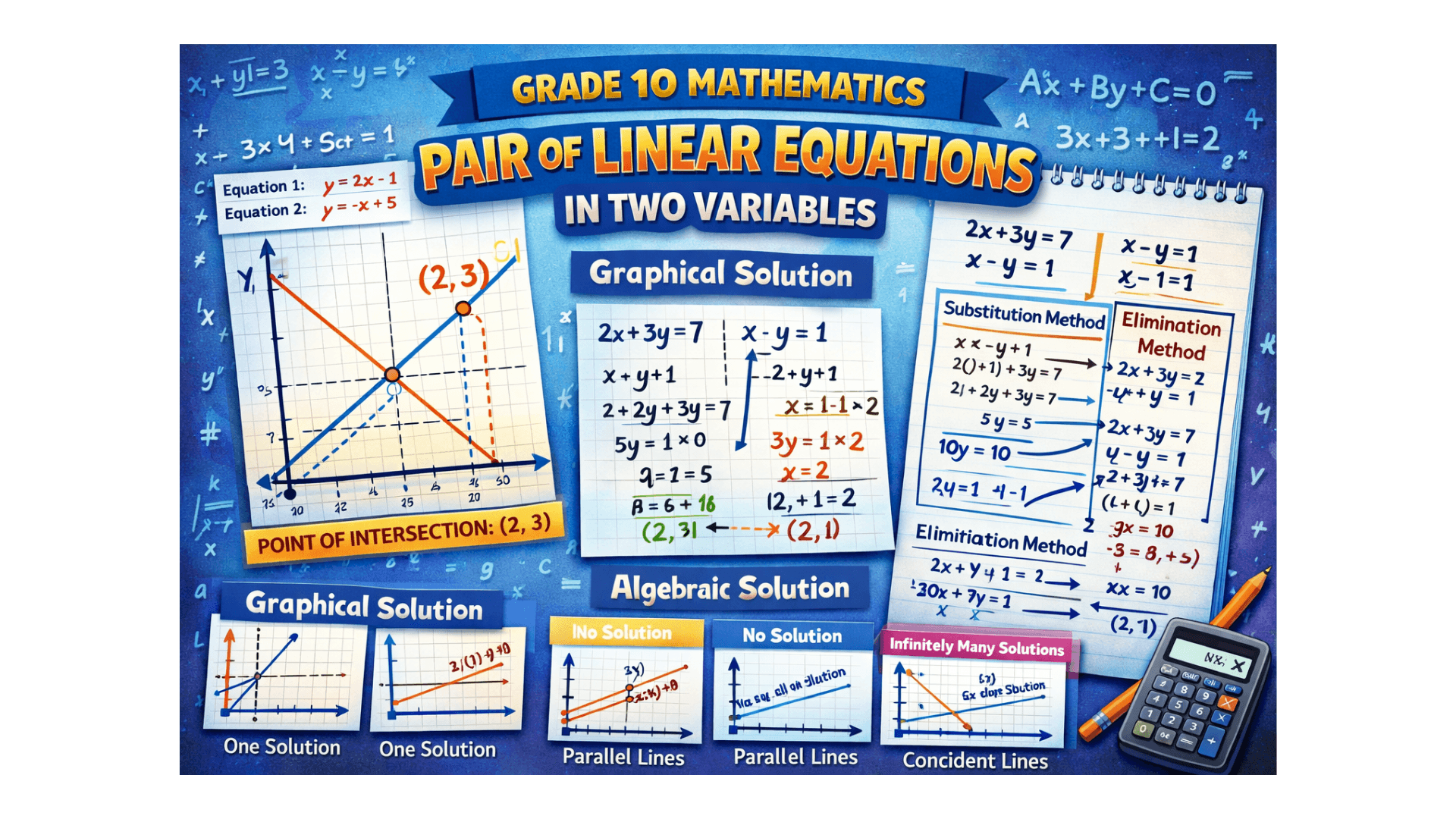
What this NCERT chapter covers?
1. The chapter explains the concept
of pairs of linear equations in two variables and how they represent relationships between unknown values.
2. Students learn how two equations can be solved together to find the correct values of variables.
3. The chapter introduces the idea of intersecting, parallel, and coincident lines.
4. It explains how ratios like a1/a2 and b1/b2 help determine the nature of solutions.
5. Students understand the conditions for unique solutions, infinitely many solutions, and no solution.
6. The chapter teaches algebraic methods such as substitution and elimination.
7. Learners practice solving equations step by step using systematic calculations.
8. It includes problems based on real-life situations like cost, numbers, and measurements.
9. Students develop logical thinking by analysing relationships between equations.
10. The chapter strengthens algebra skills that are important for exams and future mathematics learning.
11. It also helps students understand how equations behave graphically.
12. Overall, it builds confidence in solving complex algebraic problems.
How to use these NCERT solutions?
1. Start by reading the question
carefully and understanding what is being asked.
2. Try solving the equations on your own before looking at the answers.
3. Write each step clearly in your notebook while solving the problem.
4. After completing your attempt, compare your solution with the given answers.
5. Check whether your method and final answer match the solution.
6. If you find mistakes, go back and identify the step where the error occurred.
7. Parents and teachers can guide students by explaining the reasoning behind each step.
8. Encourage regular practice of similar questions to improve confidence.
9. Follow the same order of questions as given in the worksheet for better understanding.
10. Revisit difficult questions again to strengthen problem-solving skills.
Important tips & tricks for students
1. Always write the equations clearly before starting the solution.
2. Identify which method, substitution or elimination, is easier for the given problem.
3. Keep calculations neat to avoid small mistakes.
4. Check the relationship between equations to understand the type of solution.
5. Remember that intersecting lines give one solution.
6. Parallel lines usually have no solution.
7. Coincident lines give infinitely many solutions.
8. Carefully define variables while solving word problems.
9. Substitute the answer back into the equations to verify correctness.
10. Practice regularly to improve accuracy and speed in exams.
NCERT solutions – complete answer key
Exercise 3.1
1. (i)
Let number of boys = x, girls = y
x + y = 10
y = x + 4
Substitute:
x + (x + 4) = 10
2x + 4 = 10
2x = 6
x = 3
y = x + 4 = 7
Answer: Boys = 3, Girls = 7
(ii)
Let cost of pencil = x, pen = y
5x + 7y = 50
7x + 5y = 46
Multiply first by 7:
35x + 49y = 350
Multiply second by 5:
35x + 25y = 230
Subtract:
24y = 120
y = 5
Substitute:
5x + 7(5) = 50
5x + 35 = 50
5x = 15
x = 3
Answer: Pencil = ₹3, Pen = ₹5
(iii)
a1/a2 = b1/b2 ≠ c1/c2 → Parallel lines
2. (i)
a1/a2 ≠ b1/b2 → Intersecting lines
(ii)
a1/a2 = b1/b2 = c1/c2 → Coincident lines
(iii)
a1/a2 ≠ b1/b2 →
Consistent (unique solution)
3. (i)
Solve:
3x/2 + 5y/3 = 7
9x − 10y = 14
Multiply first by 6:
9x + 10y = 42
Now:
9x + 10y = 42
9x − 10y = 14
Add:
18x = 56
x = 28/9
Substitute → y = 14/9
Consistent
(iv)
a1/a2 = b1/b2 = c1/c2 →
Infinitely many solutions
(ii)
a1/a2 = b1/b2 ≠ c1/c2 →
Inconsistent
(v)
Solve:
4x/3 + 2y/8 = ? (simplify)
→ Unique solution (consistent)
(ii)
x − y = 8
3x − 3y = 16
Multiply first by 3:
3x − 3y = 24 ≠ 16
No solution
(i)
x + y = 5
2x + 2y = 10 → same equation
Infinitely many solutions
4. (iii)
2x + y = 6
4x − 2y = 4
Multiply first by 2:
4x + 2y = 12
Add:
8x = 16
x = 2
Substitute → y = 2
Let length = l, width = w
l = w + 4
Half perimeter:
l + w = 36
Substitute:
(w + 4) + w = 36
2w + 4 = 36
2w = 32
w = 16
l = 20
(i) Intersecting → choose
different ratios
Example: x + y + 1 = 0
(iv)
2x − 2y = 2
4x − 4y = 5
Multiply first by 2:
4x − 4y = 4 ≠ 5
No solution
Exercise 4.3
1
(ii)
s − t = 3
s/3 + t/2 = 6
Multiply by 6:
2s + 3t = 36
Substitute s = t + 3:
2(t+3) + 3t = 36
5t + 6 = 36
t = 6
s = 9
(iv)
0.2x + 0.3y = 1.3
0.4x + 0.5y = 2.3
Multiply by 10:
2x + 3y = 13
4x + 5y = 23
Solve → x = 2, y = 3
(iii)
3x − y = 3
9x − 3y = 9 → same
Infinitely many solutions
(v)
2x + 3y = 0
3x − 8y = 0
Solve → x = 0, y = 0
2x + 3y = 11
2x − 4y = −24
Subtract:
7y = 35 → y = 5
x = -2
m = (y − 3)/x = (5 − 3)/(-2) = -1
(vi)
Solve → x = 3, y = −2
2
(i)
x − y = 26
x = 3y
3y − y = 26
2y = 26 → y = 13
x = 39
3
(ii)
x + y = 180
x = y + 18
Substitute:
y + 18 + y = 180
2y = 162 → y = 81
x = 99
(iii)
7x + 6y = 3800
3x + 5y = 1750
Solve → x = 500, y = 300
(iv)
10a + b = 105
15a + b = 155
Subtract:
5a = 50 → a = 10
b = 5
25 km → 10×25 + 5 = 255
(v)
(x+2)/(y+2)=9/11
(x+3)/(y+3)=5/6
Solve → x = 7, y = 9
(vi)
x + 5 = 3(y + 5)
x − 5 = 7(y − 5)
Solve → x = 40, y = 10
3
Exercise 4.3
(i)
x + y = 5
2x − 3y = 4
Solve → x = 3, y = 2
(ii)
3x + 4y = 10
2x − 2y = 2
Solve → x = 2, y = 1
(iii)
3x − 5y = 4
9x − 2y = 7
Solve → x = 1, y = −1
(i)
Fraction = 2/3
(iv)
Solve → x = 3, y = 1
(ii)
Nuri = 20, Sonu = 10
(v)
Fixed = 9, per day = 3
(iii)
Number = 18
(iv)
₹50 = 10, ₹100 = 15
Why NCERT solutions help students?
NCERT solutions help students understand how to solve questions in the correct format expected in exams. They improve concept clarity, strengthen algebra skills, and give students confidence while practicing important topics from Class 10 Mathematics. With regular practice, students become more comfortable solving equations and tackling exam questions accurately.
Help your child build strong Mathematics fundamentals with expert-guided learning support.
Book a free trial