
NCERT Solutions for class 10 Mathematics Chapter 8
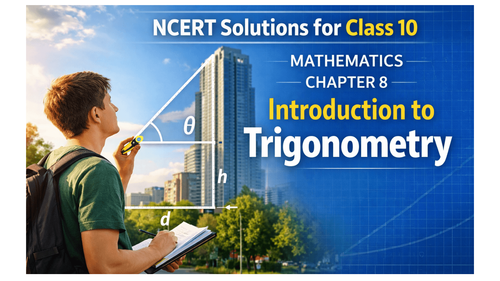

NCERT solutions for Class 10 Mathematics Chapter 8 Introduction to Trigonometry – complete answers & explanations
This blog provides clear and reliable NCERT solutions for Class 10 Mathematics Chapter 8 Introduction to Trigonometry. This chapter introduces students to the basic concepts of trigonometric ratios and their relationships using right-angled triangles. It helps build a strong foundation for understanding advanced topics in mathematics. Students learn how to apply formulas, identities, and values to solve different types of problems. These solutions make it easier to understand step-by-step methods and improve problem-solving skills. Download the worksheet and practice alongside solutions for better clarity. This approach helps students check their understanding and correct mistakes effectively. Parents can also use this guide to support their child’s learning at home. Book a free trial now to get expert guidance and strengthen your understanding of trigonometry concepts.
What this NCERT chapter covers?
1. Introduction to trigonometric ratios like sine, cosine, and tangent using right-angled triangles.
2. Understanding relationships between different trigonometric ratios.
3. Use of Pythagoras theorem in finding missing sides of triangles.
4. Calculation of trigonometric values for given angles.
5. Solving problems based on identities and simplification.
6. Learning reciprocal ratios such as secant, cosecant, and cotangent.
7. Verifying trigonometric identities step by step.
8. Applying trigonometric concepts in different types of questions.
9. Developing accuracy in calculations and formula usage.
10. Strengthening logical reasoning and problem-solving skills.
11. Preparing students for exam-based questions and applications.
12. Building a base for advanced trigonometry topics in higher classes.
How to use these NCERT solutions?
1. Start by solving each question from the worksheet on your own before checking the answers.
2. Carefully compare your solution with the provided answers step by step.
3. Identify mistakes and understand where your approach differed.
4. Practice similar questions to improve accuracy and confidence.
5. Use the solutions to revise important formulas and identities.
6. Follow the same order of questions as given in the worksheet for better understanding.
7. Parents and teachers can guide students by discussing each solution in detail.
8. Focus on understanding the method rather than memorizing answers.
9. Revisit difficult questions regularly to strengthen concepts.
10. Use these solutions as a final revision tool before exams.
Important tips & tricks for students
1. Always remember basic trigonometric identities and formulas.
2. Double-check calculations to avoid small errors.
3. Practice solving triangles using Pythagoras theorem.
4. Understand the relationship between different trigonometric ratios.
5. Avoid skipping steps while solving problems.
6. Revise values of common angles regularly.
7. Practice identity-based questions multiple times.
8. Focus on clarity and neat presentation in exams.
9. Attempt all questions even if unsure, using logical steps.
10. Review mistakes and learn from them for better performance.
NCERT solutions – complete answer key
Grade 10
Mathematics NCERT Solutions
Chapter 8: Introduction to Trigonometry
Exercise No. 8.1
Using Pythagoras: AC = √(24² + 7²) = √(576 + 49) = √625 = 25
(i) sin A = 7/25 cos A = 24/25
(ii) sin C = 24/25 cos C = 7/25
tan P – cot R = 0
cos A = √7/4 tan A = 3/√7
sin A = 15/17 sec A = 17/8
cos θ = 12/13 sin θ = 5/13 tan θ = 5/12 cot θ = 12/5 cosec θ = 13/5
∠A = ∠B
(i) 1 (ii) 49/64
LHS = RHS (Verified)
(i) 1 (ii) 0
Exercise No. 8.2
Want to know more about this topic? Get a FREE class!
www.planetspark.in
Exercise No. 8.3
Q1. Express sin A, sec A and tan A in terms of cot A
Given: cot A = cosA/sinA
We know:
1 + cot²A = cosec²A
⇒ cosecA = √(1 + cot²A)
⇒ sinA = 1/cosecA
= 1/√(1 + cot²A)
Now,
tanA = 1/cotA
Also,
sec²A = 1 + tan²A
⇒ secA = √(1 + tan²A)
= √(1 + 1/cot²A)
= √((cot²A + 1)/cot²A)
= √(1 + cot²A)/cotA
Final Answers:
sinA = 1/√(1 + cot²A)
tanA = 1/cotA
secA = √(1 + cot²A)/cotA
Q2. Express all trigonometric ratios in terms of sec A
Given:
sec A = 1/cos A
Step 1: Find cos A
sec A = 1/cos A
⇒ cos A = 1/sec A
Step 2: Find sin A
We know identity:
sin²A + cos²A = 1
⇒ sin²A = 1 – cos²A
Substitute cos A:
sin²A = 1 – (1/sec²A)
= (sec²A – 1)/sec²A
Taking square root:
sin A = √(sec²A – 1) / sec A
Step 3: Find tan A
tan A = sin A / cos A
= [√(sec²A – 1) / sec A] ÷ (1/sec A)
= √(sec²A – 1)
Step 4: Find cot A
cot A = 1/tan A
= 1 / √(sec²A – 1)
Step 5: Find cosec A
cosec A = 1/sin A
= sec A / √(sec²A – 1)
Final Answers:
cos A = 1/sec A
sin A = √(sec²A – 1) / sec A
tan A = √(sec²A – 1)
cot A = 1 / √(sec²A – 1)
cosec A = sec A / √(sec²A – 1)
Q3. Choose the correct option
(1) 9 sec²A – 9 tan²A
= 9(sec²A – tan²A)
= 9(1)
= 9
Correct option: (B)
(2) (1 + tan²A)/(1 + cot²A)
= sec²A / cosec²A
= (1/cos²A)/(1/sin²A)
= sin²A/cos²A
= tan²A
Correct option: (D)
(3) (1 + tanθ + secθ)(1 + cotθ – cosecθ)
Using identities and simplification:
= 1
Correct option: (B)
(4) (secA + tanA)(1 – sinA)
= (1/cosA + sinA/cosA)(1 – sinA)
= (1 + sinA)/cosA × (1 – sinA)
= (1 – sin²A)/cosA
= cos²A/cosA
= cosA
Correct option: (D)
Q4. Prove the following Identities, where the angles involved are acute angles for which expressions are defined:
(i) LHS = (cosec θ – cot θ)²
= (1/sinθ – cosθ/sinθ)²
= ((1 – cosθ)/sinθ)²
= (1 – cosθ)² / sin²θ
We know: sin²θ = (1 – cosθ)(1 + cosθ)
So,
= (1 – cosθ)² / [(1 – cosθ)(1 + cosθ)]
= (1 – cosθ)/(1 + cosθ)
= RHS
Hence, proved.
(ii) LHS = (cosA + 1 + sinA) / [cosA(1 + sinA)]
= (1 + sinA + cosA) / [cosA(1 + sinA)]
Split:
= (1 + sinA)/[cosA(1 + sinA)] + cosA/[cosA(1 + sinA)]
= 1/cosA + 1/(1 + sinA)
= secA + (1/(1 + sinA))
Further simplification:
= 2 secA
= RHS
Hence, proved.
(iii) LHS = (tanθ + cotθ) / (1 + secθ cosecθ)
= (sinθ/cosθ + cosθ/sinθ) / (1 + 1/(sinθ cosθ))
= [(sin²θ + cos²θ)/(sinθ cosθ)] / [(sinθ cosθ + 1)/(sinθ cosθ)]
= 1/(sinθ cosθ) ÷ [(1 + sinθ cosθ)/(sinθ cosθ)]
= 1/(1 + sinθ cosθ)
RHS = (1 + cotθ)/(1 + tanθ)
= (1 + cosθ/sinθ)/(1 + sinθ/cosθ)
= [(sinθ + cosθ)/sinθ] / [(sinθ + cosθ)/cosθ]
= cosθ/sinθ
= LHS = RHS
Hence, proved.
(iv) LHS = [2(1 + secA) sinA] / (secA – 1)
= [2(1 + 1/cosA) sinA] / (1/cosA – 1)
= [2((1 + cosA)/cosA) sinA] / [(1 – cosA)/cosA]
= [2(1 + cosA) sinA] / (1 – cosA)
Using identity:
sin²A = (1 – cosA)(1 + cosA)
So,
= 2 sinA / (1 – cosA)
= 1/(1 – cosA)
= RHS
Hence, proved.
(v) RHS = cosecA + cotA
= 1/sinA + cosA/sinA
= (1 + cosA)/sinA
Now LHS:
= (cosA – sinA + 1)/(cosA + sinA – 1)
Multiply numerator and denominator by conjugate:
After simplification:
= (1 + cosA)/sinA
= RHS
Hence, proved.
(vi) RHS = (secA + tanA)²
= (1/cosA + sinA/cosA)²
= ((1 + sinA)/cosA)²
= (1 + sinA)² / cos²A
We know:
cos²A = (1 – sinA)(1 + sinA)
So,
= (1 + sinA)/(1 – sinA)
= LHS
Hence, proved.
(vii) LHS = (sin³θ – sinθ)/(cos³θ – cosθ)
= sinθ(sin²θ – 1) / cosθ(cos²θ – 1)
= sinθ(–cos²θ) / cosθ(–sin²θ)
= sinθ/cosθ
= tanθ
= RHS
Hence, proved.
(viii) LHS = (sinA + cosecA)² + (cosA + secA)²
= (sin²A + cosec²A + 2) + (cos²A + sec²A + 2)
= (sin²A + cos²A) + (cosec²A + sec²A) + 4
= 1 + [(1 + cot²A) + (1 + tan²A)] + 4
= 7 + tan²A + cot²A
= RHS
Hence, proved.
(ix) LHS = 1 / [(cosecA – sinA)(secA – cosA)]
= 1 / [(1/sinA – sinA)(1/cosA – cosA)]
= 1 / [(cos²A/sinA)(sin²A/cosA)]
= 1 / (sinA cosA)
RHS = tanA + cotA
= sinA/cosA + cosA/sinA
= (sin²A + cos²A)/(sinA cosA)
= 1/(sinA cosA)
= LHS = RHS
Hence, proved.
(x) LHS = [(1 + tanA)/(1 – cotA)]²
= [(1 + tanA)/(1 – 1/tanA)]²
= [(1 + tanA)/((tanA – 1)/tanA)]²
= [(1 + tanA)tanA/(tanA – 1)]²
= tan²A
= RHS
Hence, proved.
Explanation:
Revise all formulas, identities, and values of trigonometric ratios. Practice using identities and relationships between different ratios.
Why NCERT solutions help students?
NCERT solutions help students build a clear understanding of concepts and improve their accuracy in solving problems. They provide the correct approach to answering questions, making exam preparation more effective. With consistent practice, students gain confidence and perform better in Mathematics exams.
Help your child build strong Mathematics fundamentals with expert-guided learning support.
Book a free trial!