
NCERT Solutions for Class 10 Maths Chapter 1

Last Updated At: 7 Apr 2026
6 min read
NCERT solutions for Class 10 Mathematics Chapter Real Numbers – complete answers & explanations
Class 10 Mathematics Chapter Real Numbers is one of the most important chapters that builds a strong foundation for higher-level maths concepts. This chapter introduces students to prime factorisation, HCF and LCM, irrational numbers, and properties of numbers that are frequently used in exams and real-life problem solving. Understanding real numbers helps students improve their logical thinking and calculation accuracy. These NCERT solutions provide clear and reliable answers that help students learn the correct approach to solving mathematical problems step by step. The solutions are designed to support revision, homework, and exam preparation in a simple and structured way. Parents and teachers can also use these answers to guide students effectively. Download the worksheet and practice alongside solutions for better clarity. Book a free trial now to get expert guidance.
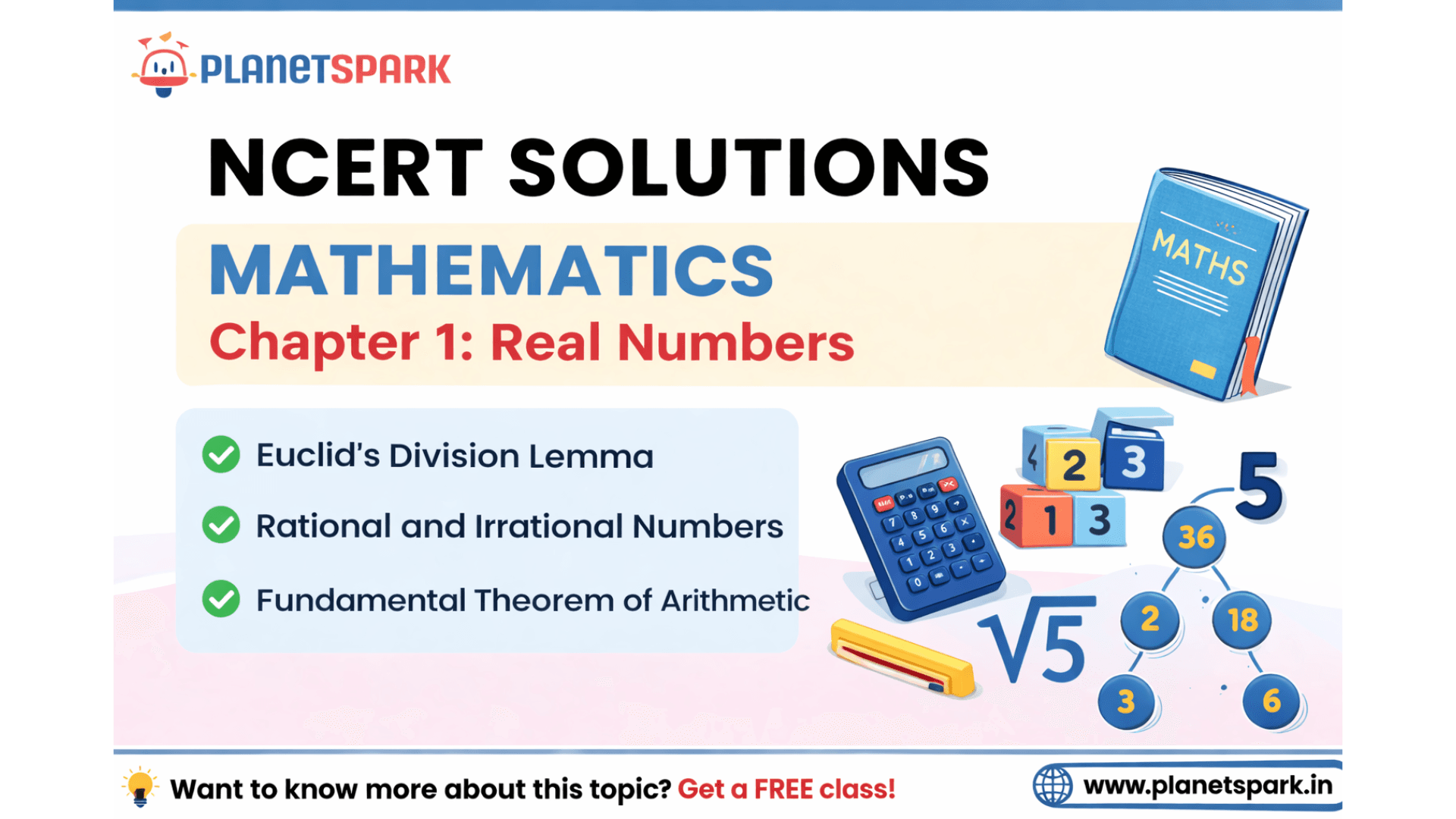
What this NCERT chapter covers?
1. This chapter explains the concept
of real numbers and how they are used in everyday mathematics.
2. Students learn prime factorisation methods to break numbers into their smallest factors.
3. It introduces the calculation of Highest Common Factor (HCF) and Lowest Common Multiple (LCM).
4. The chapter helps students understand the relationship between HCF and LCM through verification.
5. Learners explore properties of numbers such as divisibility and multiples.
6. It explains rational and irrational numbers using logical mathematical proofs.
7. Students practice solving problems involving exponents and number properties.
8. The chapter teaches how to identify composite numbers and prime numbers.
9. It builds problem-solving skills through step-by-step calculations.
10. These concepts are essential for board exams and help students develop strong mathematical reasoning.
How to use these NCERT solutions?
1. First, students should read each
question carefully and attempt to solve it on their own.
2. After solving, they can compare their answers with the provided solutions to check accuracy.
3. If a mistake is found, students should review the steps to understand the correct method.
4. Practice similar problems regularly to build confidence and speed in calculations.
5. Parents and teachers can use these answers to guide students during homework and revision.
6. Students should pay attention to calculation steps, especially in factorisation and proofs.
7. These solutions follow the same order as the worksheet, making it easy to track progress.
8. Regular practice using these solutions helps improve exam performance and accuracy.
Important tips & tricks for students
1. Always write each step clearly while solving maths problems to avoid calculation errors.
2. Learn multiplication tables and prime numbers to make factorisation faster.
3. Double-check HCF and LCM calculations before writing the final answer.
4. Practice proofs carefully and understand each step logically.
5. Avoid skipping steps, as complete working is important for scoring full marks.
6. Read the question properly before starting the solution.
7. Use rough work for calculations to keep the main answer neat.
8. Revise formulas and methods regularly before exams.
9. Stay calm and manage time wisely during tests.
NCERT solutions – complete answer key
EXERCISE 1.1
1. (i) 140 = 2 × 2 × 5 × 7
(ii) 156 = 2 × 2 × 3 × 13
(iii) 3825 = 3 × 3 × 5 × 5 × 17
(iv) 5005 = 5 × 7 × 11 × 13
(v) 7429 = 17 × 19 × 23
2. (i) 26 = 2 × 13, 91 = 7 × 13
HCF = 13
LCM = 2 × 7 × 13 = 182
Verification: 13 × 182 = 26 × 91
(ii) 510 = 2 × 3 × 5 × 17, 92 = 2 × 2 × 23
HCF = 2
LCM = 2 × 2 × 3 × 5 × 17 × 23 = 23460
Verification: 2 × 23460 = 510 × 92
(iii) 336 = 2⁴ × 3 × 7, 54 = 2 × 3³
HCF = 2 × 3 = 6
LCM = 2⁴ × 3³ × 7 = 3024
Verification: 6 × 3024 = 336 × 54
3. (i) 12 = 2² × 3, 15 = 3 × 5, 21 = 3 × 7
HCF = 3
LCM = 2² × 3 × 5 × 7 = 420
(ii) 17, 23, 29 are primes
HCF = 1
LCM = 17 × 23 × 29 = 11339
(iii) 8 = 2³, 9 = 3², 25 = 5²
HCF = 1
LCM = 2³ × 3² × 5² = 1800
4. LCM = (306 × 657) ÷ 9
= (306 ÷ 9) × 657
= 34 × 657
= 22338
5. 6ⁿ = (2 × 3)ⁿ = 2ⁿ × 3ⁿ
Since it has no factor 5, it cannot end with 0.
6. 7 × 11 × 13 + 13
= 13(7 × 11 + 1)
= 13 × 78
= composite
7 × 6 × 5 × 4 × 3 × 2 × 1 + 5
= 5(7 × 6 × 4 × 3 × 2 × 1 + 1)
= composite
7. Time taken = LCM of 18 and 12
18 = 2 × 3², 12 = 2² × 3
LCM = 2² × 3² = 36 minutes
EXERCISE 1.2
1. Assume √5 is rational.
So, √5 = a/b (a, b coprime)
⇒ 5b² = a²
⇒ 5 divides a² ⇒ 5 divides a
Let a = 5c
⇒ 5b² = 25c²
⇒ b² = 5c² ⇒ 5 divides b
Contradiction (a and b not coprime)
∴ √5 is irrational
2. Assume 3√2 + 5 is rational
⇒ 3√2 = rational number
⇒ √2 is rational
Contradiction
∴ 3√2 + 5 is irrational
3. (i) Assume 1/√2 is rational
⇒ √2 is rational
Contradiction
∴ 1/√2 is irrational
(ii) Assume 7√5 is rational
⇒ √5 is rational
Contradiction
∴ 7√5 is irrational
(iii) Assume 6 + √2 is rational
⇒ √2 is rational
Contradiction
∴ 6 + √2 is irrational
Why NCERT solutions help students?
NCERT solutions help students prepare effectively for exams by providing clear and accurate answers aligned with NCERT standards. They improve understanding of concepts, strengthen problem-solving skills, and build confidence in mathematics. Regular practice using these solutions supports better performance in school tests and board exams.
Build strong mathematics fundamentals and boost exam confidence with structured learning support.
Book a free trial