
NCERT Solutions for Class 11 English Hornbill Reading Skills Chapter 3


NCERT solutions for Class 11 English Chapter 3 Discovering Tut: the Saga Continues – complete answers & explanations
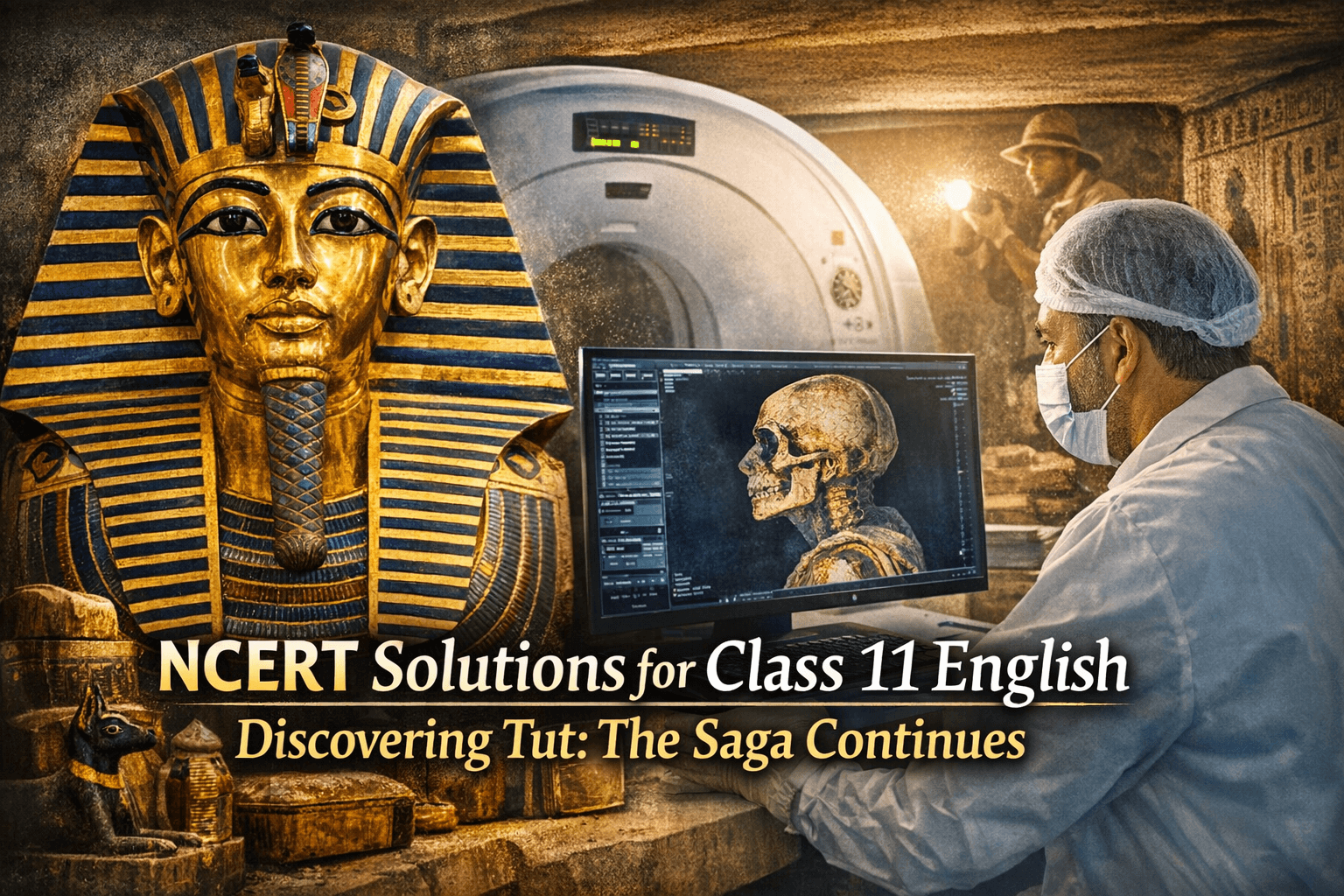
Class 11 English students explore history, science, and language skills through the chapter Discovering Tut: the Saga Continues. This chapter focuses on the investigation of the young Egyptian king Tutankhamun and how modern technology helps historians study ancient civilizations. It introduces students to important ideas about historical research, scientific investigation, cultural traditions, and language learning. This blog provides complete NCERT solutions for Class 11 English Reading Skills Chapter 3 Discovering Tut: the Saga Continues strictly based on the worksheet provided. Download the worksheet and practice alongside solutions for better clarity. Book a free trial now to get expert guidance. All answers are presented exactly in the order of the worksheet so students can easily review their work and strengthen their understanding.
What this NCERT chapter covers?
1. Understanding the historical investigation of
King Tut and the mystery surrounding his death.
2. Learning about ancient Egyptian beliefs, burial traditions, and funerary practices.
3. Exploring how modern scientific technologies such as CT scans help researchers study historical remains.
4. Discussing the importance of respecting cultural traditions while conducting scientific research.
5. Understanding how languages evolve, disappear, and can be preserved.
6. Building vocabulary through descriptive phrases and medical terminology.
7. Learning about astronomical constellations and their cultural significance.
8. Developing research and observation skills through activities related to plants, stars, and cultural symbols.
How to use these NCERT solutions?
1. First read the chapter carefully
and attempt the worksheet questions independently.
2. Use these NCERT solutions to compare your responses with the worksheet answers.
3. Check whether your answers include the correct facts and key points from the chapter.
4. Revise important concepts such as historical investigation, technology in archaeology, and vocabulary.
5. Teachers and parents can guide students by discussing the ideas presented in the chapter.
6. Follow the same sequence of questions as given in the worksheet to practise effectively.
Important tips & tricks for students
1. Carefully read the passage to understand the historical context and sequence of events.
2. Focus on the reasons behind the repeated scientific examination of King Tut’s body.
3. Remember the important actions taken by historical figures such as Akhenaten.
4. Pay attention to vocabulary such as collocations and medical terms mentioned in the chapter.
5. Understand the role of modern technology in solving historical mysteries.
6. Revise the importance of preserving languages and cultural traditions.
7. Practise identifying constellations, plants, and cultural references mentioned in the activities.
NCERT solutions – complete answer key
UNDERSTANDING THE TEXT
1
(i) King Tut’s body has been subjected to repeated scrutiny because historians and scientists want to discover the real cause of his death and understand more about the life of the young Egyptian ruler.
(ii) Howard Carter’s investigation was resented because he had to damage the mummy while removing it from the coffin, including separating the head and joints, which many people felt was disrespectful to the dead king.
(iii) Carter had to chisel away the solidified resins because the ritual resins had hardened and cemented the mummy to the bottom of the solid gold coffin, making it impossible to remove the body otherwise.
(iv) Tut’s body was buried along with gilded treasures because ancient Egyptian kings believed they would need these valuables in the afterlife and wanted to carry their riches to the next world.
(v) The boy king changed his name from Tutankhaten to Tutankhamun to restore the worship of the god Amun after the earlier ruler Akhenaten had promoted the worship of Aten and disrupted traditional religious practices.
2
(i)
• He promoted the worship of Aten, the sun disk.
• He changed his name from Amenhotep IV to Akhenaten.
• He moved the religious capital from Thebes to Akhetaten.
• He attacked the worship of Amun.
• He smashed Amun’s images and closed his temples.
(ii)
• The CT scan produced about 1700 digital X-ray images of the mummy.
• It created detailed cross-section images of Tut’s body.
• It allowed specialists to study his skull, bones and other body structures closely.
• It provided new scientific data to investigate the mystery of his death.
(iii)
• X-ray imaging
• Computed tomography (CT scan)
• Advanced medical imaging techniques
• Digital imaging technology
• Forensic analysis using radiology and anatomy
(iv)
King Tut is described as one of the first mummies to be scanned because modern CT scan technology was used to study his body scientifically. Just as he was an important king during his life, he also became one of the earliest mummies examined using advanced medical technology after death.
TALKING ABOUT THE TEXT
1
Scientific intervention helps historians and archaeologists study ancient remains and uncover hidden facts. Techniques like CT scans and forensic analysis provide scientific evidence that can help solve historical mysteries.
2
Advanced technology provides detailed information about ancient objects and human remains. However, while it gives strong scientific evidence, it may not always give completely conclusive answers about past events.
3
Traditions, rituals and funerary practices represent the beliefs and culture of ancient civilizations. These practices should be respected while studying historical remains.
4
Knowledge about the past helps us understand the development of civilizations, cultures, religions and scientific progress. It helps us gain a better understanding of the world we live in today.
THINKING ABOUT LANGUAGE
1
Egyptian is now extinct: its history dates from before the third millennium B.C., preserved in many hieroglyphic inscriptions and papyrus manuscripts. Around the second century A.D., it developed into a language known as Coptic. Coptic may still have been used as late as the early nineteenth century and is still used as a religious language by Monophysite Christians in Egypt.
2
Languages become extinct due to several reasons such as cultural change, migration, domination of stronger languages, lack of speakers, and people gradually abandoning their native language for more widely used languages.
3
Yes, it is important to preserve languages because they carry cultural traditions, history, knowledge, and identity of communities. Losing a language also means losing valuable cultural heritage.
4
Languages and dialects can be preserved by:
• Teaching them in schools
• Recording them in books and digital media
• Encouraging people to speak them at home and in communities
• Supporting literature, media, and cultural programs in local languages
WORKING WITH WORDS
1
(i) ghostly dust devils
Used to describe swirling columns of desert dust that appear mysterious and eerie.
(ii) desert sky
Refers to the vast open sky above the desert landscape.
(iii) stunning artefacts
Objects that are extremely beautiful and impressive.
(iv) funerary treasures
Valuable objects buried with the dead for use in the afterlife.
(v) scientific detachment
An unemotional and objective attitude while conducting research.
A dull grey colour symbolizing death or mourning.
(viii) eternal brilliance
The everlasting shine or beauty of objects made of gold.
(ix) ritual resins
Sticky substances used in ancient burial rituals to preserve the body.
(x) virtual body
A digital three-dimensional image of the human body created using computer technology.
CT scan
A medical imaging technique that uses multiple X-rays to create detailed cross-section images of the body.
MRI (Magnetic Resonance Imaging)
A medical technique that uses magnetic fields and radio waves to produce detailed images of organs and tissues.
Tomography
A method of imaging by sections through the use of penetrating waves such as X-rays.
Autopsy
A medical examination of a body after death to determine the cause of death.
2
Dialysis
A medical treatment that removes waste and excess fluid from the blood when the kidneys cannot function properly.
ECG (Electrocardiogram)
A test that records the electrical activity of the heart.
Post mortem
An examination of a dead body to determine the cause of death.
Angiography
A medical imaging technique used to view blood vessels using X-rays.
Biopsy
A medical test in which a small sample of tissue is removed from the body for examination.
THINGS TO DO
1 (i) Ursa Major (Saptarishi Mandala)
A constellation of seven bright stars representing the seven sages (Saptarishis) in Indian mythology.
(ii) Polaris (Dhruva Tara)
The North Star that appears almost fixed in the sky and is associated with the mythological figure Dhruva in Indian tradition.
(iii) Pegasus (Winged Horse)
A large constellation representing the winged horse from Greek mythology.
(iv) Sirius (Dog Star)
The brightest star in the night sky, associated with the constellation Canis Major.
(v) Gemini (Mithuna)
A constellation representing twins, associated with the mythological twins Castor and Pollux.
2
The flowers and leaves commonly found in our country include:
• Lotus
• Celery
• Olive (grown in some regions)
3
Some leaves and flowers used as adornments in our country include:
• Lotus flowers
• Marigold flowers
• Jasmine flowers
• Mango leaves
• Banana leaves
• Rose flowers
NOTES
Understanding the Text
Factual comprehension: giving reasons, listing
This means students should understand the facts from the chapter and answer questions by:
• Giving clear reasons based on the text.
• Listing important points or events mentioned in the chapter.
For example, explaining why King Tut’s body was studied repeatedly or listing Akhenaten’s actions.
Talking about the Text
Debate on issues raised in the text related to rediscovering history with the help of technology; respect for traditions (reflection on issues)
This section encourages discussion and debate about ideas from the chapter such as:
• Whether modern scientific technology should be used to study ancient bodies and tombs.
• Whether disturbing ancient graves is acceptable in the name of research.
• Balancing scientific curiosity with respect for cultural traditions and religious beliefs.
Thinking About Language
Extinction of language and language preservation
This part focuses on understanding:
• Why languages disappear over time.
• The importance of protecting and preserving languages.
• Ways to save languages through education, documentation, and daily use.
Working With Words
Understanding adjectival collocations; common medical terms
Students learn about:
• Collocations – words that are commonly used together (e.g., “funerary treasures”, “dark-bellied clouds”, “scientific detachment”).
• Meanings of important medical terms used in the chapter such as CT scan, autopsy, biopsy, ECG, and dialysis.
Things to Do
Relating astronomical facts and legends (across the curriculum)
Students explore constellations mentioned in the chapter and connect them with:
• Scientific facts about stars and constellations.
• Mythological or cultural stories related to them.
Finding out botanical correlates
Students identify plants and flowers mentioned in the chapter (like lotus, olive, willow, celery, cornflower) and compare them with plants used in their own country for decoration or rituals.
Why NCERT solutions help students?
NCERT solutions help Class 11 English students understand the expected structure of answers in exams and assignments. They help reinforce comprehension skills, improve vocabulary, and strengthen understanding of important concepts from NCERT Chapter Discovering Tut: the Saga Continues. Using worksheet-based answers also helps students revise efficiently and gain confidence while preparing for assessments.
Help your child strengthen English reading, vocabulary, and analytical skills with structured NCERT learning support.
Book a free trial!