
NCERT Solutions for Class 11 English Woven Words Short Stories Chapter 5
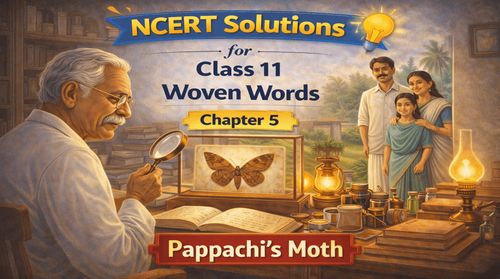

NCERT solutions for Class 11 English Chapter Pappachi’s Moth – complete answers & explanations
The chapter “Pappachi’s Moth” from Class 11 English Woven Words is a powerful short story written by Arundhati Roy. It explores themes such as family relationships, pride, jealousy, and the impact of social recognition on human behaviour. Through the story of Pappachi and Mammachi, students understand how personal ego and social expectations influence relationships. This blog provides complete NCERT solutions for Class 11 English Chapter Pappachi’s Moth strictly based on the worksheet provided. The answers follow the exact order and content of the worksheet to help students learn and revise effectively.
What this NCERT chapter covers?
1. The story highlights the troubled relationship between Pappachi and Mammachi and the emotional struggles within a family.
2. It explains themes such as jealousy, pride, recognition, gender inequality, and domestic relationships.
3. Students learn about literary techniques such as irony, symbolism, and concise storytelling.
4. The chapter introduces vocabulary related to scientific fields and helps students understand contextual meanings.
5. It develops analytical reading, interpretation, and discussion skills useful for exams and classroom discussions.
How to use these NCERT solutions?
1. First read the chapter carefully from the NCERT textbook to understand the storyline and characters.
2. Attempt the questions on your own before checking the solutions.
3. Use the answers provided here to verify your responses and understand the correct structure expected in exams.
4. Teachers and parents can guide students by discussing the ideas and themes mentioned in the answers.
5. The solutions follow the exact worksheet order so students can easily match questions with their answers.
Important tips & tricks for students
1. Focus on understanding the relationship between characters rather than memorizing the story.
2. Pay attention to themes such as pride, jealousy, and social recognition as they often appear in exam questions.
3. When answering analytical questions, include examples from the story to support your explanation.
4. Read the questions carefully and answer in clear, structured sentences.
5. For discussion or open-ended activities, express ideas clearly and logically.
NCERT solutions – complete answer key
Guess the meaning of the following expressions from the context
Ignominy of retirement – The shame or humiliation of being retired.
Conical corneas – Cone-shaped front parts of the eyes.
Slouch around – To walk or move in a lazy or unhappy manner.
Weaving – Moving unsteadily from side to side.
Sullen circles – Angry or silent social groups; unhappy company.
Entomologist – A scientist who studies insects.
Taxonomic reshuffle – A change in the scientific classification of something.
Lepidopterists – Scientists who study butterflies and moths.
Pernicious ghost – A harmful or destructive memory or presence that continues to trouble someone.
UNDERSTANDING THE TEXT
1. The relationship between Mammachi and Pappachi was unhappy and abusive. Pappachi was jealous of Mammachi’s growing success in her pickle business and could not tolerate the attention she received. He physically assaulted her regularly and later stopped speaking to her altogether. Even after the violence ended, emotional cruelty continued. Their marriage lacked affection and equality. Mammachi endured his behaviour silently, showing the imbalance of power in their relationship.
2. Mammachi stands out as independent because she started and successfully managed a pickle business despite being nearly blind (she had conical corneas). Even though she was subjected to domestic violence and humiliation, she continued working hard and built a thriving enterprise. Her strength lies in her ability to survive emotional and physical suffering while remaining productive and determined.
3. John Ipe (Pappachi) considered retirement a dishonour because he strongly identified himself with his prestigious position as an Imperial Entomologist. After Independence, his title changed, and retirement made him feel insignificant and old. He felt humiliated losing his authority and social importance. The “ignominy of retirement” refers to the shame and loss of dignity he associated with no longer holding power.
4. The deeper reason for Pappachi’s bitterness was that the moth he discovered was not named after him. Years later, when it was recognised as a new species, it was named after a junior officer he disliked. This failure to receive recognition deeply wounded his pride. The moth became a symbol of his disappointment and wounded ego, which contributed to his constant anger and bad temper.
TALKING ABOUT THE TEXT
Discuss in pairs
1. Chacko showed courage by physically stopping his father from beating Mammachi. He twisted Pappachi’s arm and warned him never to repeat the act. This shows Chacko’s moral strength and protective instinct. However, although the physical violence stopped, Pappachi’s bitterness and emotional cruelty remained.
2. Outwardly, Pappachi appeared dignified and respectable. He dressed in well-pressed suits and drove his sky-blue Plymouth car proudly. However, inside the home, he was violent and cruel. This contrast highlights hypocrisy — a respectable public image hiding private brutality.
3. Pappachi craved recognition from the outside world, especially for his scientific discovery. However, he failed to earn love and respect within his own family. His obsession with status and honour did not bring him emotional fulfilment. The story suggests that external approval cannot replace personal relationships.
APPRECIATION
1. Arundhati Roy does not directly criticise patriarchy or domestic violence. Instead, she narrates events calmly and lets readers observe the injustice. The description of beatings, jealousy, and silence reveals gender inequality without loud condemnation. The moth symbolises male ego and suppressed anger. This subtle storytelling makes the social criticism more powerful.
2. Within a few pages, the author covers Pappachi’s career, his retirement, the moth discovery, his abusive nature, and his death. Selected incidents reveal personality traits without lengthy explanation. This economy of expression allows the reader to understand entire lives through carefully chosen moments.
3. A respected scientist behaves violently at home.
The moth he hoped would bring fame instead becomes a symbol of failure.
Though he sought honour, he is remembered more for his temper.
LANGUAGE WORK
1. Entomologist and lepidopterist are mentioned in the text and you must have guessed the meanings of these words or found them out from the dictionary.
Now match the kinds of scientists given below with the work they do:
ornithologist – Study of birds
gerontologist – Study of old age
ergonomist – Study of design of equipment
dematologist – Study of the skin
cytologist – Study of cells
2. A short report announcing the death of a person in a newspaper is called an ‘obituary’. Where would you find the following
In academic writing or award documents
On a tombstone
At the end of a book
At the beginning of a research paper
At the end of a letter
Necessity is said to be the mother of invention. Read this piece below on the invention of the Braille system to help the visually impaired.
Read the passage carefully about the invention of the Braille system. Identify the main idea and important details about how Braille was developed. Be ready to answer questions or summarize the passage in your own words.
Why NCERT solutions help students?
NCERT solutions help students understand the correct format of answers expected in exams. They clarify important themes and ideas in the chapter and strengthen conceptual understanding. By following NCERT-based answers, students build confidence and improve their ability to write accurate responses in examinations.
Help your child build strong English fundamentals with expert-guided learning support.