
NCERT Solutions for Class 11 Mathematics Chapter 2

NCERT solutions for Class 11 Mathematics Chapter 2 Relations and Functions – complete answers & explanations
This blog provides clear and reliable NCERT solutions for Class 11 Mathematics Chapter 2 Relations and Functions. This chapter introduces important concepts such as relations, ordered pairs, and functions, helping students understand how mathematical elements are connected. It also explains ideas like domain, codomain, and range, which are essential for higher-level mathematics. Learning this chapter builds a strong base for algebra and other advanced topics. These solutions guide students step-by-step to follow the correct approach while solving questions and improve accuracy. Download the worksheet and practice alongside solutions for better clarity. Book a free trial now to get expert guidance.
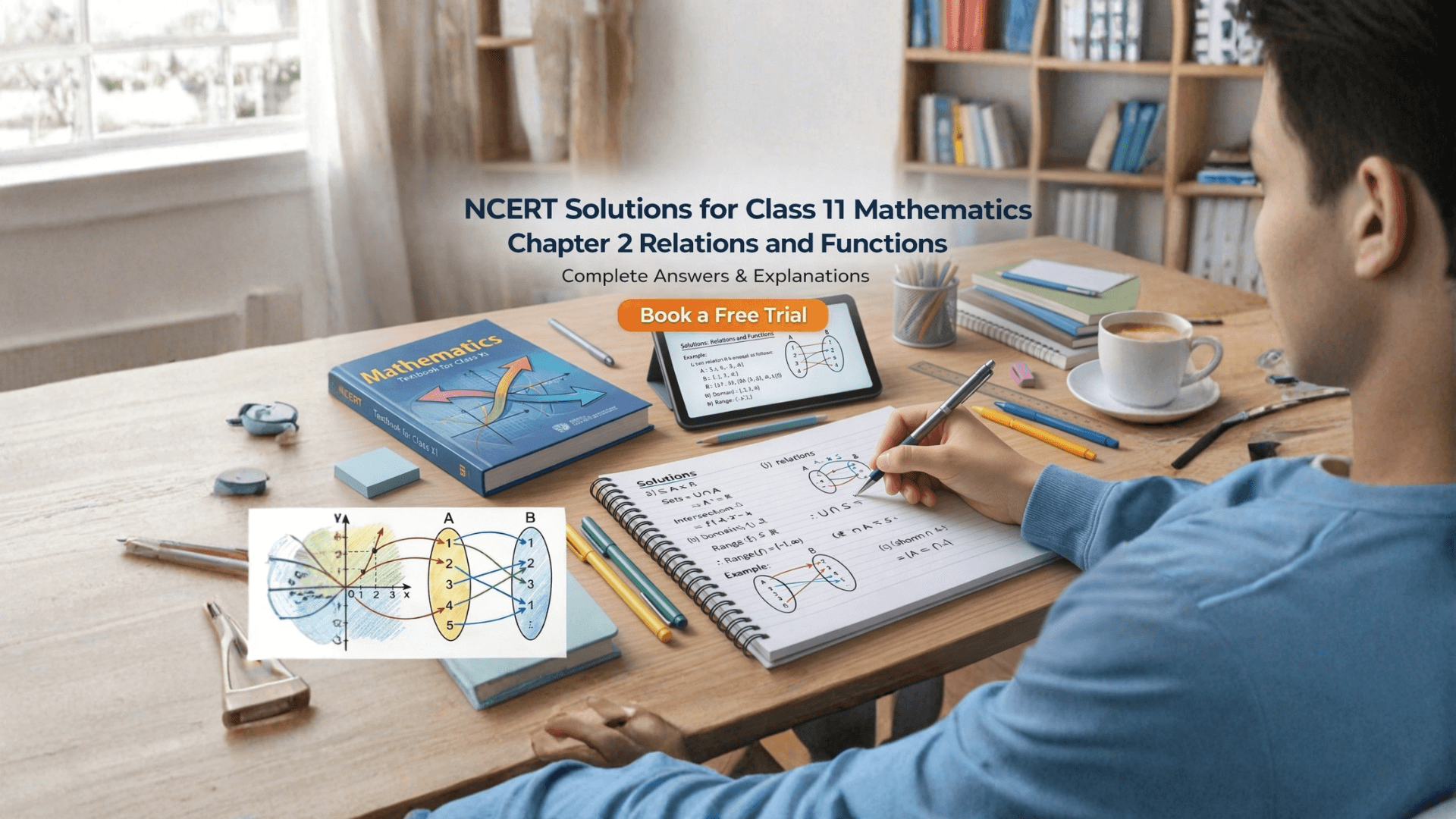
What this NCERT chapter covers?
1. Understanding relations and how ordered
pairs are formed
2. Concept of Cartesian products and their properties
3. Identifying domain, codomain, and range of relations
4. Introduction to functions and their meaning
5. Different types of functions and their characteristics
6. Checking whether a relation is a function or not
7. Evaluating functions using given values
8. Understanding mapping and connections between sets
9. Solving problems involving relations and functions
10. Learning to represent relations using sets and ordered pairs
11. Applying concepts to real mathematical problems
12. Building logical thinking and analytical skills for exams
How to use these NCERT solutions?
1. Start by attempting all questions
from the worksheet on your own
2. Read each question carefully before solving
3. Use the solutions to check your answers step-by-step
4. Compare your method with the correct answers to find mistakes
5. Focus on improving areas where you made errors
6. Follow the same order of questions as given in the worksheet
7. Practice writing answers neatly using proper mathematical steps
8. Parents and teachers can guide students by explaining difficult parts
9. Revise regularly to strengthen concepts and improve speed
10. Use these solutions as support for better understanding and accuracy
Important tips & tricks for students
1. Always write ordered pairs carefully and correctly
2. Clearly identify domain, codomain, and range in every question
3. Do not confuse relations with functions
4. Check that each input has only one output for functions
5. Practice Cartesian products to avoid mistakes
6. Be careful while writing subsets and mappings
7. Revise function values regularly to improve accuracy
8. Pay attention to notation and symbols used in questions
9. Practice different types of functions for better understanding
10. Keep your answers neat and well-structured to score full marks
NCERT solutions – complete answer key
EXERCISE 2.1
1
(i) False
Correct statement: P × Q = {(m,n), (m,m), (n,n), (n,m)}
(ii) True
(iii) True
2
(i) A × (B ∩ C) = {(1,5), (1,6), (2,5), (2,6)}
(A × B) ∩ (A × C) = {(1,5), (1,6), (2,5), (2,6)}
(ii) A × C = {(1,5), (1,6), (2,5), (2,6)}
B × D = {(1,5), (1,6), (1,7), (1,8), (2,5), (2,6), (2,7), (2,8), (3,5), (3,6), (3,7), (3,8), (4,5), (4,6), (4,7), (4,8)}
Hence, A × C ⊂ B × D
3
A × A × A = {(–1,–1,–1), (–1,–1,1), (–1,1,–1), (–1,1,1), (1,–1,–1), (1,–1,1), (1,1,–1), (1,1,1)}
4
Number of elements = 92
5
A = {a, b}
B = {x, y}
6
A × B = {(1,3), (1,4), (2,3), (2,4)}
Subsets:
φ
{(1,3)}
{(1,4)}
{(2,3)}
{(2,4)}
{(1,3),(1,4)}
{(1,3),(2,3)}
{(1,3),(2,4)}
{(1,4),(2,3)}
{(1,4),(2,4)}
{(2,3),(2,4)}
{(1,3),(1,4),(2,3)}
{(1,3),(1,4),(2,4)}
{(1,3),(2,3),(2,4)}
{(1,4),(2,3),(2,4)}
{(1,3),(1,4),(2,3),(2,4)}
Total subsets = 16
7
G × H = {(7,5), (7,4), (7,2), (8,5), (8,4), (8,2)}
H × G = {(5,7), (5,8), (4,7), (4,8), (2,7), (2,8)}
8
A = {x, y, z}
B = {1, 2}
9
A = {–1, 0, 1}
A × A = {(–1, –1), (–1, 0), (–1, 1), (0, –1), (0, 0), (0, 1), (1, –1), (1, 0), (1, 1)}
Remaining elements of A × A (excluding given pairs (–1, 0) and (0, 1)):
{(–1, –1), (–1, 1), (0, –1), (0, 0), (1, –1), (1, 0), (1, 1)}
10
Domain = {1, 2, 3, 4}
Codomain = {1, 2, 3, ..., 14}
Range = {3, 6, 9, 12}
R = {(1,6), (2,7), (3,8)}
Domain = {1, 2, 3}
Range = {6, 7, 8}
R = {(1,1), (1,2), (1,3), (1,4), (1,6), (2,2), (2,4), (2,6), (3,3), (3,6), (4,4), (6,6)}
Domain = {1, 2, 3, 4, 6}
Range = {1, 2, 3, 4, 6}
EXERCISE 2.2
1
R = {(1,4), (1,6), (1,9), (2,4), (2,6), (2,9), (3,4), (3,6), (3,9), (5,4), (5,6), (5,9)}
2
R = {(x, y): y = x + 1}
R = {(1,2), (2,3), (3,4), (4,5)}
Domain = {1, 2, 3, 4}
Range = {2, 3, 4, 5}
3
Domain = {0, 1, 2, 3, 4, 5}
Range = {5, 6, 7, 8, 9, 10}
4
(i) Function
Domain = {2, 5, 8, 11, 14, 17}
Range = {1}
(ii) Function
Domain = {2, 4, 6, 8, 10, 12, 14}
Range = {1, 2, 3, 4, 5, 6, 7}
(iii) Not a function
5
R = {(2,8), (3,27), (5,125), (7,343)}
6
Number of relations = 2⁶ = 648
7
Domain = Z
Range = Z
EXERCISE 2.3
1
(i) Domain = R
Range = R
(ii) Domain = R
Range = R
2
(i) f(0) = –5
(ii) f(7) = 9
(iii) f(–3) = –11
MISCELLANEOUS EXERCISE ON CHAPTER 2
1
f is a function
g is not a function
2
(i) 32
(ii) 82.4
(iii) 14
(iv) 100
3
(i) Range = (–∞, 2)
(ii) Range = [2, ∞)
(iii) Range = R
4
Answer = 1 2
5
Domain = R – {2, –2}
6
Domain = R
Range = {–1, 1}
7
Domain = R
Range = (–∞, 0)
8
Range = (–1, 1)
9
(f + g)(x) = 3x – 2
(f – g)(x) = –x + 4
(f/g)(x) = (x + 1)/(2x – 3)
10
a = 2
b = –1
11
(i) False
(ii) False
(iii) False
12
(i) True
(ii) False
13
Not a function
14
Range = {3, 5, 11, 13}
Why NCERT solutions help students?
These NCERT solutions help students prepare effectively for exams by providing clear and reliable answers. They improve concept clarity, ensure alignment with the NCERT pattern, and build confidence while solving similar questions.
Help your child build strong Mathematics fundamentals with expert-guided learning support.