
NCERT Solutions for Class 12 English Flamingo Prose Chapter 2
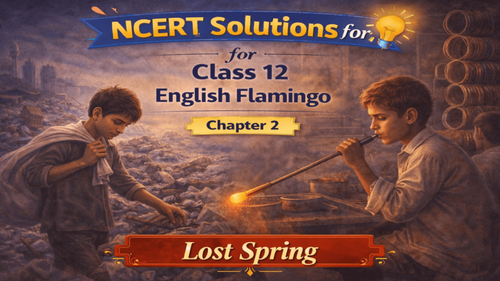

NCERT solutions for Class 11 English Chapter 2 Lost Spring – complete answers & explanations
The NCERT Chapter “Lost Spring” from Class 11 English Flamingo highlights the harsh reality of children who lose their childhood because of poverty and child labour. Written by Anees Jung, the chapter presents the stories of Saheb and Mukesh, showing how social inequality and economic hardship force many children to work instead of going to school. Through these experiences, students understand the challenges faced by disadvantaged communities and the importance of education and social awareness. This blog provides complete NCERT solutions for Class 11 English Chapter Lost Spring strictly based on the worksheet to help students understand the lesson and prepare for exams.
What this NCERT chapter covers?
1. The chapter explains the lives
of poor children who are forced to work instead of enjoying their childhood.
2. It highlights the issues of poverty, migration, and child labour in India.
3. Students learn about the struggles of ragpickers in Seemapuri and bangle makers in Firozabad.
4. The lesson develops reading comprehension, vocabulary, and awareness of literary devices.
5. It also encourages students to think about social inequality and the need to provide education and opportunities for every child.
How to use these NCERT solutions?
1. Students should first read the chapter carefully and try to answer the questions independently.
2. After attempting the questions, they can check their responses using these NCERT solutions.
3. Parents and teachers can guide students by discussing the themes and issues highlighted in the lesson.
4. These solutions follow the worksheet order exactly, making it easy to match answers with the questions.
5. Regular practice with these solutions helps students improve understanding and exam performance.
Important tips & tricks for students
1. Carefully read the story and focus on the experiences of the main characters.
2. Understand the social issues presented in the chapter such as poverty and child labour.
3. Pay attention to vocabulary expressions and figures of speech used in the text.
4. While answering questions, write clear and logical explanations.
5. Practice writing activities to improve your ability to express ideas effectively.
NCERT solutions – complete answer key
Notice these expressions in the text. Infer their meaning from the context.
Searching for something
Working very hard all day
A place to live or shelter
Continuous poverty
Small dark huts
Putting burdens or responsibilities on the child
Think as you read (Page 16)
1. Saheb is looking for gold (useful things or valuables) in the garbage dumps. He lives in Seemapuri and has come from Dhaka.
2. The author says children do not wear footwear because of poverty. Some people say it is a tradition, but actually many families cannot afford shoes.
3. No, Saheb is not happy working at the tea stall. Earlier he was free while ragpicking, but now he has lost his freedom and looks unhappy.
Think as you read (Page 17)
1. Firozabad is famous for its glass bangle industry.
2. Workers face many hazards such as high temperatures of furnaces, poisonous fumes, poor lighting, and the risk of burns or eye problems while making glass bangles.
3. Mukesh wants to break away from the family tradition of bangle making and dreams of becoming a motor mechanic, while his family accepts their difficult situation as their fate.
Understanding the text
1. People migrate from villages to cities due to poverty, lack of jobs, natural disasters like floods or storms, and the hope of finding better work and living conditions.
2. Yes, promises made to poor children are rarely kept because their families are poor and they are forced to work for survival instead of going to school. Society often ignores their problems, so their dreams remain unfulfilled.
3. Several forces keep the workers in poverty: poverty, the family tradition of bangle making, middlemen, moneylenders, and the lack of education and opportunities, which make it difficult for them to escape their situation.
Talking about the text
1. Mukesh can realise his dream by working hard, getting proper training as a motor mechanic, and breaking away from the traditional bangle-making work of his family.
2. Workers face hazards such as extreme heat from furnaces, poisonous fumes, poor lighting, eye problems, burns, and injuries while working with glass.
3. Child labour should be eliminated because it robs children of their childhood, education, and healthy development. It can be stopped through strict laws, proper education for children, and support for poor families.
Thinking about language
1. Irony
2. Metaphor
3. Metaphor
4. Contrast
5. Simile
6. Metaphor
7. Hyperbole
8. Metaphor
9. Metaphor
10. Hyperbole
11. Simile
Things to do
The beauty of glass bangles in Firozabad hides the painful lives of the workers who make them. These bangles are colourful, shiny and worn by women on happy occasions like weddings and festivals. They symbolise joy and celebration. However, the people who produce them live very difficult lives. Many workers, including children, spend long hours in hot factories near burning furnaces. The heat, smoke and poor lighting affect their health and damage their eyes. Most families remain poor and cannot escape this work because it has been their traditional occupation for generations. Children often start working at a very young age instead of going to school, which steals their childhood and dreams. Thus, while the bangles look beautiful and bring happiness to others, the lives of the workers who make them are full of hardship and suffering. This contrast clearly shows the paradox between the attractive products and the miserable lives of the labourers who produce them.
Why NCERT solutions help students?
NCERT solutions help students understand the key themes and ideas presented in the chapter. By studying these answers, students become familiar with the expected exam format and develop better writing skills. These solutions also improve comprehension, strengthen concepts, and help students gain confidence in answering literature questions.
Help your child build strong English fundamentals with expert-guided learning support.