
NCERT Solutions for Class 12 English Flamingo Prose Chapter 3
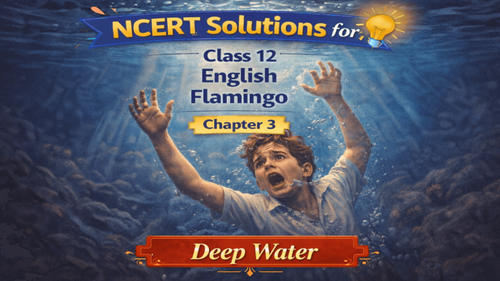

NCERT solutions for Class 12 English Chapter 3 Deep Water – complete answers & explanations
The NCERT Chapter “Deep Water” from Class 12 English Flamingo is a powerful autobiographical narrative by William O. Douglas. The story describes a frightening childhood experience when Douglas nearly drowned in a swimming pool and developed a deep fear of water. Through determination, courage, and systematic training, he gradually overcame this fear and regained confidence. The chapter highlights the psychological impact of fear and the importance of facing challenges bravely. This blog provides complete NCERT solutions for Class 12 English Chapter Deep Water strictly based on the worksheet shared, helping students understand the lesson and prepare effectively for exams.
What this NCERT chapter covers?
1. The chapter describes a real-life
incident from William Douglas’s childhood when he almost drowned in a swimming pool.
2. It explains how a traumatic experience created a deep fear of water that affected him for many years.
3. Students learn how determination, patience, and training helped Douglas overcome this fear.
4. The chapter also develops understanding of vocabulary, expressions, and first-person narrative style.
5. It encourages students to reflect on fear, courage, and personal growth through real-life experiences.
How to use these NCERT solutions?
1. Students should first read the chapter carefully and attempt the questions on their own.
2. After completing the answers, they can check their responses using these NCERT solutions.
3. Parents and teachers can use these answers to guide discussions about the theme of fear and courage.
4. The answers follow the exact order of the worksheet so students can easily match questions and responses.
5. Regular revision using these solutions helps improve comprehension and exam preparation.
Important tips & tricks for students
1. Pay close attention to Douglas’s emotions and reactions during the drowning incident.
2. Understand how fear can affect a person psychologically and physically.
3. Focus on the sequence of events showing how Douglas gradually overcame his fear.
4. Learn the meanings of important expressions and phrases used in the story.
5. Practice writing activities to improve narrative and descriptive writing skills.
NCERT solutions – complete answer key
Notice these expressions in the text. Infer their meaning from the context
Explanation:
Read the sentences in the chapter where these words appear. Use the context of the story to understand what the author is trying to convey. Write the meaning of each expression in simple words.
Treacherous
Meaning: Dangerous and unpredictable.
In the chapter, the Yakima River is called treacherous because it could easily cause accidents and drownings.
Misadventure
Meaning: An unfortunate or unlucky incident.
Here it refers to the accident when Douglas was thrown into the deep end of the swimming pool and nearly drowned.
Subdued my pride
Meaning: Controlled or overcame one’s feelings of embarrassment or ego.
Douglas felt shy about showing his thin legs but controlled his pride and entered the pool.
Bob to the surface like a cork
Meaning: Rise quickly to the surface of water like a floating cork.
Douglas thought he would push from the bottom of the pool and float up easily.
Flailed at the surface
Meaning: Move arms and legs wildly in panic.
Douglas desperately tried to stay afloat by struggling violently in the water.
Curtain of life fell
Meaning: A metaphor meaning losing consciousness or almost dying.
Douglas uses this expression to describe the moment when he felt he was about to die.
Fishing for landlocked salmon
Meaning: Catching salmon fish that live in lakes instead of the sea.
Douglas mentions this activity while describing his fishing trips.
Back and forth across the pool
Meaning: Moving repeatedly from one side of the pool to the other.
The instructor made Douglas swim across the pool many times during training.
Think as you read (Page 27)
1. The misadventure was the incident when a big boy suddenly picked Douglas up and threw him into the deep end of the swimming pool. Douglas could not swim and sank to the bottom. He struggled desperately to reach the surface and almost drowned before being rescued.
2. At first, Douglas felt frightened but tried to remain calm. Soon panic and terror took over as he struggled for breath and swallowed water. He felt helpless and paralysed with fear. His plan was to push himself from the bottom of the pool, jump upward like a cork, lie flat on the surface, and paddle to the edge.
3. The incident left Douglas deeply traumatized. He developed a strong fear of water and avoided swimming pools, lakes, and rivers. This fear followed him for many years and even ruined his enjoyment of activities like fishing, boating, and swimming.
Think as you read (Page 29)
1. Douglas loved outdoor activities such as fishing, canoeing, and swimming. His fear of water prevented him from enjoying these activities. Therefore, he decided to overcome his fear so that he could live freely and enjoy life without being controlled by terror.
2. The instructor trained Douglas gradually and patiently. He first used a belt and rope system to help him move safely across the pool. Then he taught him breathing techniques, how to put his face under water, and how to kick with his legs. Step by step, he combined these skills and eventually made Douglas a confident swimmer.
3. Douglas tested himself by swimming alone in different places. He swam across Lake Wentworth and practiced various strokes. Later he swam across Warm Lake as well. These experiences proved to him that he had finally conquered his fear of water.
Understanding the text
1. Douglas vividly describes his panic through detailed physical and emotional reactions. He mentions his lungs bursting, legs becoming paralysed, choking on water, and feeling dizzy. The repeated attempts to jump to the surface and the description of “yellow water” around him create a powerful image of terror and helplessness.
2. Douglas overcame his fear through patience, determination, and systematic training. His instructor taught him swimming techniques step by step and helped him practice regularly. Gradually his confidence grew, and he was able to swim independently. Eventually he defeated his fear completely.
3. Douglas recounts this experience to show how fear can control a person’s life if not confronted. By overcoming his fear of water, he learned that courage and determination can defeat even the strongest fears. The larger message is that the real enemy is fear itself.
Talking about the text
Explanation:
In part 1, think about a personal experience when you were afraid of something but later overcame that fear.
In part 2, recall real-life stories of people who showed courage in difficult situations. Write a short paragraph describing one such example.
1. When I was younger, I was afraid of speaking in front of the class. My voice would shake and I would feel very nervous. With practice and encouragement from my teacher, I slowly gained confidence. Now I can speak in public without fear.
(Answers may vary.)
2. Nelson Mandela showed great courage during the struggle against apartheid in South Africa. Despite being imprisoned for 27 years, he remained determined to fight for equality and freedom. His courage and perseverance eventually helped bring justice and democracy to his country.
Thinking about language
Explanation:
Rewrite a part of the story as if it were told by another person who observed the incident. Compare how the style changes.
Sample answer (Answers may vary.)
Douglas was sitting near the swimming pool when a big boy suddenly picked him up and threw him into the deep end. The boy struggled in the water and nearly drowned. People quickly pulled him out and laid him beside the pool. The incident left him frightened and weak.
Explanation:
The first-person narration used in the story is more powerful because it allows readers to feel Douglas’s fear and emotions directly.
Writing
1. Explanation:
Write about an experience where you were afraid while learning something new but later succeeded. Describe your feelings and how you overcame the fear.
Sample answer (Answers may vary.)
At last I felt released — free to walk the trails and brush aside fear. When I first learned to ride a bicycle, I was very nervous. I was afraid of falling and getting hurt. My father encouraged me and helped me practice every day.
In the beginning I fell many times and lost confidence. However, I continued practicing and slowly learned to balance. After some time, I was able to ride smoothly without help.
That experience taught me an important lesson. Fear disappears when we face it with courage and determination.
2. Explanation:
Write a short letter to a friend or relative describing something new you have recently learned.
Sample letter (Answers may vary.)
Dear Riya,
I hope you are doing well. I want to tell you about something new I learned recently. I finally learned how to swim after many weeks of practice.
At first I was nervous, but my instructor helped me step by step. Now I can swim confidently and enjoy being in the water.
I am very happy about this achievement and wanted to share it with you.
Yours lovingly,
Ananya
Things to do
Explanation:
Research water sports practiced in India and identify famous places where they take place.
Sample answer (Answers may vary.)
Some popular water sports in India include rafting, kayaking, jet skiing, scuba diving, and parasailing.
Famous places for water sports are:
Goa – parasailing, jet skiing
Rishikesh – river rafting
Andaman & Nicobar Islands – scuba diving
Kerala – kayaking and boating
These activities attract many tourists and adventure lovers.
Why NCERT solutions help students?
NCERT solutions help students understand the chapter clearly and prepare effectively for exams. By studying these answers, students learn how to present structured responses according to NCERT expectations. These solutions also improve comprehension skills, strengthen writing ability, and build confidence in answering literature questions.
Help your child build strong English fundamentals with expert-guided learning support.