
NCERT Solutions for Class 12 English Flamingo Prose Chapter 6
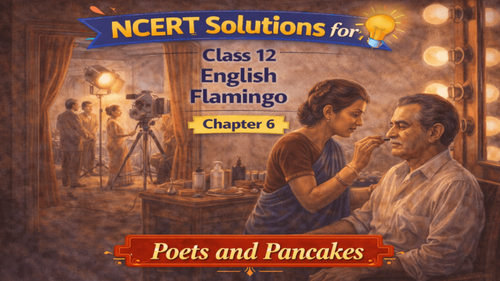

NCERT solutions for Class 12 English Chapter 6 Poets and Pancakes – complete answers & explanations
The chapter Poets and Pancakes from Class 12 English Flamingo gives readers an interesting glimpse into the early days of Indian cinema through the experiences of the author at Gemini Studios. It describes the people, departments, and humorous situations inside the studio while also highlighting how literature and cinema sometimes intersect in unexpected ways. The chapter is important because it combines humour, social observation, and real-life experiences to explain how film studios functioned during that time. In this blog, you will find complete NCERT solutions for Class 12 English Chapter Poets and Pancakes strictly based on the worksheet, helping students understand the questions and verify their answers easily.
What this NCERT chapter covers?
1. The working environment and daily
life inside Gemini Studios.
2. The roles of different departments such as the make-up department and story department.
3. Important characters like Kothamangalam Subbu and their contributions to the studio.
4. Humour and satire used by the author to describe people and situations.
5. Cultural and literary references such as the visit of an English poet.
6. Language skills including contextual vocabulary, transitions, and creative writing tasks.
How to use these NCERT solutions?
1. Carefully read the chapter Poets and Pancakes from the Class 12 English Flamingo textbook.
2. Attempt the worksheet questions on your own before checking the answers.
3. Compare your responses with the answers provided here to understand the correct ideas.
4. Pay attention to how answers are structured according to the worksheet.
5. Teachers and parents can use these solutions to guide students in understanding the chapter better.
6. The answers below follow the same order and format as the worksheet questions.
Important tips & tricks for students
1. Focus on understanding the humorous tone and narrative style used by the author.
2. Remember key details about Gemini Studios and its departments.
3. Pay attention to the characters mentioned in the chapter and their roles.
4. Understand the meaning of expressions and vocabulary used in context.
5. Read questions carefully before answering comprehension sections.
6. For writing tasks and discussions, express ideas clearly while following the instructions given.
NCERT solutions – complete answer key
Notice these expressions in the text. Infer their meaning from the context
Explanation:
Read the expressions given below and understand their meaning from the context of the story. Think about how they are used in the sentence and what feeling or idea they convey.
Meanings of the expressions:
Blew over
Meaning: The anger or problem gradually disappeared.
Was struck dumb
Meaning: Became speechless due to shock or surprise.
Catapulted into
Meaning: Suddenly pushed into a new position or situation.
A coat of mail
Meaning: Something that protects a person like armour.
Played into their hands
Meaning: Did something that unknowingly helped someone else.
The favourite haunt
Meaning: A place frequently visited or liked by a person.
Heard a bell ringing
Meaning: Something reminded someone of a familiar memory.
Think as you read ( Page 58)
1. The writer refers to the uncomfortable conditions actors faced during make-up. The make-up room had many bright incandescent lights around mirrors which produced intense heat. The actors had to sit under these lights for long periods, making the process very unpleasant.
2. The make-up department of Gemini Studios had workers from different regions of India such as Bengal, Maharashtra, Andhra Pradesh, Karnataka and Tamil Nadu. People from various linguistic and cultural backgrounds worked together, showing a form of national integration.
3. The office boy applied make-up to junior artists and crowd actors. He had joined Gemini Studios hoping to become a famous actor, writer or director. However, he remained stuck in a low position and felt that his talents were not recognised, which made him frustrated.
4. The author’s job was to collect and file newspaper clippings on various subjects. Since this work involved reading newspapers quietly in his cubicle, others felt he was doing nothing important.
Think as you read ( Page 60)
1. The office boy was frustrated because he believed his literary talents were ignored in the make-up department. He blamed Kothamangalam Subbu for his failure and directed his anger towards him.
2. Subbu’s principal was S. S. Vasan, the owner and head of Gemini Studios.
3. Subbu had many talents such as:
He was a creative writer and poet.
He was an excellent actor.
He could develop ideas for films quickly.
He had great organisational ability and loyalty to his boss.
4. The legal adviser was ironically called the “opposite” because instead of advising legally, he often caused problems. For example, he accidentally ended the actress’s career by recording and playing back her angry speech.
5. Unlike others who wore traditional khadi clothes, the lawyer wore Western clothes such as pants, tie and coat. His formal appearance and logical attitude made him appear different from the others.
Think as you read ( Page 62)
1. No, the people at Gemini Studios did not have strong political views. Although they wore khadi and admired Gandhiji, they did not have deep understanding of political ideologies.
2. The Moral Rearmament Army was welcomed because it performed plays that impressed the people of Madras. Gemini Studios hosted them warmly and allowed them to stage their productions.
3. Many Tamil plays started copying the stage style of MRA plays, especially scenes showing sunrise and sunset with simple sets and background music.
4. The Boss of Gemini Studios was S. S. Vasan, the founder and owner of the studio.
5. The lack of communication occurred because the audience could not understand the English poet’s accent or ideas. The poet also could not connect with the audience who were unfamiliar with English poetry.
6. The visit seemed mysterious because no one understood why the English poet had come to speak at a Tamil film studio. His talk confused the audience and had no clear relevance to them.
Think as you read ( Page 63)
1. The English visitor was Stephen Spender, a famous English poet and editor.
2. The author later visited the British Council Library and saw the magazine The Encounter. When he read the editor’s name, he realised it was Stephen Spender, the same person who had visited Gemini Studios.
3. The God That Failed is a book containing essays by several writers describing their experiences with Communism and their later disillusionment with it.
Understanding the text
1. The author humorously describes the make-up department, the frustrated office boy, and the confusing visit of Stephen Spender. His light-hearted tone highlights human weaknesses and misunderstandings in an entertaining way.
2. Subbu was considered second in command because he was very close to the Boss and played an important role in many creative and organisational activities of the studio.
Talking about the text
1. Today filmmaking uses advanced technology, special effects and digital equipment. In the early days of Gemini Studios, filmmaking relied mainly on basic sets, simple lighting and manual techniques.
2. Poetry and films both express emotions and ideas creatively. While poetry uses words and imagination, films use visual storytelling and performance to communicate messages.
3. Humour is often used to criticise social behaviour in a light manner. In this chapter, the author uses humour to highlight misunderstandings, frustrations and human weaknesses.
Answers may vary.
4. The author clearly had strong literary interests. He enjoyed reading, writing and participating in literary contests, showing his passion for literature despite working in a film studio.
Noticing transitions
Explanation:
Students should observe how the author moves from one idea to another in the chapter.
Example of transitions in the text:
Make-up Department → Office Boy → Subbu → Story Department → Moral Rearmament Army → English Poet → Stephen Spender
This shows the author’s rambling and conversational style of narration.
Writing
Explanation:
Students should write a short humorous description of an interesting person they know, highlighting their unusual habits or behaviour.
Example idea:
Describe a neighbour who always gives advice to everyone but never follows it himself.
Sample answer:
An Interesting Character in My Neighbourhood
In my neighbourhood lives a man named Mr. Sharma, who is famous for knowing everything about everyone. He wakes up earlier than the newspaper delivery boy and somehow manages to know the news even before the newspaper arrives. If someone buys a new car, Mr. Sharma will immediately appear at their gate asking detailed questions as if he is conducting an official investigation.
He has a strange habit of giving advice on every topic. If you are studying, he advises you to study less and relax; if you are relaxing, he advises you to study more and work hard. Once he even tried to explain to the electrician how to repair a fan, though he himself could barely switch on a light.
Despite his amusing habits, everyone in the neighbourhood secretly enjoys his presence. Without Mr. Sharma’s daily commentary on people, politics, and weather, our street would certainly be a much quieter and less entertaining place.
Things to do
Explanation:
Students should collect cartoons from newspapers or magazines and analyse how they criticise social or political issues through humour and visual symbols. This activity helps students understand satire and the relationship between images and written messages.
Why NCERT solutions help students?
NCERT solutions help students understand chapters clearly and prepare effectively for exams. They provide structured answers that match the NCERT pattern, helping learners organise their thoughts and write accurate responses. By practising with these solutions, students improve comprehension skills and gain confidence in answering Class 12 English questions.
Support your child in mastering Class 12 English concepts with expert-guided learning support.