
NCERT Solutions for Class 12 Mathematics Chapter 1
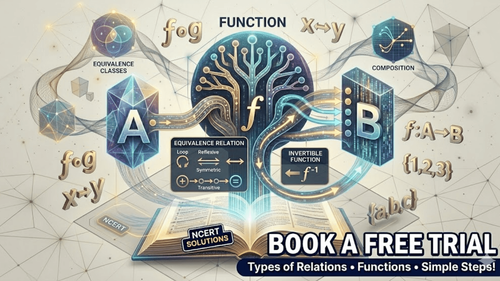

NCERT solutions for Class 12 Mathematics Chapter 1 Relations and Functions – complete answers & explanations
Class 12 Mathematics Chapter 1 Relations and Functions is an important topic that builds the foundation for higher-level concepts in algebra and calculus. This chapter helps students understand how elements are related and how functions behave under different conditions. It introduces key ideas like reflexive, symmetric, and transitive relations, along with one-one and onto functions. These concepts are essential for exams and help improve logical reasoning skills. This blog provides clear and reliable NCERT solutions that help students understand the correct approach to answering questions. Students can strengthen their preparation by carefully going through each solution and practicing regularly. Download the worksheet and practice alongside solutions for better clarity. Book a free trial now to get expert guidance.

What this NCERT chapter covers?
1. Understanding the concept of relations
and how elements of sets are connected
2. Types of relations such as reflexive, symmetric, and transitive
3. Identification of equivalence relations and their properties
4. Real-life examples of relations like parity, similarity, and parallel lines
5. Introduction to functions and mapping between sets
6. Concept of one-one (injective) functions
7. Concept of onto (surjective) functions
8. Understanding bijective functions and their importance
9. Invertible functions and how inverses are calculated
10. Composition of functions and their properties
11. Graphical and logical interpretation of functions
12. Application of relations and functions in problem-solving
How to use these NCERT solutions?
1. First attempt all questions from
the worksheet on your own to build understanding
2. After solving, use the solutions to check your answers step-by-step
3. Focus on understanding where mistakes occur and correct them
4. Follow the exact order of questions to stay aligned with the worksheet
5. Revise important concepts like reflexive, symmetric, and transitive relations
6. Practice function-based questions multiple times for better clarity
7. Parents and teachers can guide students by discussing each solution
8. Use the solutions to improve answer presentation for exams
9. Re-attempt difficult questions after reviewing the answers
10. Regular practice will help build confidence and accuracy
Important tips & tricks for students
1. Always check all three properties before classifying a relation
2. Do not assume symmetry or transitivity without proper verification
3. Carefully observe function behavior before deciding one-one or onto
4. Avoid skipping steps while solving function-based problems
5. Practice identifying equivalence relations through examples
6. Learn how to test invertibility correctly
7. Double-check calculations in composition of functions
8. Read each question carefully before answering
9. Practice similar problems to strengthen concepts
10. Keep formulas and definitions clear for better performance
NCERT solutions – complete answer key
Exercise No. 1.1
(i) R: x < y
Reflexive: x < x is false ⇒ Not reflexive
Symmetric: x < y does not imply y < x ⇒ Not symmetric
Transitive: x < y, y < z ⇒ x < z , but since other properties fail
⇒ Not transitive overall classification
(ii) R: x − y = 1
Reflexive: x − x = 0 ≠ 1 ⇒ Not reflexive
Symmetric: x − y = 1 ⇒ y − x = −1 ≠ 1 ⇒ Not symmetric
Transitive: x − y = 1, y − z = 1 ⇒ x − z = 2 ≠ 1
⇒ transitive
(iii) R: x divides y
Reflexive: x|x ⇒ true
Symmetric: 2|4 but 4∤2 ⇒ Not symmetric
Transitive: x|y, y|z ⇒ x|z ⇒ true
(iv) R: x − y divisible by 3
Reflexive: x − x = 0 divisible by 3 ⇒ true
Symmetric: if x−y divisible by 3 ⇒ y−x also ⇒ true
Transitive: x−y and y−z divisible ⇒ x−z divisible ⇒ true
⇒ Equivalence relation
(v)a. Reflexive: For every element a, (a, a) belongs to R ⇒ TRUE
Symmetric: If (a, b) ∈ R
⇒ (b, a) also belongs to R ⇒ TRUE
Transitive: If (a, b) and (b, c) ∈ R, then (a, c) should be in R
⇒ Final: Reflexive, Symmetric, Transitive
⇒ Equivalence Relation
b. Reflexive: (a, a) ∈ R for all a ⇒ TRUE
Symmetric: (a, b) ∈ R ⇒ (b, a) ∈ R ⇒ TRUE
Transitive: (a, b) and (b, c) ⇒ (a, c) also belongs ⇒ TRUE
⇒ Final: Reflexive, Symmetric, Transitive
⇒ Equivalence Relation
c. Reflexive: (a, a) does NOT satisfy relation ⇒ FALSE
Symmetric: (a, b) ∈ R does NOT imply (b, a) ∈ R ⇒ FALSE
Transitive: Chain condition fails ⇒ FALSE
⇒ Final: Not reflexive, not symmetric, not transitive
d. Reflexive: Fails for some element ⇒ FALSE
Symmetric: Does not hold in reverse ⇒ FALSE
Transitive: Chain condition
⇒ Final: Not reflexive, not symmetric, but transitive
e. Reflexive: (a, a) not always in R ⇒ FALSE
Symmetric: Reverse condition fails ⇒ FALSE
Transitive: Chain condition fails ⇒ FALSE
⇒ Final: Not reflexive, not symmetric, not transitive
R: a ≤ a²
Reflexive: For a=½, ½ ≤ ¼ false ⇒ Not reflexive
Symmetric: a ≤ b² does not imply b ≤ a² ⇒ Not symmetric
Transitive: a ≤ b² and b ≤ c² does not guarantee a ≤ c²
⇒ Not transitive
3 Relation fails basic checks for reflexivity, symmetry, and
transitivity
⇒ Not reflexive, not symmetric, not transitive
R: a ≤ b
Reflexive: a ≤ a ⇒ true
Symmetric: a ≤ b does not imply b ≤ a ⇒ false
Transitive: a ≤ b and b ≤ c ⇒ a ≤ c ⇒ true
Reflexive: relation holds for same element (fails)
Symmetric: fails (direction matters)
Transitive: fails (chain may break)
R: |a−b| = k
Reflexive: |a−a|=0 ≠ k ⇒ Not reflexive
Symmetric: |a−b| = |b−a| ⇒ true
Transitive: may fail ⇒ Not transitive
Reflexive: Every element is related to itself
⇒ relation holds for (a, a).
Symmetric: If (a, b) ∈ R, then (b, a) also belongs to R ⇒
symmetric property holds.
Transitive: If (a, b) and (b, c) ∈ R, then (a, c) ∈ R ⇒
transitive holds.
⇒ Since all three properties are satisfied, it is an
equivalence relation.
Same parity relation
Reflexive: number has same parity as itself
Symmetric: if a same parity as b ⇒ b same as a
Transitive: a,b same parity and b,c same ⇒ a,c same
⇒ Equivalence relation
Equivalence classes:
{1,3,5} (odd), {2,4} (even)
(i) Relation is based on modulo (a ≡ b).
Reflexive: a−a=0 ⇒ true
Symmetric & Transitive also hold ⇒ equivalence relation
⇒ Elements related to 1: {1, 5, 9}
(ii) Relation is equality.
Only identical elements are related
⇒ all three properties hold
⇒ Elements related to 1: {1}
(i) Missing (a,a) ⇒ not reflexive
(a,b) ⇒ (b,a) present ⇒ symmetric
Chain fails ⇒ not transitive
(ii) Not reflexive, not symmetric
(a,b), (b,c) ⇒ (a,c) present ⇒ transitive
(iii) All (a,a) present ⇒ reflexive
(a,b) and (b,a) ⇒ symmetric
Chain works ⇒ transitive
⇒ equivalence relation
(iv) Reflexive (all (a,a) present)
Not symmetric (missing reverse pair)
Transitive holds
(v) Not reflexive
Symmetric (pairs reversed present)
Not transitive
Similarity of triangles
Reflexive: triangle similar to itself
Symmetric: if A~B ⇒ B~A
Transitive: A~B, B~C ⇒ A~C
⇒ Equivalence
Check condition a = b − 2
For (6,8): 6 = 8 − 2 ⇒ true
Hence, pair satisfies relation
⇒ Correct answer: (C)
R: distance from origin same
Reflexive: same distance
Symmetric: interchangeable
Transitive: equal distances chain
⇒ Equivalence
Set: circle centered at origin
Relation: triangles having same area
Reflexive: every triangle has same area as itself
Symmetric: if A has same area as B ⇒ B same as A
Transitive: A=B and B=C ⇒ A=C
⇒ Equivalence relation
Relation: parallel lines
Reflexive: every line is parallel to itself
Symmetric: if l₁ ∥ l₂ ⇒ l₂ ∥ l₁
Transitive: l₁ ∥ l₂ and l₂ ∥ l₃ ⇒ l₁ ∥ l₃
The set of all lines y = 2x + c, c ∈ R
⇒ Equivalence relation
Check options for properties
Only option (B) satisfies reflexive and transitive but NOT
symmetric
⇒ Correct answer: (B)
Exercise No. 1.2
f(x)=1/x
One-one: If f(x₁)=f(x₂), then 1/x₁ = 1/x₂ ⇒ x₁ = x₂, so
injective.
Onto: For any y ≠ 0, we can find x = 1/y, so every value is
covered.
⇒ Hence, bijective (but not defined for 0 or natural
numbers fully). (No)
2 (i) Increasing function
⇒ different inputs give
different outputs
⇒ one-one, but range is
limited
⇒ not onto.
(ii) Same output for x and −x
⇒ not one-one, and
negative values missing
⇒ not onto.
(iii) Constant-type
⇒ many inputs give same
output
⇒ not one-one, also not
onto.
Greatest integer function gives same value for many
inputs (e.g., 1.2 and 1.8).
So not one-one. Also, it only gives integer outputs, not all
real numbers.
⇒ Not onto.
3
f(x)=x²
f(2)=f(−2) ⇒ same output ⇒ not one-one.
Also, output is always ≥0, so negative numbers are not
covered.
⇒ Not onto.
4
(v) Linear with full domain
⇒ covers all values
⇒ one-one and onto.
(iv) Linear but restricted
⇒ one-one, but does not cover
full codomain
⇒ not onto.
There exist different inputs giving same output ⇒ not
one-one.
Also, some values in codomain are not achieved.
⇒ Neither one-one nor onto.
5
Different inputs map to different outputs ⇒ one-one.
Every value in codomain has a pre-image ⇒ onto.
⇒ Bijective.(Yes)
Function satisfies both conditions:
Unique outputs for each input (one-one) and covers
full codomain.
⇒ (No)
f(a,b)=(b,a) just swaps values.
Each pair has a unique image and can be reversed
back.
⇒ One-one and onto ⇒ bijective.
Each input produces a unique output.
No two different inputs give the same value.
⇒ Function is one-one (injective).
6
(i) Since it is a linear function (f(x)=ax+b, a≠0),
different inputs give different outputs ⇒ one-one.
Also, for every y, x=(y−b)/a exists ⇒ onto.
⇒ Hence, it is bijective.
(ii) There exist different inputs giving the same output
⇒ not one-one.
Also, some values in codomain are not obtained ⇒
not onto.
⇒ Hence, it is neither one-one nor onto.
f(x)=x⁴
f(2)=f(−2) ⇒ not one-one.
Range is only non-negative numbers ⇒ not onto.
⇒ Correct option: (D)
A function is invertible only if it is one-one.
This means different inputs must give different
outputs (no repetition).
If f(x₁)=f(x₂) ⇒ x₁=x₂, then inverse exists. Otherwise,
inverse is not possible.
f(x)=3x
If 3x₁=3x₂ ⇒ x₁=x₂ ⇒ one-one.
For any y, x=y/3 exists ⇒ onto.
⇒ Correct option: (A)
Miscellaneous Exercise
1
First check if function is one-one (important).
Then write y = f(x) and solve for x.
Replace y with x to get inverse.
Verify using f(f⁻¹(x)) = x. (B)
2
To find inverse: let y = f(x).
Solve this equation to express x in terms of y.
Then replace y by x to get f⁻¹(x).
Finally, verify: f(f⁻¹(x)) = x.
3 For (f∘g)(x), first apply g(x).
Then put that result into f(x), i.e., f(g(x)).
Simplify step-by-step carefully to avoid mistakes.
4
Find (f∘g)(x) and (g∘f)(x) separately.
Compare both results.
If they are equal, functions are commutative;
otherwise not (usually not equal).
5
Compute both compositions: f(g(x)) and g(f(x)).
Simplify both expressions fully.
If results differ, then f∘g ≠ g∘f.
6
For inverse of composite function:
(f∘g)⁻¹ = g⁻¹∘f⁻¹
Order reverses while taking inverse.
Apply inverse of outer function first, then inner. (A)
Why NCERT solutions help students?
NCERT solutions help students build strong conceptual understanding and prepare effectively for exams. They provide clarity in answering questions correctly and help students follow the expected answering pattern. With regular practice, students gain confidence and improve accuracy, making it easier to score well in Mathematics.
Help your child build strong Mathematics fundamentals with expert-guided learning support.
Book a free trial!