
NCERT Solutions for Class 12 Mathematics Chapter 11
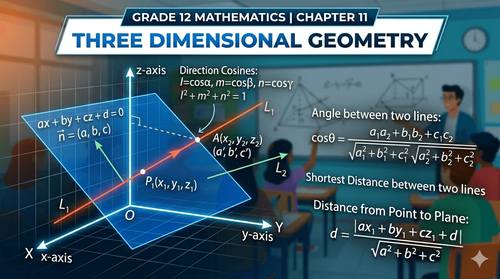

NCERT solutions for Class 12 Mathematics Chapter 11 Three Dimensional Geometry – complete answers & explanations
Class 12 Mathematics Chapter 11 Three Dimensional Geometry introduces students to the study of lines and distances in space using vector methods. This chapter helps students understand how geometry extends beyond two dimensions and how direction, position, and distance can be calculated accurately. It plays an important role in building a strong base for higher mathematics and competitive exams. Students learn to work with direction cosines, equations of lines, angles between lines, and shortest distances in space. This blog provides clear and reliable NCERT solutions to help students check their answers and improve their understanding step by step. Download the worksheet and practice alongside solutions for better clarity. Book a free trial now to get expert guidance.
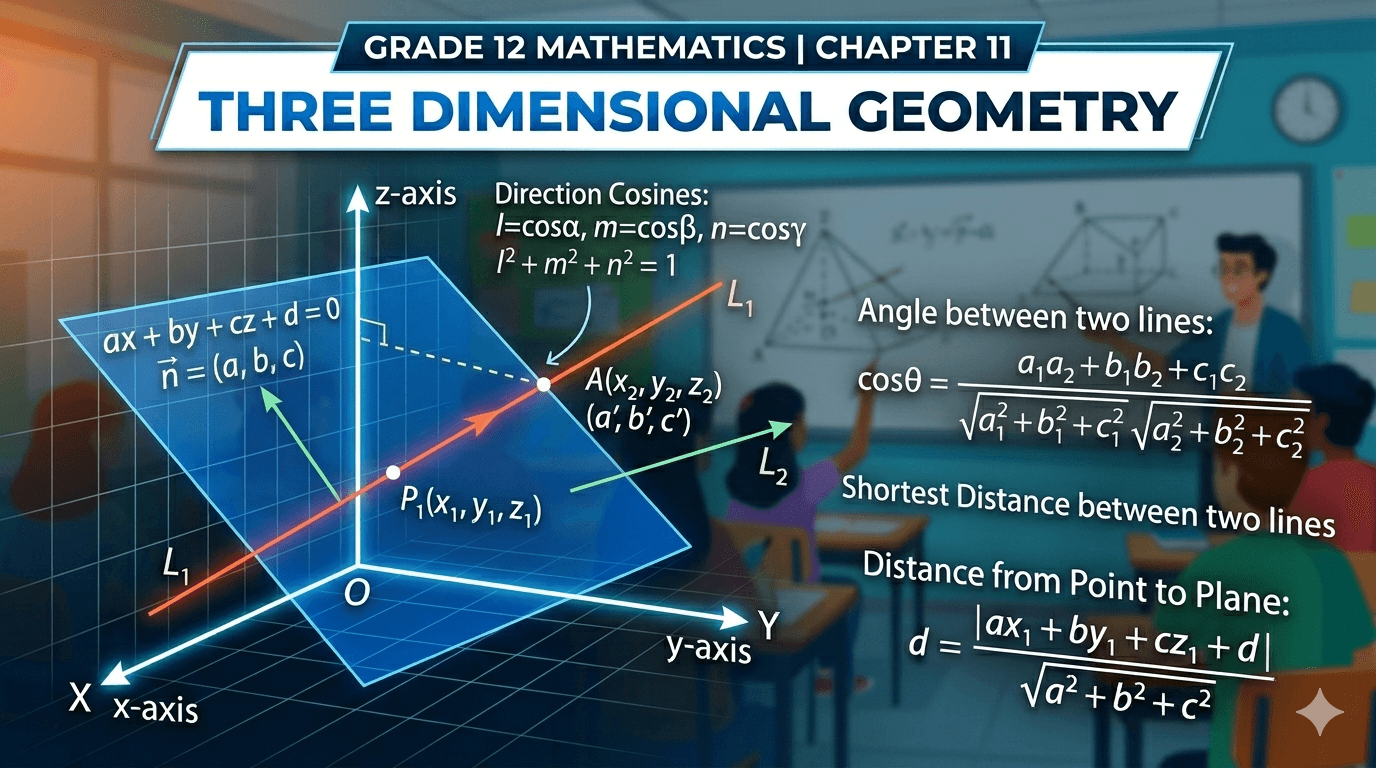
What this NCERT chapter covers?
1. Understanding direction cosines and their
relation with angles made by a line with coordinate axes
2. Learning direction ratios and their connection with direction cosines
3. Finding direction cosines of a line joining two given points
4. Writing vector and Cartesian equations of a line in space
5. Understanding parametric form and converting it into Cartesian form
6. Finding the angle between two lines using direction ratios
7. Identifying conditions for parallel and perpendicular lines
8. Understanding skew lines and their properties in space
9. Calculating the shortest distance between two skew lines
10. Finding distance between parallel lines using vector methods
11. Applying vector algebra to solve geometry problems in three dimensions
12. Developing spatial visualization and problem-solving skills
How to use these NCERT solutions?
1. First attempt all questions from
the worksheet independently without looking at the answers
2. After solving, compare your answers step by step with the given solutions
3. Identify mistakes in calculations or concepts and correct them carefully
4. Focus on understanding the method used in each solution rather than memorizing
5. Parents and teachers can guide students where they face difficulty in steps
6. Use these solutions for revision before tests and exams
7. Follow the same order of questions as given to maintain clarity
8. Practice similar problems to strengthen concepts further
Important tips & tricks for students
1. Always ensure that direction cosines satisfy the condition l² + m² + n² = 1
2. Do not confuse direction ratios with direction cosines while solving problems
3. Carefully apply formulas for angles and shortest distances
4. Practice converting vector equations into Cartesian form correctly
5. Pay attention to signs while calculating differences between coordinates
6. Recheck calculations to avoid simple arithmetic mistakes
7. Understand the concept of skew lines clearly as it is commonly tested
8. Practice diagrams to improve visualization of three dimensional figures
9. Write answers step by step to match NCERT expectations
NCERT solutions – complete answer key
Exercise 11.1
1.
l = 0
m = -1/√2
n = 1/√2
2.
l = 1/√3
m = 1/√3
n = 1/√3
3.
l = -9/11
m = 6/11
n = -2/11
4.
Points are collinear
5.
AB: (-2/√17, -2/√17, 3/√17)
BC: (-2/√17, -3/√17, -2/√17)
CA: (4/√42, 5/√42, -1/√42)
Exercise 11.2
1.
Lines are mutually perpendicular
2.
Lines are perpendicular
3.
Lines are parallel
4.
Vector form: r = (i + 2j + 3k) + λ(3i + 2j - 2k)
Cartesian form: (x - 1)/3 = (y - 2)/2 = (z - 3)/(-2)
5.
Vector form: r = (2i - 4j + k) + λ(2i + j - k)
Cartesian form: (x - 2)/2 = (y + 4)/1 = (z - 1)/(-1)
6.
(x + 2)/3 = (y - 4)/5 = (z + 5)/6
7.
r = (5i - 4j + 6k) + λ(3i + 7j + 2k)
8.
(i) cosθ = 16/21
(ii) cosθ = 6/√150
9.
(i) cosθ = 4/(7√10)
(ii) cosθ = 4/√798
10.
p = -11/5
11.
Lines are perpendicular
12.
|(b₁ × b₂) · (a₂ - a₁)| / |b₁ × b₂|
13.
2√3
14.
√14
15.
√6
Miscellaneous Exercise
1.
Angle = 90°
2.
r = λi
3.
k = 1
4.
√21
5.
r = (i + 2j - 4k) + λ(2i + j + k)
Why NCERT solutions help students?
NCERT solutions help students build strong conceptual clarity and improve exam performance. They provide the correct approach to answering questions and ensure alignment with CBSE expectations. By practicing regularly, students gain confidence and accuracy in solving problems, which is essential for scoring well.
Strengthen your Class 12 Mathematics concepts with expert-guided learning support and build confidence in solving 3D geometry problems.
Book a free trial!