
NCERT Solutions for Class 12 Mathematics Chapter 12
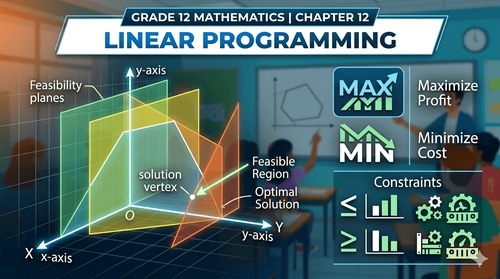

NCERT solutions for Class 12 Mathematics Chapter 12 Linear Programming – complete answers & explanations
Linear Programming is an important chapter in Class 12 Mathematics that helps students understand how to find the best possible solution under given conditions. In this chapter, students learn how to maximise or minimise a value using linear inequalities and graphical methods. It is widely used in real-life situations like business planning and resource management, making it highly practical and useful. This blog provides clear and reliable NCERT solutions that help students understand the correct approach to solving each problem step by step. The explanations are designed to build confidence and improve accuracy. Download the worksheet and practice alongside solutions for better clarity. Book a free trial now to get expert guidance.
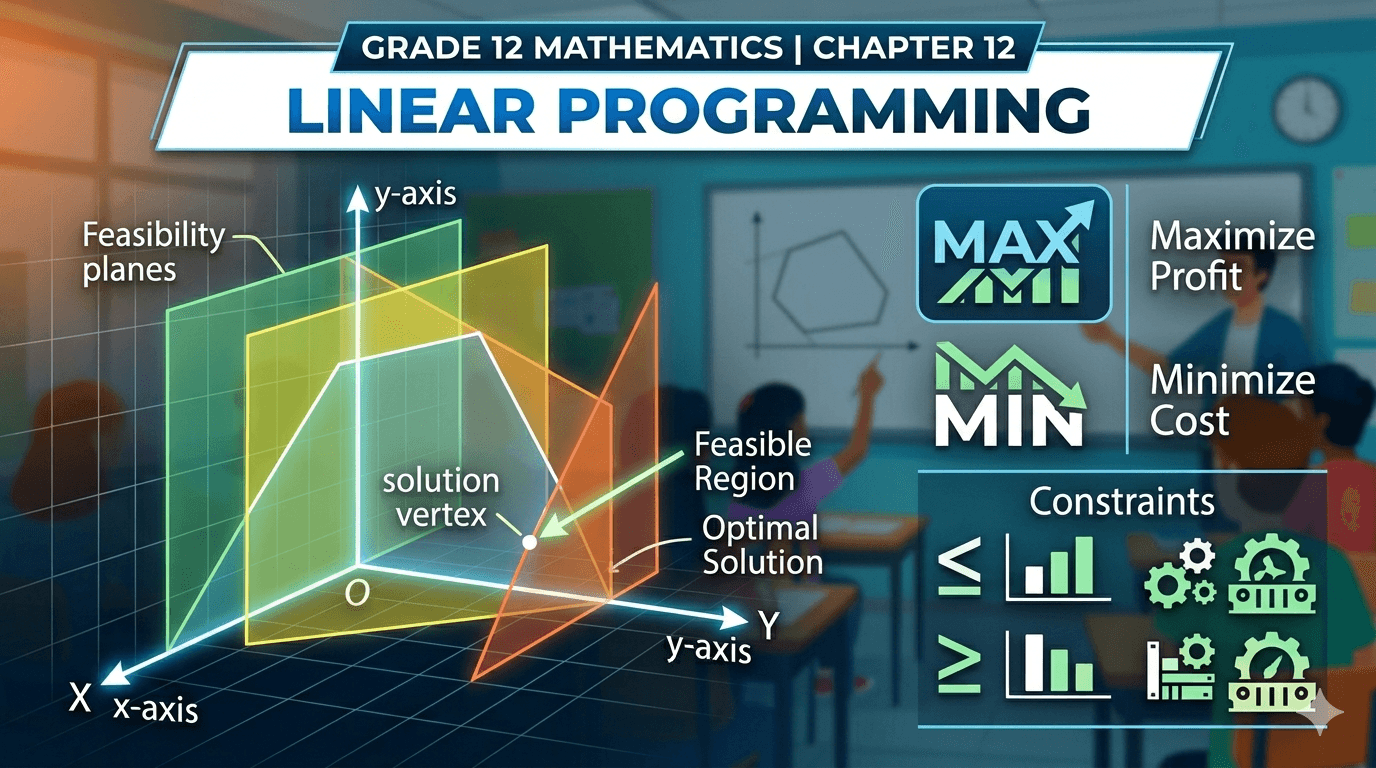
What this NCERT chapter covers?
1. Understanding the concept of linear
programming problems and optimisation
2. Formation of linear inequalities based on given conditions
3. Identification and interpretation of constraints in a problem
4. Graphical representation of inequalities on coordinate axes
5. Concept of feasible region and feasible solutions
6. Identification of corner points of the feasible region
7. Application of the corner point method to find optimal values
8. Differentiation between maximum and minimum values
9. Understanding bounded and unbounded regions
10. Solving real-life problems using mathematical modelling
How to use these NCERT solutions?
1. Start by attempting each question
from the worksheet independently
2. Carefully draw graphs wherever required before checking answers
3. Use the solutions to verify your final answers and steps
4. Compare your corner points and feasible region with the correct ones
5. Understand where mistakes occur and correct them immediately
6. Parents and teachers can guide students by checking each step
7. Follow the same order of questions as given in the worksheet
8. Use these solutions during revision to strengthen concepts
Important tips & tricks for students
1. Always write all constraints clearly before solving the problem
2. Draw neat and accurate graphs using proper scales
3. Check each inequality while identifying the feasible region
4. Do not skip corner points while evaluating the objective function
5. Evaluate the objective function at every vertex carefully
6. Be cautious while solving equations to avoid calculation errors
7. Understand whether the problem requires maximisation or minimisation
8. Revise graphical methods regularly for better speed and accuracy
NCERT solutions – complete answer key
1.
Maximum Z = 16 at (0, 4)
2.
Minimum Z = –12 at (4, 0)
3.
Maximum Z = 235/19 at (20/19, 45/19)
4.
Minimum Z = 7 at (3/2, 1/2)
5.
Maximum Z = 18 at (4, 3)
6.
Minimum Z = 6 at (0, 3) and (6, 0)
7.
Minimum Z = 300 at (60, 0)
Maximum Z = 600 at (120, 0) and (60, 30)
8.
Minimum Z = 100 at (0, 50) and (20, 40)
Maximum Z = 400 at (0, 200)
9.
Maximum Z = 1 at (3, 2)
10.
No feasible solution
Why NCERT solutions help students?
NCERT solutions help students build strong conceptual understanding and improve accuracy in exams. They provide a clear method for solving problems and ensure that answers are aligned with CBSE expectations. Regular practice with these solutions increases confidence and helps students perform better in assessments.
Help your child build strong Mathematics fundamentals with expert-guided learning support.
Book a free trial!