
NCERT Solutions for Class 12 Mathematics Chapter 2

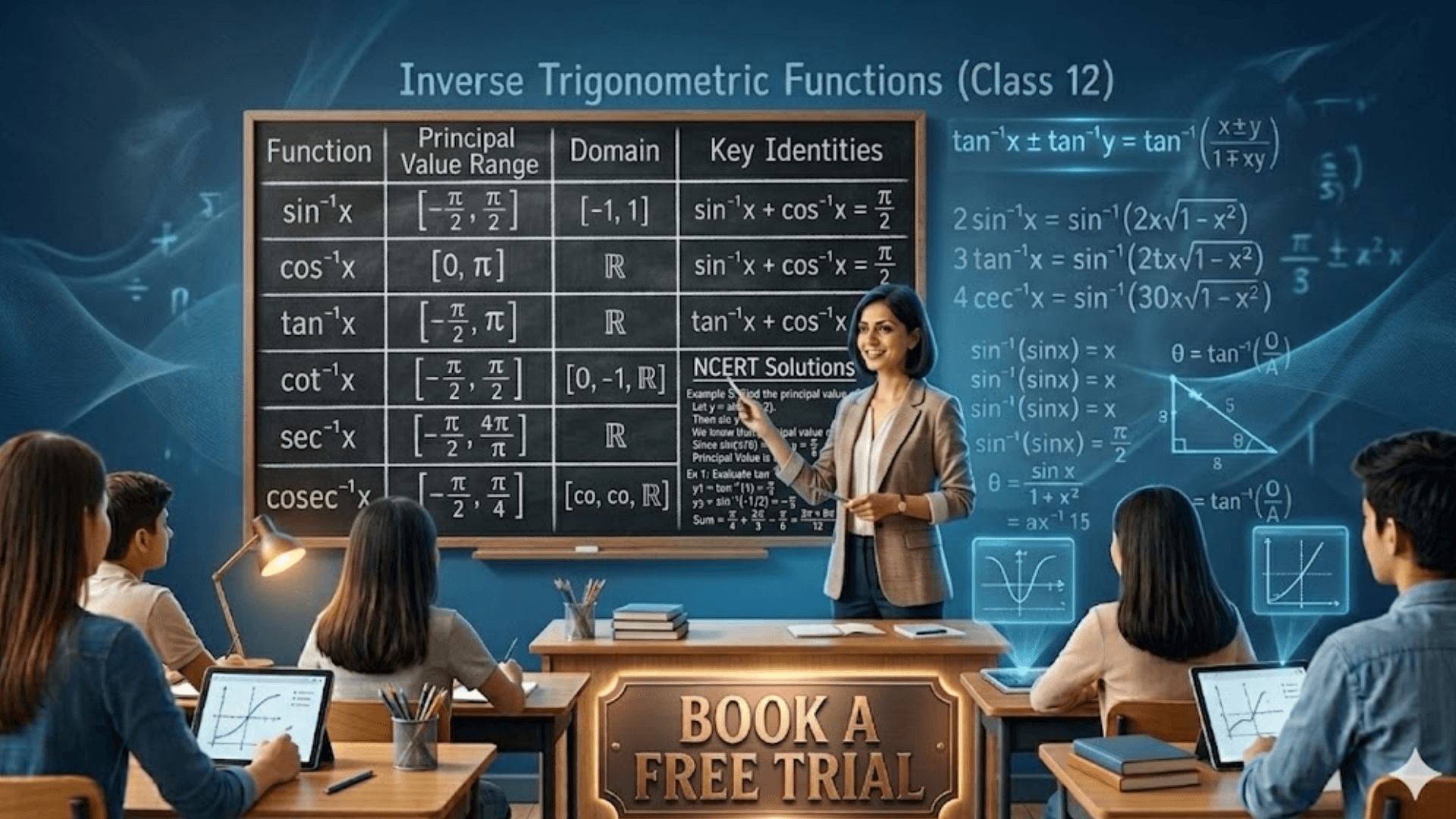
NCERT solutions for Class 12 Mathematics Chapter Inverse Trigonometric Functions – complete answers & explanations
Inverse Trigonometric Functions is an important chapter in Class 12 Mathematics that helps students understand how to find angles when trigonometric values are given. This chapter focuses on concepts like principal values, ranges, and identities of inverse trigonometric functions. It plays a key role in building a strong foundation for higher-level mathematics and is frequently asked in exams. This blog provides clear and reliable NCERT solutions that help students follow the correct approach to answering questions step by step. Students can improve their accuracy and confidence by practicing regularly. Download the worksheet and practice alongside solutions for better clarity. Book a free trial now to get expert guidance.
What this NCERT chapter covers?
1. Understanding inverse trigonometric functions such
as sin⁻¹x, cos⁻¹x, tan⁻¹x and others
2. Learning the principal value ranges of different inverse trigonometric functions
3. Evaluating inverse trigonometric expressions using standard angles
4. Applying identities like sin3θ and cos3θ in solving problems
5. Simplifying expressions involving combinations of inverse functions
6. Converting expressions into standard trigonometric forms
7. Using algebraic manipulation in trigonometric proofs
8. Solving equations involving inverse trigonometric functions
9. Understanding domain and range restrictions for valid solutions
10. Applying formulas like tan⁻¹a + tan⁻¹b in problem solving
11. Learning step-by-step evaluation of complex expressions
12. Building accuracy and speed for board exam preparation
How to use these NCERT solutions?
1. First, read each question carefully
and try solving it on your own
2. Use the solutions only after attempting the problem independently
3. Match your steps with the given answers to identify mistakes
4. Focus on understanding the method used rather than memorizing answers
5. Practice similar questions multiple times for better clarity
6. Follow the exact order of questions to stay aligned with the worksheet
7. Parents and teachers can guide students by checking step-by-step accuracy
8. Revise formulas and identities regularly while practicing
9. Use these solutions as a reference during revision before exams
10. Ensure all concepts are clear before moving to the next topic
Important tips & tricks for students
1. Always remember the principal value ranges of inverse trigonometric functions
2. Convert expressions into standard angles whenever possible
3. Use identities like sin3θ and cos3θ carefully
4. Avoid ignoring domain restrictions while solving problems
5. Practice writing step-by-step solutions clearly
6. Double-check signs (positive/negative) in answers
7. Use correct formulas for sum and difference of angles
8. Do not skip intermediate steps in calculations
9. Revise frequently to improve speed and accuracy
10. Practice more problems to gain confidence
NCERT solutions – complete answer key
Exercise No. 2.1
1 sin⁻¹(−1/2)
Let y = sin⁻¹(−1/2) ⇒ sin y = −1/2
Range of sin⁻¹x is [−π/2, π/2]
In this range, sin(−π/6) = −1/2
Answer: −π/6
2 cos⁻¹(√3/2)
Let y = cos⁻¹(√3/2) ⇒ cos y = √3/2
Range of cos⁻¹x is [0, π]
cos(π/6) = √3/2
Answer: π/6
3 cosec⁻¹(2)
cosec y = 2 ⇒ sin y = 1/2
Range: (−π/2, π/2) excluding 0
sin(π/6) = 1/2
Answer: π/6
4 tan⁻¹(−√3)
Let y = tan⁻¹(−√3) ⇒ tan y = −√3
Range: (−π/2, π/2)
tan(−π/3) = −√3
Answer: −π/3
5 cos⁻¹(−1/2)
cos y = −1/2
Range: [0, π]
cos(2π/3) = −1/2
Answer: 2π/3
6 tan⁻¹(−1)
tan y = −1
tan(−π/4) = −1
Answer: −π/4
7 sec⁻¹(2)
sec y = 2 ⇒ cos y = 1/2
cos(π/3) = 1/2
Answer: π/6
8 cot⁻¹(√3)
cot y = √3 ⇒ tan y = 1/√3
tan(π/6) = 1/√3
Answer: π/6
9 Let y = cos⁻¹(−1/2) ⇒ cos y = −1/2
Range of cos⁻¹x is [0, π]
In this range, cos(2π/3) = −1/2
Hence, y = 2π/3
Answer: 2π/3
10 cosec⁻¹(−2)
cosec y = −2 ⇒ sin y = −1/2
sin(−π/4) = −1/2
Answer: −π/4
11 tan⁻¹(1) + cos⁻¹(−1/2) + sin⁻¹(−1/2)
= π/4 + 2π/3 − π/6
Take LCM = 12
= (3π + 8π − 2π)/12
= 9π/12 = 3π/4
12 cos⁻¹(1/2) + 2sin⁻¹(1/2)
= π/3 + 2×(π/6)
= π/3 + π/3
= 2π/3
13 If sin⁻¹x = y, then by definition x = sin y.
The principal value range of sin⁻¹x is [−π/2, π/2].
So y must always lie within this interval.
Hence, −π/2 ≤ y ≤ π/2.
Correct option: (B)
14 tan⁻¹(1/√3) = π/6 because tan(π/6) = 1/√3.
sec⁻¹(2) ⇒ cos y = 1/2 ⇒ y = π/3 (principal range).
Now add: π/6 + π/3 = π/6 + 2π/6 = 3π/6.
So the final value is π/2.
Correct option: (C)
Exercise No. 2.2
1 Prove: 3sin⁻¹x = sin⁻¹(3x − 4x³)
Let x = sinθ ⇒ sin⁻¹x = θ
LHS = 3θ
RHS = sin⁻¹(3sinθ − 4sin³θ)
Use identity: sin3θ = 3sinθ − 4sin³θ
⇒ RHS = sin⁻¹(sin3θ) = 3θ
Hence proved
2 Prove: 3cos⁻¹x = cos⁻¹(4x³ − 3x)
Let x = cosθ ⇒ cos⁻¹x = θ
Use identity: cos3θ = 4cos³θ − 3cosθ
⇒ RHS = cos⁻¹(cos3θ) = 3θ
Hence proved
3 tan⁻¹x + tan⁻¹(1/x), x ≠ 0
Using identity: tan⁻¹a + tan⁻¹b = π/2 (if ab = 1, a > 0)
Here, x·(1/x) = 1
So, tan⁻¹x + tan⁻¹(1/x) = π/2
Answer: π/2
4 tan⁻¹((1 − cosx)/(1 + cosx))
Use identity: (1 − cosx)/(1 + cosx) = tan²(x/2)
So expression = tan⁻¹(tan(x/2))
Hence, result = x/2 (within principal range)
5 tan⁻¹((cosx−sinx)/(cosx+sinx))
Divide numerator & denominator by cosx
= tan⁻¹((1−tanx)/(1+tanx))
= tan⁻¹(tan(π/4 − x))
= π/4 − x
6 tan⁻¹(x/√(a²−x²))
Let x = a sinθ
⇒ √(a²−x²) = a cosθ
⇒ expression = tan⁻¹(tanθ) = θ
= sin⁻¹(x/a)
7 tan⁻¹((a²x − x³)/(a³ − ax²))
Factor numerator & denominator:
= tan⁻¹( x(a² − x²) / a(a² − x²) )
= tan⁻¹(x/a)
Now, tan⁻¹(x/a) = sin⁻¹(x/a) (standard result form)
Answer: sin⁻¹(x/a)
8 Evaluate expression
Convert all inverse trig values to standard angles
Final Answer: π/2
9 tan⁻¹x + tan⁻¹y
Use formula:
= tan⁻¹((x+y)/(1−xy))
10 sin⁻¹(sin(2π/3))
2π/3 not in principal range
sin(2π/3) = √3/2
sin⁻¹(√3/2) = π/3
11 tan⁻¹(tan(3π/4))
Range: (−π/2, π/2)
3π/4 = π − π/4
⇒ answer = −π/4
12 Evaluate each term:
tan⁻¹3 = π/3
sin⁻¹(1/2) = π/6
cot⁻¹√3 = π/6
Sum = 2π/3
13 cos(cos⁻¹(7/6))
Since cos⁻¹x is defined only for x ∈ [−1, 1]
But 7/6 > 1 → not defined
Hence expression is not valid
Correct option: (D)
14 sin(sin⁻¹(1/3 − 1/2))
Inside: 1/3 − 1/2 = −1/6
Now sin(sin⁻¹x) = x
So result = −1/6
Correct option: (B)
15 tan⁻¹3 + cot⁻¹(−√3)
cot⁻¹(−√3) = 2π/3 (principal range (0, π))
tan⁻¹3 = π/3
Sum = π/3 + 2π/3 = π
Correct option: (A)
Miscellaneous Exercise
1 cos⁻¹(cos(π/6))
Since π/6 lies in [0, π],
cos⁻¹(cos θ) = θ
Answer: π/6
2 tan⁻¹(tan(7π/6))
7π/6 = π + π/6 (outside principal range)
tan(7π/6) = tan(π/6) = 1/√3
tan⁻¹(1/√3) = π/6
Answer: π/6
3 2sin⁻¹(3/5) = tan⁻¹(24/7)
Let sinθ = 3/5 ⇒ cosθ = 4/5
Then tanθ = 3/4
⇒ tan2θ = (2tanθ)/(1−tan²θ) = (2×3/4)/(1−9/16) = 24/7
Hence, LHS = RHS
4 sin⁻¹(8/17) + sin⁻¹(3/5)
Let angles be A and B
sinA = 8/17, cosA = 15/17
sinB = 3/5, cosB = 4/5
⇒ tan(A+B) = (tanA + tanB)/(1 − tanA·tanB) = 77/36
Answer: tan⁻¹(77/36)
5 cos⁻¹(4/5) + cos⁻¹(12/13)
Let angles be A, B
cosA = 4/5, sinA = 3/5
cosB = 12/13, sinB = 5/13
⇒ cos(A+B) = (4/5)(12/13) − (3/5)(5/13) = 33/65
Answer: cos⁻¹(33/65)
6 cos⁻¹(12/13) + sin⁻¹(3/5)
Let angles be A, B
cosA = 12/13, sinA = 5/13
sinB = 3/5, cosB = 4/5
⇒ sin(A+B) = (5/13)(4/5) + (12/13)(3/5) = 56/65
Answer: sin⁻¹(56/65)
7 tan⁻¹(63/16)
Let tanθ = 63/16
Using triangle: sinθ = 63/65, cosθ = 16/65
⇒ θ = sin⁻¹(63/65) = cos⁻¹(16/65)
Split into sum: sin⁻¹(5/13) + cos⁻¹(3/5)
8 tan⁻¹(x/(1+√(1−x²)))
Let x = sinθ ⇒ √(1−x²) = cosθ
Expression = tan⁻¹(sinθ/(1+cosθ))
= tan⁻¹(tan(θ/2))
= θ/2 = sin⁻¹(x)/2
9 cot⁻¹((√(1+sinx) + √(1−sinx)) / (√(1+sinx) − √(1−sinx)))
Rationalize expression
It reduces to cot⁻¹(cot(x/2))
Answer: x/2
10 tan⁻¹((1+x)/(1−x)) type expression
Using substitution x = cos2θ
Simplifies to: π/4 − tan⁻¹(x/(1+√(1−x²)))
11 2tan⁻¹(cosx) = tan⁻¹(2cosecx)
Try standard value x = π/2
LHS = RHS
Answer: x = π/2
12 tan⁻¹(x/(1+√(1−x²))) = tan⁻¹(x/2)
Solve algebraically
Answer: x = 1
13 sin(tan⁻¹x)
Let tanθ = x ⇒ opposite = x, adjacent = 1
Hypotenuse = √(1+x²)
⇒ sinθ = x/√(1+x²)
Answer: x/√(1+x²)
14 sin⁻¹(1−x) − 2sin⁻¹x = π/2
Try x = 1/2
LHS = RHS
Answer: x = 1/2
Why NCERT solutions help students?
NCERT solutions help students build strong conceptual understanding and prepare effectively for exams. They provide the correct approach to solving problems, improve accuracy, and boost confidence. Regular practice with these solutions ensures better performance and clarity in Mathematics.
Build strong Mathematics fundamentals with expert-guided learning support.
Book a free trial!