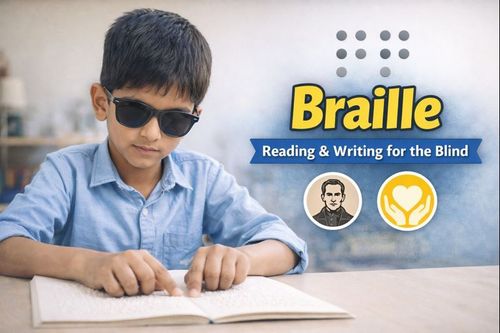
NCERT solutions for Class 4 English Unit 2 Chapter Braille – complete answers & explanations
This blog provides complete NCERT solutions
for Class 4 English Unit 2 Chapter Braille. The chapter helps students understand how visually impaired people read and write using the Braille system and teaches empathy, kindness, and awareness about challenges faced by people with low vision. It also introduces students to important language skills through speaking, listening, writing, and grammar activities. These NCERT solutions are prepared strictly according to the worksheet and follow the exact question order. What this NCERT chapter covers?1. Understanding the Braille alphabet and raised dot system
2. Learning about Louis Braille and his contribution
3. Developing empathy for people with visual impairment
4. Speaking and listening skills through sensory activities
5. Writing skills using observation and description
6. Grammar practice with present and past continuous tense
7. Safety awareness and social responsibility
How to use these NCERT solutions?1. Students should first read the chapter and attempt all questions on their own
2. Use these NCERT solutions to check answers after completion
3. Parents and teachers can guide students using the worksheet order
4. Follow each section carefully without skipping activities
5. Use the answers to understand correct sentence structure and tense usage
Important tips & tricks for students1. Read instructions carefully before attempting activities
2. Write answers neatly and in complete sentences
3. Follow examples given in grammar questions
4. Take activities seriously and complete them honestly
5. Be thoughtful while answering discussion-based questions
NCERT solutions – complete answer keyLet us Think
A. Answer the following questions
1. The Braille alphabet is a system of raised dots. Blind people read it by touching the dots with their fingers. Each letter has a different dot pattern.
2. Night Writing was not a success because it was difficult to learn and use.
3. Louis Braille simplified Night Writing and created the Braille alphabet, which made reading easy for blind people.
B. Think and discuss
1. The cane is white so that others can see it clearly and know that the person is blind. This helps people give way and offer help.
2. People would find it hard to walk, read, work, and travel. Accidents could happen, and daily life would become very difficult.
Let us Speak
Close your eyes. Pick an object. Keep the object back. Now complete the sentences and share them with the class.
Explanation:
Choose an object without looking at it. Use only your sense of touch to understand its shape and size.
Let us Listen
Your teacher will read out the following words. Listen carefully and repeat.
Explanation:
This activity helps you learn to pronounce words clearly. Listen carefully to your teacher and notice the “spl” sound at the beginning of each word. Repeat the words slowly and loudly so your speaking and listening skills improve. Practising these sounds will help you read and speak English more confidently.
Let us Write
A. Write these words using the Braille alphabet. You can paste “bindis”. One is done for you.
Cat
C → 1,4 | A → 1 | T → 2,3,4,5
Man
M → 1,3,4 | A → 1 | N → 1,3,4,5
Boy
B → 1,2 | O → 1,3,5 | Y → 1,3,4,5,6
Jug
J → 2,4,5 | U → 1,3,6 | G → 1,2,4,5
Your name
Write each letter of your name using the Braille chart.
Explanation:
This activity will help you understand how letters are written in the Braille alphabet. Look at the example given and see how dots are used for each letter. Use bindis or small dots to form the Braille pattern for each letter of the word. Write each word carefully by matching the correct dots. Finally, try writing your own name in Braille.
B. Louis Braille lost his eyesight in an accident. List the precautions that should be taken to protect eyes from harm.
Do not play with firecrackers or sharp objects.
Wear protective glasses while playing or working.
Do not rub your eyes with dirty hands.
Keep pointed objects away from the eyes.
Follow safety rules given by elders and teachers.
C. Read the following sentences and notice the underlined words. Change them to the past as shown in the examples.
I am sleeping. → I was sleeping.
The dogs are barking at the stranger. → The dogs were barking at the stranger.
Grandfather is searching for his spectacles. → Grandfather was searching for his spectacles.
Sheeba is writing a letter. → Sheeba was writing a letter.
He is singing a song. → He was singing a song.
We are playing kho-kho. → We were playing kho-kho.
The man is using his hands to push his wheelchair. → The man was using his hands to push his wheelchair.
D. Look at the picture story. Fill in the blanks from the suitable options.
My friend Tarandeep told me an interesting thing yesterday. She was feeding her friends, the squirrels and the sparrows. She was scattering grains for them. Her grandmother was hanging out the clothes to dry on a clothesline. Grandmother was entering the house when a strong wind began to blow. When she returned with the clothes pegs, she saw a wonderful scene. The sparrows and squirrels were sitting on the clothes to prevent them from falling. Tarandeep was clapping her hands with joy. Grandmother put the pegs on the clothes, and Tarandeep set down a bowl of water for her friends.
Let us Do
Explanation:
Press a shape or letter on paper using a pencil or matchstick. Close your eyes and feel the raised shape with your finger. Try to guess the shape. Then do the same activity with your friend or using white clay. Think about children who have low vision. Write or say how you can help them as a friend or classmate, like helping them read or showing kindness.
Let us Explore
Explanation:
Find out the name of a nearby place or centre that helps people who cannot see properly. You may ask your teacher, parents, or search with help.
Self Assessment
Explanation:
Read each statement carefully and think about how you learn and work in class. Tick (✓) the boxes that are true for you. You can tick more than one box for each question. There are no right or wrong answers—be honest. Why NCERT solutions help students?NCERT solutions help students understand concepts clearly, build empathy, practise correct grammar usage, and prepare confidently for exams using syllabus-aligned answers.
Help your child build strong English fundamentals with expert-guided learning support.
Book a free trial!
|