
NCERT Solutions for Class 7 English Poorvi Unit 3 Chapter 3
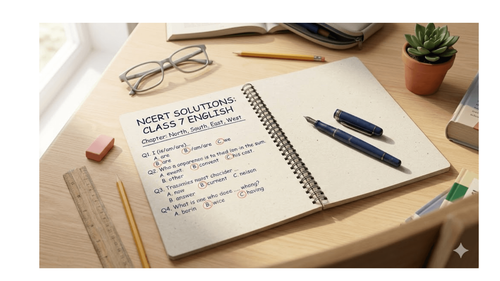
NCERT solutions for Class 7 English Chapter North, South, East, West – complete answers & explanations
The chapter “North, South, East, West” from Class 7 English Poorvi introduces students to travel experiences across different parts of India. Through Shaana’s postcards and observations, students explore India’s diverse geography, cultures, and natural landscapes. This chapter also highlights environmental changes and the excitement of discovering new places. In this blog, you will find complete NCERT solutions for Class 7 English Chapter North, South, East, West, strictly based on the worksheet provided, with answers presented in the exact order for easy learning and exam preparation.
What this NCERT chapter covers?
1. Understanding travel experiences through postcards
and personal observations.
2. Learning about India’s diverse geography such as glaciers, forests, deserts, rivers, and beaches.
3. Recognising environmental changes like glacier melting and flooding.
4. Building vocabulary related to travel and nature.
5. Practising subject–verb agreement and word usage.
6. Developing listening, speaking, writing, and research skills through activities.
How to use these NCERT solutions?
1. First read the NCERT chapter carefully before attempting the worksheet questions.
2. Try to answer each question on your own to build understanding and confidence.
3. Use these NCERT solutions to check your answers and understand the correct responses.
4. Follow the answers in the same sequence as given in the worksheet to avoid confusion.
5. Parents and teachers can guide students by discussing concepts and encouraging independent thinking.
Important tips & tricks for students
1. Read the postcards carefully to understand the places and activities mentioned.
2. Pay attention to details related to geography, travel experiences, and environmental changes.
3. When answering comprehension questions, write clear and complete sentences.
4. Practise subject–verb agreement carefully while choosing verb forms.
5. For activities and discussions, express ideas clearly and confidently.
6. Always follow the worksheet instructions and maintain the same order while writing answers.
NCERT solutions – complete answer key
Before we Read
I Work in pairs. Discuss the place that you have enjoyed travelling to. Talk about who you went with, how you travelled, and what you learnt from the experience.
Explanation:
Students work in pairs and talk about a place they enjoyed visiting. They should mention who they travelled with, how they travelled (bus, train, car, etc.), and what they learnt from the trip.
II Which State or Union Territory of India do you live in? Write the following details about it.
Explanation:
Students should write details about the State or Union Territory in which they live. They need to mention the part of the country it belongs to (North, East, Northeast, West, South, or Centre), its capital city, the main language spoken there, important rivers flowing through the state, famous tourist attractions, and popular local food.
III Work in pairs. Recall the names of the states of our country which have ‘Pradesh’ in their names. Mention if it is in the North, East, Northeast, West, South or Centre of our country. Recall any special feature about each ‘Pradesh’. Share your answers with your classmates and the teacher.
Explanation:
Students work in pairs and recall the names of Indian states that contain the word ‘Pradesh’. They write the first part of the state’s name along with ‘Pradesh’, identify which part of the country the state belongs to (North, East, Northeast, West, South, or Centre), and mention one special feature of that state. They then share their responses with the class and the teacher.
Let us discuss
Complete the table given below based on Shaana’s postcards. An example has been done for you. Share your answers with your classmates and the teacher.
Explanation:
Students read Shaana’s postcards and complete the table by identifying the places she visited and describing the activities or features mentioned in the text.
1
white and blue glaciers; throwing snowballs
2
quiet mountains; colourful birds chirping in the morning
3
Arunachal Pradesh
4
hot desert with sand everywhere; colourful clothes
5
rafting in the river; fast and exciting water
6
learning to surf on rough sea waves
7
Olaikaadu beach (Rameswaram)
Let us Think and Reflect
I Read the extracts given below and answer the questions that follow
1
(i) D
(ii) Amma is sad about the frequent flooding in Sundarbans because climate and environmental changes are causing the wetlands to flood more often.
(iii) “I hope they don’t follow us home.”
(iv) A
2
(i) The speaker chooses to stay awake because she enjoys looking out of the train window and watching the beautiful landscape.
(ii) She means the plateaus look very beautiful and surprising, beyond what people might imagine.
(iii) A
(iv) sense of connection; shared experiences
II Answer the following questions.
1
Shaana might have been scared of tunnels because they are dark and enclosed, and the sudden darkness when a train enters a tunnel can feel frightening.
2
Yes. Shaana mentions that her parents threw snowballs at each other, splashed water like children, and enjoyed rafting and travelling, showing that they were having fun like children.
3
These observations indicate environmental changes such as climate change. There is less snow in glaciers and more flooding in wetlands, showing that natural conditions are changing.
4
Shaana visits glaciers in Kashmir, mountains in Himachal Pradesh, forests in Arunachal Pradesh, wetlands in Sundarbans, deserts in Gujarat, rivers like the Narmada, plateaus in Goa, and beaches in Chennai and Rameswaram. These places show India’s diverse geography.
5
Shaana uses expressive language such as “best day ever”, “you won’t believe”, and “so amazing”. She also shares fears like being scared of tunnels or worried about animals following them, which shows excitement, curiosity, and sometimes fear.
6
Shaana might have learnt about India’s geography, cultures, languages, and natural environments. Her travels would help her understand how diverse and beautiful the country is.
7
The author uses postcards to show travel experiences in a simple and personal way. It helps readers follow the journey step-by-step and understand Shaana’s thoughts and feelings.
Let us Learn
I Read the words from the text given in Column 1 and match them with suitable pictures in Column 2.
Explanation:
Students match the travel-related words with the correct pictures.
1 – vi
2 – ii
3 – iii
4 – iv
5 – v
6 – i
II Read the situations given in Column 1. Choose the associated words from the text given in the box below and write them in Column 2. An example has been done for you.
Explanation:
Students choose the correct word from the lesson that best fits each situation.
1
scary
2
existed
3
blink
4
splashed
5
amazing
6
floating
III The following word grid has six words related to ‘travel’ used in the lesson. Circle the words in the grid. You can search horizontally and vertically. The last letter of each word has been highlighted.
Explanation:
Students find and circle travel-related words hidden in the grid.
1
boat
2
drove
3
train
4
walked
5
raft
6
sea
IV Read the following sentences from the text and underline the subject and the verb.
Explanation:
Students identify the subject and verb in each sentence to understand subject–verb agreement.
1
Subject: Amma and Appa
Verb: are
2
Subject: it
Verb: is
3
Subject: hills and beaches
Verb: are
V Choose the correct option from the words given in the brackets.
Explanation:
Students select the correct verb form according to the rules of subject–verb agreement.
1
is
2
have
3
is
4
was
5
makes
6
is
7
remain
8
is
9
need
10
was
Let us Listen
Explanation:
Students listen to a passage about Agartala and agarwood and choose the correct answers based on what they hear.
1
under the agar tree
2
gharuwood
3
woody and flowery
4
when the tree gets infected
5
perfumes and wood carvings
Let us Speak
Explanation:
Students discuss their travel preferences with a partner and practise speaking using suitable expressions.
Students discuss their travel preferences with a partner using expressions such as “I prefer… because…”, “I would rather… than…”, and “Given a choice, I would go for…”.
Let us Write
Explanation:
Students write a formal application to the school principal requesting leave for a few days.
Let us Explore
Explanation:
Students complete creative and research-based activities related to geography, culture, and travel in India.
I Solve the crossword puzzle by identifying the States and Union Territories of India using the clues given
Explanation:
Students solve the crossword puzzle by identifying the Indian states and union territories related to the clues.
Across
2. Ladakh
7. Rajasthan
9. Puducherry
11. Karnataka
12. Telangana
14. Sikkim
15. Gujarat
16. Bihar
Down
1. Mizoram
3. Andaman and Nicobar Islands
4. Meghalaya
5. Goa
6. Uttarakhand
8. Odisha
10. Jharkhand
13. Haryana
II
Explanation:
Students research unique historical or cultural places in their village, region, or state and share their findings with the class.
III
Explanation:
Students research the Hornbill Festival of Nagaland, including when it is celebrated, who participates in it, and the cultural events organised during the festival.
Why NCERT solutions help students?
NCERT solutions help students understand the chapter clearly and prepare effectively for exams. By following the NCERT format and answer structure, students learn how to present answers correctly in school assessments. These solutions also improve concept clarity, strengthen reading comprehension, and build confidence while studying Class 7 English chapters.
Help your child build strong English comprehension and grammar skills with expert-guided learning support.