
NCERT Solutions for Class 7 Mathematics Ganita Prakash II Chapter 2
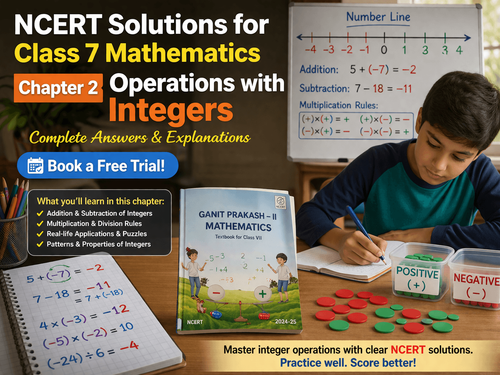

NCERT solutions for Class 7 Mathematics Chapter Operations with Integers – complete answers & explanations
In Class 7 Mathematics, Chapter 2: Operations with Integers builds the foundation for understanding operations involving positive and negative numbers. This chapter explores how to perform addition, subtraction, multiplication, and division with integers. Through engaging examples and applications, students gain clarity on the rules for working with integers, which are crucial for solving real-world problems. This chapter also includes simple and clear rules for working with integers, ensuring students become comfortable with operations involving both positive and negative values. The NCERT solutions provided here follow the exact format to ensure proper understanding. Download the worksheet and practice alongside solutions for better clarity. Book a free trial now to get expert guidance.
What this NCERT chapter covers?
1. Introduction to integers, their types
(positive and negative) and how they are used in everyday life.
2. Rules for addition and subtraction of integers with both positive and negative numbers.
3. Performing integer multiplication, using simple rules based on sign (positive or negative).
4. Division of integers and its application to real-world scenarios.
5. The commutative and associative properties of integer addition and multiplication.
6. Using integers in problem-solving involving temperature, money, and other real-life applications.
7. Understanding and applying the concept of additive inverses.
8. Using the distributive property of multiplication over addition for integers.
9. Recognizing patterns in integer multiplication and division for quicker calculations.
10. Working with integers in puzzles, games, and real-life problems.
11. Building a strong understanding of the connection between mathematical operations and real-world contexts.
How to use these NCERT solutions?
1. Begin by reading and attempting
each question on your own to practice.
2. Use the solutions to verify your answers and understand any mistakes.
3. Compare your approach to the solution to learn the correct method.
4. Practice integer operations by following the rules given for addition, subtraction, multiplication, and division.
5. Use real-life examples to understand how integers are used in everyday situations.
6. Parents and teachers can assist students with these solutions to enhance understanding.
7. Follow the worksheet order exactly to make sure you understand the concepts step by step.
8. Reattempt any difficult questions after reviewing solutions to gain clarity.
9. Use these solutions as a revision tool before exams for quicker problem-solving.
Important tips & tricks for students
1. When adding integers with different signs, subtract the smaller number from the larger number and keep the sign of the larger number.
2. Practice multiplying negative numbers: a positive times a negative gives a negative result, and a negative times a negative gives a positive result.
3. When dividing integers, remember that if the signs are different, the result is negative; if they are the same, the result is positive.
4. Use number lines to visualize addition and subtraction of integers.
5. When dealing with large numbers, break them down into smaller parts to make multiplication and division easier.
6. Always remember the rules for subtracting integers — subtracting a negative number is the same as adding its positive equivalent.
7. Keep practicing integer word problems, especially those related to temperature or financial transactions.
8. Apply the commutative and associative properties to simplify problems involving addition and multiplication of integers.
9. Take extra time to understand the distributive property — it can make solving complex problems much easier.
10. Regular practice is the key to mastering integer operations, so stay consistent.
NCERT solutions – complete answer key
2.1 A Quick Recap of Integers
The two numbers are 18 and 7.
Their sum: 18 + 7 = 25
Their difference: 18 − 7 = 11
Thus, the two numbers are 18 and 7.
If we swap the numbers, we get:
First number = 7
Second number = 18
Sum: 7 + 18 = 25
Difference: 7 − 18 = −11
So, the two numbers are 7 and 18.
Formula for the final position of the coin:
Rightward movement = positive integer
Leftward movement = negative integer
First strike = 5 units (rightward)
Second strike = -7 units (leftward)
Final position: 5 + (-7) = -2 units.
Figure it Out
(a) The two numbers are 18 and 9.
(b) The two numbers are 8 and -4.
(c) The two numbers are 5 and -5.
(d) The two numbers are -5 and 5.
(e) The two numbers are -4 and -3.
(f) The two numbers are -10 and 3.
The longest jump size is the HCF because it is the greatest number that divides both numbers exactly.
2.2 Multiplication of Integers
For 4 × (-2):
Multiply: 4 × (-2) = -8
For 4 × (-6):
Multiply: 4 × (-6) = -24
For 9 × (-7):
Multiply: 9 × (-7) = -63
Multiplying integers is straightforward with the rule:
If the signs are different, the product is negative; if the signs are the same, the product is positive.
Figure it Out
1.
(a) -6
(b) 10
(c) 4
(d) -21
2.
(a) -56088
(b) 56088
(c) -56088
For (-4) × 2:
We know that (-4) × 2 = -8. This is achieved by placing 2 negative tokens in the bag 4 times.
The pattern holds when multiplying positive and negative numbers. Multiplying with negative numbers results in negative products, while multiplying with positive numbers results in positive products.
When multiplying two integers, the product is always the same regardless of the order (commutative property):
For example: 5 × (-3) = (-3) × 5.
For -1 × a:
When a is positive, -1 × a = -a.
When a is negative, -1 × a = a.
Figure it Out
(a) -6
(b) -8
(c) -10
(d) 5
(e) -32
(f) -63
Figure it Out
(a) 18 × 3 = 54
(b) 9 × (-4) = -36
(c) 2 × 7 = 14
3.3 Patterns, Properties, and a Pretty Procedure!
When one number is a multiple of the other, the HCF is the smaller number.
Examples: (4, 12), (5, 20), (7, 21), (9, 27)
General statement: If one number divides the other, the HCF is the smaller number.
Efficient Procedures for HCF and LCM
HCFs:
For 300 and 150 → HCF = 150
For 630 and 770 → HCF = 70
LCM of 96 and 360 = 1440
Figure it Out
(a) HCF = 10
(b) HCF = 10
(c) HCF = 1
(d) HCF = 2
(e) HCF = 81
Figure it Out
1. HCF = 15
2. LCM = 720
3. HCF = 25
Why NCERT solutions help students?
NCERT solutions help students understand the rules of working with integers, including addition, subtraction, multiplication, and division. By practicing these solutions, students not only gain clarity on the operations but also improve their ability to apply these concepts to solve real-world problems. This leads to increased confidence and better problem-solving skills.
Help your child build strong Mathematics fundamentals with expert-guided learning support.