
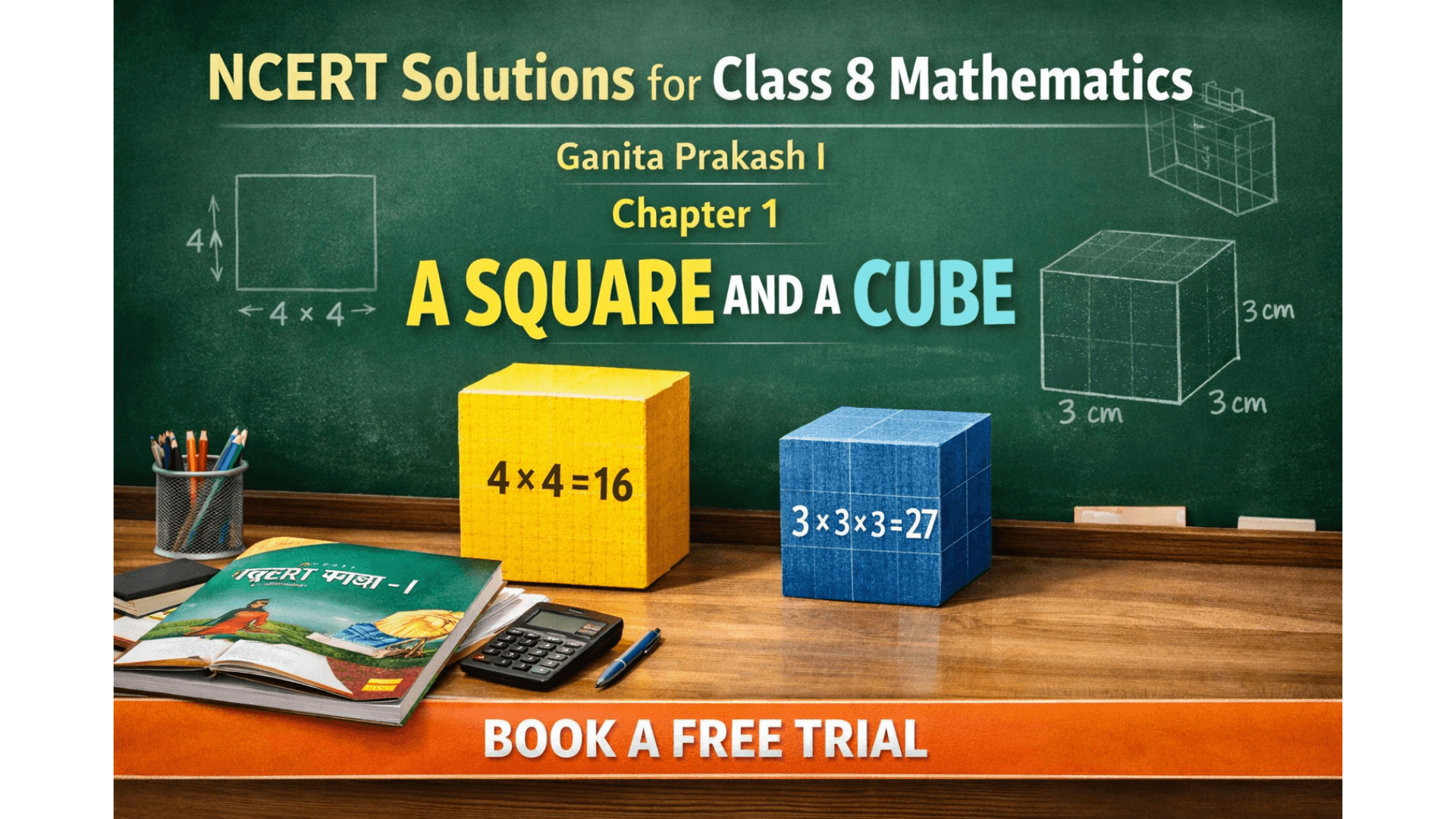
NCERT Solutions for Class 8 Mathematics Ganita Prakash I Chapter 1


NCERT solutions for Class 8 Maths Chapter A square and a cube – complete answers & explanations
This blog provides complete NCERT solutions for Class 8 Maths Chapter A square and a cube. This chapter introduces important concepts like square numbers, cube numbers, square roots, and cube roots. It helps students understand number patterns and their properties. Download the worksheet and practice alongside these solutions for better clarity and learning. You can also book a free trial now to get expert guidance and improve writing and comprehension skills. All solutions provided here are strictly based on the given worksheet, ensuring accuracy and alignment with NCERT expectations.
What this NCERT chapter covers?
1. Understanding square numbers and perfect
squares
2. Properties and patterns of squares
3. Square roots and estimation methods
4. Identifying perfect squares using prime factorisation
5. Concept of cube numbers and perfect cubes
6. Cube roots and their properties
7. Relationship between numbers, patterns, and sequences
How to use these NCERT solutions?
1. First, attempt all questions from
the worksheet on your own
2. Use these solutions to check your answers step-by-step
3. Compare your approach with the given answers
4. Focus on understanding patterns and logic
5. Teachers and parents can guide students using these structured solutions
6. Follow the exact order of questions as given in the worksheet
Important tips & tricks for students
1. Remember that square numbers never end with 2, 3, 7, or 8
2. Learn patterns of squares and cubes to solve faster
3. Practice prime factorisation to identify perfect squares and cubes
4. Be careful while calculating square roots and cube roots
5. Always check units digit patterns before solving
6. Practice “Figure it Out” questions for better understanding
NCERT solutions – complete answer key
Puzzle Section
Write the locker numbers that remain open.
1, 4, 9, 16, 25, 36, 49, 64, 81, 100
Explanation: Lockers remain open if they are toggled an odd number of times. Only perfect squares have an odd number of factors, so square-numbered lockers stay open.
Which are these five lockers (toggled exactly twice)
2, 3, 5, 7, 11
Explanation: Prime numbers have exactly two factors (1 and the number itself), so their lockers are toggled twice.
1.1 Square Numbers
Write 5 numbers such that you can determine by looking at their units digit that they are not squares.
12, 23, 37, 58, 77
Explanation: Squares never end with 2, 3, 7, or 8.
Which of the following numbers have the digit 6 in the units place?
(ii) 342, (iv) 562, (vi) 822
Explanation: These numbers end with 6, matching the condition.
If a number contains 3 zeros at the end, how many zeros will its square have at the end?
6 zeros
Explanation: Squaring doubles the number of trailing zeros.
What do you notice about the number of zeros at the end of a number and the number of zeros at the end of its square?
The square of a number always has an even number of zeros at the end.
What can you say about the parity of a number and its square?
If a number is even, its square is even. If a number is odd, its square is odd.
Using the pattern above, find 36², given that 35² = 1225.
36² = 1225 + 71 = 1296
Explanation: The difference between consecutive squares is the next odd number (2n+1).
What is the nth odd number?
2n – 1
Explanation: Odd numbers follow the formula 2n – 1.
Find how many numbers lie between two consecutive perfect squares.
Between n² and (n+1)², there are 2n numbers.
How many square numbers are there between 1 and 100? Between 101 and 200? Largest square less than 1000?
- 1–100 → 10 squares
- 101–200 → 4 squares
- Largest square < 1000 → 961 (31²)
Can you see any relation between triangular numbers and square numbers? Extend the pattern.
1 + 3 = 4 = 2²
3 + 6 = 9 = 3²
6 + 10 = 16 = 4²
Next term: 10 + 15 = 25 = 5²
The area of a square is 49 sq. cm. What is the length of its side?
Explanation: √49 = 7.
What is the square root of 64?
±8
Explanation: Both +8 and -8 squared give 64.
Is 324 a perfect square?
Yes, √324 = 18
Explanation: Prime factorisation groups evenly.
Is 156 a perfect square?
No
Explanation: Prime factors cannot be paired completely.
Find whether 1156 and 2800 are perfect squares using prime factorisation
- 1156 → Perfect square, √1156 = 34
- 2800 → Not a perfect square
Estimate √1936
√1936 = 44
Explanation: 1936 lies between 40² and 45², closer to 44².
Estimate √250
√250 ≈ 15.8 (closer to 16)
Explanation: 250 lies between 15² and 16².
Largest square handkerchief from cloth of area 125 cm²?
Side length = 11 cm
Explanation: 11² = 121 < 125, but 12² = 144 > 125.
Figure it Out (Squares)
1. Not perfect squares: 2032, 2048, 1027
2. 108² ends with 4
3. 126² = 15625 + 251 = 15876
4. Side length = 21 m (√441)
5. Smallest square divisible by 4, 9, 10 = 900
6. Multiply 9408 by 21 → √197568 = 444
7. (i) 33 numbers (between 16² and 17²)
(ii) 199 numbers (between 99² and 100²)
8. Missing numbers: 212, 152, 192
9. 256 tiny squares = 2⁸
1.2 Cubic Numbers
How many cubes of side 1 cm make a cube of side 3 cm?
3³ = 27
Complete the table of cubes
- 12³ = 1728
- 15³ = 3375
- 6³ = 216
- 16³ = 4096
- 7³ = 343
- 8³ = 512
- 9³ = 729
- 10³ = 1000
- 20³ = 8000
Possible last digits of cubes?
0, 1, 4, 5, 6, 9
Explanation: Observed from cube patterns.
Can a cube end with exactly two zeroes (00)?
No
Explanation: Cubes of multiples of 10 end with three or more zeros.
Find cube roots
(i) ∛64 = 4
(ii) ∛512 = 8
(iii) ∛729 = 9
Figure it Out (Cubes)
1
∛27000 = 30, ∛10648 = 22
2 . Multiply by 3
3. (i) The cube of any odd number is even → False
(ii) There is no perfect cube that ends with 8 → False (512 ends with 8)
(iii) The cube of a 2-digit number may be a 3-digit number → True
(iv) The cube of a 2-digit number may have seven or more digits → True
(v) Cube numbers have an odd number of factors → False
4. 1331 → 11
4913 → 17
12167 → 23
32768 → 32
5. Greatest: 67³ – 66³ = 13411
Puzzle Time
Square Pairs Arrangement:
Numbers 1 to 17 can be arranged such that adjacent sums are squares.
Example sequence:
16 – 9 – 7 – 2 – 14 – 11 – 5 – 20 – 4 – 21 – 15 – 10 – 6 – 3 – 13 – 12 – 1
Why NCERT solutions help students?
NCERT solutions help students build strong conceptual understanding and improve exam readiness. They ensure that answers are accurate, structured, and aligned with NCERT guidelines. Regular practice using these solutions boosts confidence and helps students perform better in exams.
Strengthen your child’s Maths concepts with structured and worksheet-based NCERT solutions.