
NCERT Solutions for Class 9 English Beehive Chapter 4
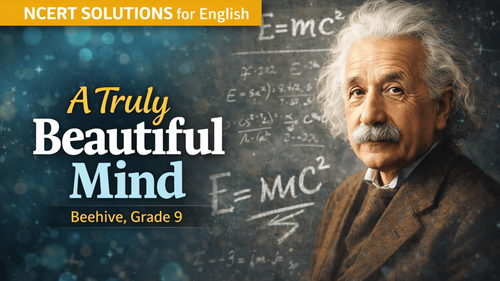

NCERT Solutions for Class 9 English Chapter 4 A Truly Beautiful Mind – Complete Answers
This NCERT solutions guide for Class 9 English Beehive Chapter 4 **A Truly Beautiful Mind** helps students clearly understand the life, personality, and achievements of Albert Einstein. The lesson presents Einstein not only as a scientific genius but also as a human being — a curious child, a rebellious student, a devoted scientist, and finally a peace-loving global citizen.
These solutions strictly follow the NCERT textbook and maintain the exact order of questions and exercises so students can easily practise and verify their answers for homework, revision, and exams.
What this NCERT chapter covers?
1. Einstein’s childhood and schooling
2. His dislike for rigid discipline and traditional education
3. His interest in mathematics, physics, and music
4. His relationship with Mileva Maric
5. His scientific discoveries including the Theory of Relativity
6. The famous formula E = mc²
7. His Nobel Prize and worldwide fame
8. His role in warning about atomic weapons and later campaigning for peace
9. Einstein as a scientist and a world citizen
How to use these NCERT solutions?
1. First read the chapter carefully from the NCERT textbook
2. Try to answer the questions yourself
3. Then check the answers given here
4. Revise important events in chronological order
5. Practise the language section for exams
Important tips for students
1. Remember key dates (1879, 1905, 1921, 1939, 1955)
2. Learn the significance of E = mc²
3. Focus on Einstein’s personality traits
4. Prepare short answers for exams
5. Practise the grammar section carefully
────────────────────────
NCERT Solutions – Complete Answer Key
────────────────────────
THINKING ABOUT THE TEXT
1.
(i) 9
(ii) 7
(iii) 3
(iv) 10
(v) 15
(vi) 8
(vii) 11
2.
(i) His playmates
(ii) The headmaster
(iii) His mother
3.
(i) He hated the strict discipline and felt suffocated in the school.
(ii) Switzerland had a more liberal education system than Munich.
(iii) Mileva shared his intellectual interests and supported him against people who criticised him.
(iv) Einstein was independent-minded and valued free thinking.
4.
He called it the “bureau of theoretical physics” because he secretly worked on his scientific ideas there.
5.
He warned that Germany might develop an atomic bomb.
6.
He was deeply shocked and later worked for world peace and disarmament.
7.
Because he worked for peace, democracy, and international harmony beyond national boundaries.
8. Chronological order:
9. Einstein is born in Ulm.
10. Einstein attends high school in Munich.
11. His family moves to Milan.
12. Einstein leaves school due to regimentation.
13. He joins university in Zurich and meets Mileva.
14. He works in the patent office.
15. He publishes the special theory of relativity.
16. He proposes the general theory of relativity.
17. He receives the Nobel Prize.
18. He writes to Franklin Roosevelt.
19. He leaves Germany for the USA.
20. Einstein dies.
────────────────────────
THINKING ABOUT LANGUAGE
────────────────────────
I.
1. became weak
2. in disagreement
3. declared
4. campaigning
5. permanently
6. in a state of commotion
7. interested
II.
1. Working round the clock, the firefighters finally put out the fire.
2. She watched the sunset above the mountain, noticing the colours blending softly into one another.
3. The excited horse pawed the ground rapidly, neighing continually.
4. Having taken the wrong train, I found myself in Bangalore instead of Benaras.
5. Having not bathed for two days, I was desperate to get to the bathroom.
6. The stone steps, being worn down, needed to be replaced.
7. The actor received hundreds of letters from his fans, asking him to send them his photograph.
────────────────────────
WRITING – NEWSPAPER REPORT
────────────────────────
Student Unearths Einstein Manuscript
21 August 2005. An original handwritten Albert Einstein manuscript has been discovered at a university in the Netherlands.
It was found by a student, Rowdy Boeynik, while researching old scientific papers belonging to a friend of Einstein.
The 16-page manuscript dated 1924 describes Einstein’s work on the behaviour of atoms at low temperature, known today as the Bose-Einstein Condensation. His fingerprints were also found on the papers.
The manuscript will be preserved at Leyden University, where Einstein once received the Nobel Prize.
────────────────────────
DICTATION
────────────────────────
Activity:
Listen carefully to the teacher and write the dictated paragraphs with correct spelling and punctuation.
Get clear, exam-ready understanding with reliable NCERT Solutions and guided learning support.
Book a free trial!