
What Is Career Cushioning and Why It Matters at Work


Table of Contents
- What Is Career Cushioning
- Why Career Cushioning Matters in Today’s Workplace
- Career Cushioning vs Job Hugging vs Quiet Quitting
- What Is Coffee Badging at Work and Its Connection
- Internal Networking Tips to Strengthen Career Cushioning
- Step-by-Step Guide to Start Career Cushioning
- Common Mistakes to Avoid
- The Role of Communication in Career Cushioning
- Future Trends in Career Cushioning
- Build Confidence, Communication, and Career Readiness With P
- Take Control of Your Career Future
In a world where layoffs can happen overnight and industries evolve rapidly, depending on a single job feels risky. What if you could protect your career before uncertainty even begins? Career cushioning is the proactive strategy of preparing for future opportunities while still being employed. It helps you reduce anxiety, increase employability, and take control of your professional journey.
In this blog, you will explore what career cushioning means, why it matters, and how it connects to workplace trends like job hugging vs quiet quitting and what is coffee badging at work. You will also learn practical internal networking tips and actionable strategies to secure your future.
What Is Career Cushioning
Career cushioning is the practice of strengthening your professional safety net while you are still employed. Instead of reacting to job loss, layoffs, or sudden industry changes, professionals prepare in advance through upskilling, networking, and exploring opportunities.
It is often described as a “career backup plan,” but it goes beyond that. It represents a shift in mindset from dependency on one employer to taking full control of your career journey. In today’s fast-changing work environment, this proactive approach helps you stay prepared for both expected and unexpected transitions.
Career cushioning does not mean you are dissatisfied with your job. It means you are future-focused. You continue performing well in your current role while quietly building options for growth, stability, and flexibility.
Key Aspects of Career Cushioning
1. Skill Diversification
One of the most important parts of career cushioning is continuously learning new skills. Industries are evolving rapidly, and skills that are in demand today may become outdated tomorrow. By gaining certifications or learning new tools, you increase your relevance and market value.
For example, a finance professional who learns data analytics or automation tools becomes more competitive in the job market. Similarly, a marketer who understands AI-driven campaigns or digital analytics can access better opportunities. Skill diversification ensures that you are not limited to a single role or function.
2. Networking
Networking plays a powerful role in career cushioning. Many job opportunities are never publicly advertised. They are shared within professional circles or through referrals.
Building genuine relationships with colleagues, mentors, and industry professionals helps you stay informed about opportunities and trends. Networking is not just about asking for help. It is about exchanging ideas, learning from others, and building long-term professional trust.
Strong networks also provide emotional support and guidance during career transitions, making the process smoother and less stressful.
3. Active Monitoring
Career cushioning requires staying alert to market trends and opportunities. This includes regularly updating your resume, keeping your LinkedIn profile active, and tracking industry developments.
When you monitor the job market, you understand your current value and the skills that employers are seeking. This awareness helps you make better decisions about learning and career moves.
For instance, if you notice increasing demand for a specific skill, you can start learning it early and stay ahead of the competition.
4. Financial Preparedness
Financial stability is an often overlooked but critical part of career cushioning. Having an emergency fund gives you the freedom to make career decisions without pressure.
It allows you to:
- Take time to find the right opportunity instead of accepting the first offer
- Invest in courses or certifications
- Explore new career paths or industries
Financial preparedness reduces stress and increases confidence during uncertain times.
Why Career Cushioning Is a Smart Strategy
Career cushioning is not about planning to leave your job. It is about ensuring that you are never stuck without options. It gives you flexibility and control over your career decisions.
Professionals who practice career cushioning are better prepared for:
- Sudden layoffs
- Industry disruptions
- Career transitions
- Growth opportunities
They do not wait for change to happen. They prepare for it in advance.

Why Career Cushioning Matters in Today’s Workplace
The modern workplace is constantly evolving. Technological advancements, economic uncertainty, and changing business models have made job stability less predictable than before. In such an environment, relying solely on one role or organization can be risky.
Career cushioning helps professionals stay prepared and confident despite these uncertainties.
Benefits of Career Cushioning
1. Increased Security
One of the biggest advantages of career cushioning is the sense of security it provides. When you know you have updated skills, strong networks, and financial backup, you feel less anxious about potential job loss.
This confidence allows you to perform better at work because you are not driven by fear. Instead, you are motivated by growth and learning.
2. Career Agility
Career cushioning makes you adaptable. As industries evolve, professionals need to learn new tools, technologies, and processes. Those who continuously upgrade their skills can quickly shift roles or industries when needed.
For example, professionals who adapted to digital tools during technological shifts were able to stay relevant and even grow faster in their careers.
3. Higher Internal Value
Interestingly, career cushioning not only prepares you for external opportunities but also benefits your current role. The new skills you acquire and the knowledge you gain often make you more valuable to your organization.
This can lead to:
- Promotions
- Salary increases
- Leadership opportunities
- Greater recognition
Employers value individuals who take initiative and invest in their own growth.
4. Empowerment and Control
Career cushioning changes your mindset. Instead of relying entirely on your employer for job security, you take ownership of your career path.
This sense of control is empowering. It allows you to make decisions based on your goals, not just circumstances. You become proactive instead of reactive.
Real-World Example
Consider a marketing professional who starts learning AI tools, builds a strong LinkedIn presence, and actively connects with industry experts. Over time, they develop a strong personal brand and stay updated with trends.
If their company faces layoffs, they are not starting from zero. They already have:
- In-demand skills
- A visible professional presence
- A strong network
As a result, they can quickly find new opportunities or even transition into a better role.
The Bigger Impact
Career cushioning does more than protect your job. It builds long-term confidence and resilience. It ensures that your career growth is not dependent on external factors alone.
In a world where change is constant, career cushioning transforms uncertainty into opportunity.
Feeling unsure about your career growth? Book your FREE demo class now and build confidence before opportunities pass you by. Limited slots available!
Career Cushioning vs Job Hugging vs Quiet Quitting
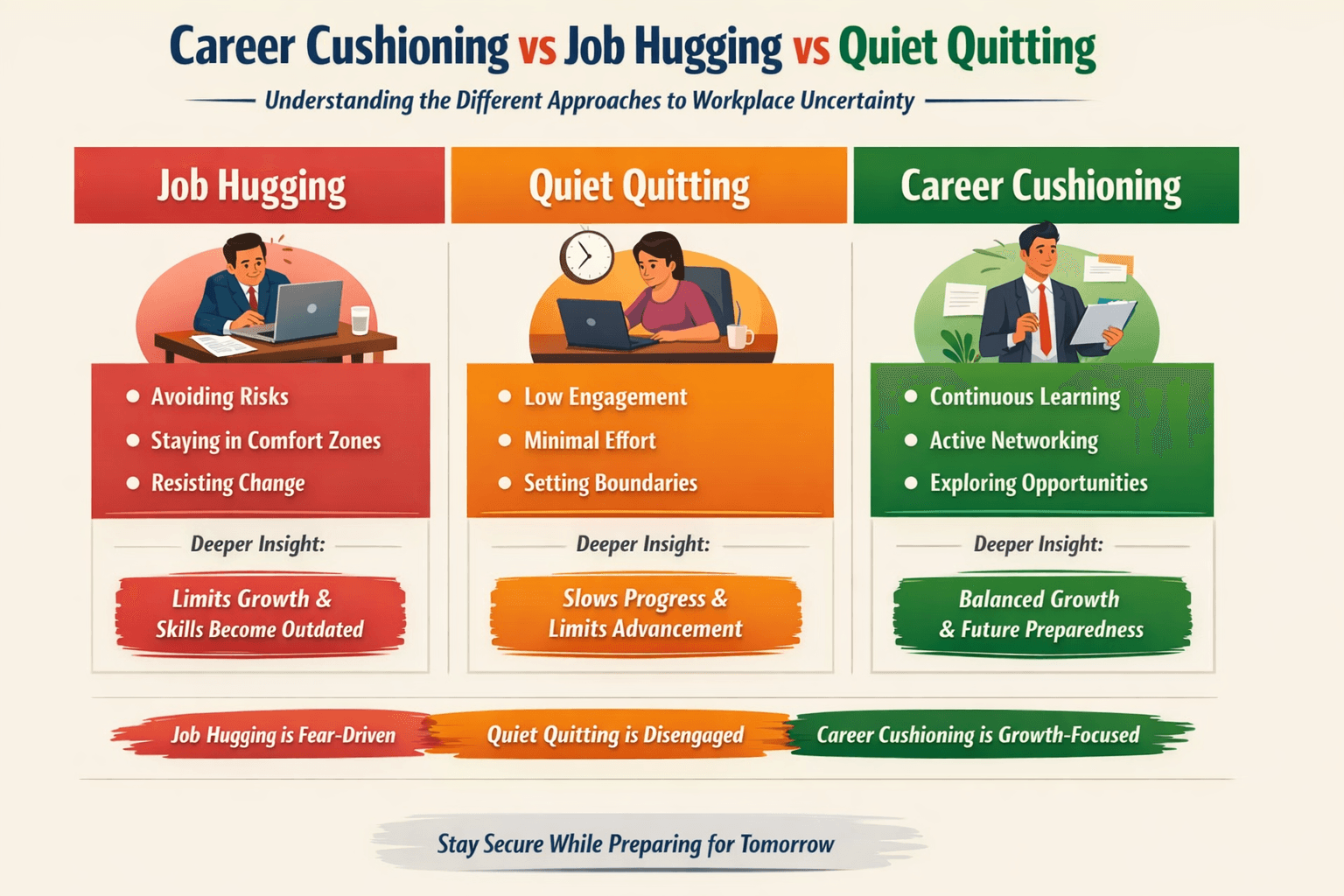
Understanding job hugging vs quiet quitting is essential to see why career cushioning is the most balanced and future-ready approach. While all three are responses to workplace uncertainty, they reflect very different mindsets and outcomes.
Job Hugging
Job hugging happens when employees hold tightly to their current role out of fear. Instead of exploring new opportunities or learning new skills, they prioritize stability at all costs.
Key characteristics:
- Avoiding risks or career changes
- Staying within comfort zones
- Resisting new responsibilities or challenges
Deeper insight:
While job hugging may feel safe in the short term, it can be limiting in the long run. Employees who avoid change often miss out on growth opportunities. Over time, their skills may become outdated, making it harder to transition if needed.
For example, an employee who refuses to learn new technology because they are comfortable in their current role may struggle when their company adopts new systems.
Quiet Quitting
Quiet quitting is when employees choose to do only what is required in their job role without going beyond expectations. It is often driven by burnout, lack of motivation, or a desire to maintain work-life balance.
Key characteristics:
- Low engagement with work
- Minimal initiative or effort
- Clear boundaries between work and personal life
Deeper insight:
While quiet quitting can protect mental health in some cases, it can also limit career growth. Employees who stop putting in effort may miss opportunities for promotions, recognition, and skill development.
For example, an employee who avoids taking initiative in projects may not be considered for leadership roles, even if they have the potential.
Career Cushioning
Career cushioning is a proactive and balanced approach. It allows you to stay committed to your current role while preparing for future opportunities.
Key characteristics:
- Performing well in your current job
- Continuously learning and upskilling
- Building strong professional networks
- Exploring opportunities without urgency
Deeper insight:
Career cushioning ensures that you are always prepared, without compromising your current responsibilities. It helps you grow while staying secure.
For example, a professional who attends online courses, connects with industry experts, and updates their portfolio regularly will always be ready for better opportunities.
Key Insight
- Job hugging is fear-driven and limits growth
- Quiet quitting is disengagement-driven and slows progress
- Career cushioning is growth-driven and future-focused
Career cushioning stands out because it combines stability with progress. It helps you stay secure while continuously moving forward in your career.
What Is Coffee Badging at Work and Its Connection
Many professionals today are asking, what is coffee badging at work and why it has become so popular.
Coffee badging refers to a workplace behavior where employees briefly visit the office, often just long enough to be seen or badge in, grab coffee, and then leave to work remotely.
What It Reflects
- A shift toward flexible work culture
- Reduced importance of physical presence
- Greater focus on productivity and outcomes rather than hours spent in the office
Deeper Understanding
Coffee badging highlights a major change in workplace expectations. Employees are no longer measuring productivity by time spent in the office. Instead, they value flexibility, autonomy, and efficiency.
It also shows that employees want to maintain visibility without sacrificing convenience. This reflects a balance between traditional workplace expectations and modern work preferences.
Connection to Career Cushioning
Both coffee badging and career cushioning indicate a broader shift toward self-driven careers. Employees are taking control of how they work and how they grow.
An employee practicing coffee badging might also be:
- Taking online courses to upgrade skills
- Building professional connections outside the organization
- Exploring freelance or side opportunities
Key takeaway: Career cushioning and coffee badging both reflect independence. Professionals are no longer relying solely on employers for growth. They are actively shaping their own career paths.
Internal Networking Tips to Strengthen Career Cushioning
Networking is one of the most powerful pillars of career cushioning. Strong internal relationships can open doors to opportunities that are not publicly visible.
Why Internal Networking Matters
- Increases your visibility within the organization
- Builds trust with managers and leaders
- Helps you discover new roles or projects early
Practical Internal Networking Tips
1. Build cross-team relationships: Do not limit yourself to your immediate team. Interacting with colleagues from different departments helps you understand the organization better and increases your reach.
2. Speak up in meetings: Sharing ideas, asking questions, and contributing to discussions helps you stand out. Visibility often leads to recognition.
3. Seek mentorship: Mentors can guide you, provide feedback, and help you navigate your career path more effectively.
4. Offer help proactively: Helping others builds goodwill and strengthens relationships. It also showcases your skills and reliability.
5. Attend company events: Informal interactions during events or workshops help build stronger connections in a relaxed environment.
Example
An employee who collaborates with multiple teams and contributes actively in meetings is more likely to be noticed by leadership. This increases their chances of being considered for promotions or leadership roles.
Key takeaway: Networking is not about collecting contacts. It is about building meaningful and lasting professional relationships.
Struggling to communicate confidently at work? Book a trial class today and stand out before your next opportunity arrives. Don’t wait!
Step-by-Step Guide to Start Career Cushioning
Starting career cushioning does not require major changes. Small, consistent actions can make a big difference over time.
Step 1: Evaluate your current skills
Take time to assess your strengths and identify areas for improvement. Understanding your current position helps you plan your next steps effectively.
Step 2: Upskill regularly
Focus on skills that are in demand in your industry. This could include technical skills, communication skills, or leadership abilities.
Step 3: Build your personal brand
Maintain an active LinkedIn profile, share insights, and showcase your achievements. A strong personal brand increases your visibility.
Step 4: Monitor opportunities
Keep an eye on job openings and market trends. This helps you understand your value and stay prepared for future opportunities.
Step 5: Build financial security
Creating an emergency fund gives you the confidence to make better career decisions without pressure.
Quick Checklist
- Update your resume every 6 months
- Learn one new skill every quarter
- Network consistently with professionals
- Stay updated with industry trends
Key takeaway: Consistency matters more than intensity. Small steps taken regularly lead to long-term success.
Common Mistakes to Avoid
Career cushioning is effective only when approached thoughtfully. Avoiding common mistakes ensures better results.
Common Mistakes
- Ignoring current responsibilities: Focusing too much on future opportunities while neglecting your current role can harm your reputation. Balance is essential.
- Superficial networking: Building shallow connections without meaningful interaction does not add value. Focus on genuine relationships.
- Neglecting soft skills: Technical skills are important, but communication and confidence play a key role in career growth.
- Delaying action: Waiting for the perfect moment often leads to missed opportunities. Start with small steps today.
- Being overly secretive: While discretion is important, avoiding collaboration can damage workplace relationships.
Key takeaway: Career cushioning should enhance your current performance, not compromise it.
The Role of Communication in Career Cushioning
Communication is the foundation of career success. It connects all aspects of career cushioning, from networking to personal branding.
Why Communication Matters
- Helps you build strong professional relationships
- Improves your visibility within the organization
- Increases confidence during presentations and interviews
Key Communication Skills
- Public speaking: Helps you present ideas clearly and confidently.
- Active listening: Builds trust and improves understanding in conversations.
- Professional writing: Ensures clear and effective communication through emails and reports.
- Persuasive communication: Helps you influence decisions and showcase your ideas effectively.
Example
A professional who communicates confidently during meetings is more likely to be noticed by leadership. This increases their chances of growth and recognition.
Final Insight: Communication transforms preparation into opportunity. It is the skill that turns your efforts into visible success.
Want to speak confidently in meetings and interviews? Secure your spot in a live 1:1 class now and get ahead of your competition. Limited seats!
Future Trends in Career Cushioning
Career cushioning is no longer just a short-term response to uncertainty. It is steadily becoming a long-term career strategy that professionals across industries are अपनting. As the nature of work evolves, these trends are shaping how individuals prepare, grow, and secure their careers.
1. Continuous Learning
Lifelong learning is now a necessity rather than a choice. Skills are becoming outdated faster due to rapid technological advancements. Professionals who regularly update their knowledge stay competitive and adaptable.
For example, someone in marketing today may need to learn AI tools, data analytics, or automation platforms to stay relevant. Similarly, professionals in finance, HR, and operations are constantly upgrading their skills to match changing demands.
Continuous learning also builds confidence. When you know you are improving consistently, you feel more prepared to take on new challenges or opportunities.
2. Skill-Based Hiring
Employers are increasingly focusing on what you can do rather than what degree you hold. Skill-based hiring is gaining importance because companies need employees who can deliver results immediately.
This means certifications, practical experience, and real-world projects are becoming more valuable than traditional qualifications alone.
For example, a candidate with hands-on experience in digital marketing tools may be preferred over someone with only theoretical knowledge.
This trend aligns perfectly with career cushioning because it encourages professionals to focus on building practical, job-ready skills.
3. Flexible Work Models
Remote and hybrid work models are becoming the norm in many industries. Professionals now have more flexibility in how and where they work.
This flexibility allows individuals to:
- Learn new skills alongside their job
- Take on freelance or side projects
- Manage time more effectively
It also encourages professionals to think beyond a single organization. Many people now explore global opportunities without relocating.
Flexible work has made career cushioning easier because professionals can invest time in growth while maintaining their current roles.
4. Personal Branding
In today’s digital world, your online presence plays a major role in your career growth. Personal branding is about showcasing your skills, achievements, and expertise on platforms like LinkedIn.
A strong personal brand helps you:
- Attract job opportunities
- Build credibility in your field
- Expand your professional network
For example, professionals who regularly share insights, write posts, or showcase their work online are more likely to be noticed by recruiters and industry leaders.
Personal branding is a key part of career cushioning because it ensures visibility even when you are not actively job searching.
5. Side Income Streams
Many professionals are exploring additional income sources alongside their primary jobs. This could include freelancing, consulting, teaching, or running small online businesses.
Side income streams provide:
- Financial security
- Skill diversification
- Exposure to new industries
For example, a software developer might take freelance projects, or a writer might start content creation on the side. These activities not only generate income but also strengthen professional profiles.
Having multiple income sources reduces dependency on a single job, which is a core principle of career cushioning.
The Bigger Picture
These trends show a clear shift in how careers are managed today. Professionals are moving away from traditional, linear career paths and adopting a more flexible, skill-driven approach.
Career cushioning fits perfectly into this new landscape. It encourages continuous growth, adaptability, and independence.
Instead of waiting for change to happen, professionals are preparing for it in advance. This mindset not only protects against uncertainty but also opens up new opportunities for growth and success.
Build Confidence, Communication, and Career Readiness With PlanetSpark's Personality Development Classes
PlanetSpark personality development classes are designed for working professionals who want to improve communication, confidence, and leadership skills in real-world scenarios. These programs focus on helping learners express ideas clearly, perform confidently in meetings, and build strong professional relationships. Structured learning ensures consistent improvement and measurable outcomes.
Key features:
- Live 1:1 interactive classes with expert trainers
- Personalized feedback and performance tracking
- Real-world practice like presentations, interviews, and discussions
- Confidence-building exercises tailored for professionals
- Structured curriculum aligned with career growth
- Focus on business communication and workplace readiness

Take Control of Your Career Future
Success today is not about waiting for opportunities. It is about preparing for them. Career cushioning empowers you to stay ready, confident, and adaptable in an ever-changing world.
By continuously learning, building strong relationships, and improving communication, you create a career that is secure and future-ready. Stay consistent, stay proactive, and take charge of your journey.
Frequently Asked Questions
Career cushioning is a proactive approach where professionals prepare for future opportunities while still working, through upskilling, networking, and planning.
It refers to employees briefly showing presence in the office and then working remotely, reflecting flexible work trends.
Job hugging is fear-driven attachment to a job, while quiet quitting is doing minimal work. Career cushioning focuses on growth and preparation.
Internal networking helps build visibility, trust, and access to hidden opportunities within an organization.
Yes, being prepared for opportunities reduces anxiety and boosts confidence in decision-making.
Strong communication improves networking, visibility, and career opportunities.
The best time is now. Career cushioning should be a continuous process throughout your career.
Personalized Communication Roadmaps
Record a video to get a AI generated personalized communication reports