
Best Career Objective Examples for Professional Growth


Table of Contents
- What is a Career Objective and Why It Matters
- How to Write a Career Objective for a Resume
- Key Elements of Effective Objectives
- Advanced Tips to Make It Stronger
- Pro Tip
- Common Mistakes to Avoid
- Why This Skill Matters
- Career Objective Example for Different Professional Stages
- Best Objective for Resume Across Industries
- Career Objective for CV vs Resume
- Advanced Strategies to Make Your Career Objective Stand Out
- Common Mistakes to Avoid in Career Objectives
- Real-World Career Objective Examples That Work
- How Career Objectives Support Long-Term Professional Growth
- Transform Your Communication with PlanetSpark Personality De
- Build a Clear Path Toward Professional Excellence
What if one small section of your resume could decide whether you get shortlisted or ignored? Many working professionals struggle to write a strong career objective that clearly communicates their value. Most resumes sound generic, lack direction, or fail to align with the job role, reducing their chances of being shortlisted.
In the competitive job market, recruiters spend only a few seconds scanning each resume. If your objective does not immediately communicate clarity and relevance, your profile may be overlooked.
In this blog, you will learn how to write impactful career objectives, explore detailed examples for different roles and experience levels, understand mistakes to avoid, and discover expert strategies to strengthen your resume.
Let’s begin by understanding why a career objective still matters in modern professional growth.
What is a Career Objective and Why It Matters
A Career Objective is a concise statement placed at the top of your resume that outlines your professional goals, key skills, and the value you bring to an organisation.
Even though many professionals now use summaries, a well-crafted objective still plays a crucial role, especially when you want to communicate direction or transition into a new role.
A strong Career Objective works as your personal brand statement. It immediately tells recruiters who you are, what you want, and how you can contribute.
Why It Still Matters
- It creates a strong first impression
- It sets the context for your entire resume
- It helps recruiters quickly assess your relevance
- It highlights clarity and confidence
Example
Weak: “Looking for a job in a reputed company”
Strong: “Results-driven operations professional seeking to streamline processes and improve efficiency through data-driven strategies.”
The difference lies in clarity, specificity, and value.
Professionals who craft tailored career objectives for resume statements often stand out because they show purpose and direction.
Not getting shortlisted despite having the right skills? Book your free trial now and learn how to present your profile with confidence and clarity
How to Write a Career Objective for a Resume
Writing an effective career objective for a resume requires a strategic and thoughtful approach. It is not just a line at the top of your resume, but a positioning statement that defines how a recruiter perceives you within seconds. Instead of copying generic templates, tailor your objective to each role, reflecting both your capabilities and your intent.
A well-written career objective bridges the gap between your past experience and your future aspirations while clearly showing how you can add value to the organisation.
Step-by-Step Framework
1. Start with Your Professional Identity
Clearly define who you are in one phrase. This gives immediate context to the recruiter.
- Mention your current role, qualification, or domain
- Keep it concise and relevant
Example:
“Experienced project manager”
“Data-driven marketing professional”
Why this matters: Recruiters scan resumes quickly. Your identity helps them instantly categorise your profile.
2. Add Relevant Skills
Highlight 2 to 3 key skills that are directly aligned with the job role.
- Focus on high-impact skills
- Use keywords from the job description
- Balance technical and soft skills
Example: “Skilled in agile methodologies, team leadership, and stakeholder communication”
Why this matters: This section strengthens your credibility and improves ATS visibility.
3. Define Your Career Goal
State what you are aiming to achieve in your next role.
- Be specific about the position or area
- Avoid vague phrases like “seeking a challenging role”
- Align your goal with the company’s needs
Example: “Seeking to lead cross-functional teams in delivering high-impact projects”
Why this matters: It shows direction and helps recruiters understand your intent.

4. Show Value to the Organisation
This is the most important part. Explain what you bring to the table.
- Focus on contribution, not just personal growth
- Use outcome-driven language
- Highlight impact wherever possible
Example: “To improve operational efficiency and deliver measurable business outcomes”
Why this matters: Recruiters care more about what you can do for them than what you want for yourself.
Formula
A simple and effective structure to follow:
Role + Skills + Goal + Value
Complete Example
“Detail-oriented financial analyst with expertise in forecasting and budgeting seeking to support strategic decision-making and improve financial performance.”
Key Elements of Effective Objectives
To make your career objective stand out, ensure it includes the following elements:
- Specific and role-focused: Avoid generic statements and tailor it to the job
- Value-driven: Emphasise contribution rather than just personal goals
- Aligned with long-term goals: Reflect your career direction
- Clear and concise: Keep it simple and easy to read
Advanced Tips to Make It Stronger
- Use action verbs like “drive,” “enhance,” “optimise,” or “lead”
- Avoid buzzwords that do not add meaning
- Keep it within 2 to 3 lines
- Reflect confidence without sounding exaggerated
Pro Tip
Always customise your career objective using keywords from the job description.
- This improves ATS compatibility
- Increases chances of getting shortlisted
- Makes your resume more relevant to recruiters
Common Mistakes to Avoid
Instead of writing: “Looking for a challenging position to grow my career”
Write: “Marketing professional seeking to enhance brand visibility through data-driven campaigns and strategic planning”
Why This Skill Matters
Learning how to write a career objective effectively is one of the most underrated skills in professional growth.
A strong objective not only improves your resume but also:
- Builds clarity in your career direction
- Improves how you communicate your value
- Boosts your confidence in interviews
- Helps you stand out in competitive job markets
Career Objective Example for Different Professional Stages
Your experience level plays a major role in shaping your career objectives.
Career Objective for Freshers
Freshers should emphasise learning, adaptability, and foundational skills.
Examples:
- “Motivated graduate seeking an entry-level position to apply analytical and communication skills in a growth-oriented organisation.”
- “Enthusiastic fresher looking to gain practical experience while contributing to team success through strong problem-solving abilities.”
Career Objective for Experienced Professionals
Experienced candidates must highlight achievements and domain expertise.
Examples:
- “Experienced marketing professional aiming to enhance brand performance through data-driven strategies and campaign optimisation.”
- “Operations manager with 8 years of experience seeking to drive efficiency and improve business outcomes.”
Career Objective for Career Transition
- “Customer service professional transitioning into HR, leveraging interpersonal skills and employee engagement experience.”
Career Objective for Leadership Roles
- “Strategic leader seeking to drive organisational growth through innovation, team development, and operational excellence.”
These sample career objective statements demonstrate how personalisation improves effectiveness.
Want to confidently explain your strengths in interviews, too? Book your demo class today and practice real-world communication before your next interview
Best Objective for Resume Across Industries
Different industries require different tones, priorities, and value propositions. A strong career objective should reflect not only your skills but also the industry you are targeting. Recruiters look for alignment between your objective and the role’s demands, so customisation is critical.
Below are industry-wise breakdowns, with explanations and multiple examples, to help you craft a stronger, more relevant statement.
1. IT Industry
The IT sector values technical expertise, innovation, and problem-solving ability. Your career objective should highlight your technical stack, adaptability, and ability to build scalable solutions.
Examples:
- “Software developer skilled in AI and cloud computing seeking to build scalable and innovative solutions.”
- “Full-stack developer with expertise in JavaScript and microservices, aiming to develop high-performance applications that enhance user experience.”
- “Data analyst proficient in Python and machine learning seeking to deliver actionable insights and optimise business decisions.”
What works here:
- Specific technologies mentioned
- Focus on innovation and scalability
- Clear contribution to business outcomes
2. Marketing
Marketing roles demand creativity, analytical thinking, and a strong understanding of consumer behaviour. Your objective should balance creativity with measurable impact.
Examples:
- “Creative marketer focused on driving brand engagement through data-driven campaigns.”
- “Digital marketing specialist aiming to increase online visibility and lead generation through SEO and performance marketing.”
- “Content strategist seeking to build compelling narratives that enhance audience engagement and brand positioning.”
What works here:
- Blend of creativity and analytics
- Focus on results like engagement and growth
- Clear alignment with marketing goals
3. Finance
Finance professionals are expected to be detail-oriented, analytical, and risk-aware. Your objective should reflect accuracy, strategy, and decision-making ability.
Examples:
- “Finance professional aiming to improve financial planning and risk management strategies.”
- “Financial analyst with expertise in forecasting and budgeting seeking to support strategic decision-making.”
- “Accountant focused on ensuring compliance and optimising financial processes for organisational efficiency.”
What works here:
- Emphasis on accuracy and analysis
- Focus on financial outcomes
- Strong alignment with business strategy
4. Human Resources
HR roles focus on people management, culture building, and organisational development. Your objective should highlight interpersonal skills and employee-focused impact.
Examples:
- “HR specialist dedicated to enhancing employee experience and organisational effectiveness.”
- “Talent acquisition professional seeking to attract and retain top talent through strategic hiring practices.”
- “HR executive focused on improving employee engagement and building a positive workplace culture.”
What works here:
- Focus on people and culture
- Emphasis on engagement and retention
- Alignment with organisational goals
5. Healthcare
Healthcare roles prioritise compassion, patient care, and precision. Your objective should reflect empathy as well as professional competence.
Examples:
- “Dedicated healthcare professional committed to delivering patient-centred care.”
- “Registered nurse seeking to provide high-quality patient care while ensuring safety and efficiency.”
- “Medical professional aiming to improve patient outcomes through evidence-based practices.”
What works here:
- Strong emphasis on patient care
- Balance between empathy and expertise
- Focus on outcomes and safety
6. Sales
Sales professionals are evaluated based on performance, targets, and revenue generation. Your objective should be results-oriented and impact-driven.
Examples:
- “Results-driven sales professional seeking to increase revenue through strategic client acquisition.”
- “Business development executive aiming to expand market reach and drive consistent sales growth.”
- “Sales manager focused on building strong client relationships and achieving revenue targets.”
What works here:
- Clear focus on results and revenue
- Strong action-oriented language
- Emphasis on growth and performance
7. Bonus: Management and Leadership Roles
For professionals targeting leadership roles, the objective should highlight strategic thinking, decision-making, and team leadership.
Examples:
- “Strategic leader seeking to drive organisational growth through innovation and team development.”
- “Experienced manager aiming to improve operational efficiency and lead high-performing teams.”
Each of these professional career objective statements aligns with industry expectations and clearly demonstrates value.
Career Objective for CV vs Resume
Understanding the difference between a career objective for a CV and a resume is essential for a proper application.
Resume
- Short and job-specific
- Focused on the immediate role
- Tailored for each application
CV
- Broader and detailed
- Includes long-term goals
- Often used in academic or research roles
Example
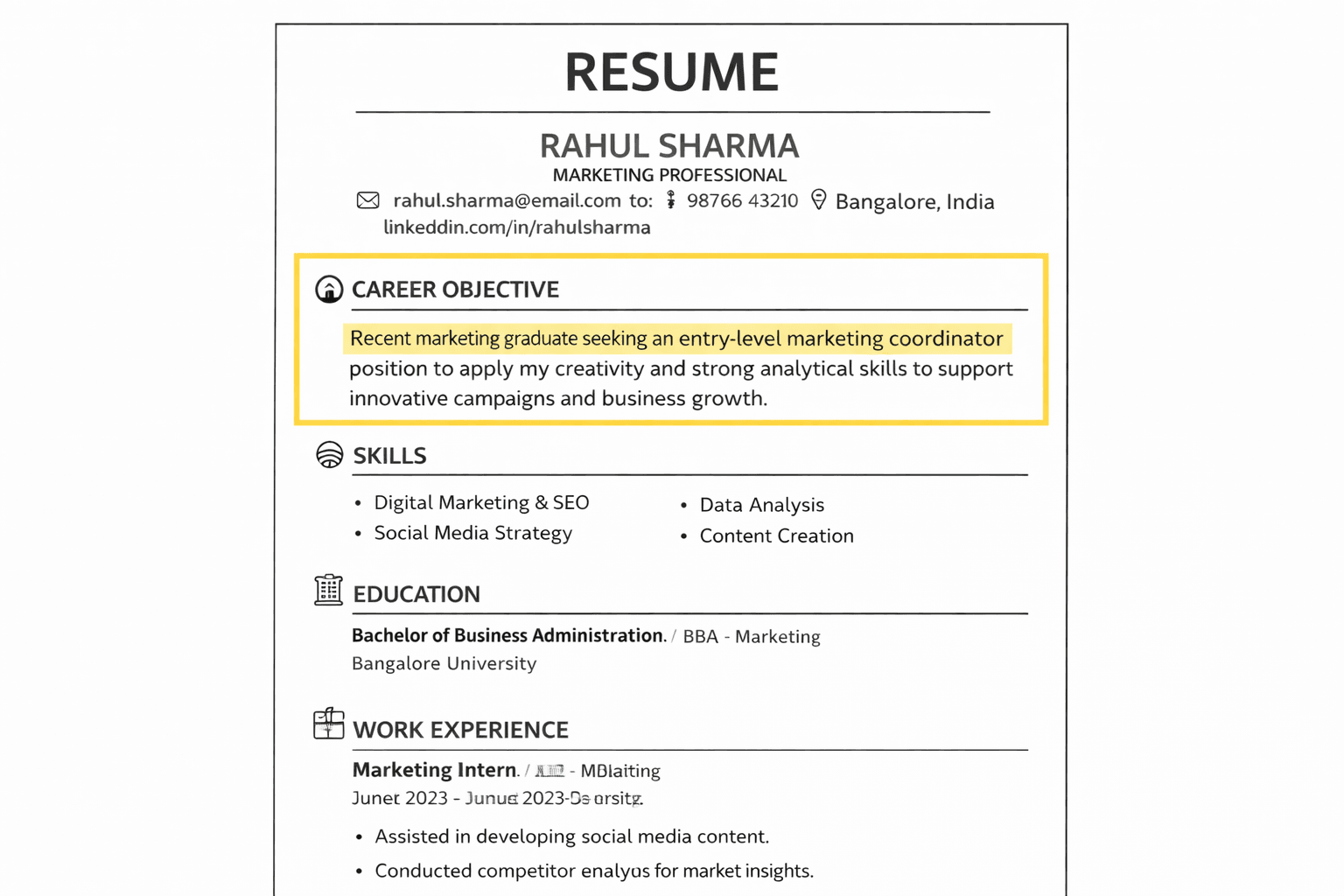
Resume: “Business analyst seeking to improve operational efficiency through data-driven insights.”
CV: “Research-focused professional aiming to contribute to advancements in business analytics and data science.”
Choosing the right format ensures your career objective example aligns with the document type.
Advanced Strategies to Make Your Career Objective Stand Out
Most professionals stop at writing basic, generic objectives. However, in a competitive job market, that is not enough. Recruiters often scan hundreds of resumes, and only those that demonstrate clarity, relevance, and impact stand out.
To truly differentiate yourself, your career objective must go beyond stating your goals. It should communicate your value, your thinking, and your alignment with the role.
Below are advanced strategies that can transform your resume objective from average to exceptional.
1. Use Measurable Impact
Instead of making generic claims, focus on outcomes and results. Even if you are not including exact numbers, your language should reflect a measurable contribution.
Weak Example: “Sales professional looking for growth opportunities”
Strong Example: “Sales professional seeking to increase revenue through strategic client acquisition and retention strategies.”
Even Better (with measurable tone): “Sales professional focused on driving revenue growth through high-value client acquisition and long-term retention strategies.”
Why this works:
- Shows results-oriented thinking
- Reflects business impact
- Makes your profile more credible
Pro Tip: If possible, align your statement with metrics such as growth, efficiency, or performance improvements.
2. Align with Company Vision
A generic objective can apply to any company. A strong one feels tailored to a specific organisation.
Before writing your objective:
- Research the company’s mission and values
- Understand their industry position
- Identify their current goals or challenges
Example: “Marketing professional seeking to drive brand growth through innovative digital strategies aligned with customer-centric business goals.”
Why this works:
- Shows genuine interest in the company
- Demonstrates effort and research
- Creates a stronger connection with recruiters
Advanced Insight: Even subtle alignment, such as using similar language to the company’s website, can make your resume feel more relevant.
3. Highlight Unique Strengths
Most resumes mention common skills such as communication and teamwork. To stand out, focus on what makes you different.
Ask yourself:
- What skills do I have that others may not
- What problems can I solve better than others
- What combination of skills makes me unique
Example: “Data analyst with expertise in predictive modelling and storytelling seeking to translate complex data into actionable business insights.”
Why this works:
- Combines technical and communication strengths
- Highlights a unique value proposition
- Makes your profile memorable
Pro Tip:
Use a combination of hard skills and soft skills to create a strong positioning.
4. Use Action-Oriented Language
The words you choose can significantly impact how your objective is perceived. Passive language sounds weak, while action-oriented language creates confidence and authority.
Weak Words: Looking for, hoping to, trying to
Strong Words: Drive, lead, optimise, enhance, deliver, build
Example:
“Operations professional aiming to optimise processes and enhance efficiency through data-driven strategies.”
Why this works:
- Sounds confident and proactive
- Reflects leadership mindset
- Creates a stronger impression
Advanced Tip:
Start your objective with a strong adjective and follow it with an action verb.

5. Keep It Concise but Powerful
Many professionals make the mistake of writing long and complicated objectives. In reality, clarity always wins over complexity.
Your objective should ideally be:
- 2 to 3 lines long
- Easy to read at a glance
- Focused on key value points
Example:
“Detail-oriented HR professional seeking to enhance employee engagement and drive organisational effectiveness.”
Why this works:
- Clear and direct
- No unnecessary words
- Easy for recruiters to understand quickly
6. Tailor for Every Role
One of the most overlooked strategies is customisation. Sending the same objective for every job significantly reduces your chances.
What to do:
- Modify your objective based on the job description
- Use role-specific keywords
- Reflect the responsibilities mentioned
Example:
If the role emphasises leadership: “Team-focused manager seeking to lead high-performing teams and deliver strategic business outcomes.”
If the role emphasises analytics: “Data-driven professional aiming to improve decision-making through advanced analytics.”
Why this works:
- Improves relevance
- Increases ATS compatibility
- Shows attention to detail
7. Balance Ambition with Practical Value
It is important to show ambition, but it should not sound unrealistic or self-centred.
Weak Example:
“Looking to become a top leader in the organization”
Strong Example:
“Aspiring leader seeking to contribute to team success while developing strategic decision-making skills.”
Why this works:
- Shows a growth mindset
- Remains grounded and realistic
- Aligns personal growth with organisational value
These strategies elevate your resume objective examples from average to exceptional.
Still using generic resume statements that get ignored? Book a free trial class and learn how to stand out in a competitive job market
Common Mistakes to Avoid in Career Objectives
Avoiding mistakes is as important as writing correctly.
Common Errors
- Being too vague
- Using clichés
- Writing long paragraphs
- Ignoring job requirements
- Focusing only on personal goals
Before and After Example
Before: “Looking for a challenging opportunity”
After: “Data analyst seeking to leverage analytical skills to improve business decision-making.”
Expert Tip
Always ask yourself: Does this statement clearly show my value?
If not, refine it.
Real-World Career Objective Examples That Work
Here are more detailed and practical examples for various goals.
For Skill Development
“Highly motivated IT professional seeking opportunities to master AI and data analytics to improve system performance.”
For Growth-Oriented Roles
“Results-driven professional aiming to leverage communication and leadership skills to drive organisational success.”
For Entry-Level
“Goal-oriented graduate seeking to apply academic knowledge and contribute to team success.”
For Long-Term Vision
“Seeking a role in a forward-thinking organisation that encourages continuous learning and career growth.”
These examples highlight clarity, ambition, and value.
Want to speak confidently and grow faster in your career? Book your free trial class now and take your first step toward transformation today
How Career Objectives Support Long-Term Professional Growth
A Career Objective is not just a resume section. It reflects your mindset and professional direction.
Long-Term Benefits
- Improves clarity in career planning
- Helps in better job alignment
- Builds confidence in communication
- Enhances personal branding
It also evolves with your career. As your skills grow, your objective should reflect your new aspirations.
Professionals who regularly refine their professional career objective statements are more confident and focused in their careers.
Transform Your Communication with PlanetSpark Personality Development Classes
PlanetSpark Personality Development programs are designed for working professionals who want to build strong communication, confidence, and professional presence.
These programs focus on real-world application, helping you perform better in interviews, presentations, and workplace conversations.
Who are these classes for
- Professionals aiming for promotions
- Job seekers preparing for interviews
- Individuals struggling with communication confidence
Why structured learning matters
Unstructured learning often leads to inconsistent progress. A guided curriculum ensures steady improvement and measurable outcomes.
Key Features and USPs:
- Live 1:1 interactive classes
- Expert educators and communication coaches
- Real-world practice, like interviews and presentations
- Personalised feedback and progress tracking
- Confidence-building frameworks
- Structured curriculum aligned to professional needs
- Exposure to a global learner community across 13+ countries
PlanetSpark has already delivered over 1 million classes, helping learners significantly improve their communication and confidence.

Build a Clear Path Toward Professional Excellence
Your career objective reflects your ambition, clarity, and direction. When written thoughtfully, it strengthens your resume and builds confidence in your professional identity.
Keep refining your objective as you grow. With consistent effort and improved communication, you can unlock better opportunities and long-term success.
Frequently Asked Questions
At PlanetSpark, we define it as a concise statement highlighting your goals, skills, and value to the employer.
Focus on clarity, relevance, and value. Keep it short and tailored to the job role.
A strong example clearly defines your role, skills, and contribution to the organisation.
Yes. It helps highlight direction, expertise, and leadership goals.
A CV objective is broader, while a resume objective is specific and role-focused.
Keep it concise, use relevant keywords, and focus on employer value.
Focus on skills, learning ability, and contribution rather than experience.
Personalized Communication Roadmaps
Record a video to get a AI generated personalized communication reports