
Creative Activities for Students: Inspire Young Minds

Table of Contents
- Creative Classroom Activities to Inspire Young Minds
- Creative Activities to Spark Imagination Across All Ages
- Creative Group Activities for Students to Try Together
- Encouraging Creativity Beyond the Classroom
- Integrating Creativity in Everyday Learning
- How Educators Can Promote Creative Learning
- Bringing Creativity into Everyday Learning
- Inspiring Young Minds to Create and Grow
Creative Activities for Students open the door to imagination, curiosity, and lifelong learning. This blog takes you through fun and meaningful ideas for every age, from playful kindergarten crafts to inspiring high school projects. Each activity nurtures creativity, teamwork, and confidence. With PlanetSpark’s engaging live classes, children learn to express themselves, innovate, and grow into confident thinkers and storytellers ready to shape their own bright futures.
Creative Classroom Activities to Inspire Young Minds
Creativity in education sparks curiosity and builds confidence. Whether through language or problem-solving, imaginative tasks make learning interactive, enjoyable, and deeply engaging for students of all ages.
1. Creative English Activities for Students
Language learning is one of the best avenues to encourage creativity. Traditional grammar lessons can be transformed into dynamic, engaging experiences when students are invited to use their imagination.
Here are some innovative English activities that make learning expressive and fun:
- Story Cubes: Give students dice or cards with images. They roll them and craft an original story connecting all the elements shown. This enhances storytelling, vocabulary, and sequencing skills.
- Character Interviews: Students pick a favorite book character and conduct an “interview” as if they were a journalist. This boosts comprehension and creative writing.
- Poetry Collage: Encourage them to cut out words from old magazines and rearrange them into meaningful poems. This activity enhances linguistic creativity and appreciation for rhythm and structure.
- Dialogue Writing Challenge: Divide students into pairs. Each writes half of a conversation between two imaginary characters, then combines them to see what story emerges.
By turning English lessons into a space for self-expression, teachers foster not just fluency but creativity and confidence in communication.
2. Creative Thinking Activities for Students
Creative thinking isn’t limited to art or language, but with mindset. It encourages students to approach challenges from new perspectives. Teachers can integrate critical and creative thinking into any subject with simple, effective exercises.
Some effective examples include:
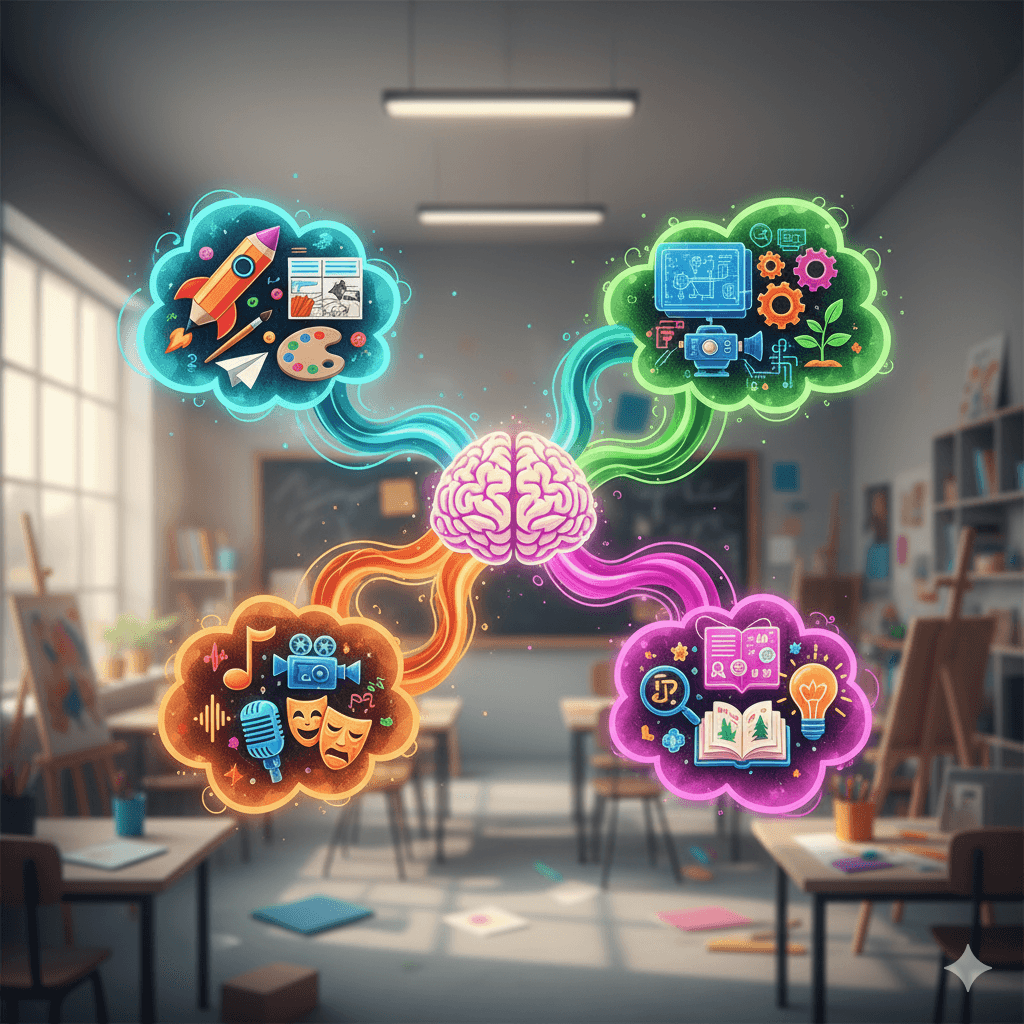
- Mind Mapping: Students visualize connections between ideas using drawings, arrows, and symbols. This enhances comprehension and innovation.
- What-If Scenarios: Pose imaginative questions such as, “What if gravity stopped for 10 seconds?” or “What if animals could talk?” Students discuss or write solutions.
- Mystery Box Challenge: Place random objects in a box. Students must invent a use for them or connect them in a short story.
- Reverse Engineering: Give them a finished product (like a paper plane) and ask how it was made. Then have them improve it.
Such creative thinking activities for students help them develop resilience, originality, flexibility, and skills that are vital for modern learning and problem-solving. Students interested in writing a creative drama script can click click here and learn to write easily.
Creative Activities to Spark Imagination Across All Ages
Creativity grows as children do from playful exploration in kindergarten to innovative problem-solving in high school. Each stage offers unique ways to nurture imagination, confidence, and curiosity through joyful learning.
1. Creative Activities for Kindergarten Students
At the kindergarten level, creativity blossoms through play. Children learn best when they can explore textures, sounds, and colors while building early imagination and coordination.
Here are some age-appropriate ideas:
- Finger Painting Emotions: Ask children to paint how they feel today using colors instead of words.
- Nature Collage: Take a nature walk and collect leaves, pebbles, and flowers. Create a collage together.
- Storytime Theater: After reading a story, let kids act it out using puppets or costumes.
- Shape Monsters: Cut out colorful paper shapes and have children glue them into funny monster designs.
These creative activities for kindergarten students help enhance motor skills, language development, and social interaction through joyful exploration. Parents planning summer activities for their kids can read this informational blog for many creative activities to keep them occupied.
2. Creative Activities for Primary Students
As students enter primary school, they start forming connections between subjects and their world. Creativity here builds confidence and curiosity.
Engaging creative activities for primary students can include:
- Design a New Planet: Students imagine a new planet, draw its landscape, name its species, and describe its weather.
- DIY Science Journal: Combine science and art with students documenting experiments by drawing diagrams and writing observations in colorful journals.
- Math in Art: Use symmetry, patterns, or tessellations to make math visual and fun.
- Invent a New Sport: Kids create rules, equipment, and team names for an original game, then play it together.
These activities mix academic learning with imagination, ensuring that creativity becomes part of everyday study rather than a separate subject.
Boost your child’s confidence and expression with PlanetSpark.
3. Creative Thinking Activities for Middle School Students
Middle school is a crucial time for developing independence and critical thought. Creative thinking activities for middle school students help them channel curiosity into innovation.
Here are some classroom-tested ideas:
- Digital Storytelling: Students create short films or animated stories using online tools. This combines technology, writing, and creativity.
- Design a Time Capsule: Ask them to collect items that represent their current life and predict how future generations might view them.
- Problem-Solving Workshops: Present real-world issues (like waste management or energy use) and let students brainstorm solutions.
- Improve Games: Theatre-based improvisation games boost communication, empathy, and spontaneity.
At this stage, students begin to discover their passions. Activities that allow choice and personal expression encourage a lifelong love for learning and creativity.
4. Creative Thinking Activities for High School Students
High school students often juggle academic pressure with identity development. Creative exercises at this stage are powerful tools for stress relief, collaboration, and innovation.
Some impactful creative thinking activities for high school students include:
- Innovation Labs: Create teams to brainstorm ideas for real-world challenges, such as sustainable living or community improvement.
- Podcast Production: Students produce podcasts on topics they care about music, history, or social issues, building speaking and technical skills.
- Short Film Festival: Assign groups to produce 3-minute films around a common theme. This encourages teamwork and artistic direction.
- Design Thinking Projects: Teach them to empathize, define, ideate, prototype, and test, which are essential skills for modern careers.
These exercises not only strengthen creativity but also prepare students for college, entrepreneurship, and leadership roles in the future.
Let your child lead, speak, and inspire with PlanetSpark.
Creative Group Activities for Students to Try Together
Collaboration is at the heart of creativity. Group activities help students learn teamwork, empathy, and collective problem-solving skills are crucial for personal and professional growth.
Here are some fun group-based ideas:
- Escape Room Challenge: Teams solve puzzles or riddles to “escape” a classroom or virtual room. It encourages cooperation, logic, and excitement.
- Community Project Design: Students plan initiatives like recycling drives or reading clubs.
- Collaborative Mural: Groups create murals around a theme like “Diversity” or “Dreams.” Each student contributes a unique piece.
- Debate with a Twist: Instead of standard debates, ask groups to defend ideas they don’t personally agree with, promoting empathy and perspective-taking.
Creative group activities for students strengthen relationships and teach that collaboration often fuels innovation.
Encouraging Creativity Beyond the Classroom
Parents and teachers play a key role in encouraging creativity beyond the classroom. They can nurture curiosity by asking open-ended questions, providing unstructured playtime, and celebrating effort instead of perfection. These actions help children think freely and explore ideas with confidence.
Introducing art, music, and drama as part of daily learning makes education more engaging. Allowing flexible project topics or giving students choices in assignments fosters independence and imagination. Such simple practices inspire lifelong creativity and make learning more meaningful.
Turn your child into a confident storyteller and thinker.
Integrating Creativity in Everyday Learning
Creativity should be part of everyday learning, not just confined to certain subjects. When students explore ideas through experiments, storytelling, and design, they build deeper understanding and curiosity across disciplines. Every lesson becomes a chance to think differently and express freely.
In science, let students design experiments or models. In math, use puzzles and patterns to make learning fun. Encourage diary entries or skits in social studies and combine coding with creativity in technology. When creativity is a mindset, learning becomes limitless.
How Educators Can Promote Creative Learning
Educators can cultivate a creative classroom environment by:
- Encouraging Questions: Allow students to ask “why” and “how.” This nurtures curiosity and helps them think critically and independently.
- Embracing Mistakes: Treat errors as learning opportunities. When students feel safe to fail, they become more confident and innovative thinkers.
- Using Interdisciplinary Projects: Blend multiple subjects like art, science, and writing. This approach helps students see connections and apply creativity in new ways.
- Providing Real-World Context: Relate lessons to everyday experiences. Connecting learning to real life makes concepts meaningful and sparks genuine interest.
- Promoting Student Choice: Offer students the freedom to select topics or methods. Choice encourages responsibility, creativity, and personal engagement in learning.
A creative classroom is one where students feel safe to imagine, experiment, and express themselves without fear of judgment.
Bringing Creativity into Everyday Learning
Creativity does not need a special occasion; it thrives in everyday moments. Teachers and parents can weave imagination into daily routines by encouraging open-ended questions, playful exploration, and curiosity-driven learning. A math lesson can become an art project, a science experiment can turn into a storytelling challenge, and a history topic can inspire a dramatic performance. When learning feels alive and interactive, students develop a deeper understanding, confidence, and a genuine enthusiasm for discovery.

PlanetSpark: Building Confidence Through Personality Development
PlanetSpark empowers children to become confident, expressive, and emotionally intelligent individuals through its holistic Personality Development Program. Designed beyond academics, it focuses on communication, leadership, self-awareness, and skills that shape future-ready personalities. With activity-based learning, expert trainers, and real-time feedback, PlanetSpark helps every child grow into a poised and articulate individual.
Key Services Include:
- Holistic Curriculum: Covers communication etiquette, goal setting, self-awareness, and leadership.
- Social-Emotional Learning Framework: Based on CASEL principles to nurture empathy and collaboration.
- Interactive Learning: Includes role plays, mock interviews, journaling, and real-life simulations.
- Leadership Training: Develops confidence, responsibility, and teamwork through engaging challenges.
- Parent Consultations: Regular updates on progress in confidence, openness, and self-expression.
- Body Language & Etiquette Coaching: Builds presence through tone control, posture, and respectful interaction.
PlanetSpark ensures every child learns to express with clarity, lead with confidence, and grow with purpose.
Inspiring Young Minds to Create and Grow
Creative activities are not merely classroom fun, but they’re a foundation for lifelong success. Whether it’s storytelling in kindergarten or design thinking in high school, each creative experience shapes how a student perceives the world.
By integrating imagination into daily learning, we nurture thinkers, dreamers, and innovators ready to shape the future.
So, whether you’re a teacher designing lessons or a parent seeking meaningful engagement at home, remember this: every moment can become a creative opportunity. With platforms like PlanetSpark leading the way, creativity in education isn’t just possible, it’s unstoppable.
Frequently Asked Questions
Creative Activities for Students are engaging tasks that inspire imagination, problem-solving, and self-expression. They include storytelling, art, group challenges, and critical thinking games for all ages.
Creative activities enhance communication, confidence, and curiosity. They also improve teamwork, emotional intelligence, and innovative thinking, helping students apply classroom learning to real-life situations.
PlanetSpark nurtures creativity through live, interactive sessions where children practice storytelling, public speaking, and writing. Its expert mentors guide students to think originally and express confidently.
Younger children enjoy art, play, and sensory exploration, while older students engage in debates, storytelling, and problem-solving projects that encourage imagination and teamwork.
PlanetSpark combines personalized training, fun learning tools, and real-time feedback to make creative learning exciting. It helps children become confident communicators and innovative thinkers.
Teachers and parents can ask open-ended questions, appreciate curiosity, provide choices in activities, and let children explore ideas freely to make learning creative and meaningful every day.