
Top 10 Ethical Reasoning for Young Debaters

Table of Contents
- Why Ethical Reasoning Matters in Debates
- Ethical Reasoning for Young Debaters: Core Frameworks
- A Systematic 7-Step Ethical Reasoning Model
- Top 10 Ethical Reasoning Skills Every Young Debater Needs
- Practice Topics for Young Debaters
- Build Confident Thinkers with PlanetSpark Personality Develo
- Build Your Voice with Integrity and Confidence
What if winning a debate was not the goal, but discovering the truth was?
Many teens struggle to present arguments that are logical, fair, and convincing. They often rely on emotions or one-sided opinions, which weakens their credibility. Ethical reasoning for young debaters helps bridge this gap by teaching students how to think critically, evaluate situations, and argue responsibly.
In this guide, you will learn structured frameworks, explore moral dilemmas for classroom discussion, understand identifying logical fallacies in news, and master bias detection for students. You will also discover practical tools and activities to apply these skills in real debates.
Let’s begin by understanding why ethical reasoning is the foundation of powerful debating.
Why Ethical Reasoning Matters in Debates
Ethical reasoning transforms debating from a competition into a meaningful intellectual exercise. It allows students to analyze issues deeply rather than simply defending a position.
When teens debate without ethical reasoning, arguments often become emotional or biased. This reduces clarity and impact. Ethical reasoning ensures that arguments are built on fairness, logic, and responsibility.
Key benefits include:
- Builds credibility and trust: When you support your arguments with fair reasoning and accurate information, people are more likely to believe and respect your viewpoint. Judges, teachers, and peers see you as a thoughtful and reliable speaker.
- Encourages balanced thinking: Ethical reasoning teaches you to look at both sides of an issue. Instead of being one-sided, you consider different perspectives, which leads to more complete and stronger arguments.
- Improves clarity in communication: When your thoughts are structured using logic and ethics, your arguments become clearer and easier to understand. This helps you present your ideas confidently and effectively.
- Reduces misinformation: By questioning sources and identifying logical fallacies, you avoid spreading incorrect or misleading information. This makes your arguments more accurate and trustworthy.
- Prepares students for real-world decision making: Ethical reasoning is not just useful in debates. It helps you make better decisions in everyday life, whether it is choosing what is right in a difficult situation or solving problems logically.
For example, in debates about social media regulation, ethical reasoning helps students consider both freedom of expression and the risks of misinformation. This balanced approach leads to stronger and more persuasive arguments.
Ethical Reasoning for Young Debaters: Core Frameworks
Ethical reasoning for young debaters becomes far more effective when students use structured frameworks. These frameworks act like mental tools that help you analyze arguments from multiple angles instead of relying on personal opinions or emotions.
When you apply these frameworks, you begin to ask better questions such as “Who benefits?”, “Is this fair?”, and “Does this respect everyone involved?”. This leads to stronger, more balanced arguments.
1. Consequentialism (Utilitarianism)
This framework focuses on outcomes. An action is considered ethical if it creates the greatest benefit for the largest number of people.
For young debaters, this means evaluating the results of a decision rather than just the intention behind it.
Example: Mandatory vaccinations may limit personal freedom, but they protect public health and save lives. From a utilitarian perspective, this is ethical because it benefits the majority.
How to use in debates:
- Ask: What are the long-term effects?
- Compare benefits vs harm
- Focus on impact on society
2. Deontology (Duty-Based Ethics)
This framework focuses on rules and moral duties. Actions are considered right if they follow ethical principles, regardless of the outcome.
It teaches students that some actions are inherently right or wrong.
Example: Lying is considered wrong, even if it helps someone in the short term.
How to use in debates:
- Ask: Is this action morally correct?
- Focus on rules, rights, and responsibilities
- Highlight ethical boundaries
3. Virtue Ethics
This framework focuses on character and personal values. Instead of asking “What should I do?”, it asks “What kind of person should I be?”.
It encourages traits like honesty, courage, empathy, and integrity.
Example: Choosing to tell the truth in a difficult situation shows courage and honesty.
How to use in debates:
- Focus on intentions and character
- Highlight moral values
- Connect actions to personal growth
4. Rights-Based Ethics
This framework emphasizes protecting individual rights such as freedom, privacy, and equality.
It is especially useful in debates about laws, policies, and human rights.
Example: Even if banning social media reduces misinformation, it may violate freedom of expression.
How to use in debates:
- Identify whose rights are affected
- Balance individual rights vs collective good
- Discuss fairness and justice
5. Justice and Fairness
This approach focuses on equal treatment and fair distribution of resources and opportunities.
It helps debaters analyze whether decisions are biased or discriminatory.
Example: Providing equal access to education ensures fairness across different social groups.
How to use in debates:
- Ask: Is this fair for everyone?
- Identify inequality or bias
- Focus on equal opportunities
6. Care-Based Ethics
This framework emphasizes empathy, relationships, and emotional understanding.
It reminds debaters that decisions affect real people and relationships.
Example: Supporting a struggling friend instead of strictly following rules shows compassion.
How to use in debates:
- Consider emotional impact
- Focus on relationships
- Highlight human connection
These frameworks help debaters evaluate arguments logically and ethically instead of relying only on emotions or assumptions.
A Systematic 7-Step Ethical Reasoning Model
To apply ethical reasoning effectively, students can follow a structured step-by-step process. This model helps break down complex situations into manageable parts.
- Gather the facts: Understand the situation clearly. Avoid assumptions and focus on verified information.
- Identify the ethical issue: Recognize the conflict between values, such as honesty vs loyalty.
- List principles or values involved: Identify which ethical frameworks apply, such as fairness, rights, or consequences.
- Explore possible actions: Think of all possible solutions instead of jumping to conclusions.
- Compare options with ethical principles: Evaluate which option aligns best with ethical values.
- Evaluate consequences: Consider both short-term and long-term effects of each choice.
- Make a justified decision: Choose the most ethical option and be ready to explain your reasoning.
Example
In a debate on cheating in exams:
- Facts: A student cheats to pass
- Issue: Honesty vs academic success
- Options: Report the student or ignore
- Evaluation: Reporting promotes fairness, ignoring supports friendship
- Decision: Choose based on ethical priorities
This method helps students think deeply, avoid impulsive decisions, and build well-structured arguments.
Understanding Moral Dilemmas for Classroom Discussion
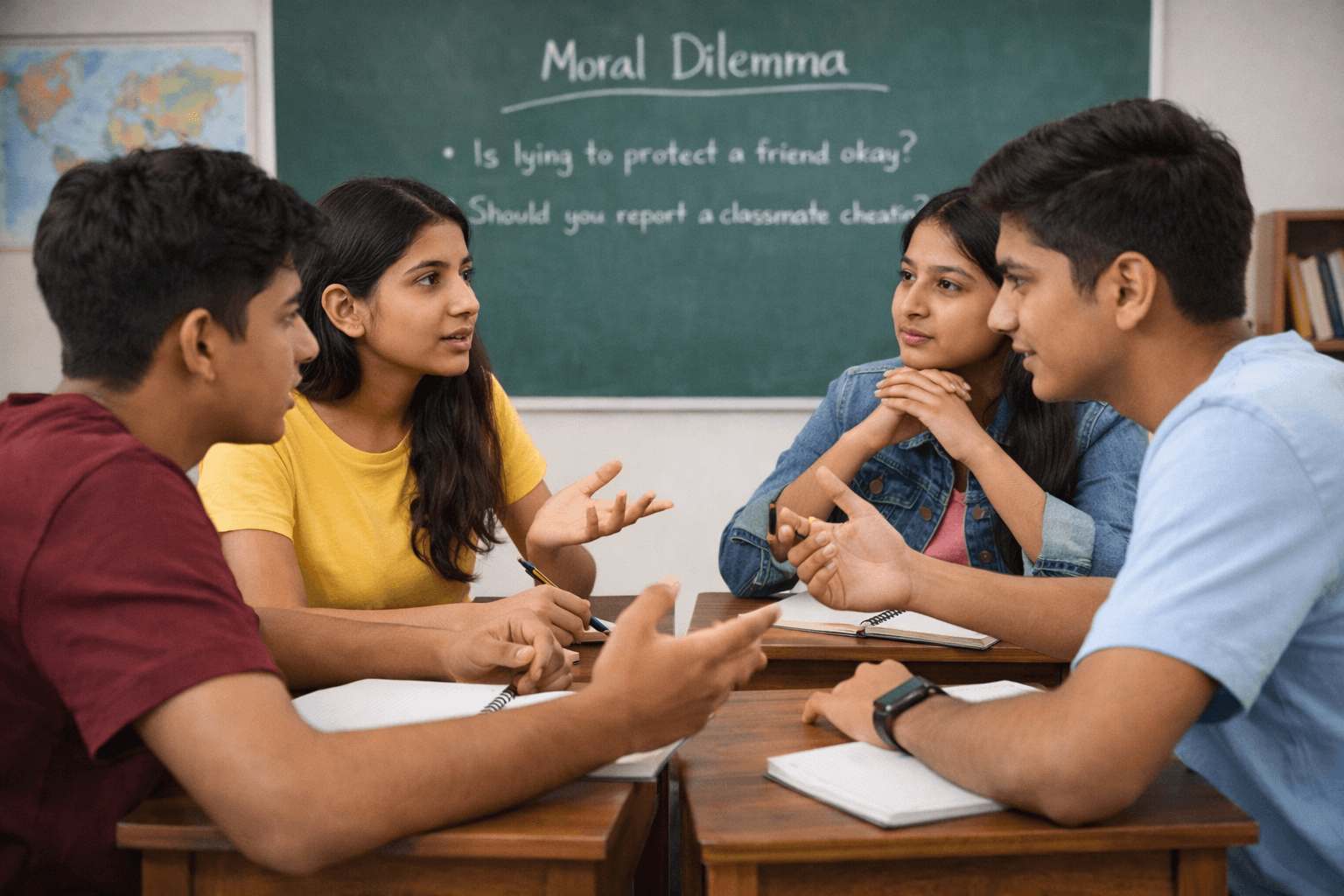
Moral dilemmas are situations where every choice has both positive and negative consequences. There is no single correct answer, which makes them ideal for developing ethical reasoning.
They challenge students to think beyond simple right or wrong and explore complex decision making.
Examples Explained
- Should you lie to protect a friend from punishment?
- Is breaking rules acceptable if it helps someone?
- Should schools monitor student activity for safety?
Each of these situations involves conflicting values like honesty, safety, freedom, and responsibility.
How These Help Students
- Think critically by analyzing multiple sides
- Evaluate consequences before making decisions
- Understand perspectives of different stakeholders
- Build structured arguments with logical reasoning
How to Approach Moral Dilemmas
- Identify the main conflict
- Consider who is affected
- Analyze possible outcomes
- Apply ethical frameworks
- Justify your decision
Regular practice with moral dilemmas strengthens decision making and prepares students for real-world situations.
Identifying Logical Fallacies in News and Debates
Understanding identifying logical fallacies in news is essential for building strong arguments. Logical fallacies are errors in reasoning that make arguments weak or misleading.
Common Logical Fallacies Explained
- Ad hominem: Attacking the person instead of the argument
- Strawman: Misrepresenting someone’s argument to make it easier to attack
- False dilemma: Presenting only two options when more exist
- Slippery slope: Assuming extreme outcomes without proof
- Hasty generalization: Drawing conclusions from limited evidence
How to Identify Them
- Check if evidence supports the claim
- Look for emotional language or exaggeration
- Analyze if the reasoning is logical
- Question whether all possibilities are considered
Example: Saying “All social media is harmful” ignores positive uses like education and communication.
Recognizing fallacies helps students challenge weak arguments and strengthen their own reasoning.
Want to spot weak arguments instantly? Book a demo class now and learn expert-level debate techniques today.
Bias Detection for Students: Think Beyond Assumptions
Bias detection for students is crucial for fair and objective thinking. Bias can influence how information is presented and interpreted, often leading to incomplete or misleading arguments.
Types of Bias Explained
- Confirmation bias: Accepting only information that supports your beliefs
- Cultural bias: Judging based on cultural norms
- Personal bias: Influenced by personal experiences
How to Detect Bias
- Check if only one perspective is presented
- Look for missing or ignored information
- Analyze tone and word choice
- Compare multiple sources
How to Reduce Bias
- Stay open to different viewpoints
- Question your assumptions
- Seek reliable and diverse sources
- Practice critical thinking
Bias detection ensures arguments are balanced, fair, and credible.
Ethical Standards for Debate Rounds
Ethical debating requires following certain rules to maintain fairness and respect. These standards ensure that debates remain constructive and meaningful.
Key Principles Explained
- Respect opponents by listening carefully and responding thoughtfully
- Avoid personal attacks and focus only on arguments
- Use accurate evidence to support claims
- Represent arguments fairly without distortion
- Accept complexity and acknowledge multiple viewpoints
Key Rules
- Attack arguments, not people
- Avoid misrepresentation
- Acknowledge opposing perspectives
Following these standards builds trust and improves the overall quality of debates.
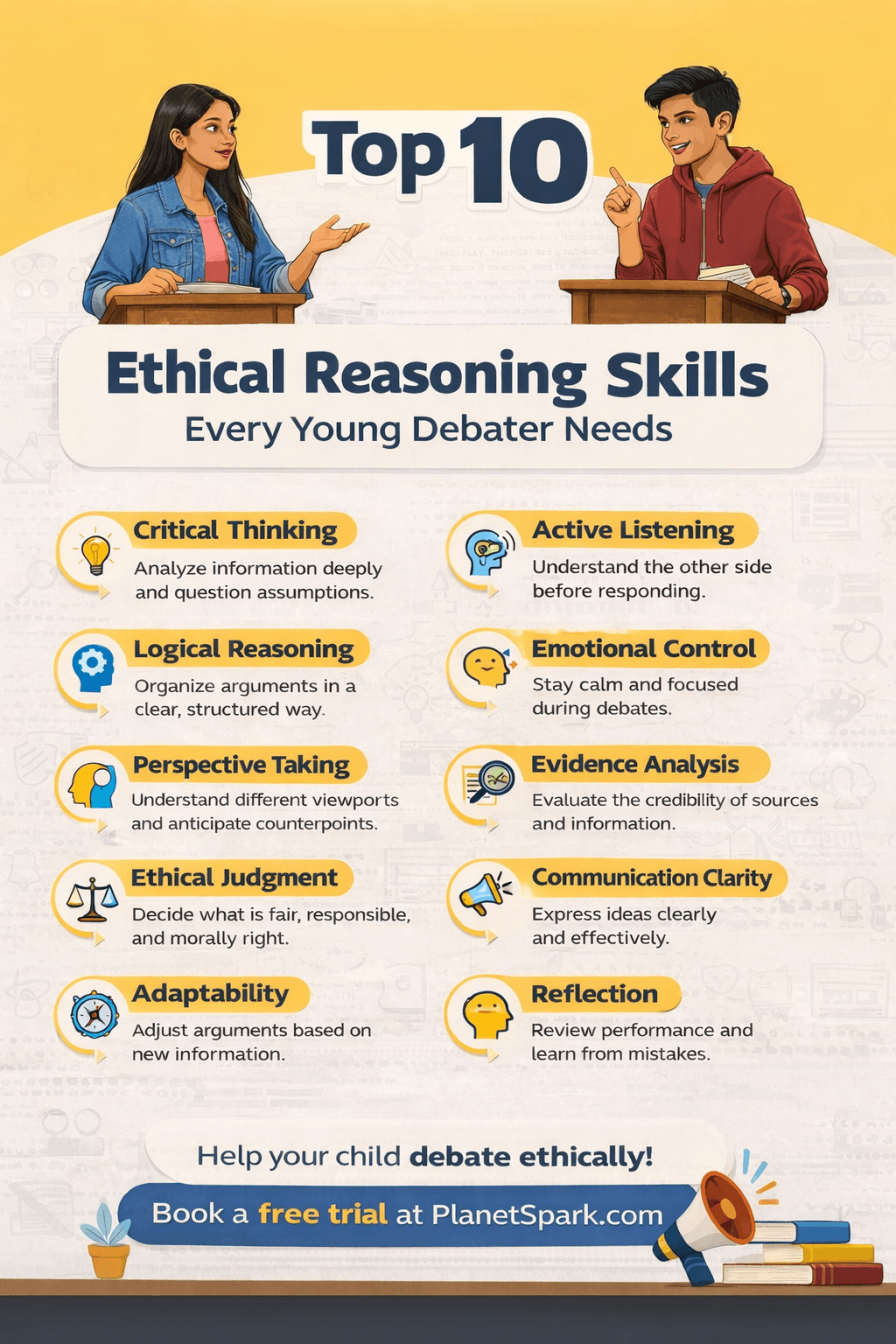
Top 10 Ethical Reasoning Skills Every Young Debater Needs
These skills form the foundation of effective debating and ethical thinking. Developing them helps students not only perform better in debates but also make smarter decisions in everyday life.
1. Critical Thinking
Critical thinking means analyzing information deeply instead of accepting it at face value. It involves questioning assumptions, evaluating evidence, and identifying gaps in reasoning.
Example: Instead of agreeing with a news headline, a critical thinker asks, “What evidence supports this claim?”
2. Active Listening
Active listening is the ability to fully understand what your opponent is saying before responding. It prevents misunderstandings and helps you build stronger counterarguments.
Example: Listening carefully allows you to identify weak points in your opponent’s argument and respond effectively.
3. Logical Reasoning
Logical reasoning helps you organize your thoughts in a structured and coherent way. It ensures your arguments follow a clear flow from evidence to conclusion.
Example: Presenting a claim, supporting it with facts, and explaining its impact logically.
4. Emotional Control
Debates can become intense, but staying calm helps you think clearly and respond effectively. Emotional control prevents arguments from becoming personal.
Example: Even if you disagree strongly, you respond respectfully instead of reacting impulsively.
5. Perspective Taking
This skill involves understanding and considering viewpoints different from your own. It helps you build balanced arguments and anticipate counterpoints.
Example: In a debate on school uniforms, you consider both discipline benefits and personal expression concerns.
6. Evidence Analysis
Evidence analysis means evaluating the reliability and relevance of information. Not all sources are trustworthy, so debaters must verify facts before using them.
Example: Using credible research instead of social media opinions.
7. Ethical Judgment
Ethical judgment helps you decide what is fair, responsible, and morally right in a situation. It combines logic with values.
Example: Deciding whether an action is justified even if it has positive outcomes.
8. Communication Clarity
Clear communication ensures your ideas are easy to understand. It involves using simple language, structured arguments, and confident delivery.
Example: Explaining complex ideas in a way that everyone can follow.
9. Adaptability
Debates are dynamic. Adaptability allows you to adjust your arguments based on new information or opposing viewpoints.
Example: Changing your approach when your opponent presents strong evidence.
10. Reflection
Reflection involves reviewing your performance and identifying areas for improvement. It helps you grow with each debate.
Example: After a debate, analyzing what worked well and what could be improved.
Developing these skills helps students succeed in debates and builds lifelong abilities like decision making, communication, and critical thinking.
Practice Topics for Young Debaters
Starting with simple topics helps build confidence before moving to more complex and sensitive issues. These topics allow students to apply ethical reasoning in relatable and engaging ways.
1. Relatable Topics
These topics connect with students’ daily experiences, making them easier to discuss.
- Should homework be optional?
Encourages thinking about responsibility, learning, and student well-being.
- Is it okay to lie to protect someone?
Explores the conflict between honesty and loyalty.
2. Social Issues
These topics introduce broader societal perspectives and ethical challenges.
- Should social media be regulated?
Balances freedom of expression with safety and misinformation concerns.
- Should school uniforms be mandatory?
Examines equality, discipline, and personal freedom.
3. Environmental Topics
These topics help students think about global responsibility and sustainability.
- Should plastic be banned worldwide?
Considers environmental protection versus economic impact and convenience.
4. Technology Ethics
These topics prepare students for future challenges in a digital world.
- Should AI replace teachers?
Explores efficiency, human connection, and the role of technology in education.
These topics gradually build students’ confidence and ability to handle complex debates.
Practical Activities to Build Ethical Reasoning
Learning becomes more effective when students actively practice skills rather than just reading about them. These activities make ethical reasoning engaging and practical.
- Debate Practice: Regular debates help students apply ethical frameworks, structure arguments, and improve confidence. It also teaches quick thinking and adaptability.
- Case Study Analysis: Analyzing real-life situations helps students understand how ethical reasoning works in practical scenarios. It improves decision making and problem-solving skills.
- News Evaluation: Reviewing news articles helps students practice identifying logical fallacies in news and detecting bias. This builds awareness of misinformation.
- Role Playing: Acting out different roles allows students to experience multiple perspectives. This strengthens empathy and perspective-taking skills.
- Journaling: Writing reflections helps students organize their thoughts, evaluate decisions, and track their progress over time. It enhances self-awareness and critical thinking.
These activities strengthen ethical reasoning, improve confidence, and make learning interactive, practical, and enjoyable.
Build Confident Thinkers with PlanetSpark Personality Development
PlanetSpark personality development classes are designed to transform teens into confident communicators, ethical thinkers, and future leaders. These debate programs go beyond academics to build real-world communication and decision-making skills.
Students learn through structured, interactive sessions guided by expert trainers who understand each learner’s unique pace and personality.
What Makes PlanetSpark Unique
- 1:1 personal trainers for every child
- Personalised curriculum and roadmap
- SparkX AI video analysis tool for performance tracking
- AI-led practice sessions for independent learning
- Spark Diary for daily writing and reflection habits
- Gamified learning tools like SparkBee for fun practice
- Structured parent-teacher meetings and progress tracking
Advanced Learning Ecosystem
- Debate clubs and storytelling communities
- Safe content sharing via Sparkline platform
- Competitions, showcases, and recognition events
- SparkShop eBooks for skill enhancement
These features ensure continuous improvement in confidence, communication, and ethical reasoning skills.

Build Your Voice with Integrity and Confidence
Ethical reasoning is not just about debates. It shapes how you think, communicate, and make decisions in everyday life. When teens learn to evaluate arguments fairly and express ideas clearly, they build confidence that lasts a lifetime.
Consistent practice, exposure to diverse perspectives, and a willingness to learn can transform your debating skills. Over time, you will not only become a stronger speaker but also a thoughtful and responsible individual ready to face real-world challenges.
Also Read: Best Debate Topics for Kids with Simple Arguments Guide
100+ Best Debate Topics for Students | For School & Competition
Debate Club: Activities, Rules, and Topics to Build Public Speaking Skills
Frequently Asked Questions
Ethical reasoning helps students evaluate arguments based on fairness, logic, and responsibility instead of emotions.
They improve critical thinking and help students explore multiple perspectives before forming opinions.
It prevents misinformation and helps students build strong, evidence-based arguments.
It is the ability to recognize unfair or one-sided thinking in arguments and information.
Through debate practice, analyzing scenarios, and guided learning programs.
Ignoring opposing views, using weak evidence, and relying too much on emotions.
Yes, it improves decision making, communication, and problem solving skills.