
Master Facilitation Techniques for Hybrid Meetings


Table of Contents
- Why Hybrid Meetings Demand a New Facilitation Approach
- Core Principles of Facilitation Techniques for Hybrid Meetin
- How to Prevent Awkward Silence in Hybrid Meetings
- Prompting Discussion in Meetings with Confidence
- Engaging Quiet Participants in Hybrid Meetings
- Restarting Stalled Conversations Without Losing Momentum
- Upgrade Your Confidence with PlanetSpark Personality Develop
- Transform Your Meetings Into Powerful Conversations
Hybrid meetings often fail when remote voices are ignored and conversations lose momentum. Many professionals struggle with awkward silence in meetings, unequal participation, and difficulty prompting discussion in meetings.
What if every meeting you led felt engaging, inclusive, and productive from start to finish?
This blog explains practical facilitation techniques for hybrid meetings that help you lead inclusive, engaging, and high-impact sessions. You will learn how to prioritize remote participants, restart stalled conversations, engage quiet participants, and prevent communication gaps. At PlanetSpark will also explore proven frameworks and tools that top professionals use.
Let’s begin by understanding why hybrid meetings need a smarter approach.
Why Hybrid Meetings Demand a New Facilitation Approach
Hybrid meetings are not simply a mix of online and offline communication. They create two parallel experiences that must be managed intentionally.
In traditional meetings, everyone shares the same environment. In hybrid settings, remote participants rely on screens, audio clarity, and structured cues. This often leads to awkward silence in meetings or uneven participation.
Common Challenges
- Remote participants being ignored unintentionally: In fast-moving discussions, facilitators often focus on people physically present, causing remote participants to feel overlooked or disconnected.
- In-room dominance in discussions: People in the same room tend to interact more naturally, which can lead to them speaking more and unintentionally dominating the conversation.
- Delayed responses due to lag: Internet delays or hesitation in unmuting can slow down responses, making remote participants appear less engaged even when they are not.
- Lack of visual cues: Remote participants miss out on body language and eye contact, making it harder to understand reactions or know when to speak.
- Difficulty in prompting discussion in meetings: Without clear structure or directed questions, participants may hesitate to contribute, leading to low interaction and slow discussions.
To solve this, facilitators must adopt a remote-first mindset. This means designing the meeting experience for remote attendees first, then integrating in-person participants seamlessly.
Why This Matters
Strong facilitation techniques for hybrid meetings ensure:
- Equal participation across all attendees
- Clear communication flow
- Structured and engaging discussions
- Reduced confusion and silence
For example, when everyone joins through their own device, even in-office employees participate equally in chat, polls, and breakout sessions.
Struggling to keep everyone engaged in hybrid meetings?
Book your FREE trial class today and learn expert facilitation skills before your next meeting. Limited slots available!
Core Principles of Facilitation Techniques for Hybrid Meetings By PlanetSpark
To master hybrid meetings, you must follow principles that ensure clarity, engagement, and inclusivity.
1. Remote-First Participation
Encourage all participants to join via their laptops, even in the same room. This creates equal access to tools and communication channels.
2. Intentional Engagement
Do not wait for people to speak. Actively invite responses using names and structured prompts.
3. Structured Interaction Frameworks
Use methods like Think-Write-Share to ensure everyone contributes before open discussion begins.
4. Equal Visibility and Presence
Encourage camera usage and active listening to build connections.
5. Dedicated Facilitation Roles
Assign a co-facilitator to manage chat, tech issues, and remote engagement.
These principles directly help with:
- Engaging quiet participants
- Restarting stalled conversations
- Preventing awkward silence in hybrid meetings
When applied consistently, these principles transform meetings from passive discussions into dynamic collaboration spaces.
How to Prevent Awkward Silence in Hybrid Meetings
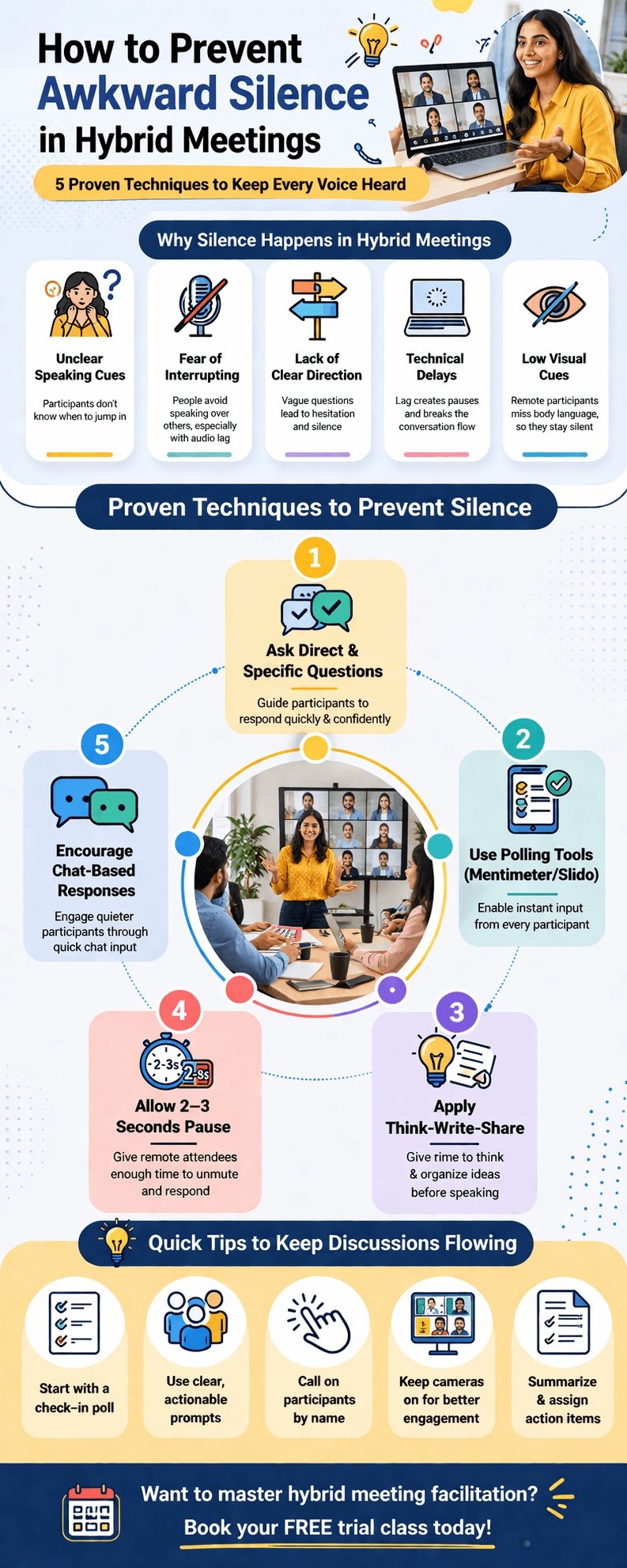
Silence in hybrid meetings often signals confusion, hesitation, or disengagement. Knowing how to prevent awkward silence in hybrid meetings is essential for maintaining energy.
Why Silence Happens
- Participants are unsure when to speak: In hybrid meetings, unclear cues make people hesitate, as they are unsure about the right moment to jump into the conversation.
- Fear of interrupting: Many participants avoid speaking because they do not want to talk over someone, especially when there is a slight audio delay.
- Lack of clear direction: When questions are too broad or vague, people do not know what is expected from them, leading to silence.
- Technical delays: Lag in audio or video makes responses slower, which can create awkward pauses and break the flow of discussion.
Proven Techniques to Prevent Silence
- Ask direct and specific questions: Clear questions guide participants and make it easier for them to respond quickly and confidently.
- Use polling tools like Mentimeter or Slido: These tools allow instant participation from everyone, even those who hesitate to speak aloud.
- Apply Think-Write-Share before discussions: Giving participants time to think and write helps them organize ideas before speaking.
- Allow intentional pause time of 2 to 3 seconds: A short pause gives remote participants enough time to unmute and respond without feeling rushed.
- Encourage chat-based responses: Chat allows quick input and helps engage participants who are less comfortable speaking.
Example
Instead of asking: “Any thoughts?”
Ask: “What is one improvement we can implement this week?”
Structured Flow to Avoid Silence
- Opening check-in poll
- Guided discussion with prompts
- Interactive group activity
- Summary with action points
These steps ensure continuous engagement and eliminate long pauses.
Facing awkward silence in meetings too often?
Secure your demo session now and learn how to lead confident conversations. Don’t miss out!
Prompting Discussion in Meetings with Confidence
Prompting discussion in meetings is a skill that separates average facilitators from great leaders.
High-Impact Techniques
- Waterfall Chat: Participants type responses but send them together. This prevents bias and encourages independent thinking.
- Round-Robin Sharing: Each participant contributes briefly, ensuring equal voice.
- Scenario-Based Questions: Present real-life challenges to stimulate thinking.
- Layered Questioning: Start simple, then deepen with follow-ups.
- Visual Collaboration Tools: Use platforms like Miro to capture ideas visually.
Example in Action
“Let’s hear from our remote team first. What are your suggestions?”
This ensures remote voices are prioritized and discussions remain balanced.
Prompting discussion effectively keeps meetings interactive, focused, and productive.
Engaging Quiet Participants in Hybrid Meetings
Engaging quiet participants is critical for inclusive decision-making. Many professionals hesitate due to lack of confidence or unclear signals.
Why Participants Stay Quiet
- Fear of judgment: Many participants hesitate to speak because they worry their ideas might be criticized or not good enough.
- Lack of clarity: When instructions or questions are unclear, people are unsure what to say, so they choose to stay silent.
- Technical discomfort: Some participants struggle with tools like mute, chat, or video, which makes them less confident to speak.
- Feeling overlooked: When facilitators focus more on certain individuals, others may feel ignored and stop trying to contribute.
Practical Strategies
- Call participants by name: Inviting someone directly encourages them to speak and makes them feel included in the discussion.
- Use anonymous input tools: Tools like polls or anonymous boards allow participants to share ideas without fear of judgment.
- Create breakout rooms with mixed groups: Smaller groups make it easier for people to speak and share their thoughts comfortably.
- Encourage chat participation: Chat gives a low-pressure way to contribute, especially for those who are less confident speaking aloud.
- Acknowledge contributions positively: Appreciating responses builds confidence and motivates participants to engage more in future discussions.
Example
“Aman, we would really value your perspective here.”
This simple approach builds confidence and encourages participation.
Build Psychological Safety
Create an environment where all ideas are respected. Avoid criticism and interruptions.
Engaging quiet participants ensures diverse ideas and stronger collaboration.
Do you hesitate to speak up in meetings?
Book a personalized trial session and build confidence before your next big meeting. Spots filling fast!
Restarting Stalled Conversations Without Losing Momentum
Every meeting faces moments when discussions slow down. Restarting stalled conversations is essential to maintain progress.
Signs of a Stalled Conversation
- Long pauses
- Repeated points
- Low engagement
- Lack of new ideas
Effective Techniques
- Reframe the question
- Introduce new insights
- Switch to brainstorming
- Invite new voices
- Summarize and redirect
Example
“Let’s approach this differently. What would success look like here?”
Restarting stalled conversations helps maintain energy and direction.
Remote-First Strategy to Bridge the Hybrid Gap
A remote-first strategy ensures fairness and inclusivity.
Key Practices
- Prioritize remote participants
- Use shared digital tools
- Assign a remote advocate
- Ensure equal speaking opportunities
Benefits
- Balanced participation
- Higher engagement
- Better collaboration
This approach removes the divide between physical and virtual attendees.
Using Tools to Enhance Hybrid Facilitation
Technology enhances engagement when used effectively.
Recommended Tools
- Mentimeter for polls
- Miro for brainstorming
- Slido for voting
- Zoom or Teams for communication
Best Practices
- Test tools before meetings
- Keep tools simple
- Ensure accessibility for all
Technology supports facilitation by making participation easier and more interactive.
Want to lead meetings like a pro using modern tools?
Book your FREE demo class now and learn practical facilitation techniques before your next meeting!
Before, During, and After Meeting Strategy
Before the Meeting
- Share agenda in advance
- Test technology
- Set expectations
During the Meeting
- Assign co-facilitator
- Monitor chat
- Encourage equal participation
After the Meeting
- Share summary
- Assign action items
- Collect feedback
This structured approach ensures consistency and improvement.

How PlanetSpark Helps You Measure the Success of Hybrid Meetings
Key Metrics
- Participation rate
- Engagement quality
- Achievement of goals
- Feedback
Improvement Methods
- Surveys
- Observations
- Iterative changes
Continuous improvement helps you master facilitation techniques for hybrid meetings over time.
Upgrade Your Confidence with PlanetSpark Personality Development Classes
PlanetSpark personality development program is designed with a research-backed, structured approach to help learners build confidence, communication skills, and leadership presence in real-world scenarios.
These classes are ideal for professionals who struggle with speaking in meetings, expressing ideas clearly, or leading discussions confidently. Structured learning ensures long-term improvement, not just temporary tips.
What Makes PlanetSpark Unique
- 1:1 personalized live classes with expert trainers
- Customized learning roadmap based on your communication level
- AI-powered feedback tools for speech and presentation improvement
- Real-world practice like mock meetings and presentations
- Confidence-building framework with measurable progress tracking
- Interactive activities and structured curriculum
Learners also benefit from continuous feedback, progress reports, and guided practice that ensures consistent improvement in communication and personality development.

Transform Your Meetings Into Powerful Conversations
Mastering facilitation techniques for hybrid meetings is more than a professional skill. It is a leadership advantage. When you learn to engage participants, prevent awkward silence in meetings, and guide meaningful discussions, you build trust and confidence.
With consistent effort and the right strategies, you can turn every meeting into an opportunity to lead, influence, and grow.
Frequently Asked Questions
At PlanetSpark, we define facilitation techniques for hybrid meetings as structured methods that ensure equal participation, clear communication, and active engagement for both remote and in-person attendees.
PlanetSpark recommends using direct questions, structured frameworks, and interactive tools to maintain flow and eliminate silence effectively.
Our trainers focus on personalized communication strategies like name-based prompts and confidence-building techniques to help individuals speak up.
We teach reframing techniques, guided prompts, and structured discussion methods to keep conversations moving.
At PlanetSpark, we emphasize that prompting ensures inclusivity, better decision-making, and stronger collaboration.
It is a strategy where meetings are designed to prioritize remote participants to ensure equal engagement and participation.
Absolutely. With structured training and consistent practice, anyone can master facilitation and communication skills.
Personalized Communication Roadmaps
Record a video to get a AI generated personalized communication reports