
How to Be More Goal-Oriented at Work? 5 Tips with PlanetSpark


Have you ever finished a grueling eight-hour shift feeling like you’ve been sprinting on a treadmill, exhausted, sweaty, but exactly where you started? You answered forty emails, sat through three meetings, and "extinguished" five minor fires, yet the needle on your career hasn't moved an inch.
This is the productivity paradox. Being "busy" is not the same as being effective. The difference lies in one fundamental trait: being goal oriented.
In today’s fast-paced professional landscape, the ability to zoom out from the daily grind and focus on the destination is what separates the leaders from the followers. But what does goal oriented meaning actually look like in practice? It’s not just about having a wish list; it’s about a systematic approach to output.
In this deep dive, we’ll explore five practical strategies to transform your work ethic and show you how platforms like PlanetSpark can help the next generation master the art of purpose-driven success.
What is Goal Oriented? Defining the Focused Professional
Before we dive into the "how," we must clarify the "what." What is goal oriented behavior?
At its core, being goal-oriented means you are motivated by a specific end result. You prioritize tasks that lead directly to that result and have the discipline to ignore distractions that don’t. While a task-oriented person focuses on "doing the thing," a goal oriented person focuses on "why we are doing the thing and what it will achieve."
Goal Oriented in Management
In a corporate setting, goal oriented in management refers to a leadership style where KPIs (Key Performance Indicators) and OKRs (Objectives and Key Results) are the primary drivers. Managers who embody this trait don't just micromanage schedules; they empower their teams by providing a clear vision of the finish line and allowing them the autonomy to find the most efficient path there.
Strategy 1: Master the Art of "Backward Mapping"
Most people start their day by looking at what’s right in front of them. To be truly goal oriented, you need to flip the script.
Backward Mapping (also known as Backward Design) involves starting with the final goal and working your way back to the present moment.
- Identify the Ultimate Outcome: (e.g., "I want to lead the regional marketing campaign by Q4.")
- Determine the Penultimate Step: ("I need to demonstrate success in a smaller pilot project by Q3.")
- Identify Necessary Skills/Resources: ("I need to master data analytics and project management software.")
- Set Immediate Actions: ("I will enroll in a certification course this week.")
By working backward, you ensure that every daily task is a direct link in a chain leading to your ultimate objective. This prevents you from getting bogged down in "busy work" that doesn't contribute to your long-term growth.

Strategy 2: Use the "Rule of Three" Daily
One of the biggest enemies of a goal oriented mindset is the never-ending To-Do list. When you have thirty items on a list, your brain naturally gravitates toward the easiest ones (like clearing your inbox) rather than the most impactful ones.
The Strategy: Every morning (or the night before), identify the three specific things you must accomplish today to move closer to your goals.
- Priority 1: The "Big Rock", the hardest, most important task.
- Priority 2: The "Medium Rock", a task that sustains momentum.
- Priority 3: The "Maintenance Rock", a necessary task that prevents backsliding.
If you finish these three, everything else is a bonus. This focus ensures that even on your most chaotic days, you’ve made tangible progress.
Strategy 3: Optimize Your Environment for Focus
You cannot be goal oriented in an environment designed for distraction. Research shows that it takes an average of 23 minutes to regain deep focus after an interruption.
To stay aligned with your objectives:
- Time-Block Your Calendar: Dedicate specific hours to "Deep Work" where you turn off Slack, email, and your phone.
- Visual Cues: Keep your primary goal written on a sticky note attached to your monitor. This serves as a constant reminder of why you are saying no to distractions.
- Audit Your Meetings: Before accepting an invite, ask: "Does this meeting align with my current goals?" If the answer is no, see if you can receive a summary via email instead.
Strategy 4: Develop a Growth Mindset and Communication Skills
Being goal oriented isn't just about spreadsheets and deadlines; it’s about people and self-belief. You need to be able to communicate your goals to your stakeholders and pivot when you hit a roadblock.
This is where the psychological component of what is goal oriented comes into play. You must view obstacles not as failures, but as data points. If a strategy isn't working, a goal-oriented professional doesn't give up; they refine the process.
Effective Communication: You need to be able to advocate for your goals. Whether you are asking for a promotion or pitching a new project, your ability to articulate the "Value Proposition" is key. If you can't communicate why your goal matters to the organization, you won't get the support you need to achieve it.
Strategy 5: Implement Weekly Reflection and Pivot Sessions
The most common reason people fail to stay goal oriented is "drift." You start the month with a clear objective, but by week three, the cumulative weight of small requests and administrative noise has pushed you off course.
To combat this, you must treat your goals as a living document, not a "set it and forget it" plaque on the wall.
The 20-Minute Review: Every Friday afternoon, dedicate 20 minutes to a brutal self-audit. Ask yourself:
- What percentage of my time this week was spent on high-impact tasks vs. maintenance?
- What was the biggest obstacle to my progress, and how can I remove it next week?
- Is the goal I set still relevant, or do I need to pivot based on new information?
This habit creates a feedback loop. It allows you to celebrate small wins which releases dopamine and keeps you motivated, while identifying patterns of procrastination before they become permanent habits. A goal-oriented person isn't someone who never gets distracted; they are someone who notices the distraction quickly and corrects their course.
Master your goals with PlanetSpark today.
The Anatomy of a Goal-Oriented Mindset
Let's break down the psychological profile of someone who is truly goal oriented.
Why This Matters for Your Career Longevity
In the age of AI and automation, the "task-doer" is becoming obsolete. Machines can follow instructions perfectly. What machines cannot do is set a visionary goal, navigate complex human emotions to achieve it, and pivot based on an intuitive understanding of the market.
By becoming more goal oriented, you are effectively "future-proofing" your career. You move from being a replaceable cog in the machine to the person who decides where the machine should go.
A Journey From Shyness to Confidence
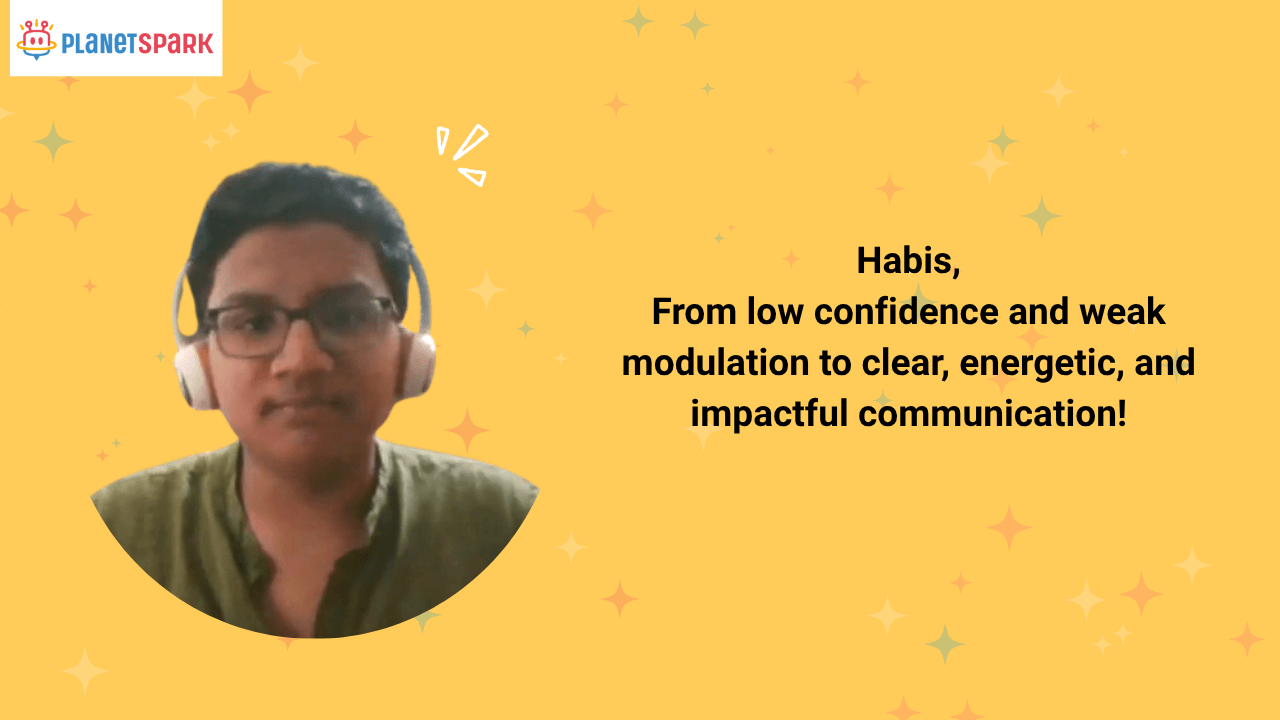
Meet Habis; once a shy speaker, now delivering every message with clarity, confidence, and strong stage presence.
How PlanetSpark Transforms "Doubters" into "Doers"
PlanetSpark transforms "doubters" into "doers" by treating confidence as a trainable skill rather than a fixed trait. Through our Personality Development program, we use a "Communication-Confidence Loop" to help you master how to overcome self-doubt at work and build a commanding professional presence.
- Executive Presence: Master voice modulation to sound like a natural authority figure.
- Improvised Speaking: Learn to think on your feet and handle unexpected questions with ease.
- Body Language Mastery: Align your non-verbal cues with your professional goals.
- Active Practice: Gain experience in a supportive, low-pressure environment.
- Expert Coaching: Receive real-time feedback to refine your unique leadership style.
Conclusion: Your Roadmap to Success
Becoming goal oriented at work is a journey, not a destination. It starts with the small, daily choice to prioritize impact over activity. It requires the discipline to look at your calendar and say, "This doesn't serve my purpose," and the courage to reflect on your progress every single week.
Frequently Asked Questions
Unlike traditional tutoring, PlanetSpark focuses on the holistic development of a child's confidence. Through interactive role-plays and "missions," children are encouraged to step out of their comfort zones. This reduces anxiety and fosters a "growth mindset," where obstacles are viewed as data points rather than failures, a core characteristic of any successful, goal-driven professional.
Absolutely. PlanetSpark’s curriculum focuses on "New Age Skills" like public speaking, critical thinking, and social etiquette. These are the foundations of goal oriented in management. A child who learns to articulate their vision and manage their time early is far more likely to grow into a leader who can align team efforts with organizational objectives and navigate high-pressure corporate environments.
PlanetSpark uses project-based learning to teach children the goal oriented meaning through real-world applications. By setting clear targets, such as delivering a 5-minute speech or completing a creative writing portfolio, students learn to break down large ambitions into manageable steps. This builds the "muscle memory" of success, teaching them that big results are the product of small, focused actions.
A task-oriented person focuses on the process, checking items off a list to stay busy. A goal oriented person focuses on the outcome. For example, a task-oriented employee might feel successful after sending 50 emails, while a goal-oriented employee feels successful only if those 50 emails move a project closer to its deadline or generate a specific number of leads.
The most effective way is to use the STAR method (Situation, Task, Action, Result). Instead of general claims, provide a specific metric-driven example: "I aimed to increase client retention by 15% (Goal); I implemented a new feedback loop (Action); and we achieved a 20% increase within six months (Result)." This proves you don't just work hard, you work with a specific, measurable destination in mind.
It is a dynamic combination of both. While some people are naturally more driven (trait), being goal oriented is primarily a developable soft skill. It involves mastering specific behaviors like time-blocking, backward mapping, and prioritization. Experts agree that this mindset is highly malleable and can be strengthened over time through consistent practice and the right organizational systems.