
Growth Mindset vs Fixed Mindset: Key Differences, Benefits, and How to Develop the Right Mindset
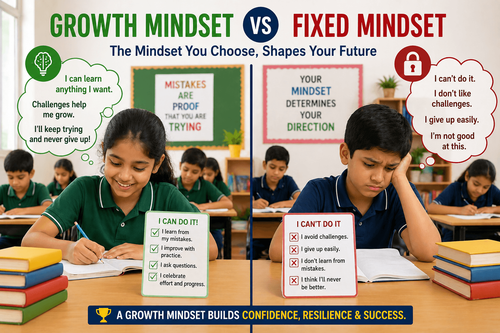

Table of Contents
- What is a Mindset?
- What is a Growth Mindset?
- What is a Fixed Mindset?
- Growth Mindset vs Fixed Mindset: Key Differences
- Why Growth Mindset is Important for Kids and Students
- Benefits of Developing a Growth Mindset
- How to Develop a Growth Mindset in Kids
- Activities to Build a Growth Mindset
- Role of Parents and Teachers in Shaping Mindset
- Common Myths About Growth Mindset
- PlanetSpark’s Role in Developing a Growth Mindset
- Long-Term Impact of Growth Mindset
- Conclusion
The way we think about our abilities plays a powerful role in shaping our success, confidence, and overall growth. This way of thinking is known as a mindset. In education and personal development, two types of mindsets are often discussed: the growth mindset and the fixed mindset. Understanding the difference between these two can significantly impact how children learn, how students perform, and how individuals handle challenges in life.
A growth mindset encourages the belief that abilities and intelligence can be developed through effort, learning, and persistence. In contrast, a fixed mindset assumes that talents and intelligence are static and cannot be changed. These contrasting beliefs influence how individuals respond to failure, challenges, and feedback.
In today’s competitive and fast-changing world, developing a growth mindset is essential for long-term success. This article explores the meaning of mindset, the differences between growth and fixed mindsets, and why cultivating the right mindset is crucial for children and learners.
What is a Mindset?
A mindset is a set of beliefs and attitudes that shape how individuals perceive their abilities and approach challenges. It influences decision-making, behavior, and the way people respond to success and failure.
Meaning of Mindset in Psychology
In psychology, mindset refers to the underlying assumptions individuals have about their intelligence, talents, and potential. These beliefs are often formed early in life and can be influenced by experiences, environment, and feedback from others.
For example, a child who is consistently praised for effort may develop a belief that hard work leads to improvement. On the other hand, a child who is labeled as “naturally smart” may feel pressured to maintain that image, leading to fear of failure.
Understanding mindset helps explain why some individuals embrace challenges while others avoid them.
Importance of Mindset in Learning and Development
Mindset plays a crucial role in academic success and personal growth. Students with a positive and adaptive mindset are more likely to take risks, try new strategies, and persist through difficulties.
A strong mindset also supports emotional development. It helps children handle setbacks, manage stress, and build resilience. In contrast, a limiting mindset can lead to self-doubt, fear of failure, and lack of motivation.
By shaping mindset early, parents and educators can influence how children approach learning and life challenges.
What is a Growth Mindset?
A growth mindset is the belief that abilities, intelligence, and skills can be developed through effort, practice, and learning. It encourages individuals to see challenges as opportunities rather than obstacles.
The concept of growth mindset was popularized by Carol Dweck, a renowned psychologist who studied motivation and learning. According to her research, individuals with a growth mindset believe that their potential is not fixed and can improve over time.
This belief fosters a love for learning and a willingness to embrace challenges, which are essential for personal and academic success.
Key Characteristics of a Growth Mindset
Children and individuals with a growth mindset display several positive traits that contribute to their development.
They are willing to take on challenges, even if the tasks seem difficult at first. Instead of avoiding obstacles, they view them as opportunities to learn and grow.
They also understand the value of effort. Rather than expecting immediate success, they focus on the process and are willing to put in the work required to improve.
Another important characteristic is resilience. When faced with failure, individuals with a growth mindset do not give up easily. Instead, they analyze their mistakes and use them as learning experiences.
They are also open to feedback. Constructive criticism is seen as a tool for improvement rather than a personal attack.
Examples of Growth Mindset in Daily Life
Growth mindset can be observed in everyday situations. For example, a student who struggles with math but continues to practice and seek help demonstrates a growth mindset.
Similarly, a child learning a new skill, such as playing an instrument or speaking a new language, may face challenges but remains motivated to improve.
Even simple statements reflect mindset differences. Saying “I can’t do this yet” instead of “I can’t do this” shows a willingness to learn and grow.
Build confidence, resilience, and learning skills—Join a FREE PlanetSpark Demo Class now!
What is a Fixed Mindset?
A fixed mindset is the belief that intelligence, talents, and abilities are static and cannot be changed. Individuals with this mindset often avoid challenges and fear failure.
Definition of Fixed Mindset
In a fixed mindset, people believe that their abilities are predetermined. They may think that they are either good at something or not, with little room for improvement.
This belief can limit personal growth and discourage individuals from trying new things.
Key Characteristics of a Fixed Mindset
Individuals with a fixed mindset often avoid challenges because they fear failure. They prefer to stay within their comfort zone where they feel safe and capable.
They may also give up easily when faced with difficulties. Instead of trying different approaches, they may assume that they are not capable of succeeding.
Another common trait is sensitivity to feedback. Criticism may be taken personally, leading to defensiveness or discouragement.
Additionally, they may feel threatened by the success of others, viewing it as a reflection of their own limitations.
Examples of Fixed Mindset Behavior
Fixed mindset behavior can be seen in statements like “I’m just not good at this” or “I’ll never be able to learn this.”
For example, a student who avoids participating in class discussions because they fear making mistakes is displaying a fixed mindset.
Similarly, a child who gives up on a puzzle after one failed attempt may believe that they lack the ability to solve it.
Growth Mindset vs Fixed Mindset: Key Differences
Understanding the differences between growth mindset and fixed mindset helps highlight their impact on learning and success.
A growth mindset encourages individuals to embrace challenges, persist through difficulties, and view effort as a path to mastery. In contrast, a fixed mindset leads to avoidance of challenges, fear of failure, and a belief that effort is unnecessary if one is truly talented.
When it comes to failure, individuals with a growth mindset see it as a learning opportunity, while those with a fixed mindset may view it as a reflection of their limitations.
In terms of feedback, a growth mindset welcomes constructive criticism, whereas a fixed mindset may resist or ignore it.
These differences ultimately influence long-term outcomes. A growth mindset supports continuous improvement and success, while a fixed mindset can limit potential.
Help your child develop a growth mindset for success—Book a FREE PlanetSpark Demo Class today!
Why Growth Mindset is Important for Kids and Students
Developing a growth mindset in children and students is essential for long-term academic success and emotional well-being. In an increasingly competitive environment, children who believe they can improve through effort are more likely to stay motivated and resilient.
Improves Academic Performance
A growth mindset encourages students to focus on learning rather than just results. Instead of aiming only for high marks, they begin to value understanding concepts and improving skills. This shift in perspective leads to deeper learning and better academic outcomes over time.
Students with a growth mindset are also more willing to try new strategies when they face difficulties. Rather than giving up on a challenging subject, they explore different approaches, seek help, and continue practicing until they succeed.
Builds Confidence and Resilience
Confidence is not just about success—it is about the ability to face challenges without fear. A growth mindset helps children understand that failure is not the end but a step toward improvement.
When children learn to handle setbacks positively, they develop resilience. This ability to bounce back from failure is crucial not only in academics but also in life.
Over time, this resilience builds a strong sense of self-belief, allowing children to take risks and explore new opportunities.
Enhances Problem-Solving Skills
A growth mindset encourages curiosity and critical thinking. Children learn to analyze problems, experiment with solutions, and learn from mistakes.
This approach enhances problem-solving skills, making them more adaptable and resourceful. Whether it’s solving a math problem or navigating a social situation, children with a growth mindset are better equipped to find effective solutions.
Benefits of Developing a Growth Mindset
Adopting a growth mindset offers a wide range of benefits that extend beyond academic success. It shapes how individuals approach life, challenges, and opportunities.
One of the most significant benefits is improved learning ability. Individuals with a growth mindset are more open to acquiring new skills and knowledge, making them lifelong learners.
Motivation is another key advantage. When people believe that effort leads to improvement, they are more likely to stay committed and work hard toward their goals.
A growth mindset also contributes to better mental well-being. It reduces fear of failure and promotes a positive attitude toward challenges, helping individuals manage stress more effectively.
Additionally, it improves communication and interpersonal skills. People with a growth mindset are more open to feedback and collaboration, which strengthens relationships.
Overall, a growth mindset creates a foundation for continuous growth and long-term success.
How to Develop a Growth Mindset in Kids
Developing a growth mindset requires consistent effort and guidance from parents and educators. It involves creating an environment that encourages learning, effort, and resilience.
Encourage Effort Over Results
One of the most effective ways to build a growth mindset is to focus on effort rather than outcomes. Praising children for their hard work, persistence, and strategies reinforces the idea that success comes from effort.
For example, instead of saying “You’re so smart,” parents can say, “You worked really hard on this.” This shifts the focus from innate ability to effort and improvement.
Teach Kids to Embrace Challenges
Children should be encouraged to step out of their comfort zones and take on new challenges. This helps them understand that growth happens when they try something difficult.
Parents and teachers can create opportunities for children to explore new activities, whether it’s learning a new subject, participating in a competition, or developing a new skill.
Use Positive Language and Self-Talk
The way children talk to themselves has a significant impact on their mindset. Encouraging positive self-talk helps them build confidence and resilience.
Replacing phrases like “I can’t do this” with “I can learn this with practice” fosters a growth-oriented attitude.
Adults can model this behavior by using positive language in their own communication.
Promote Learning from Mistakes
Mistakes should be seen as opportunities to learn rather than failures to avoid. Teaching children to analyze their mistakes and understand what went wrong helps them improve.
Parents and teachers can create a safe environment where children feel comfortable making mistakes and learning from them.
Activities to Build a Growth Mindset
Practical activities can help reinforce growth mindset principles and make learning more engaging for children.
Goal-setting exercises are a great way to encourage children to focus on progress. By setting achievable goals and tracking their progress, children learn the value of effort and persistence.
Reflection journals allow children to think about their experiences, identify challenges, and recognize their improvements. This helps them develop self-awareness and a positive attitude toward learning.
Problem-solving games encourage critical thinking and creativity. These activities challenge children to find solutions and learn from trial and error.
Role-playing challenges can also be effective. By acting out different scenarios, children can practice handling difficult situations and develop confidence in their abilities.
Empower your child to embrace challenges and grow—Sign up for a FREE PlanetSpark Demo Class today!
Role of Parents and Teachers in Shaping Mindset
Parents and teachers play a crucial role in shaping a child’s mindset. Their attitudes, feedback, and behavior significantly influence how children perceive themselves and their abilities.
Creating a Supportive Environment
A supportive environment encourages curiosity, exploration, and learning. Children should feel safe to ask questions, try new things, and make mistakes without fear of judgment.
Positive reinforcement and encouragement help build confidence and motivation.
Modeling Growth Mindset Behavior
Children learn by observing adults. When parents and teachers demonstrate a growth mindset—by embracing challenges, learning from mistakes, and showing persistence—children are more likely to adopt the same attitude.
For example, sharing personal experiences of overcoming challenges can inspire children to develop a similar mindset.
Providing Constructive Feedback
Feedback should focus on improvement rather than criticism. Constructive feedback helps children understand their strengths and areas for growth.
Instead of pointing out what went wrong, adults can guide children on how to improve, making feedback more effective and encouraging.
Common Myths About Growth Mindset
There are several misconceptions about growth mindset that can lead to misunderstandings.
One common myth is that having a growth mindset means always being positive. In reality, it involves acknowledging challenges and working through them, not ignoring difficulties.
Another misconception is that growth mindset ignores natural talent. While effort is important, individual strengths also play a role in success.
Some people also believe that adopting a growth mindset leads to instant results. However, it is a gradual process that requires consistent effort and practice.
Understanding these myths helps in applying growth mindset principles more effectively.
PlanetSpark’s Role in Developing a Growth Mindset
In today’s learning environment, structured platforms play an important role in nurturing essential skills and mindsets. One such platform is PlanetSpark, which focuses on building communication and confidence in children.
PlanetSpark’s programs are designed to encourage creativity, self-expression, and continuous improvement—all key aspects of a growth mindset. Through activities like public speaking, storytelling, and creative writing, children learn to overcome fear, accept feedback, and improve their skills.
The platform provides personalized guidance, helping children identify their strengths and work on areas of improvement. This approach fosters a positive learning attitude and builds confidence.
By integrating communication skills with mindset development, PlanetSpark helps children become more resilient, adaptable, and confident learners.
Long-Term Impact of Growth Mindset
The benefits of a growth mindset extend far beyond childhood. Individuals who develop this mindset are better prepared to handle challenges in their personal and professional lives.
A growth mindset supports continuous learning, which is essential in today’s rapidly changing world. It also enhances emotional intelligence, helping individuals manage stress and build strong relationships.
In the long run, a growth mindset contributes to career success, adaptability, and overall well-being. It empowers individuals to take control of their development and pursue their goals with confidence.
Conclusion
Understanding the difference between growth mindset and fixed mindset is the first step toward personal and academic growth. While a fixed mindset can limit potential, a growth mindset opens the door to continuous improvement and success.
By encouraging effort, embracing challenges, and learning from mistakes, parents and educators can help children develop a mindset that supports lifelong learning.
In a world full of opportunities and challenges, cultivating a growth mindset is one of the most valuable skills a child can develop. With consistent practice and the right guidance, every child can learn to believe in their ability to grow and succeed.
Frequently Asked Questions
A growth mindset believes abilities can improve through effort, while a fixed mindset assumes abilities are unchangeable.
It helps students stay motivated, handle challenges, and improve their learning outcomes.
Yes, with practice, guidance, and positive reinforcement, a fixed mindset can be transformed into a growth mindset.
By encouraging effort, using positive language, and helping children learn from mistakes.