
Heuristic Meaning and Problem Solving Skills at PlanetSpark


Table of Contents
- Understanding the Heuristic Meaning: A Simple Start
- What is a Heuristic? A Deeper, Practical Explanation
- Why Understanding Heuristic Meaning Matters for Students
- Types of Heuristics: The Building Blocks of Better Thinking
- How Heuristics Improve Logical Reasoning Skills
- Heuristic Meaning in Real Life: Simple Examples Students Wil
- Success Story: Shreesh’s Creative Growth with PlanetSpark
- PlanetSpark and Heuristic Learning: A Perfect Match for Mode
- Heuristic Meaning in Communication & Public Speaking
- Why PlanetSpark Is the Perfect Learning Partner for Your Chi
- Learn Heuristic Meaning as a Lifelong Skill With PlanetSpark
Heuristic meaning refers to using smart mental shortcuts that help people solve problems quickly and make faster decisions without overthinking. This guidance explains the concept in a simple, practical way, showing how heuristics improve learning, reasoning, communication, and everyday choices. It also highlights how PlanetSpark strengthens these skills through interactive activities, real-world practice, and intuitive thinking techniques that help children become confident, sharp, and efficient problem-solvers.
Understanding the Heuristic Meaning: A Simple Start
Before diving deep, let’s define the core idea.
Heuristics meaning refers to the approach of using mental shortcuts, practical strategies, or rule-of-thumb techniques to solve problems quickly and efficiently. Instead of analysing everything in detail, heuristics help us make smart guesses, form quick judgements, and arrive at workable solutions.
These shortcuts do not guarantee perfect outcomes every time but they dramatically speed up thinking.
At its core, the heuristic mindset is about being resourceful, drawing from experience, and using simplified reasoning to reach a solution that is “good enough” for the moment.
Think of heuristics as:
- Cognitive shortcuts
- Fast-thinking tools
- Practical decision guides
- Efficient problem-solving methods
- Smart ways to reduce mental load
Understanding heuristic meaning is especially important today because we deal with more choices, more information, and more pressure than ever before.

What is a Heuristic? A Deeper, Practical Explanation
The question “What does Heuristic mean?” deserves a thorough, clear answer because students, teachers, and professionals often misunderstand the concept.
A heuristic is:
- A mental shortcut
- A problem-solving technique
- A simplified rule that saves time
- An intuitive strategy
- A quick method to find an approximate answer
Instead of using a strict formula or carrying out a complex analysis, heuristics rely on instinct, experience, and simplified reasoning.
Here are a few examples to illustrate:
Example 1: Shopping Decisions
You see two products. One is familiar, the other is not. You instantly pick the familiar one.
This is the familiarity heuristic when you trust what you already know.
Example 2: Choosing a Route
When driving, you avoid narrow lanes without checking traffic data because you assume broader roads are faster.
This is the availability heuristic by using immediately available information.
Example 3: Solving a Puzzle
You look for patterns rather than trying every possibility.
This is the pattern heuristic, used widely in mathematics and reasoning.
Example 4: Exam Preparation
Instead of reading the whole chapter, you revise summaries and solve past papers first.
A great example of the efficiency heuristic.
These shortcuts reduce complexity and help you make decisions with confidence.
Give Your Child the Power to Speak with Confidence!
Why Understanding Heuristic Meaning Matters for Students
Students today face challenges that require quick comprehension, smart learning, and sharper decision-making. Mastering heuristics can boost:
1. Academic Excellence
Heuristics help students solve reasoning questions, interpret comprehension passages, understand tricky word problems, and break down big tasks into manageable steps.
2. Faster Thinking
Exams, interviews, and competitions reward quick, accurate thinking. Heuristics reduce overthinking and improve response time.
3. Smart Learning
Students learn how to prioritise important information, ignore irrelevant data, and decode patterns—skills essential for subjects like maths, science, language, and logical reasoning.
4. Stress-Free Exam Preparation
Instead of memorising everything, students learn how to study strategically using mental shortcuts.
5. Real-World Decision-Making
From choosing friends wisely to managing time better, heuristics prepare children to make sensible choices in daily life.
This is exactly where platforms like PlanetSpark bring a unique advantage like teaching children to think, reason, communicate, and solve problems confidently using modern learning techniques. Students can click this link to unlock their best self with online Personality Development Classes from PlanetSpark professionals
Types of Heuristics: The Building Blocks of Better Thinking
To truly grasp heuristic meaning, it helps to understand its main types. These categories appear in psychology, cognitive science, linguistics, reasoning exams, and communication development.
1. Availability Heuristic
People base decisions on the examples that easily come to mind.
Example: You think air travel is dangerous after hearing news of one crash.
2. Anchoring Heuristic
You rely too heavily on the first piece of information you encounter.
Example: If the first price you see for a phone is ₹50,000, anything below it feels like a bargain.
3. Representativeness Heuristic
You judge based on similarities or stereotypes.
Example: Believing a quiet person must be an introvert.
4. Recognition Heuristic
If you recognise one option and not the other, you assume the familiar one is better.
Example: Choosing a known brand over an unknown one.
Help Your Child Grow into a Smart and Confident Communicator!
5. Affect Heuristic
Decisions based on emotions rather than logic.
Example: Avoiding a subject simply because it looks difficult.
6. Simplicity Heuristic
Choosing the simplest explanation or solution.
Example: Students picking the shortest solution in maths when time is limited.
Understanding these types makes decision-making much more conscious and controlled. Click this link to get personality development training for all ages from the professionals of PlanetSpark.
How Heuristics Improve Logical Reasoning Skills
Logical reasoning is at the heart of academic success. Heuristics help students solve:
- Puzzles
- Logical sequences
- Patterns
- Deductive questions
- Word problems
- Critical reasoning
- Verbal and non-verbal reasoning
Here’s how heuristics help:
1. Pattern Recognition
Heuristics push the mind to identify similarities, shapes, sequences, and repeated ideas—skills crucial for reasoning exams.
2. Time Efficiency
Most competitive tests give very little time per question. Heuristics allow students to eliminate wrong choices quickly.
3. Smart Estimation
When exact answers aren’t necessary, approximations save time and effort.
4. Breaking Complex Problems
Students learn to divide large questions into smaller, manageable chunks.
5. Recalling Relevant Information
Instead of scanning the entire memory, heuristics pull out only the most relevant examples.
In short, heuristics upgrade a student’s problem-solving toolkit.
Heuristic Meaning in Real Life: Simple Examples Students Will Love
To truly internalise the idea, here are relatable real-life examples:
Choosing What to Wear
You look outside, see clouds, and instantly grab a jacket.
Availability heuristic
Guessing the Meaning of a New Word
You match it with a familiar root word.
Linguistic heuristic
Choosing a Book
You pick the one with an attractive cover or known author.
Recognition heuristic
Solving a Maths Problem
You skip unnecessary steps and use a mental shortcut.
Problem-solving heuristic
While Speaking on Stage
You follow the “3-point rule” instead of memorising everything.
Communication heuristic
Choosing a Friend
You trust your intuition rather than analysing every quality.
Affect heuristic
These examples show why understanding heuristic meaning is so essential for students and adults alike.
Success Story: Shreesh’s Creative Growth with PlanetSpark
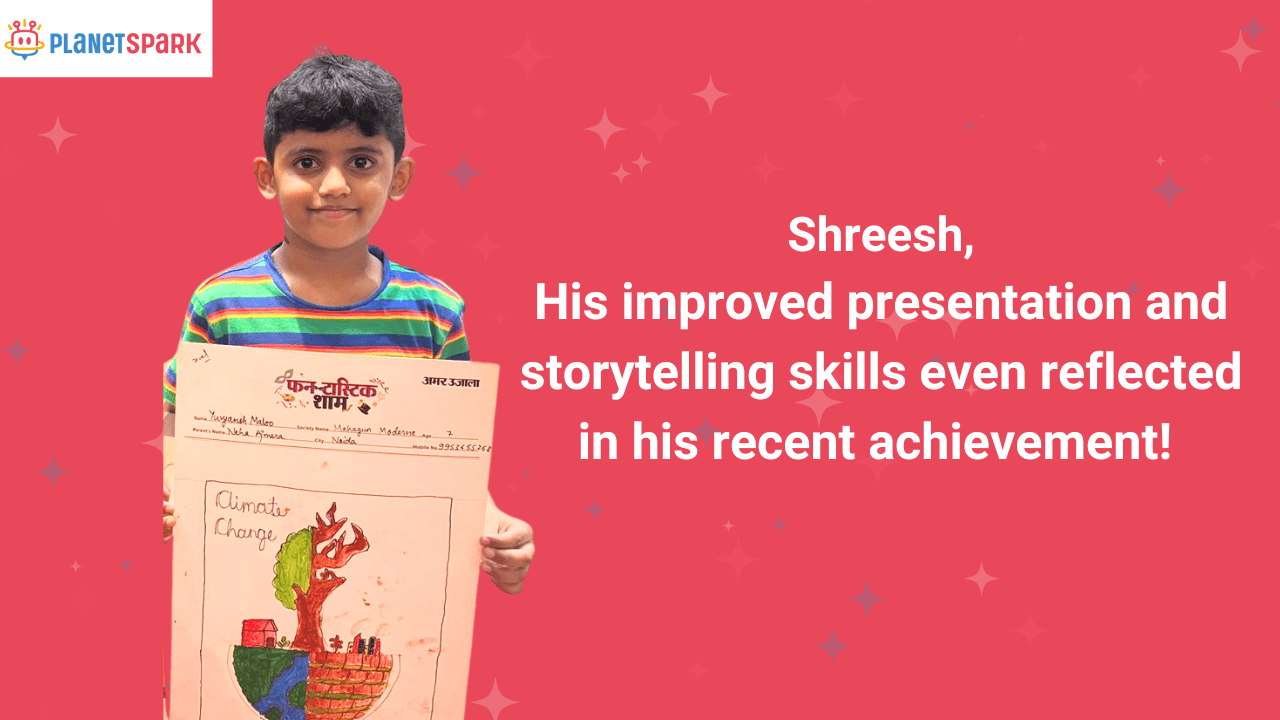
PlanetSpark has helped Shreesh express his ideas creatively and confidently. His improved presentation and storytelling skills even reflected in his recent achievement — winning second place in the Junior Category of a drawing competition on ‘Climate Change’ organised by the Amar Ujala team.
If you want your child to build confidence, think creatively, and communicate with clarity, PlanetSpark’s expert-guided classes can help them grow just like Shreesh. Let your child take the next step toward stronger skills today!
PlanetSpark and Heuristic Learning: A Perfect Match for Modern Learners
PlanetSpark is known for strengthening communication skills, public speaking, creative writing, and overall cognitive development in children. What many don’t realise is that PlanetSpark naturally integrates heuristic-based learning techniques into its classes.
Here’s how PlanetSpark enhances heuristic thinking:
1. Smart Learning Framework
Children learn to summarise, prioritise, and decode ideas quickly about core principles of heuristic reasoning.
2. Confidence-Based Decision Making
Public speaking activities train quick reflexes, spontaneous thinking, and intuitive responses.
3. Pattern Recognition through Activities
Creative worksheets and reasoning exercises strengthen mental shortcuts.
4. Exposure to Real-World Scenarios
Role plays, debates, and storytelling help students build emotional, analytical, and recognition heuristics.
5. Critical Thinking Development
Teachers guide students to question, explore, and refine their intuition rather than memorise blindly.
6. Consistent Practice
Regular sessions transform heuristics from a concept into a habit.
Students who learn with PlanetSpark naturally become faster thinkers, better speakers, sharper learners, and confident problem solvers.
Heuristic Meaning in Communication & Public Speaking
Heuristics are not limited to psychological theory but they are vital in communication and presentation skills too.
1. The Rule of Three
Speakers break down ideas into three parts because audiences remember three points easily.
2. First-Impression Anchoring
Listeners anchor their judgement on the speaker’s opening lines.
3. The Familiarity Heuristic in Writing
Readers trust topics that connect to known stories or examples.
4. Simplicity Heuristic in Explaining Complex Ideas
Great speakers simplify, not overcomplicate.
5. Emotion-Based Persuasion
Emotions influence audience decisions more than logic alone.
PlanetSpark trains students in all these communication heuristics, helping them become impactful speakers at a young age.

Why PlanetSpark Is the Perfect Learning Partner for Your Child
PlanetSpark creates confident, well spoken, and future ready children through personalised training, engaging digital tools, and activity based learning. With expert coaching and structured practice, kids develop communication strength, emotional intelligence, and strong personality traits that help them thrive in school and beyond.
Personality Development Services at PlanetSpark:
- Builds confidence through guided speaking and real time practice
- Strengthens leadership and teamwork with interactive tasks
- Enhances emotional intelligence using SEL based modules
- Improves social etiquette and polite communication skills
- Teaches body language, eye contact, and effective posture
- Encourages clarity of thought through journaling and reflections
- Boosts decision making and problem solving abilities
- Develops assertiveness and respectful expression
- Supports goal setting and personal growth habits
- Offers regular parent consultations for steady progress
Learn Heuristic Meaning as a Lifelong Skill With PlanetSpark
Heuristics are not just academic tools but they are life skills that help in decision-making, communication, creativity, problem-solving, and understanding the world. When students learn heuristics, they learn how to think smarter, faster, and with greater confidence.
Platforms like PlanetSpark accelerate this journey by giving children a structured environment to strengthen intuition, communication, critical thinking, and real-time decision-making. Through interactive activities, guided reasoning, and spontaneous speaking opportunities, children learn to apply mental shortcuts in meaningful ways.
Mastering heuristics early lays the foundation for success in school, competitive exams, college, professional life, and personal growth. It empowers children to navigate challenges without fear, think independently, and grow with confidence.
Frequently Asked Questions
Heuristic Meaning refers to using quick mental shortcuts or practical strategies to solve problems efficiently. Instead of following long steps, heuristics help you make smart, fast decisions based on experience, patterns, and intuition.
Heuristics help students think faster, solve reasoning questions, understand concepts quickly, and reduce overthinking. They improve decision-making, exam performance, problem-solving, and overall cognitive flexibility, making learning smoother and more effective.
Heuristics guide everyday decisions such as choosing familiar products, estimating answers, selecting the best route, or guessing meanings from context. They simplify complex situations, helping people react quickly without analyzing every detail.
PlanetSpark builds heuristic thinking through interactive classes, reasoning activities, public speaking sessions, and real-life decision-making tasks. Children naturally develop quicker judgment, pattern recognition, and confident problem-solving, boosting their cognitive and communication skills.
Yes. Speakers use heuristics like simplifying ideas, structuring points in threes, recalling patterns, and making intuitive decisions during presentations. These shortcuts help them speak confidently, engage audiences, and deliver clear, impactful messages.
PlanetSpark blends intuitive learning, structured practice, and confidence-building tasks. Children learn to think faster, respond spontaneously, and use mental shortcuts wisely, helping them apply heuristic meaning in academics, communication, and real-life situations.