
How to Help Your Child Handle Stress and Frustration


Table of Contents
- How to Help Children Manage Frustration
- How to Help Your Child Manage Frustration?
- Understand What Sparks the Frustration
- Common Reasons Children Feel Frustrated
- Encourage Kids to Take Control
- Teach Self-Talk for Confidence
- Stay Calm When Your Child Is Frustrated
- Validate Your Child’s Feelings
- Help Them Label Emotions
- Help Them Verbalize Their Feelings
- Teach Deep Breathing & Stoplight Technique
- Use Distraction Techniques
- Redirect Anger Into Positive Actions
- Positive Redirection Ideas
- Avoid Common Triggers
- Build From Your Child’s Strengths
- Give Positive Attention
- Improve Verbal Communication
- Accept Your Child’s Anger
- Encourage “Rethinking Emotions”
- Take Breaks When Needed
- What to Say When Your Child Is Frustrated (Scripts for Paren
- Handling Frustration in School
- How to Help a Child with Anger Issues at School
- For Children Who Get Frustrated While Learning
- Use Visual Tools to Teach Patience & Emotions
- Encourage Physical Movement to Release Stress
- Fun Activities to Build Frustration Tolerance
- Activity 5 : Freeze and Breathe
- Conclusion:
- About PlanetSpark : Personality Development
Frustration is a natural emotion. Every child feels it whether during homework, while playing games, or when something doesn’t go their way. But learning how to manage frustration is an important life skill that helps children grow into confident, patient, emotionally strong adults. In this blog, we will explore why children get frustrated, how parents can help, and fun activities to build frustration tolerance.
We will also share tips inspired by PlanetSpark’s learning methods, where children are taught emotional control, communication skills, and confidence through engaging activities.
How to Help Children Manage Frustration
Frustration is normal for every child. It happens when things don’t go their way like tough homework, losing a game, or arguments with friends. Learning to manage frustration helps children stay calm, confident, and happy.
This guide shares simple tips and fun activities to help kids handle their feelings and turn frustration into a positive skill.
Confidence begins with the first small step.
Book a free demo class today.
How to Help Your Child Manage Frustration?
Frustration looks different for every child.
Some children cry, Some get angry, Some shout or throw things, Some become silent And some simply give up.
But the good news?
Children can learn to manage frustration just like they learn maths, reading, or sports.
Below are the best strategies explained simply that parents and kids can start using today.
Understand What Sparks the Frustration
Before solving frustration, we must know what causes it.
Common Reasons Children Feel Frustrated
Here’s a simple table that explains common causes:
| Cause | Examples |
|---|---|
| Schoolwork | Difficult math problem, reading long chapters, spelling mistakes |
| Games & Sports | Losing a game, not scoring well, slow improvement |
| Social Situations | Friends not listening, feeling left out |
| Family Expectations | Being told to study, follow rules, finish homework |
| Communication Problems | Not able to express feelings or needs |
| Overwhelm | Too many tasks, too much noise, too many instructions |
Activity : Frustration Detective
Ask your child to become a Detective and find what made them frustrated today.
Make a daily sheet:
| What happened? | How I felt | What I did | What I can do next time |
|---|
This helps children understand emotions instead of reacting to them.
Encourage Kids to Take Control
Children feel better when they feel capable.
Instead of doing everything for them, help them learn how to handle situations on their own.
Teach Self-Talk for Confidence
Example phrases a child can use:
“I can try again.”
“I am learning.”
“It’s okay to make mistakes.”
“I’ll ask for help calmly.”
“I won’t give up.”
Children who speak kindly to themselves stay calmer during hard moments
Stay Calm When Your Child Is Frustrated
Kids learn by watching. If the parent stays calm, the child feels safe. But if the parent reacts with anger, shouting, or frustration the child gets more upset.
Calm Parent = Calm Child Formula
Here is a simple method:
Pause → Breathe → Speak Softly → Guide
Example
Child: “I CAN’T DO THIS MATH! IT’S TOO HARD!”
Parent: (takes a deep breath) “I hear you. Let’s slow down and try one small step together.”
Your calm voice helps your child feel understood.
Validate Your Child’s Feelings
Validation means saying:
“I understand your feeling.”
“It’s okay to feel this way.”
This makes children feel respected.
Examples of Validation
Instead of saying:
“Stop crying.”
“Don’t be angry.”
“It’s nothing.”
Say this:
“I can see you are frustrated.”
“It’s okay to feel upset.”
“Let’s talk about it.”
Validation opens the door to communication.
Read More: Great speakers aren’t born, they’re nurtured.
Help Them Label Emotions
Many children do not know the words for their feelings.
When they cannot express, they become more frustrated.
Simple Emotion Words for Kids
| Feeling | Meaning |
|---|---|
| Frustrated | Something is not working the way I want |
| Angry | Strong upset feeling |
| Confused | Not understanding something |
| Nervous | Worried or scared |
| Excited | Happy and energetic |
| Disappointed | Expectation not met |
Fun Game “Emotion Bingo”
Make boxes with feelings.
When your child feels something, they point to the box.
This builds emotional vocabulary.
Help Them Verbalize Their Feelings
After naming emotions, teach them to talk about those emotions.
Examples:
“I feel angry because my game crashed.”
“I feel frustrated because I can’t solve this question.”
“I feel sad because my friends didn’t include me.”
Talking reduces emotional pressure.
Strong communication builds a strong personality.
Book a free demo class now
Teach Deep Breathing & Stoplight Technique
This is a powerful, child-friendly method.
Stoplight Method
| Light | Meaning | Child Action |
|---|---|---|
| Red | I’m very upset | Stop. Do nothing. Pause. |
| Yellow | I’m calming down | Take deep breaths. Think of choices. |
| Green | I feel okay | Try again or take positive action. |
Deep Breathing Exercise (for Kids)
Ask your child to:
Breathe in for 4 seconds
Hold for 2 seconds
Breathe out for 6 seconds
Repeat 5–7 times.
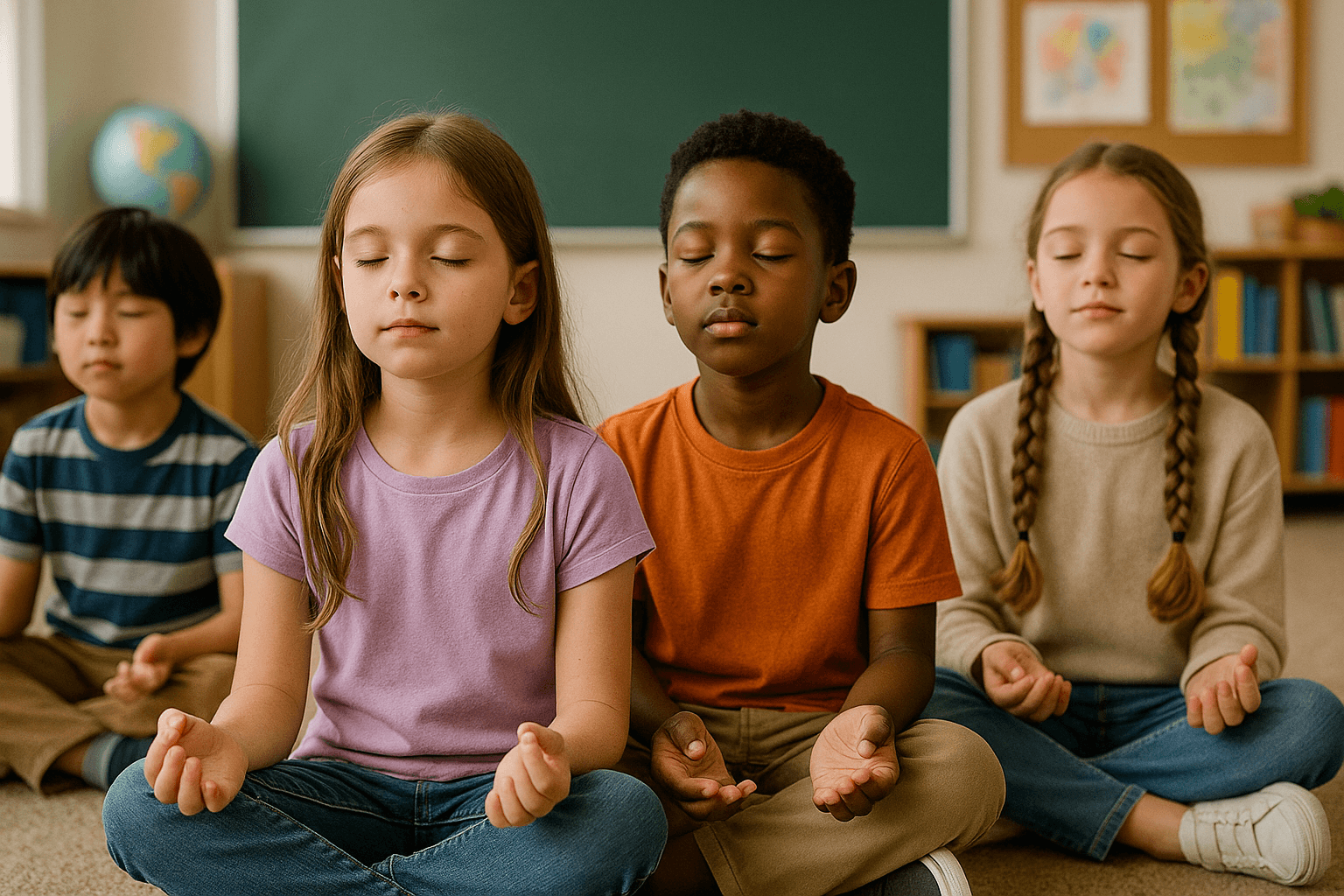
Use Distraction Techniques
Sometimes frustration becomes too strong.
In those moments, distraction works well.
Healthy Distractions
Drink water
Walk for 2 minutes
Stretch
Listen to calming music
Draw or doodle
Play with a stress ball
Look outside the window
A small break resets the brain.
Problem Solving Together
Instead of giving solutions immediately, guide children to find their own answers.
4 Step Problem Solver for Kids
What is the problem?
What are 2–3 possible solutions?
Which solution is best?
Try it and see what happens.
This teaches independence.
Redirect Anger Into Positive Actions
Children’s anger is powerful energy.
Redirect it don’t suppress it.
Positive Redirection Ideas
| Angry Behavior | Healthy Alternative |
|---|---|
| Shouting | Counting backwards from 10 |
| Throwing things | Punch a pillow, squeeze a stress ball |
| Hitting | Do 10 jumping jacks |
| Crying loudly | Go to a quiet corner and breathe |
You can create a “Calm Corner” at home with:
Soft toys
Coloring books
Stress balls
Emotion cards
Water bottle
Avoid Common Triggers
Some situations create repeated frustration.
Identify & Reduce Triggers
| Trigger | Example | What Parents Can Do |
|---|---|---|
| Overloaded homework | Too many tasks at once | Break tasks into smaller chunks |
| Hunger | Child gets cranky | Give snacks at the right time |
| Sleep | Child is tired | Maintain bedtime routine |
| Too much noise | Loud environment | Create a quiet study space |
| Pressure | High expectations | Encourage effort, not perfection |
Build From Your Child’s Strengths
Every child has strengths:
Creativity
Memory
Logic
Communication
Kindness
Problem-solving
Leadership
Humor
Celebrate Strengths Weekly
Make a “Strength Chart”:
| Child’s Strength | Example This Week | Parent Comment |
|---|---|---|
| Patience | Waited calmly before asking for help | “Great self-control!” |
| Creativity | Made a story | “Loved your imagination!” |
| Confidence | Spoke in class | “You were brave!” |
This boosts emotional resilience.
Your child’s voice deserves to be heard.
Book a free demo class
Give Positive Attention
Children feel calmer when they receive positive attention.
Daily 10 Minute Rule
Spend 10 minutes daily in undisturbed parent-child time:
Play a game
Draw together
Talk
Walk
Read a short story
When children feel connected, frustration reduces.
Improve Verbal Communication
Children often become frustrated when they cannot express themselves clearly. PlanetSpark strongly focuses on improving communication skills for children.
Easy Communication Exercises
Describe a picture in detail
Explain an object in 30 seconds
Practice storytelling
Say 3 things they liked about school today
Ask open-ended questions
These strengthen speaking skills and reduce emotional outbursts.
Accept Your Child’s Anger
Anger is normal.
Children feel:
Angry
Disappointed
Embarrassed
Overwhelmed
Parents should accept these emotions without judgment.
Use the Phrase
“It’s okay to feel this way. Let’s handle it together.”
Acceptance creates emotional safety.

Encourage “Rethinking Emotions”
Teach children:
“Emotions are not bad. They are messages.”
Examples:
Anger = Something feels unfair
Frustration = Something is difficult
Sadness = Something matters
Fear = Something feels risky
When children understand emotions, they control them better.
Take Breaks When Needed
Sometimes, the best solution is a pause.
Break Ideas
Splash water on face
Eat a fruit
Go for a small walk
Pet an animal
Stretch
Listen to calming sounds
What to Say When Your Child Is Frustrated (Scripts for Parents)
Here are helpful sentences:
Calming Scripts
“I’m right here with you.”
“Let’s solve this together.”
“Take your time.”
“Let’s try a different way.”
“It’s okay to ask for help.”
Motivational Scripts
“You are learning. Mistakes are okay.”
“I saw how hard you tried.”
“Let’s take a break and try again.”
“You can do this.”
Handling Frustration in School
Many children get frustrated at school because:
Teachers move fast
Friends don’t understand
Homework piles up
They feel embarrassed asking questions
Help Children Speak Up
Teach them to say:
“Can you explain this again?”
“I need a little help.”
“Can you slow down?”
“I didn’t understand this part.”
Communication reduces classroom stress.

How to Help a Child with Anger Issues at School
Here are the steps:
Step by Step Action Plan
Talk to your child about what happened.
Discuss the triggers.
Inform the teacher.
Teach calming methods.
Practice role-plays at home.
Celebrate improvements.
PlanetSpark uses similar methods during speaking classes.
Every confident child starts with guidance and practice.
Book a free demo class today.
For Children Who Get Frustrated While Learning
Some children feel pressure because they want to get everything right.
Teach them:
Learning takes time
It’s okay to fail
Progress matters more than perfection
Turn learning into a fun activity instead of a stressful task.
Teach Children the Power of Routine
Children feel safe when they know what will happen next.
A predictable routine reduces frustration because children feel prepared, confident, and in control.
Benefits of a Daily Routine
| Routine Element | How It Helps the Child |
|---|---|
| Fixed wake-up time | Reduces morning rush stress |
| Study hour | Helps mental preparation |
| Playtime | Releases stress and builds emotional balance |
| Family talk time | Improves communication |
| Bedtime routine | Reduces tiredness-related anger |
Simple Routine Chart for Kids
Wake up
Freshen up
Breakfast
School time
Rest
Homework
Play
Dinner
Family talk
Sleep
Children with routines feel more stable emotionally.
Use Visual Tools to Teach Patience & Emotions
Kids understand better when they can see ideas.
Useful Visual Tools
| Tool | How It Helps |
|---|---|
| Emotion Cards | Helps children identify feelings |
| Traffic Light Chart | Helps predict behaviour phases |
| Patience Thermometer | Shows when frustration is rising |
| Calm-Down Wheel | Offers choices for calming activities |
| Routine Charts | Reduces confusion and anger |
Fun Classroom Style Activity
“Color Your Feelings”
Give your child 5 colors and let them color how they feel right now.
Red = Angry
Yellow = Nervous
Blue = Sad
Green = Calm
Pink = Happy
This simple visual game helps them understand emotional changes.
Encourage Physical Movement to Release Stress
Sometimes frustration builds up like energy in the body.
Physical movement helps release that energy safely.
Quick Movement Ideas (1–2 minutes)
10 jumping jacks
Running on the spot
Dancing for 30 seconds
Stretching arms and legs
Touch-your-toes challenge
Shake-your-hands exercise
Why Movement Helps
Reduces anger
Refreshes the mind
Improves oxygen flow
Shifts focus from the problem
Makes problem-solving easier afterward
Movement is a natural calm-down strategy for children.
Personality grows when children learn to express freely.
Book a free demo class.
Fun Activities to Build Frustration Tolerance
Here are enjoyable ways to help children grow emotionally stronger.
Activity 1 : Puzzle Time Challenge
Give a difficult puzzle.
Set a timer.
Encourage them to take breaks.
Teach them to stay patient.
Activity 2 : Balloon Melt Down
Ask your child to blow a balloon slowly.
This calms anxiety instantly.
Activity 3 : Slow-Mo Drawing
Ask them to draw something very slowly.
This builds patience.
Activity 4 : Throw Your Anger Away
Give them paper to scribble when angry.
Then throw it in the dustbin.
Activity 5 : Freeze and Breathe
Play music.
When music stops → freeze → take 3 deep breaths.
Fun + calming = best combination.
Conclusion:
Frustration is a part of growing up, but it doesn’t have to control your child. With patience, guidance, and simple strategies like deep breathing, problem solving, and positive attention children can learn to manage their emotions calmly. Encouraging them, validating their feelings, and practicing fun activities builds confidence, patience, and emotional strength.
By helping your child handle frustration today, you are giving them a lifelong skill that will make them happier, more resilient, and ready for any challenge.
About PlanetSpark : Personality Development
PlanetSpark helps children build confidence, strong communication skills, and a powerful personality through interactive, 1:1 live classes. Our Personality Development Program strengthens social skills, expression, leadership, and emotional intelligence helping kids present themselves confidently in school and in life.
1. 1:1 Expert Mentorship
Each child learns with a certified personality development coach who tailors every session to their behaviour, strengths, and comfort level ensuring visible confidence and personal growth.
2. Personalised Growth Roadmap
A customised curriculum develops communication, body language, social etiquette, emotional awareness, and leadership skills guiding learners from shy to self-assured.
3. AI-Powered Expression & Communication Feedback
With SparkX and AI-led practice tools, students receive instant insights on voice, clarity, expression, and body language making improvement fast, measurable, and fun.
4. Interactive & Activity-Based Learning
Roleplays, storytelling, debates, creative tasks, and real life scenarios help children practise social skills in a playful, engaging way that boosts confidence naturally.
5. Confidence for Every Situation
Through guided speaking drills, group interaction activities, and stage-readiness training, kids learn to express themselves clearly and confidently whether in class, on stage, or in everyday life.
Frequently Asked Questions
Because something feels difficult, overwhelming, or they cannot express their feelings.
Use deep breathing, distraction, validation, or a calm corner.
Yes, 100% normal. It is part of emotional growth.
Use games, puzzles, calm activities, and praise small improvements.
Redirect energy, teach communication skills, and stay calm.