
How to Overcome Self-Doubt at Work with PlanetSpark?


Table of Contents
- The Silent Career Killer: Understanding Self-Doubt at the Wo
- The Anatomy of Confidence: Why It Matters
- The 5 Pillars of Professional Confidence Building
- 7 Proven Strategies: How to Overcome Self-Doubt at Work
- Deep Dive: The Impact of Self-Doubt on Leadership
- Comparison: Confidence vs. Self-Doubt at Work
- Overcoming the Cultural Barrier
- Practical Exercise: The "Confidence Audit"
- Long-Term Benefits of Building Professional Confidence
- A Journey From Shyness to Confidence
- How PlanetSpark Transforms "Doubters" into "Doers"
- The Path Forward
x
Imagine you are sitting in a high-stakes boardroom meeting. You’ve prepared for weeks. You have the data, the strategy, and the solution to a problem that has been plaguing your team for months. But as the CEO asks for input, your heart begins to race. A cold sweat forms. A voice in the back of your head whispers, “What if you’re wrong? What if they realize you don’t actually know what you’re doing?” You stay silent. Someone else pitches a similar idea, receives a round of applause, and you’re left wondering why you couldn't just speak up.
If this sounds familiar, you aren’t alone. That nagging voice is self-doubt, and it is one of the most significant hurdles to professional growth. Understanding how to overcome self-doubt at work is not just about feeling better; it’s about unlocking the career trajectory you’ve worked so hard to achieve.
The Silent Career Killer: Understanding Self-Doubt at the Workplace
Self-doubt at the workplace acts like an invisible ceiling. It doesn’t matter how many degrees you have or how impressive your resume is; if you don’t believe in your own capability, you will consistently undersell yourself. This phenomenon often manifests as "Imposter Syndrome," where high-achieving individuals fear being exposed as "frauds."
The Psychology Behind the Shadow
Self-doubt isn't a personality trait; it's a cognitive habit. It often stems from a "Fixed Mindset," a concept popularized by psychologist Carol Dweck. In a fixed mindset, you believe your abilities are carved in stone. Therefore, any mistake isn't just a hurdleit's an indictment of your fundamental worth.
When you struggle with a lack of confidence at work, your brain enters a "threat state." The amygdala, the part of the brain responsible for the fight-or-flight response, takes over. This effectively shuts down the prefrontal cortex, the area responsible for logical reasoning, creativity, and complex decision-making. Essentially, self-doubt makes you less intelligent in the moments you need your brain the most.
The Anatomy of Confidence: Why It Matters
Before we dive into the "how-to," we must understand the "why." Confidence is the currency of the professional world. It is the bridge between potential and performance. It influences every facet of your work life:
- Decision Making: Confident leaders make firm decisions without constant second-guessing. They understand that a "good" decision made now is often better than a "perfect" decision made too late.
- Leadership & Influence: Teams naturally gravitate toward individuals who project competence and calm. Influence is rarely about who is the loudest; it’s about who carries themselves with the most conviction.
- Negotiation & Advocacy: Whether it’s a salary hike or a project deadline, confidence ensures you get what you deserve. If you don't advocate for yourself, no one else will.
- Resilience: High professional confidence building creates a buffer. When things go wrong (and they will), a confident professional views the setback as a temporary external event rather than a personal failure.

The 5 Pillars of Professional Confidence Building
To truly master how to overcome self-doubt at work, we need to look at confidence as a structure supported by five distinct pillars. If one is weak, the whole structure shakes.
1. Competence and Skill Mastery
Confidence without competence is arrogance. However, many professionals have the competence but lack the "feeling" of it.
- The Solution: Continuous upskilling. When you know your subject matter inside out, your brain has less room to manufacture doubt. This is why platforms are vital they bridge the gap between "knowing" and "showing."
2. Communication and Articulation
You can be the most brilliant coder, accountant, or strategist in the world, but if you cannot explain your value, you will remain invisible. Lack of confidence at work often manifests as "mumbled" ideas or a refusal to speak up in meetings.
- The Solution: Active voice training. Learning how to structure an argument on the fly and using assertive (not aggressive) language changes how others perceive youand how you perceive yourself.
3. Emotional Intelligence (EQ)
Self-doubt is an emotion. To manage it, you must understand it. High EQ allows you to recognize when a "doubt spiral" is starting and use grounding techniques to stop it.
- The Solution: Mindfulness and self-reflection. Ask yourself: "Is this thought a fact, or is it a feeling?"
4. Personal Branding and Presence
How you show up your posture, your dress, your digital footprint affects your internal state. This isn't about vanity; it's about "Enclothed Cognition," the scientific term for how our clothes and physical appearance change our psychological processes.
5. Social Proof and Networking
We are social creatures. Having a tribe of peers who validate your work provides the external reinforcement needed to build internal strength.
7 Proven Strategies: How to Overcome Self-Doubt at Work
Overcoming deep-seated doubt isn’t a weekend project; it’s a systematic rewiring of your professional mindset.
Strategy 1: Reframe Failure as Feedback
The most successful people in the world aren't those who never fail; they are those who fail the most and learn the fastest. Instead of seeing a rejected proposal as a sign of inadequacy, view it as a data point.
- Action Step: Create a "Failure Log." Write down what went wrong, what you learned, and one thing you’ll do differently. This turns a painful memory into a strategic asset.
Strategy 2: The "Evidence Folder" Method
Our brains are hardwired with a "negativity bias." To counter this, keep a digital or physical "Evidence Folder."
- Include: Screenshots of praise, successful project metrics, and certificates of completion.
- The Goal: When that voice says "you're not good enough," you present it with a 50-page dossier of proof that says otherwise.
Stop letting a lack of confidence at work hold you back and join PlanetSpark to develop the communication skills that turn every meeting into an opportunity.
Strategy 3: Master the Art of Public Speaking
If you want to know how to overcome self-doubt at work, start by finding your voice literally. Public speaking is the #1 fear for most adults, even above death. Mastering this skill gives you a "superpower" that 90% of your colleagues don't have.
- PlanetSpark’s Role: Through structured public speaking courses, you learn to manage the physiological symptoms of anxiety (the shaky hands, the cracking voice) and turn that nervous energy into "dynamic presence."
Strategy 4: Stop the Perfectionism Loop
Perfectionism is often just self-doubt in a fancy suit. By setting impossible standards, you guarantee that you will fall short, which then "proves" your doubt was right.
- Action Step: Practice "B-Minus Work" on low-stakes tasks. Realize that the world doesn't end when things aren't perfect. This builds the "courage muscle" needed for high-stakes projects.
Strategy 5: Find a Mentor or a "Professional Mirror"
You cannot see your own back, and you often cannot see your own brilliance. A mentor provides a mirror to your strengths that you might be overlooking. They offer perspective that comes from years of navigating similar anxieties.
Strategy 6: The "Two-Minute Power Pose"
Social psychologist Amy Cuddy's research shows that standing in a posture of confidence (hands on hips, feet apart) for just two minutes can increase testosterone and lower cortisol.
- Implementation: Do this in a bathroom stall or a private office before any high-pressure situation. It’s a biological hack for your brain.
Strategy 7: Upskill Your Personality
The modern workplace is no longer just about IQ; it's about "Soft Power." This includes:
- Active Listening: Making others feel heard, which builds your own social capital.
- Conflict Resolution: Handling disagreements without losing your cool.
- Storytelling: Turning dry data into a compelling narrative.
Deep Dive: The Impact of Self-Doubt on Leadership
As you move up the corporate ladder, self-doubt at the workplace becomes more dangerous. It doesn't just affect you; it affects your entire team. A leader who doubts themselves often:
- Micromanages: Because they are afraid a subordinate's mistake will reflect poorly on them.
- Avoids Conflict: Because they don't feel "authorized" to hold others accountable.
- Stifles Innovation: Because they are too afraid of the risks associated with new ideas.
Professional confidence building is, therefore, a leadership requirement. When you invest in your own growth through programs like those offered by PlanetSpark, you aren't just helping yourself you are becoming the leader your team deserves.
Comparison: Confidence vs. Self-Doubt at Work
Transform your career trajectory by mastering the art of executive presence and professional confidence building with PlanetSpark’s expert-led coaching.
Overcoming the Cultural Barrier
In many cultures, "humility" is taught as a primary virtue. While humility is important, it is often confused with self-deprecation. You can be humble (recognizing you don't know everything) while still being confident (knowing you have the capacity to learn and contribute).
Break the cycle of thinking that "playing small" makes you a better person. In the professional world, playing small only makes you an overlooked person. Lack of confidence at work is a disservice to your company and your colleagues because it keeps your best ideas hidden.
Practical Exercise: The "Confidence Audit"
Spend 10 minutes today conducting a "Confidence Audit" of your work life. Answer these three questions honestly:
- Where do I hide? (e.g., "I never turn my camera on during Zoom calls," or "I never suggest new ideas in the group chat.")
- What is the "Cost of Silence"? (e.g., "Because I didn't speak up, I'm working on a project I hate," or "My colleague got the credit for my idea.")
- What is one "Micro-Risk" I can take tomorrow? (e.g., "I will ask one question in the town hall meeting.")
Long-Term Benefits of Building Professional Confidence
When you finally master how to overcome self-doubt at work, the transformation ripples through every area of your life.
- Career Longevity: You stop burning out because you aren't spending 50% of your energy on "anxiety management."
- Higher Earning Potential: Study after study shows that perceived confidence is often more highly correlated with salary than actual IQ.
- Better Relationships: When you aren't seeking constant validation at work, you have more emotional energy for your family and friends.
- Mental Health: Reducing the constant "background noise" of self-criticism leads to lower stress and higher overall life satisfaction.
A Journey From Shyness to Confidence
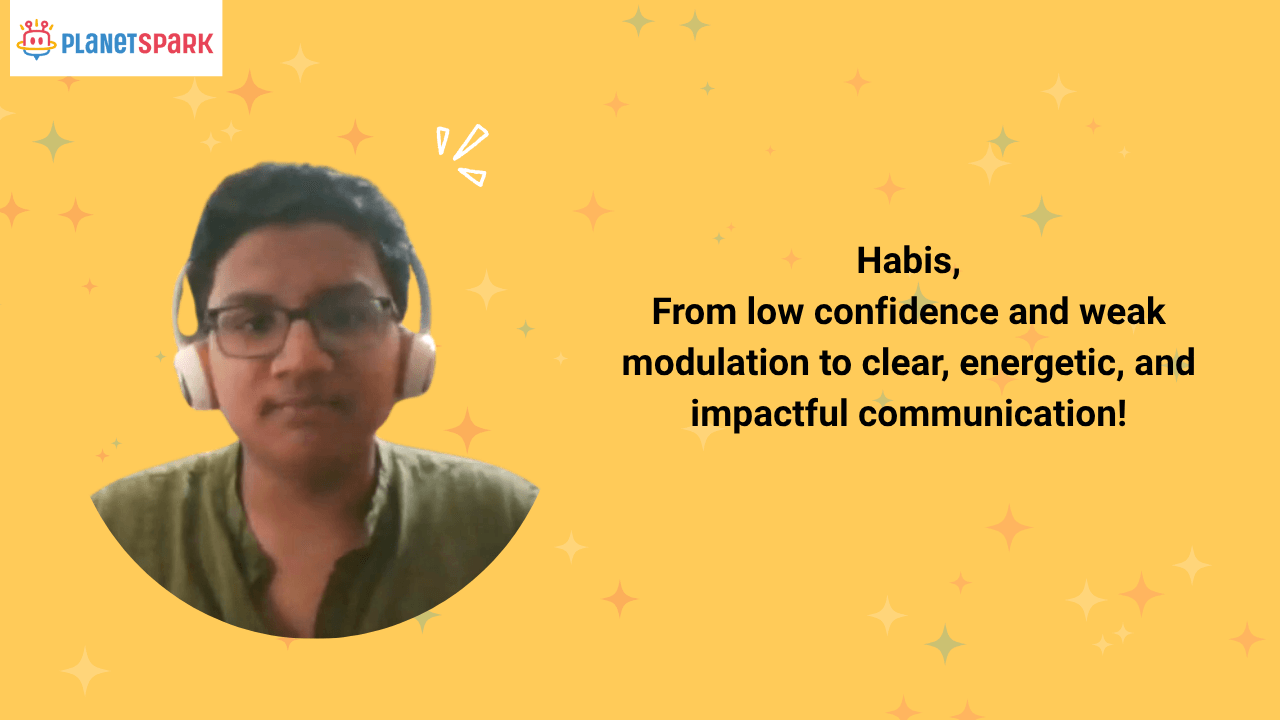
Meet Habis; once a shy speaker, now delivering every message with clarity, confidence, and strong stage presence.
How PlanetSpark Transforms "Doubters" into "Doers"
PlanetSpark transforms "doubters" into "doers" by treating confidence as a trainable skill rather than a fixed trait. Through our Personality Development program, we use a "Communication-Confidence Loop" to help you master how to overcome self-doubt at work and build a commanding professional presence.
- Executive Presence: Master voice modulation to sound like a natural authority figure.
- Improvised Speaking: Learn to think on your feet and handle unexpected questions with ease.
- Body Language Mastery: Align your non-verbal cues with your professional goals.
- Active Practice: Gain experience in a supportive, low-pressure environment.
- Expert Coaching: Receive real-time feedback to refine your unique leadership style.
The Path Forward
The journey from self-doubt to self-assurance isn't a straight line. There will be days when that old voice returns. The difference is that, with the right training and mindset, you will have the tools to silence it.
You don't need to be perfect to be confident. You just need to be willing to show up, speak up, and stand up for your own value. Whether it’s through self-reflection, seeking a mentor, or enrolling in a transformative program at PlanetSpark, the time to start is now.
Frequently Asked Questions
Most training programs are passive. PlanetSpark is active and habit-based. We use a specialized "Communication-Confidence Loop" that focuses on repetitive, live practice with expert feedback. This ensures that confidence becomes a permanent part of your professional identity rather than just a temporary boost from a one-day seminar.
Definitely. We don't try to turn introverts into extroverts; we help them master "Quiet Authority." Our personality development modules teach you how to prepare for meetings, speak with conviction, and use active listening to influence others. We help you ensure your contributions are recognized without requiring you to be the loudest person in the room.
PlanetSpark targets the root of anxiety: the fear of being judged. Our curriculum focuses on professional confidence building through live practice in public speaking and assertive communication. By mastering your "voice" in a supportive environment, you reduce the physiological stress response, allowing you to stay calm and articulate during high-pressure meetings.
Yes. This is a common phase of the professional learning curve. When you are in a new environment, your brain is in a "high-alert" state as it navigates new social and technical landscapes. Self-doubt at the workplace is a sign that you are growing and stretching your capabilities beyond your previous comfort zone.
A lack of confidence at work is often triggered by Imposter Syndrome, the fear of being "found out" despite your success. Other factors include the "Comparison Trap"measuring your internal struggles against others' external successes, and a lack of training in soft skills like public speaking, which can make you feel unequipped for leadership roles.
To stop the cycle of doubt, focus on "objective evidence." Keep a Win Journal to document praise, successful projects, and problems you've solved. This creates a factual counter-narrative to your inner critic. Additionally, practice how to overcome self-doubt at work by setting small, daily goals; achieving them builds the "competence loop" necessary for long-term confidence.