
Learn to Set Long-Term Goals in an Interview | PlanetSpark


Table of Contents
- What is a Long-Term Goal: Definition, Meaning, and Clarity
- Why Long-Term Goals in an Interview Matter for Selection
- What Are Some Long-Term Goals: Practical Examples for Profes
- 5 Long-Term Goals You Can Use in Interviews
- How to Answer “What are Your Goals” in an Interview
- Long-term Goals in an Interview for Freshers vs Experienced
- Key Strategies for Answering Long-Term Goals in an Interview
- Common Mistakes to Avoid
- How to Align Long-Term Goals with Company Vision
- Advanced Framework: Crafting a Perfect Answer
- How to Deliver Your Answer Confidently
- PlanetSpark Personality Development Classes for Professional
- Build a Strong Future with Clear Goals
“What are your long-term goals?” This one question can silently decide your interview outcome.
Many working professionals struggle to answer this confidently. A vague answer makes you seem directionless, while an unrealistic one raises red flags. Recruiters are not just testing your ambition; they are evaluating your clarity, commitment, and long-term fit.
This blog will help you master long term goals in interviews with clear frameworks, real examples, and expert-backed strategies. You will learn how to structure your answer, align it with company goals, and avoid critical mistakes. You will also discover proven techniques that top candidates use to stand out.
Let’s begin by understanding what a long-term goal truly means and why it plays such a crucial role in interviews.
What is a Long-Term Goal: Definition, Meaning, and Clarity
Understanding the long term goal definition is the first step toward answering interview questions effectively. A long-term goal is a professional objective you aim to achieve over 3 to 5 years or longer. It reflects your career direction, growth mindset, and long-term commitment to learning and development.
Unlike short-term goals, which focus on immediate tasks or milestones, long-term goals provide a bigger picture of where you want your career to go. They are not just about ambition but also about structured, realistic progress.
Key Characteristics of Strong Long-Term Goals
- Clear direction and purpose
- Realistic and achievable timeline
- Alignment with your current career path
- Focus on continuous improvement
- Contribution to organisational success
Why Interviewers Care About Long-Term Goals
Recruiters ask this question to understand whether you are thinking ahead or simply looking for a temporary opportunity. They want candidates who are committed to growing within the organisation and contributing over time.
For example: “I aim to grow into a leadership role where I can manage teams, mentor individuals, and contribute to strategic decisions within the organisation.”
This answer works because it reflects ambition, clarity, and alignment.

Why Long-Term Goals in an Interview Matter for Selection
Answering long-term goals in an interview effectively can often become the deciding factor between you and another equally qualified candidate. While your technical skills and experience get you shortlisted, your clarity of thought and career direction often influence the final hiring decision.
Recruiters are not just hiring for the present role. They are hiring for potential, growth, and long-term contribution. When they ask about your long-term goals, they are trying to understand whether you are someone who will grow with the organisation or someone who may leave quickly after gaining short-term benefits.
Your answer gives them a deeper insight into your mindset. It reflects how seriously you take your career, whether you plan ahead, and how well you understand your own strengths and future direction. A well-structured response shows maturity, self-awareness, and professional intent.
What Recruiters are Evaluating
When interviewers ask this question, they are subconsciously assessing multiple aspects of your personality and professional thinking:
- Your career vision: Do you have a clear idea of where you want to go, or are you uncertain about your path? Candidates with clarity are often preferred because they require less direction and are more focused.
- Your commitment level: Employers invest time and resources in hiring and training. They want to know if you are likely to stay and grow rather than leave quickly.
- Your ability to plan long-term: Long-term thinking indicates a strategic mindset. It shows that you are capable of setting goals and working consistently toward them.
- Your alignment with company growth: Companies prefer candidates whose goals align with their future plans. If your growth supports the company’s direction, you become a stronger fit.
How it Influences Hiring Decisions
A strong answer can positively influence how recruiters perceive you beyond your resume:
- Builds trust with recruiters: Clear goals signal honesty and transparency. Recruiters feel more confident about your intentions.
- Shows you are serious about your career: It reflects that you are not applying randomly but have a purpose behind your choices.
- Reflects stability and reliability: Candidates with long-term goals are often seen as more stable and less likely to switch jobs impulsively.
- Demonstrates leadership potential: Discussing growth, responsibility, and contribution indicates you are thinking beyond execution and moving toward leadership.
Why this Matters More than you Think
In many cases, hiring decisions are not just about who is the most skilled, but about who is the most aligned. A candidate who clearly communicates their long-term goals appears more dependable, focused, and future-ready.
Professionals who articulate their goals effectively are often seen as individuals who can grow into bigger roles, take ownership, and contribute meaningfully to the organisation’s success. This is exactly what recruiters look for when making their final decision.
Not sure if your answers are interview-ready? Book a free PlanetSpark trial class and learn how to structure winning responses before your next interview. Limited seats.
What Are Some Long-Term Goals: Practical Examples for Professionals
Understanding what some long-term goals are is not just about listing ambitions. It is about presenting a clear, thoughtful vision of your career that aligns with your role, industry, and the company you are applying to. A strong answer shows that you are not only focused on getting the job but also on growing within it.
When recruiters ask this question, they are looking for goals that reflect progression, contribution, and stability. Your goals should indicate that you want to evolve professionally while adding value to the organisation over time.
What Makes a Long-Term Goal Effective
Not all goals create a strong impression. The most effective ones share a few important qualities:
- They show growth over time, not sudden jumps
- They are connected to your current role or skills
- They demonstrate value creation for the company
- They reflect a learning mindset and adaptability
For example, saying “I want to grow into a leadership role” is good, but explaining how you plan to get there makes it much stronger.
Common Long-Term Goals Explained in Depth
Let’s break down the common goals and understand why they work well in interviews:
- Transitioning into leadership roles: This shows that you are thinking beyond individual contribution. It reflects your ability to take responsibility, manage people, and influence outcomes.
- Becoming a domain expert: This indicates depth of knowledge and commitment to mastering your field. Companies value experts who can solve complex problems and guide teams.
- Managing high-impact projects: This demonstrates your commitment to meaningful work that drives results. It reflects ambition and ownership.
- Enhancing communication and leadership skills: Strong communication is critical in every role. Highlighting this shows self-awareness and willingness to improve.
- Driving business growth: This aligns directly with company goals. It shows that you are thinking from a business perspective, not just a personal one.
Detailed Example Answers with Explanation
- “Over the next five years, I aim to take on leadership responsibilities where I can mentor junior team members and contribute to team success.”
This answer works because it combines growth, leadership, and contribution. It shows you are ready to evolve and support others. - “My long-term goal is to become a subject matter expert in my field and work on innovative projects that add value to the organisation.”
This highlights expertise and innovation, both of which are highly valued in most industries.
You can strengthen these answers further by adding a timeline or mentioning steps you plan to take.
How to Personalise your Long-Term Goals
A generic answer can reduce your impact. Personalisation is what makes your response stand out.
- Consider your current strengths: Identify what you are already good at and build your goals around it.
- Identify future growth areas: Think about the skills you need to develop to reach the next level.
- Align with industry trends: Make sure your goals are relevant to where your industry is heading.
- Keep your goals realistic: Ambition is good, but it should be achievable within a reasonable timeframe.
A well-thought-out answer shows that you are not just reacting to opportunities but actively shaping your career. It reflects clarity, confidence, and professionalism.
Candidates who can clearly explain their long-term goals are often seen as more focused, motivated, and prepared for future responsibilities. This makes them more attractive to recruiters seeking long-term contributors, not just short-term hires.
5 Long-Term Goals You Can Use in Interviews
Here are 5 long-term goals that are widely accepted and effective across industries. These goals are not just popular choices; they work because they reflect growth, responsibility, and alignment with what employers actually look for in candidates.
Instead of simply stating them, understanding why they work and how to expand them can help you deliver a much stronger and more convincing answer in interviews.
1. Leadership Development
“I aim to grow into a leadership role where I can manage teams and drive results.”
This goal shows that you are thinking beyond your current responsibilities and are willing to take ownership in the future. Leadership is not just about managing people; it is about decision-making, accountability, and guiding others toward success.
To make this stronger, you can add how you plan to get there. For example, you might mention developing communication skills, taking initiative in projects, or mentoring juniors over time.
2. Skill Specialisation
“I want to become an expert in my field and handle complex responsibilities.”
This goal highlights the depth of knowledge and dedication to your profession. Companies value individuals who are not just generalists but specialists who can solve complex problems and bring expertise to the team.
You can strengthen this answer by mentioning specific skills, certifications, or areas of expertise you want to develop. This makes your goal more concrete and believable.
3. Strategic Impact
“My goal is to contribute to strategic decisions and business growth.”
This goal reflects a shift from execution to higher-level thinking. It shows that you want to understand the bigger picture and contribute to decisions that shape the organisation’s future.
To enhance this, you can mention your interest in understanding business metrics, market trends, or cross-functional collaboration. This shows that you are preparing yourself for larger responsibilities.
4. Continuous Learning
“I plan to continuously upgrade my skills to stay relevant.”
In this fast-changing work environment, learning is essential. This goal demonstrates adaptability and a growth mindset. It tells recruiters that you are willing to evolve with the industry.
You can make this more impactful by mentioning specific ways you plan to learn, such as certifications, workshops, or hands-on experience.
5. Organisational Contribution
“I aim to contribute significantly to the company’s long-term success.”
This is one of the most important goals because it directly aligns your growth with the company’s growth. It shows that you are not just focused on personal success but also on adding value to the organisation.
To make this stronger, you can explain how your skills and efforts will support team goals, improve processes, or drive results.
These goals are effective because they strike the right balance between ambition and practicality. They show that you:
- Want to grow in your career
- Are willing to take responsibility
- Understand the importance of continuous learning
- Care about contributing to the organisation
When you present these goals with clarity and a structured explanation, you position yourself as a candidate who is not only capable today but also valuable for the future.

How to Answer “What are Your Goals” in an Interview
Answering the question “What are your goals?” requires more than just ambition. It requires clarity, structure, and the ability to connect your personal growth with the company’s vision. Many candidates struggle not because they lack goals, but because they cannot present them clearly and convincingly.
Interviewers are not expecting a perfect answer. They are looking for a well-thought-out response that shows you understand your career direction and how this role fits into it. A structured answer helps you sound confident, professional, and focused.
Proven Answer Structure
A strong answer usually follows a logical flow. Here is how you can expand each step:
- Start with your current role and strengths: Briefly explain where you are in your career. Highlight your key skills or areas of focus. This provides context for your goals and demonstrates self-awareness.
- Mention your growth direction: Talk about how you want to grow over the next few years. This could include gaining expertise, taking on more responsibilities, or improving specific skills. This step shows ambition and a desire to improve.
- Connect your goals with the company: This is the most important part. Show how your goals align with the company's offerings. This reassures the interviewer that you are likely to stay and grow within the organisation.
- Keep it realistic and achievable: Avoid unrealistic expectations, such as rapid promotions or drastic career shifts. Your goals should reflect steady and logical progression.
Expanded Example Answer
“I am currently focused on strengthening my skills in my domain and gaining hands-on experience through challenging projects. Over the next few years, I want to take on more responsibilities, collaborate with cross-functional teams, and contribute to key business outcomes. In the long term, I aim to grow into a leadership role where I can guide teams, mentor others, and support organisational success while continuously improving my own capabilities.”
This answer works well because it shows:
- Present focus
- Future growth
- Alignment with the organisation
- Leadership ambition
Additional Tips to Make your Answer Stand Out
- Practice your answer multiple times: Practising helps you speak more naturally and confidently during the interview.
- Keep your tone conversational: Avoid sounding robotic or overly rehearsed. Speak as if you are explaining your goals to a colleague.
- Avoid memorisation: Instead of memorising, understand your answer so you can adapt it based on the situation.
- Focus on clarity and simplicity: Use simple language and avoid overcomplicating your response. Clear answers are always more impactful.
- Add a personal touch: If possible, include a small detail about what motivates you. This makes your answer more authentic and relatable.
Still unsure if your answer sounds confident enough? Book your PlanetSpark demo class today and practice with expert trainers before your next interview. Limited slots available.
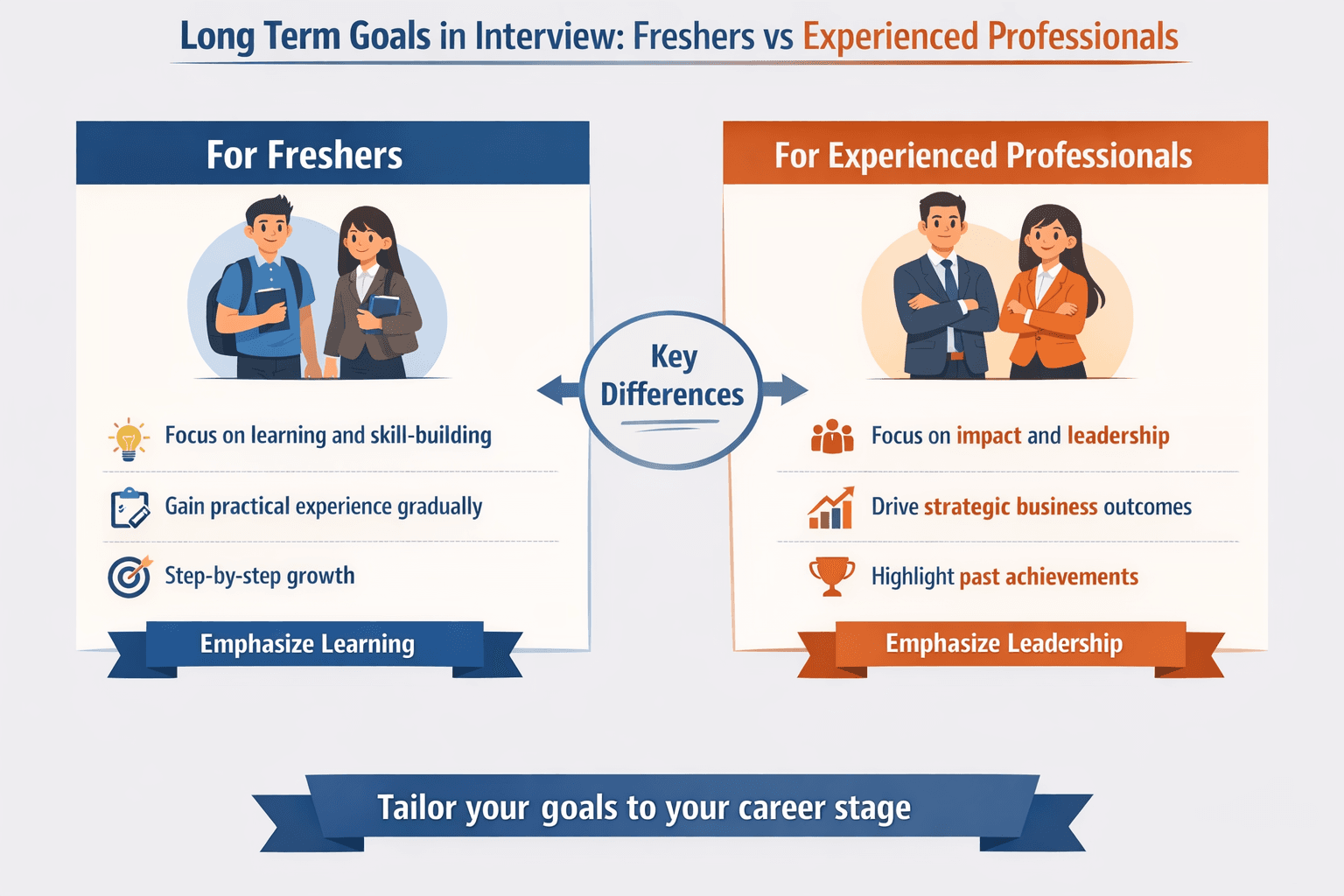
Long-term Goals in an Interview for Freshers vs Experienced Professionals
Understanding how to answer long-term goals in an interview depends heavily on your experience level. Recruiters do not expect the same kind of answer from a fresher and a working professional. What matters is relevance, clarity, and alignment with where you are in your career.
For Freshers
Freshers are at the beginning of their careers, so interviewers focus on their learning mindset, adaptability, and willingness to grow. Since freshers may not have extensive work experience, their goals should reflect curiosity and openness to learning rather than immediate leadership ambitions.
Example: “I want to build a strong foundation in my field, gain practical experience, and gradually take on more responsibilities as I grow.”
This works because it shows:
- A willingness to learn
- Realistic expectations
- Long-term commitment to growth
Freshers can further strengthen their answer by outlining how they plan to learn, such as by working on projects, improving communication skills, or earning certifications.
For Experienced Professionals
Experienced candidates are expected to go beyond learning. Their answers should highlight impact, leadership, and contribution to business outcomes. Recruiters want to see how you can grow into roles that influence teams and strategy.
Example:
“I aim to expand my expertise, take on leadership responsibilities, and contribute to strategic business decisions that drive organisational growth.”
This works because it shows:
- Growth in responsibility
- Ability to lead and influence
- Alignment with business goals
Experienced professionals can enhance their responses by highlighting past achievements and how they plan to build on them.
Key Differences Explained
- Freshers emphasise learning: They focus on building skills and gaining experience step by step.
- Professionals emphasise impact and leadership: They focus on contributing at a higher level and influencing outcomes.
Understanding this distinction ensures your answer feels natural and appropriate for your career stage, which increases your credibility during the interview.
Key Strategies for Answering Long-Term Goals in an Interview
To craft a powerful answer, you need more than just a goal. You need a strategy that makes your answer clear, structured, and relevant.
1. Align with Company Vision
Before the interview, research the company’s mission, growth plans, and industry position. When your goals reflect the company’s direction, it shows that you are genuinely interested in growing with them.
2. Be Realistic and Ambitious
A strong answer balances aspiration with practicality. Saying you want to become a CEO in two years may sound unrealistic, while saying you want to learn without growth may sound weak. The key is steady and believable progression.
3. Focus on Value Addition
Your answer should not sound self-centred. Instead of focusing only on your growth, explain how your development will benefit the company. This shifts your answer from personal ambition to professional contribution.
4. Break Down your Goals
Instead of giving a broad goal, show the steps you plan to take. This demonstrates planning ability and seriousness. For example, mention skill development, project involvement, or leadership opportunities.
5. Use the SMART Framework
The SMART framework helps make your goals clear and structured:
- Specific
- Measurable
- Achievable
- Relevant
- Time-bound
Example
“My short-term goal is to master my role. Long term, I want to take on leadership responsibilities and contribute to strategic improvements.”
This answer works because it shows progression from learning to leadership, making it both realistic and impactful.
Common Mistakes to Avoid
Even strong candidates can lose opportunities by making simple mistakes while answering this question.
Common Mistakes Explained
- Giving vague answers: Saying “I want to grow” without explaining how makes your answer weak and unclear.
- Being overly ambitious: Unrealistic goals can make you appear impractical or inexperienced.
- Not aligning with the role: If your goals do not match the job, recruiters may question your fit.
- Talking about unrelated goals: Personal or unrelated ambitions can distract from your professional intent.
- Showing lack of commitment: Answers that suggest short-term interest can reduce your chances.
How to Improve your Answer
- Prepare your answer in advance
- Practice speaking confidently
- Keep your answer structured
- Stay relevant to the role and company
Avoiding these mistakes ensures your answer is clear, professional, and impactful.
How to Align Long-Term Goals with Company Vision
Alignment is one of the most critical factors in answering this question effectively. Recruiters prefer candidates who can grow along with the organisation rather than independently of it.
Steps to Align your Goals
- Research the company thoroughly: Understand its products, services, and future plans
- Understand its growth direction: Look at where the company is heading and what roles will be important
- Identify how your role contributes: Connect your responsibilities to the company’s bigger picture
- Link your goals to company success: Show how your growth will support organisational objectives
Example
“I would like to grow within the organisation and contribute to its long-term success by taking on leadership responsibilities.”
This answer works because it directly connects personal growth with company success, which is exactly what recruiters want to hear.
Advanced Framework: Crafting a Perfect Answer
If you want to stand out from other candidates, using a structured framework can make your answer more powerful and convincing.
Step 1: Define your Goal
Clearly state what you want to achieve in the long term. Avoid vague statements and be specific about your direction.
Step 2: Show Past Actions
Mention what you have already done to move toward your goal. This shows that your goal is not just a thought but something you are actively working on.
Step 3: Outline your Future Plan
Explain the steps you will take to achieve your goal. This demonstrates planning and commitment.
Step 4: Connect to the Role
Show how the current job fits into your long-term plan. This reassures the interviewer that you are making a thoughtful career decision.
Example
“My goal is to become a leader in my field. I have already started developing my skills through projects and training. Going forward, I plan to take on more responsibilities and leadership opportunities. This role aligns perfectly with my growth plan.”
This answer works because it covers present, past, and future while clearly connecting everything to the role.
Still unsure how to structure answers like this confidently? Join a PlanetSpark trial class and get expert feedback before your next interview. Limited seats available.
How to Deliver Your Answer Confidently
Even a well-structured answer can lose impact if it is not delivered confidently. Communication plays a key role in how your answer is perceived.
Tips for Confident Delivery Explained
- Maintain eye contact: This shows confidence and engagement with the interviewer
- Speak clearly and at a steady pace: Rushing can make you sound nervous, while clarity improves understanding
- Use positive body language: Sit upright, use natural gestures, and avoid a closed posture
- Avoid filler words: Words like “um” or “like” can reduce the impact of your answer
- Practice mock interviews: Practising in real-like situations helps you become more comfortable
Confidence is not something you are born with. It is built through preparation, repetition, and self-awareness. The more you practice your answers, the more natural and impactful they will sound during the actual interview.
PlanetSpark Personality Development Classes for Professionals
PlanetSpark offers advanced learning programs designed to help working professionals improve communication, confidence, and interview performance. These programs focus on real-world skills like public speaking, business communication, and personality development.
With over 1 million classes delivered globally and a strong presence in multiple countries, PlanetSpark provides a structured, interactive learning experience. Their AI-powered curriculum and expert trainers ensure that learners develop practical skills that directly impact career growth.
Key Features
- Live 1:1 interactive sessions
- Expert communication coaches
- Real interview practice
- Personalized feedback
- Confidence-building exercises
- Structured curriculum
- Global learner community

Build a Strong Future with Clear Goals
Clarity in your long-term goals can transform your career journey. When you communicate your vision effectively, you stand out as a confident and focused professional.
Keep refining your goals, practising your answers, and improving your communication. With consistency and effort, you will not only succeed in interviews but also build a strong and fulfilling career path.
Frequently Asked Questions
At PlanetSpark, we guide learners to answer this effectively. A strong example is: “My long-term goal is to grow into a leadership role and contribute to strategic decisions.”
PlanetSpark recommends leadership growth, skill specialisation, and contributing to business success.
PlanetSpark teaches Clarity, Confidence, Communication, Consistency, and Credibility.
Goals like becoming an expert, leading teams, and contributing to company growth are effective.
PlanetSpark helps through mock interviews, feedback, and structured frameworks.
Communication helps you express your thoughts clearly, create a strong impression, and show confidence, increasing your chances of success.
PlanetSpark offers live sessions, expert coaching, and personalised feedback to improve performance.
Personalized Communication Roadmaps
Record a video to get a AI generated personalized communication reports