
Simple Robotics Projects Kids Can Try | Easy Beginner Guide
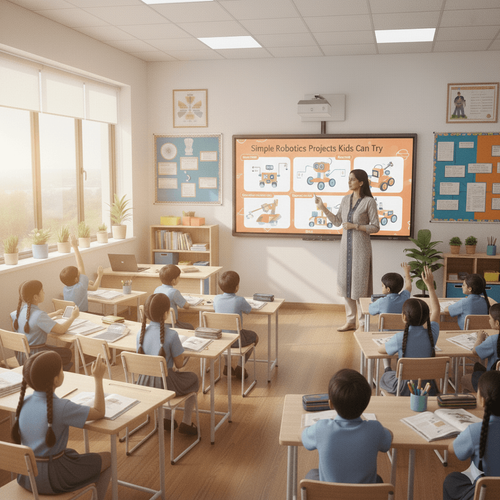

Robotics is no longer limited to engineers, laboratories, or high-tech classrooms. Today, even young children can explore the world of robotics right at home using simple tools, everyday materials, and beginner-friendly experiments that spark curiosity and creativity. With the right guidance, kids can build small robots, understand basic mechanics, learn how sensors work, and explore the foundation of automation,all through playful, hands-on learning.
This blog on Simple Robotics Projects Kids Can Try helps parents understand how robotics supports a child’s cognitive and emotional development, why early exposure matters, and how simple DIY creations can enhance problem-solving, confidence, communication, and logical thinking. From vibration-based bots and cardboard robotic hands to basic sensor-powered robots, this guide offers everything a young learner needs to begin their robotics journey,no complex circuits, expensive kits, or advanced coding knowledge required.
Why Simple Robotics Projects Matter for Kids
The Growing Appeal of Simple Robotics Projects Kids Can Try
The global education landscape is shifting, and STEM learning has become essential for today’s young generation. Simple robotics projects kids can try introduce children to technology in a playful way, helping them understand mechanics, automation, creativity, and basic coding concepts.
Hands-on robotics cultivates essential 21st-century skills,including problem solving, critical thinking, structured planning, and intuition. These are not merely technical skills; they shape a child into an independent thinker.
Many parents assume robotics requires expensive kits, but today even household materials can be used to create beginner robots. What kids need is guidance, curiosity, and the right set of projects.
How Robotics Supports Cognitive and Emotional Growth in Children
Working on robotics projects requires children to think, test, break, rebuild, and refine ideas. These trial-and-error cycles naturally improve patience, resilience, and focus,soft skills that carry beyond academics.
Kids become more confident as they see their creation move, sense its environment, or respond to commands. Robotics also nurtures emotional growth by teaching perseverance and helping kids deal with small failures during experimentation.
Simple robotics projects improve:
✔ Logical reasoning
✔ Visual-spatial understanding
✔ Fine motor skills
✔ Creative imagination
✔ Emotional regulation
Top Simple Robotics Projects Kids Can Try (Beginner-Friendly & Fun)
1. Bristlebot – The Simplest Robot a Child Can Build
A bristlebot is a tiny robot made using a toothbrush head, a vibrating motor, and a battery. This robot wiggles its way forward and teaches kids the basics of motion, vibrations, and balance. It’s one of the easiest robotics projects available.
Materials needed: Toothbrush head, coin motor, double-sided tape, button cell battery.
Skills learned:
Motor control basics
Balance and stability
Movement mechanics
This project introduces mechanical robotics without intimidating components. Kids love watching their bristlebots race!
2. Light-Seeking Robot (Phototropic Robot)
This project helps kids understand how robots sense and respond to light. Using simple components,light sensors, a small breadboard, and motors,children can build a robot that automatically moves toward light sources like lamps.
Skills learned:
Sensor-based decision making
Basic circuit logic
Real-world automation concepts
3. Line-Following Robot Using Black Tape
This is a beginner version of industrial line-following robots. The child uses IR sensors and a basic motor driver module. The robot detects the contrast of a black line on white paper and follows it.
Skills learned:
Sensors and microcontrollers
Automation logic
Intro to coding (if using Arduino or Micro:bit)
4. Clap-Responding Robot (Sound-Activated Robot)
Kids can create a robot that reacts to sound using a simple sound sensor and a motor. When someone claps, the robot moves or switches direction.
Skills learned:
Sound-to-motion conversion
Understanding input-output behaviour
Building interactive robotics
5. Obstacle-Avoiding Robot (Ultrasonic Sensor Bot)
This project introduces kids to the fundamental logic behind self-driving cars. With an ultrasonic sensor, a microcontroller like Arduino, and basic wheels, kids can build an obstacle-avoiding robot.
Skills learned:
Distance measurement
Environmental sensing
Logical automation
This is one of the most exciting simple robotics projects kids can try because it feels advanced while being beginner-friendly.
6. DIY Robot Hand Using Cardboard and Strings
This robotics-meets-craft project helps children understand the mechanics behind robotic arms. Using cardboard, strings, and straws, kids can build a functional robotic hand.
Skills learned:
Human anatomy replication
Mechanical movement
Coordination and control
7. Solar-Powered Mini Robot
With a tiny solar panel, a micro motor, and lightweight material, kids can build a robot that operates using sunlight alone.
Skills learned:
Renewable energy
Circuit connections
Understanding solar power
8. Art Bot – A Robot That Draws
Using markers as legs and a simple vibrating motor, students can build a robot that creates colourful patterns on paper.
Skills learned:
Creativity + engineering
Motor control
Symmetry and design thinking
9. Micro:bit Gesture-Controlled Robot
Kids use BBC Micro:bit (a tiny coding board) to control a robot using hand gestures. The sensors detect tilt, direction, and acceleration.
Skills learned:
Coding logic
Sensor integration
Wireless control
10. Water-Level Indicator Robot
With a simple buzzer, wires, and a container, kids can create a water-level detection system. This introduces them to the concept of robotics used in home appliances.
Skills learned:
Real-world problem solving
Electrical conduction
Alert systems
Learning Robotics at Home: Tips for Parents
Encourage Exploration, Not Perfection
When children begin exploring robotics, they won’t always get everything right,and that’s exactly how learning should be. Instead of aiming for a perfectly working robot, focus on nurturing their curiosity and willingness to try new ideas. The “trial and error” process teaches resilience, patience, and creative problem-solving. Celebrate small wins, whether it’s fixing a loose wire or making a motor move for the first time. The goal is to help your child enjoy the journey of discovery, not just the final outcome.
Start with No-Code Robotics Kits
For beginners, coding can sometimes feel intimidating. That’s why no-code or block-based robotics platforms are a great starting point. Tools like Scratch, Micro:bit, Lego WeDo, and MIT App Inventor allow kids to drag and drop coding blocks, making it easier to understand logic, sequencing, and cause–effect relationships. These kits gradually introduce children to the basics of automation and robotics without overwhelming them with syntax. As they grow more confident, they can slowly transition to text-based coding at their own pace.
Integrate Storytelling Into Robotics
Storytelling is a powerful way to help children understand and express what they are building. When kids describe their robot’s purpose, how it works, and what problems it solves, they practice essential skills like sequencing, clarity, presentation, and structured communication. Ask them to name their robot, create a backstory, or explain its “mission.” This not only deepens their understanding but also enhances creativity, imagination, and public-speaking abilities. Robotics becomes more engaging when children feel emotionally connected to their creations,turning technical learning into a fun storytelling adventure.
PlanetSpark Personality Development Course: The Ultimate Support for Young Innovators
Robotics builds intelligence-but personality development builds confidence. PlanetSpark ensures both grow hand-in-hand.
Holistic Curriculum Beyond Academics
Kids learn:
Communication etiquette
Leadership
Critical thinking
Self-awareness
Peer interaction
Goal setting
Structured thinking
This helps children articulate their ideas, explain robotics projects confidently, and collaborate well.
Social-Emotional Learning (SEL) Focus
Younger children benefit from:
✔ Emotional awareness
✔ Regulation
✔ Mindfulness
✔ Self-control
These skills ensure your child manages frustration during challenging robotics activities.
Practical, Activity-Based Learning
The course includes:
Mock interviews
Public introductions
Journaling
Role play
Case studies
Real-life scenario simulations
This helps children present their robotics projects with clarity and confidence.
Confidence Meter & Parent Consultations
Parents receive insights into:
Confidence level
Posture
Communication
Leadership
Social behaviour
Etiquette & Body Language Mastery
PlanetSpark teaches:
✔ Eye contact
✔ Posture
✔ Respectful communication
✔ Tone modulation
These skills make kids strong presenters and group leaders.
1:1 Personal Trainers for Every Child
Kids receive personalised live sessions from certified communication experts.
Personalised Curriculum
Every child’s learning path is customised based on grammar, fluency, confidence, and communication needs.
SparkX – AI Video Analysis
AI evaluates clarity, posture, grammar, confidence, and delivery,offering practical improvement steps.
AI-Led Practice Sessions
Kids practise with a virtual AI coach, improving fluency and storytelling independently.
Gamified Learning Modules
Includes quizzes, spelling games, grammar challenges, and daily revision activities.
Parent-Teacher Meetings
Parents receive regular updates, detailed reports, and personalised action plans.
Exclusive Clubs & Communities
Debate Club, Story Writing Club, Podcasting Club, Writers Guild, Comedy Club, and more.
Sparkline – Safe Kids’ Social Platform
Children share videos, stories, and reflections in a secure environment.
Contests & Showcases
Children participate in storytelling events, open mics, creative writing contests, and speech competitions.
Boost Your Child’s Future With Robotics & Communication Skills
Robotics teaches children to innovate, solve problems, and dream big. But communication, confidence, and personality development give them the power to express those ideas to the world. When children learn robotics alongside strong soft skills, they become future-ready creators, leaders, and thinkers.
PlanetSpark ensures this balance with its structured, personalised, and engaging personality development program,designed to make children confident, expressive, and growth-oriented. Whether your child is building a bristlebot or coding a sensor-based robot, effective communication helps them present ideas confidently and shine in competitions, academics, and life.
You may also read :
Frequently Asked Questions
Kids as young as 5 can begin with basic mechanical robotics such as bristlebots, art bots, or cardboard robotic hands. Ages 7–10 can progress to sensor-based robots, while children above 10 can begin coding-driven robotics. The key is starting simple and introducing complex ideas gradually. Robotics is flexible and adapts to a child’s curiosity and skill level.
Not all projects require coding. Many starter robots—like bristlebots, art bots, solar bots—use motors and simple circuits. Coding becomes necessary only when sensors, microcontrollers, or automation features are added. Kids can start with drag-and-drop coding platforms like Scratch or Micro:bit to ease into programming.
Kids can start robotics using low-cost materials such as toothbrush heads, motors, sensors, tape, cardboard, batteries, and wires. Many household items—from plastic bottles to old toys—can be reused. Parents can also purchase inexpensive robotics kits for structured learning.
Robotics strengthens problem solving, logical thinking, creativity, spatial awareness, and emotional resilience. Kids learn through trial and error, making them more patient and persistent. Building robots also enhances memory, pattern recognition, and analytical thinking—qualitites essential for academic and real-life success.
Robotics builds technical intelligence; personality development builds communication and confidence. When children learn both, they become better at explaining ideas, presenting projects, collaborating with peers, and leading teams. PlanetSpark’s Personality Development Course ensures kids express their creativity effectively and grow into confident innovators.