
Spatial Reasoning Guide: Visual Learning with PlanetSpark
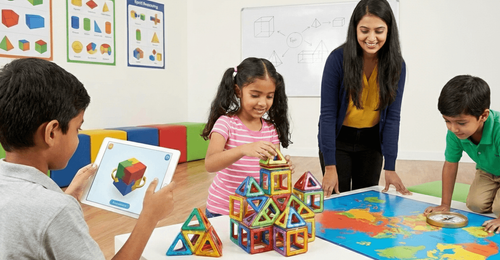

Table of Contents
- What Is Spatial Reasoning?
- Why Spatial Reasoning Skills Are Crucial for Children
- Spatial Reasoning Skills in Child Development
- Signs of Weak Spatial Reasoning in Children
- Spatial Reasoning vs Other Cognitive Skills
- Examples of Spatial Reasoning in Daily Life
- How to Improve Spatial Reasoning Skills in Kids with PlanetS
- Success Story by PlanetSpark
- Why Choose PlanetSpark for Developing Personality in Kids?
- Final Thoughts: Unlock Visual Learning with PlanetSpark
Language and numbers are important, but a child’s intelligence goes far beyond reading and maths. One of the most powerful yet often overlooked cognitive abilities is spatial reasoning. From solving puzzles and understanding maps to excelling in maths, science, art, and even sports, spatial reasoning skills play a crucial role in how children learn and interact with the world.
Many parents notice that their child struggles with shapes, directions, visual puzzles, or organising objects, but don’t realise that these challenges are linked to spatial reasoning ability. The good news is that spatial reasoning is not fixed and can be developed, strengthened, and improved with the right guidance and practice.
In this in-depth blog, PlanetSpark explains the spatial reasoning meaning, why it matters, signs of weak spatial skills, age-wise development, spatial reasoning questions, practical activities, and how expert-led training helps children unlock their full learning potential.
What Is Spatial Reasoning?
Spatial reasoning is the ability to understand, imagine, manipulate, and mentally organise objects and spaces. It helps children understand how things fit together, move, rotate, and relate to each other in the physical or visual world. In simple words, spatial reasoning is the ability to think in pictures and spaces rather than only words.
The spatial reasoning meaning includes:
- Visualising shapes and objects
- Understanding positions and directions
- Mentally rotating or transforming objects
- Recognising patterns, symmetry, and layouts
Closely linked to this is spatial meaning, which refers to understanding location-based concepts such as:
- Left and right
- Top and bottom
- Near and far
- Inside and outside
- Before and after
Children use spatial reasoning skills daily, often without realising it.
Why Spatial Reasoning Skills Are Crucial for Children
Strong spatial reasoning skills form the backbone of learning across multiple subjects and real-life tasks.
- Spatial Reasoning and Mathematics: Mathematics is highly visual. Children rely on spatial reasoning ability to:
a. Understand shapes and geometry
b. Visualise word problems
c. Interpret graphs and charts
d. Learn fractions, angles, and measurements
Children who struggle with spatial reasoning often find maths confusing, even when they understand numbers and basic concepts. - Spatial Reasoning in STEM Learning: Spatial reasoning skills are essential for STEM (Science, Technology, Engineering, Mathematics).
They help children in:
a. Visualise scientific processes
b. Understand diagrams and models
c. Build structures and circuits
d. Think logically in coding and robotics
Research consistently shows that strong visual-spatial skills predict future success in STEM careers. - Impact on Reading and Writing: Many parents don’t realise that spatial reasoning also affects literacy.
Children need spatial reasoning skills to:
a. Recognise letters and symbols
b. Maintain spacing while writing
c. Align text properly on a page
d. Understand diagrams and illustrations in books
Weak spatial meaning can lead to poor handwriting, letter reversals, and reading difficulty. - Real-Life Problem Solving: Beyond academics, spatial reasoning ability helps children:
a. Navigate spaces confidently
b. Organise belongings
c. Play sports effectively
d. Solve everyday problems logically
e. These are lifelong skills that extend far beyond classrooms. - Enhances Creativity and Imagination: Art, drawing, storytelling, and design all depend on visual-spatial intelligence. Kids imagine scenes, arrange elements, and express ideas visually.
Spatial Reasoning Skills in Child Development
Spatial reasoning development begins in early childhood and grows with age and experience.
Spatial Reasoning Skills by Age 3–5
- Recognising basic shapes
- Completing simple puzzles
- Understanding “in”, “on”, and “under”
- Sorting objects by size or shape
Spatial Reasoning Skills by Ages 6–8
- Reading simple maps
- Building with blocks or LEGO
- Understanding left and right
- Copying drawings and patterns
Spatial Reasoning Skills by Ages 9–12
- Solving complex visual puzzles
- Understanding geometry concepts
- Visualising 3D shapes
- Interpreting graphs and diagrams
Children develop at different speeds, but consistent difficulty may indicate a weak spatial reasoning ability.
Unlock your child’s visual learning power—book a free PlanetSpark demo today.
Signs of Weak Spatial Reasoning in Children
Weak spatial reasoning skills can affect a child’s learning in subtle but significant ways. These difficulties are often misunderstood as carelessness, lack of focus, or low ability, even though the child may be intelligent and verbally strong. Understanding these signs helps parents and teachers support children early.
- Difficulty Solving Puzzles
Children with weak spatial reasoning ability often struggle with jigsaw puzzles, block puzzles, or shape-matching games. They may find it hard to visualise how pieces fit together or become easily frustrated and give up quickly. This happens because puzzles require the brain to:
Visualise the whole picture
Rotate pieces mentally
Understand part-to-whole relationships
When spatial skills are weak, children cannot easily imagine how pieces will look once placed, making puzzles challenging. - Difficulty Understanding Shapes and Geometry
Spatial reasoning is essential for recognising shapes, understanding angles, and learning geometry concepts. Children with weak spatial skills may:
Confuse similar shapes (square vs rectangle)
Struggle with 3D shapes like cubes or cylinders
Find geometry questions confusing, even if they know the formulas
This difficulty arises because geometry depends heavily on visualisation, not memorisation. Without strong spatial meaning, children find it hard to picture shapes in their minds. - Confusion with Directions (Left / Right)
A common sign of weak spatial reasoning is confusion between directions, such as:
Left and right
Up and down
In front of / behind
For example, a child may take longer to respond to instructions like “turn left” or “sit behind your friend.” This can affect classroom movement, sports, dance, and daily navigation. - Messy Handwriting or Poor Spacing
Children with weak spatial skills often struggle with handwriting. You may notice:
Uneven spacing between letters or words
Letters floating above or below lines
Writing that slopes or overlaps
Writing requires strong spatial control. Knowing how much space a letter needs, where it should be placed, and how to maintain alignment is very important in writing. Weak spatial reasoning skills make it difficult to organise writing neatly on a page. - Struggles with Maps, Charts, or Diagrams
Maps, graphs, and diagrams require children to interpret visual information. Children with spatial difficulties may:
Misread charts
Struggle to follow maps
Get confused by labelled diagrams in science or geography
This is because these tools require understanding relationships between objects, distances, directions, and proportions, which are all core elements of spatial reasoning. - Difficulty Copying from the Board
Many children with weak spatial skills struggle to copy text or diagrams from the board accurately. Common issues include:
Skipping lines or words
Writing in the wrong order
Losing place while copying
This happens because copying involves shifting visual attention between two spaces (board and notebook) while maintaining structure and alignment. Weak spatial awareness makes this task mentally exhausting. - Problems Organising Drawings or Layouts
When drawing or colouring, children with weak spatial reasoning ability may:
Draw objects too big or too small
Place drawings randomly on the page
Struggle to maintain proportions
For example, a house might have a door larger than the building, or objects may overlap unnaturally. These challenges reflect difficulty in judging size, distance, and placement within space.
Why These Signs Are Often Missed
These challenges often affect academic performance even when the child:
- Has a good vocabulary
- Speaks confidently
- Understands concepts verbally
Even though the child can talk well, adults may assume the problem is laziness or inattention. In reality, the issue lies in how the brain processes visual and spatial information.
Why Early Support in Spatial Reasoning Matters?
If weak spatial reasoning skills are not addressed early, children may:
- Lose confidence in maths and science
- Avoid visual learning tasks
- Feel frustrated or anxious in school
- Underperform despite strong intelligence
The good news is that spatial reasoning is highly trainable. With structured activities, guided practice, and expert-led programs, children can significantly improve their spatial skills.
Spatial Reasoning vs Other Cognitive Skills
Skill | What It Focuses On |
|---|---|
Spatial reasoning | Visualising and manipulating space |
Verbal skills | Understanding and using language |
Logical reasoning | Patterns, rules, cause-effect |
Memory | Storing and recalling information |
A child may be strong verbally but weak spatially, which is why balanced development matters.
Help your child think smarter in shapes and spaces. Book a free PlanetSpark class now.
Examples of Spatial Reasoning in Daily Life
Here are simple spatial reasoning examples children experience daily:
- Fitting toys into a box
- Arranging books on a shelf
- Drawing a house with windows and doors
- Playing jigsaw puzzles
- Navigating a classroom
- Building with blocks
- Understanding diagrams in textbooks
Spatial Reasoning Questions
Spatial reasoning questions are designed to help children think visually. Instead of relying only on words or numbers, these questions encourage children to observe shapes, patterns, positions, and movements and understand how objects relate to each other in space.
These questions train the brain to see, imagine, and manipulate objects mentally, which is a critical skill for learning maths, science, coding, and even daily problem-solving.
Example 1: Pattern Completion
Question: Which shape completes the pattern?
🔺 🔺 🔵 🔺 🔺 ❓
Explanation: Here, the child must identify the repeating pattern. The sequence shows:
Two triangles (🔺 🔺)
One circle (🔵)
Then again, two triangles (🔺 🔺)
So, the missing shape must be a circle (🔵).
This type of spatial reasoning question helps children in recognising visual patterns, predicting what comes next, and helps in logical thinking.
Example 2: Mental Rotation
Question: If a triangle shape is rotated 90 degrees, what will it look like?
Explanation: In this question, the child does not physically turn the shape. Instead, they must rotate the shape in their mind and imagine how it would look after turning.
This trains children to visualise movement, understand rotation and orientation, and build strong mental imagery skills. Mental rotation is especially important for geometry, engineering concepts, puzzles, and STEM learning.
Example 3: Identifying Views of Objects
Question: Which object looks the same when viewed from the top?
Explanation: Here, children must imagine looking at an object from a different angle (top view instead of front view). This requires them to understand perspective, compare shapes visually, and analyse dimensions and structure. Such questions strengthen a child’s ability to interpret diagrams, maps, and 3D figures.
How to Improve Spatial Reasoning Skills in Kids with PlanetSpark
Improving spatial reasoning skills does not require complicated tools or advanced lessons. In fact, children develop strong spatial thinking best through hands-on activities, visual play, and everyday conversations. When learning feels fun and natural, children absorb concepts faster and retain them longer.
Below are some proven and practical ways PlanetSpark helps children strengthen spatial reasoning skills at home and in learning environments.
Play with Puzzles and Building Blocks
One of the most effective ways to improve spatial reasoning skills is through puzzles and construction toys. These activities require children to look at shapes, understand how pieces fit together, and visualise the final result.
Examples include:
Jigsaw puzzles of increasing difficulty
Tangram sets that form pictures using geometric shapes
LEGO, blocks, or magnetic tiles for building structures
How this helps:
a. When children assemble puzzles or build models, they learn to:
b. Recognise shapes and sizes
c. Understand part-to-whole relationships
d. Visualise space and structure
e. Rotate pieces mentally before placing them
Encourage Drawing, Art, and Visual Creativity
Art is a powerful tool for developing spatial understanding. Activities like drawing, colouring, and designing allow children to explore space freely and creatively.
With activities such as:
- Drawing shapes, houses, or maps
- Copying patterns or pictures
- Designing simple floor plans or scenes
- Colouring within shapes and boundaries
How this helps:
- Drawing and art activities help children:
- Understand proportion and placement
- Develop visual memory
- Improve hand-eye coordination
- Translate ideas from the mind to paper
This directly supports visual learning power and strengthens spatial awareness.
Use Spatial Language in Everyday Conversations
Language plays a big role in developing spatial reasoning. Using spatial words regularly helps children understand positions, directions, and relationships between objects.
Common spatial words to use include:
- Above, below, beside, between
- Near, far, inside, outside
- Bigger, smaller, taller, shorter
- Turn, flip, rotate, slide
Example:
Instead of saying, “Put the toy there,” say,
“Put the toy under the table” or “Place it beside the chair.”
How this helps:
- Hearing and using spatial language daily helps children:
- Build a strong spatial vocabulary
- Understand directions clearly
- Improve listening and comprehension
- Apply spatial concepts naturally in real life
Introduce Visual and Logic-Based Games
Games are one of the best tools for improving spatial reasoning skills because they combine fun with learning.
Great visual games include:
- Spot the difference
- Maze puzzles
- Matching and sorting games
- Pattern recognition games
- Shape and shadow matching
How this helps: These games train children to:
- Observe details carefully
- Compare shapes and layouts
- Track movement and pathways
- Predict outcomes visually
Such activities sharpen visual discrimination and logical thinking, both key elements of spatial reasoning.
Ask Visual Thinking Questions Regularly
Asking the right questions encourages children to think deeply and visualise possibilities rather than rush to answers.
Try asking questions like:
- “What happens if we turn this shape?”
- “Where do you think this piece will fit?”
- “Which object looks different from the others?”
- “How can we rearrange this to make it fit?”
How this helps: These questions push children to:
- Imagine changes mentally
- Analyse space and structure
- Explain their thinking
- Build confidence in problem-solving
Over time, children learn to think before acting, a skill that supports both academics and life decisions.
Success Story by PlanetSpark
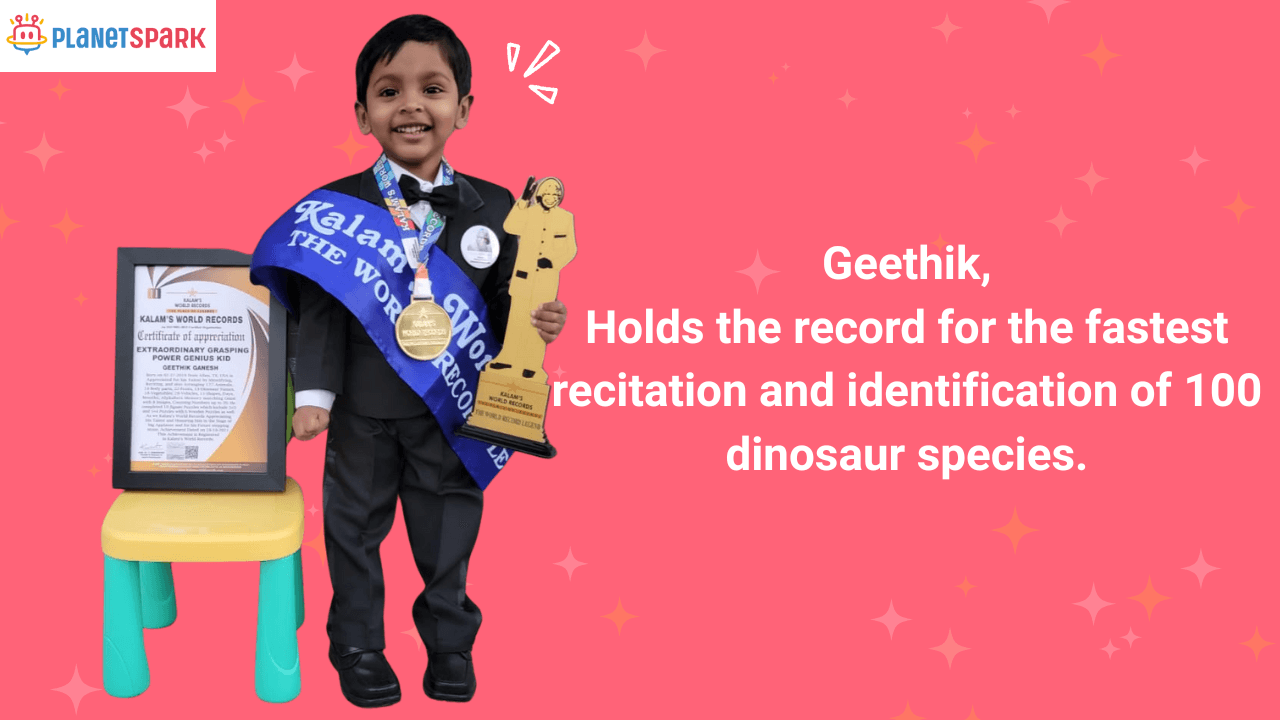
"Geethik, a bright Standard 1 learner, amazed everyone by achieving the Fastest Recitation and Identification of 100 Species of Dinosaurs. With incredible focus, memory, and confidence, he named each dinosaur swiftly and accurately, which is an achievement that reflects his strong communication skills and sharp learning abilities.
Through structured speaking practice, vocabulary building, and confidence-boosting activities at PlanetSpark, Geethik learned how to express knowledge clearly and perform fearlessly. His journey proves that when young minds receive the right guidance, even big achievements come early."
Book a free PlanetSpark demo class and help your child discover their hidden superpowers!
Why Choose PlanetSpark for Developing Personality in Kids?
At PlanetSpark, we believe that true intelligence goes beyond academics. While subjects like maths and language build knowledge, personality development builds confidence, leadership, and emotional strength—skills children need to succeed in school and in life. Here’s why thousands of parents trust PlanetSpark to shape their child’s overall growth:
Holistic Development Beyond Academics
PlanetSpark’s personality development program is designed to nurture the whole child, not just exam scores. Children learn:
Effective communication etiquette
Confident self-introduction
Goal setting and self-awareness
Peer interaction and teamwork
Leadership and critical thinking
This ensures children grow into confident speakers, thoughtful listeners, and responsible individuals—not just good students.
2. SEL-Based Curriculum (CASEL Aligned)
Our program is rooted in Social-Emotional Learning (SEL) principles aligned with CASEL frameworks. This means children actively develop:
Emotional intelligence
Empathy and respect for others
Self-control and decision-making
Healthy relationship-building skills
These abilities help children manage emotions, handle challenges calmly, and build meaningful social connections.
3. Practical, Activity-Based Learning
Children don’t just learn, they experience. PlanetSpark uses engaging, real-world activities such as:
Mock interviews and public introductions
Journaling and reflection exercises
Feedback sharing sessions
Real-life scenario simulations
This hands-on approach ensures children apply skills naturally, making learning fun, memorable, and effective.
4. Leadership & Self-Presentation Training
We focus on building essential soft skills that schools often overlook. Through interactive challenges, children develop:
Confidence to express opinions
Leadership and responsibility
Assertiveness with respect
Collaboration and teamwork
These skills help children stand out in classrooms, competitions, and social settings.
5. Confidence Meter & Parent Consultations
PlanetSpark believes parents are partners in growth. Our Confidence Meter tracks improvements in traits like:
Confidence
Openness
Leadership orientation
Social comfort
Regular parent consultations ensure you stay informed about your child’s progress and receive expert guidance to support growth at home.
6. Etiquette, Body Language & Presence
Personality is not just what children say but how they say it. Our etiquette and body language sessions teach:
Proper eye contact
Confident posture
Respectful communication
Clear voice and tone modulation
These skills help children present themselves confidently in classrooms, on stage, and in everyday interactions.
Final Thoughts: Unlock Visual Learning with PlanetSpark
Spatial reasoning is the foundation of visual learning, logical thinking, and problem-solving. Children who develop strong spatial reasoning skills early are better prepared for academics, careers, and life. If your child struggles with shapes, diagrams, puzzles, or visual tasks, expert-led guidance from PlanetSpark can make a powerful difference.
Frequently Asked Questions
Regular practice of spatial reasoning questions helps children:
- Strengthen visual memory – remembering shapes, layouts, and patterns
- Improve attention and focus – noticing details carefully
- Enhance logical thinking – analysing visual information step by step
- Build problem-solving confidence – tackling unfamiliar challenges calmly
- Prepare for competitive exams – many aptitude and reasoning tests include spatial questions
Children with strong spatial reasoning skills tend to:
- Perform better in exams
- Understand visual questions quickly
- Develop confidence in learning
- Excel in competitive assessments
These skills also prepare children for future challenges beyond academics.
Beyond academics, spatial reasoning skills help children:
- Think independently
- Solve real-life problems
- Adapt to new situations
- Prepare for future careers
From engineering and medicine to design and technology, spatial reasoning is essential in almost every field.
Yes. PlanetSpark follows a visual learning-focused curriculum that uses diagrams, illustrations, and real-world examples. This helps children clearly understand shapes, patterns, positions, and spatial relationships, naturally improving their visual and spatial reasoning abilities.
PlanetSpark engages children in interactive games, logical challenges, and visual problem-solving activities. These fun, hands-on tasks encourage children to think in images, recognise patterns, and manipulate objects mentally by making spatial reasoning enjoyable and effective.