
Spatial Reasoning: Build Stronger Visual Thinking Skills with PlanetSpark
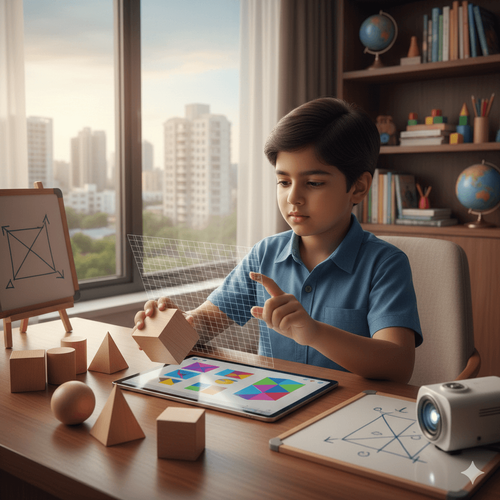

Table of Contents
- Spatial Reasoning Meaning: Understanding the Basics
- What is Spatial Orientation Reasoning?
- Spatial Visualization Reasoning Questions: Testing Your Skil
- Why Spatial Reasoning Matters for Academic Success?
- Developing Spatial Reasoning in Young Children
- Spatial Reasoning Activities for School Students
- Common Challenges in Spatial Reasoning Development
- Spatial Reasoning in Different Learning Styles
- Spatial Reasoning Assessment and Progress Monitoring
- Technology and Spatial Reasoning Development
- Long-Term Benefits of Strong Spatial Reasoning
- How PlanetSpark Develops Spatial Reasoning Skills?
- Embrace Your Child's Spatial Reasoning Journey with PlanetSp
Imagine being able to mentally rotate objects, visualize how puzzle pieces fit together, or navigate through a complex maze without getting lost. These incredible abilities all stem from one powerful cognitive skill: spatial reasoning. This essential mental capability helps students excel not just in mathematics and science, but also in everyday activities like packing a suitcase, reading maps, or even playing sports. At PlanetSpark, we recognize that developing strong spatial reasoning skills during childhood creates a foundation for academic success and real-world problem-solving that lasts a lifetime.
Spatial reasoning is more than just a fancy term; it's a critical thinking skill that influences how children understand their environment, process visual information, and solve complex problems. Through our innovative programs at PlanetSpark, we help students strengthen their visual thinking abilities using engaging activities, interactive challenges, and proven teaching methods designed specifically for young learners.
Spatial Reasoning Meaning: Understanding the Basics
Before we dive deeper, let's explore the spatial reasoning meaning in simple terms. Spatial reasoning is your brain's ability to think about objects in three dimensions and understand how they relate to each other in space. It's like having a mental playground where you can move, rotate, and manipulate objects in your mind without physically touching them.
This cognitive skill involves several important components:
- Visualizing objects from different angles and perspectives
- Understanding relationships between objects in space
- Mental rotation of shapes and figures
- Recognizing patterns in visual information
- Predicting movements and transformations of objects
When children develop strong spatial reasoning, they gain the ability to see the world in a more dimensional way. They can imagine what a building looks like from the inside just by seeing the outside, or predict how pieces will fit together before attempting to assemble them.
Unlock your child's visual thinking potential with PlanetSpark!
Book a free trial class today and discover how we make learning spatial skills fun and effective!
What is Spatial Orientation Reasoning?
Spatial orientation reasoning is a specific type of spatial thinking that focuses on understanding your position relative to objects around you, or understanding how objects relate to each other in space. Think of it as your mental compass and map combined into one powerful tool.
Key Aspects of Spatial Orientation Reasoning:
Personal Orientation Children learn to understand concepts like left and right, up and down, near and far. This helps them navigate their environment confidently and give or follow directions accurately.
Object Relations Understanding how multiple objects are positioned relative to each other. For example, recognizing that the book is on top of the table, which is next to the chair, which is across from the door.
Perspective Taking The ability to imagine how a scene would look from a different viewpoint. This is crucial for reading maps, understanding diagrams, and empathizing with others' physical perspectives.
Navigation Skills Using mental maps to move through spaces efficiently. Children with strong spatial orientation reasoning can find their way in new environments and remember routes more easily.
Developing spatial orientation reasoning helps students excel in geography, understand scientific diagrams, follow complex instructions, and become more independent in their daily activities.
Transform your child's problem-solving abilities! Join PlanetSpark's specialized cognitive development programs designed for young minds.
Spatial Visualization Reasoning Questions: Testing Your Skills
Spatial visualization reasoning questions are specially designed challenges that assess and strengthen your ability to mentally manipulate visual information. These questions appear in competitive exams, aptitude tests, and intelligence assessments because they effectively measure spatial thinking abilities.
Common Types of Spatial Visualization Questions:
Mental Rotation Questions These present a shape or object and ask you to identify how it would look after being rotated. Students must imagine the object turning in their mind to find the correct answer.
Pattern Completion Visual puzzles where students identify missing pieces or predict the next shape in a sequence. These questions test pattern recognition and spatial prediction skills.
Paper Folding Problems Questions that show a piece of paper being folded and cut, then ask students to predict what it looks like when unfolded. This tests mental manipulation and visualization skills.
3D Shape Recognition Students must identify which 2D shapes can form a given 3D object, or recognize 3D shapes from different angles. This builds understanding of dimensional relationships.
Mirror Image Questions These ask students to identify how an object would appear when reflected. This tests symmetry understanding and mental transformation abilities.
Block Counting Problems where students count hidden blocks in a 3D structure, requiring them to visualize objects they cannot directly see.
Why Spatial Reasoning Matters for Academic Success?
Strong spatial reasoning skills directly correlate with success in multiple academic subjects and career paths. Research shows that children who develop these skills early have significant advantages throughout their educational journey.
Academic Benefits:
Mathematics Excellence Spatial reasoning is fundamental to geometry, understanding graphs, visualizing equations, and solving word problems. Students with strong spatial skills often grasp mathematical concepts more quickly and retain them better.
Science Understanding From visualizing molecular structures in chemistry to understanding planetary movements in astronomy, spatial reasoning is essential for scientific thinking. It helps students understand complex systems and processes.
Technology and Engineering Future careers in STEM fields require exceptional spatial abilities. Students who develop these skills early are better prepared for coding, robotics, engineering design, and technological innovation.
Reading and Literacy Spatial skills help with letter recognition, understanding text layout, and visualizing story settings. These abilities support early literacy development and reading comprehension.
Art and Creativity Understanding proportion, perspective, and composition all depend on spatial reasoning. These skills enable students to express themselves creatively and appreciate visual arts.
Developing Spatial Reasoning in Young Children
The good news about spatial reasoning is that it's a skill that can be developed and strengthened with practice. Unlike some innate abilities, spatial thinking improves significantly through targeted activities and consistent engagement.
Early Development Strategies:
Play with Building Blocks Construction toys like LEGO, blocks, and magnetic tiles are excellent for developing spatial skills. Children learn about balance, symmetry, and three-dimensional relationships through hands-on building.
Puzzle Solving Jigsaw puzzles, tangrams, and shape-sorting games strengthen visual perception and spatial visualization. Start with age-appropriate puzzles and gradually increase complexity.
Drawing and Art Activities Encourage children to draw objects from different angles, create maps of familiar places, or copy three-dimensional shapes. These activities develop visualization and representation skills.
Physical Movement Games Activities like obstacle courses, dance, and sports help children understand their body's position in space and develop spatial orientation reasoning naturally through movement.
Map Reading Introduce simple maps and encourage children to follow routes or create their own maps of familiar spaces like their home or school.
Unlock your child's full cognitive potential! Join PlanetSpark where expert educators make spatial reasoning development engaging and effective.
Spatial Reasoning Activities for School Students
As children grow older, spatial reasoning activities can become more sophisticated and challenging. Here are engaging exercises perfect for school-age students:
Advanced Spatial Challenges:
Origami and Paper Crafts Following origami instructions requires students to visualize folds and predict outcomes, strengthening spatial visualization reasoning questions solving abilities.
Chess and Strategy Games These games develop spatial planning, multiple perspective-taking, and strategic thinking across a spatial plane.
Coding and Programming Learning to code helps students think spatially about coordinates, movement, and object manipulation in digital spaces.
Architecture and Design Projects Challenge students to design dream houses, create city layouts, or plan garden spaces. These projects integrate multiple spatial reasoning skills.
Geometry Challenges Solve complex geometric problems, work with 3D shapes, and explore transformations like rotation, reflection, and translation.
Virtual Reality Experiences Educational VR programs can provide immersive spatial learning experiences, though physical activities should remain the priority.
Common Challenges in Spatial Reasoning Development
While spatial reasoning can be developed in all children, some students face specific challenges that require additional support and tailored approaches.
Recognizing and Addressing Difficulties:
Left-Right Confusion Some children struggle with directional concepts. Consistent practice with physical activities and verbal reinforcement helps overcome this challenge.
Difficulty Visualizing Rotations Mental rotation is particularly challenging for some learners. Using physical manipulatives before progressing to mental visualization helps build this skill gradually.
Trouble with Perspective Changes Understanding how objects look from different viewpoints requires practice. Games that involve switching perspectives help develop this ability.
Pattern Recognition Issues Some students need extra support identifying visual patterns. Starting with simple, obvious patterns and gradually increasing complexity builds confidence.
3D to 2D Translation Problems Converting between three-dimensional objects and two-dimensional representations can be confusing. Using drawing exercises alongside physical objects clarifies these relationships.
At PlanetSpark, our educators are trained to identify these challenges early and implement targeted interventions that help every student succeed.
Spatial Reasoning in Different Learning Styles
Understanding that children learn differently is crucial for developing spatial reasoning effectively. Some students are naturally visual learners, while others benefit from kinesthetic or auditory approaches.
Adapting to Learning Styles:
Visual Learners These students thrive with diagrams, color-coding, videos, and visual demonstrations. They benefit from seeing spatial concepts illustrated clearly.
Kinesthetic Learners Hands-on activities, building projects, and physical manipulation of objects help these students internalize spatial reasoning meaning through touch and movement.
Auditory Learners Verbal descriptions, discussing spatial relationships aloud, and listening to step-by-step instructions support these students' spatial development.
Logical Learners These students appreciate understanding the "why" behind spatial concepts and benefit from systematic problem-solving approaches.
PlanetSpark's multi-sensory teaching approach ensures that regardless of learning style, every student can develop strong spatial reasoning skills.
Discover your child's unique learning style and optimize their spatial development! PlanetSpark's expert educators create personalized learning paths.
Spatial Reasoning Assessment and Progress Monitoring
Measuring spatial reasoning development helps students and parents understand growth and identify areas needing additional focus. Assessment shouldn't feel like testing but rather like engaging challenges that reveal capabilities.
Assessment Methods:
Standardized Spatial Tests Age-appropriate assessments that measure various aspects of spatial thinking provide baseline measurements and track improvement over time.
Portfolio Review Collecting samples of student work like drawings, building projects, and solved spatial visualization reasoning questions shows progress visually.
Observation Records Teachers note how students approach spatial tasks, their problem-solving strategies, and their confidence levels during activities.
Self-Reflection Encouraging students to think about their own spatial thinking helps develop metacognitive awareness and ownership of their learning.
Comparative Analysis Comparing performance on similar tasks over time reveals growth and highlights successful strategies.
Technology and Spatial Reasoning Development
While physical activities remain crucial, technology offers valuable tools for developing spatial reasoning when used appropriately and in moderation.
Effective Digital Tools:
Educational Apps Age-appropriate apps designed specifically for spatial reasoning development provide instant feedback and adaptive difficulty levels.
3D Modeling Software Programs that allow students to create and manipulate three-dimensional objects on screen strengthen visualization skills.
Interactive Geometry Programs Digital tools that demonstrate transformations, rotations, and geometric relationships make abstract concepts concrete.
Augmented Reality Learning AR applications overlay digital information onto the physical world, creating unique spatial learning opportunities.
Video Game Design Creating simple games requires students to think spatially about character movement, level design, and object interactions.
PlanetSpark integrates appropriate technology with traditional hands-on learning to provide balanced, effective spatial reasoning development.
Ready to give your child the cognitive edge they need? Join PlanetSpark's innovative spatial reasoning program that blends technology with proven teaching methods.
Long-Term Benefits of Strong Spatial Reasoning
Developing spatial reasoning during childhood creates advantages that extend far beyond school years. These skills become valuable assets throughout life, influencing career success and daily problem-solving abilities.
Lifelong Advantages:
Career Opportunities Strong spatial skills open doors to careers in engineering, architecture, medicine, aviation, design, technology, and many other high-demand fields.
Problem-Solving Excellence People with well-developed spatial reasoning approach problems more creatively and can visualize multiple solutions simultaneously.
Enhanced Creativity Spatial thinking supports innovation, artistic expression, and the ability to imagine possibilities that others might miss.
Practical Life Skills From packing efficiently to assembling furniture to parking cars, spatial reasoning makes everyday tasks easier and more efficient.
Continued Learning Strong spatial skills make learning new technical subjects, understanding complex systems, and adapting to new technologies easier throughout life.
How PlanetSpark Develops Spatial Reasoning Skills?
At PlanetSpark, we've developed a comprehensive approach to building spatial reasoning abilities in young learners. Our methodology combines scientific research with engaging, age-appropriate activities that make learning natural and enjoyable.
Structured Curriculum Our spatial reasoning program progresses logically from foundational concepts to advanced challenges, ensuring students build skills systematically without gaps in understanding.
Interactive Learning We use digital tools, hands-on activities, and collaborative challenges that keep students engaged while developing their spatial thinking abilities.
Expert Instructors Our certified educators understand child development and cognitive science, enabling them to identify each student's strengths and areas for growth.
Personalized Attention Small class sizes ensure every child receives individual support and challenges appropriate to their skill level.
Real-World Applications We connect spatial reasoning concepts to real-life situations, helping students understand why these skills matter and how to apply them beyond the classroom.
Progress Tracking Regular assessments help parents and students see measurable improvement in spatial thinking abilities over time.
Elevate your child's academic performance across all subjects! PlanetSpark's comprehensive programs strengthen spatial reasoning and cognitive skills.
Embrace Your Child's Spatial Reasoning Journey with PlanetSpark
Spatial reasoning is not just another academic skill; it's a fundamental cognitive ability that shapes how children understand and interact with their world. From solving spatial visualization reasoning questions to developing strong spatial orientation reasoning, these capabilities build confidence, enhance learning, and prepare students for future success.
Understanding the true spatial reasoning meaning goes beyond definitions; it's about recognizing the power of visual thinking and its impact on every aspect of learning and life. When children develop these skills early, they gain tools for academic excellence, creative expression, and practical problem-solving that serve them throughout their lives.
At PlanetSpark, we're passionate about unlocking every child's cognitive potential. Our comprehensive spatial reasoning programs are designed specifically for young learners, combining expert instruction with engaging activities that make developing these crucial skills natural and enjoyable. We understand that every child learns differently, which is why our personalized approach ensures each student receives the support and challenges they need to thrive.
The journey to stronger spatial thinking begins with a single step. Whether your child struggles with spatial concepts or shows natural aptitude, our programs meet them where they are and guide them toward excellence. Through proven teaching methods, interactive learning experiences, and consistent encouragement, we help students build confidence alongside capability.
Don't let another day pass without giving your child the cognitive advantages they deserve. Strong spatial reasoning skills open doors to STEM careers, enhance creativity, improve academic performance, and build problem-solving abilities that last a lifetime. The investment you make today in developing these skills will pay dividends throughout your child's educational journey and beyond.
Remember, every spatial reasoning expert started as a beginner. Your child's journey toward stronger visual thinking skills begins now, and PlanetSpark is here to guide every step of the way with expertise, encouragement, and proven results.
Frequently Asked Questions
Spatial reasoning is the ability to understand, visualize, and mentally manipulate objects in space. It helps children imagine shapes from different angles, understand directions, and solve visual problems using mental images rather than physical objects.
Spatial reasoning supports success in maths, science, reading, art, and technology. It helps children understand geometry, graphs, maps, diagrams, and patterns. Strong spatial skills also improve problem-solving, creativity, and everyday tasks like navigation and organization.
Spatial orientation reasoning is the ability to understand where objects are located in relation to oneself or other objects. It includes skills like left-right awareness, direction-following, map reading, and perspective-taking, which are essential for independence and learning.
Parents can encourage building with blocks, solving puzzles, playing board games, drawing maps, doing origami, and discussing directions during daily activities. Hands-on play combined with verbal explanation strengthens spatial thinking naturally.
PlanetSpark builds spatial reasoning through structured activities, puzzles, visualization challenges, coding tasks, and interactive problem-solving. Expert educators personalize lessons to each child’s learning style, ensuring consistent improvement in visual thinking and confidence.