
Understanding Virtual Reality for Children | Benefits
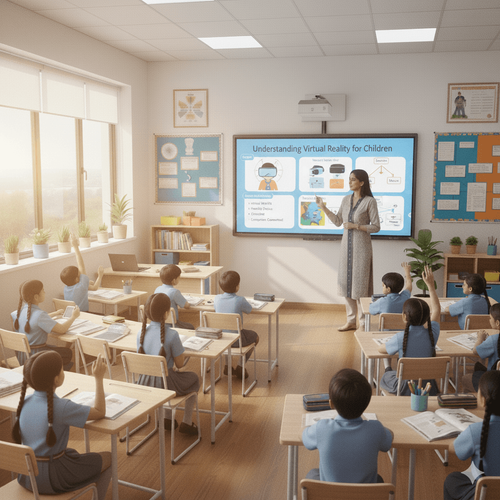

Table of Contents
- What Is Virtual Reality and Why Is It Important for Children
- The Role of Virtual Reality in Children’s Learning and Devel
- Benefits of Virtual Reality for Kids
- Practical Uses of VR for Children – From Learning to Life Sk
- Are There Any Risks of VR for Children?
- VR and Social-Emotional Development in Children
- PlanetSpark Personality Development Course: Building Confide
- Rise Above the Ordinary – A Motivating
Virtual Reality (VR) has rapidly evolved from being just a futuristic entertainment gadget to becoming one of the most influential educational and developmental tools for children. Today, parents increasingly search for Understanding Virtual Reality for Children because they want reliable, practical, and child-friendly information about this technology. They wish to know how VR works, how it affects the developing brain, and how it can be used safely and meaningfully to support learning, creativity, and emotional growth.
This blog breaks down VR in simple, parent-friendly language. It explores its wide-ranging benefits, potential risks, and real-life applications in academics and life skills. You’ll also find age-appropriate usage guidelines, safety tips, developmental insights, and strategies for integrating VR into your child’s daily learning routine. Whether your child uses VR for fun, studies, or creativity, this guide will help you make informed, responsible decisions for their holistic development.
What Is Virtual Reality and Why Is It Important for Children?
Understanding Virtual Reality for Children – A Simple Explanation
Virtual Reality refers to a computer-generated, three-dimensional environment that children can see and interact with using a VR headset. Instead of watching content on a screen, kids “step inside” the digital world,whether it’s a rainforest, the solar system, a historical era, or an imaginative storyscape.
For children, VR feels like a magical portal where learning becomes more visual, immersive, and exciting. This immersion helps kids grasp complex concepts easily,like biology, space, geography, and physics,by experiencing them instead of simply reading about them.
VR isn't just for entertainment; its educational role is now widely recognized by schools, ed-tech platforms, and cognitive development experts. Through VR, kids can explore creativity, storytelling, problem-solving, and curiosity in entirely new ways.
The Role of Virtual Reality in Children’s Learning and Development
How VR Helps Children Learn Better
Children absorb knowledge best when learning feels real, interactive, and emotionally engaging. Virtual Reality transforms this learning process by placing children directly inside the experience. Instead of simply reading or watching, VR enables them to see, feel, touch, and explore concepts in three-dimensional environments.
Studies show that VR-based learning significantly improves:
Memory retention – Children remember concepts better when they experience them visually and physically.
Conceptual understanding – VR breaks down complex information into digestible, immersive models.
Engagement levels – Kids are naturally excited and motivated to learn through interactive simulations.
Attention span – The immersive nature of VR reduces distraction, keeping children focused longer.
Multi-sensory learning – VR activates sight, sound, and motion, strengthening neural connections and making learning deeper and faster.
With VR, learning environments extend far beyond classrooms. Kids can dive into the deepest oceans, walk across Mars, visit the pyramids of Egypt, explore the human brain, or conduct science experiments,without any physical risk. This transforms learning from passive intake to active exploration, encouraging curiosity, confidence, and independent thinking.
Benefits of Virtual Reality for Kids
1. Enhanced Creativity and Imagination
Virtual Reality fuels imagination by presenting endless possibilities. Children can:
Create and design their own 3D worlds
Interact with animated characters
Build models or environments
Explore fantasy and realistic simulations
These immersive experiences encourage creativity beyond traditional drawing or storytelling. Kids can visualize scenarios, build digital landscapes, and experiment with ideas—building artistic, cognitive, and innovation skills simultaneously.
2. Improved Focus and Attention
VR minimizes distractions by immersing children completely in a task. When a child enters a virtual world, the outside environment fades away, helping them concentrate naturally. This process:
Improves attention span
Boosts task persistence
Supports children with attention challenges
Helps maintain deep learning for longer durations
Unlike textbooks or videos, VR stimulates the brain to remain alert and involved, leading to stronger learning outcomes.
3. Better Understanding of Difficult Concepts
Some topics are too abstract or complex for young minds to imagine. VR bridges this gap by offering 3D visualizations and hands-on simulations, making complicated subjects simple and enjoyable.
Children can:
Watch planets orbit the sun in a realistic solar system
Explore organs inside the human body
Program virtual robots
Walk inside a volcano
Witness photosynthesis in action
These dynamic experiences make understanding faster, clearer, and more meaningful.
4. Emotional Learning Through Realistic Scenarios
VR supports emotional and social development by placing children in controlled, real-life simulations. Kids can practise:
Helping friends in challenging situations
Sharing, cooperating, and collaborating
Solving group problems
Handling disagreements
Responding empathetically
These scenarios build emotional intelligence, empathy, communication skills, and cultural awareness—skills essential for real-world interactions.
5. Multisensory Skill Development
Unlike traditional learning methods, VR teaches through multiple senses:
Visual learning through 360° views and 3D models
Auditory learning through narration, game sounds, and interactive voices
Kinesthetic learning through motion-based activities
This multisensory approach strengthens neural pathways, making information easier to understand and recall. It benefits all learners, especially children who struggle with purely verbal or written learning.
Kids learn to synchronise sight, sound, and movement,skills essential for brain development, motor coordination, and deep comprehension.
Practical Uses of VR for Children – From Learning to Life Skills
Educational Applications of VR for Kids
VR has transformed how children understand academic subjects. Here’s how:
Science Learning
Explore the solar system
Dive into the deep sea
Zoom into the human body
Conduct virtual experiments
Mathematics
3D geometry
Measurement through interaction
Problem-solving puzzles
History and Geography
Walk through ancient civilizations
Travel across continents
Witness historical events
Language Learning
Storytelling environments
Immersive reading experiences
Pronunciation practice.
Are There Any Risks of VR for Children?
Understanding Safety, Risks, and Age Recommendations
Just like any digital tool, VR requires balanced, supervised usage.
Key Concerns:
1. Eye Strain and Vision Fatigue
Long VR sessions may cause discomfort, especially in younger children whose eyes are still developing.
2. Motion Sickness
Some kids may experience dizziness or nausea due to sensory imbalance.
3. Overstimulation
Highly immersive environments may overwhelm sensitive children.
4. Physical Injury
If children walk or jump while wearing headsets, they can collide with objects.
Recommended Safety Tips:
Limit VR to 15–20 minutes per session
Ensure proper lighting
Use age-appropriate content
Set up a safe, open space
Always supervise usage
Check headset size and comfort
VR and Social-Emotional Development in Children
How VR Helps Kids Build Emotional Intelligence
VR scenarios help children practise:
Problem solving
Conflict resolution
Empathy
Collaboration
Leadership
Self-regulation
Through simulations, kids learn how to react in different real-life situations, improving emotional maturity.
PlanetSpark Personality Development Course: Building Confident, Future-Ready Children
PlanetSpark offers one of India’s most advanced, structured, and personalised personality development courses for children. Here's everything included:
Holistic Curriculum Beyond Academics
PlanetSpark’s curriculum focuses on:
Communication etiquette
Self-introduction
Goal setting
Peer interaction
Leadership
Self-awareness
Critical thinking
These essential life skills build strong foundational confidence.
Social-Emotional Learning (SEL) Based Design
Specially designed for young learners, the program includes:
Emotional awareness
Emotional regulation
Learning through reflection
Guided expression activities
Practical, Activity-Based Learning
Children learn through:
Mock interviews
Public speaking
Journaling
Feedback sharing
Simulations of real-life situations
Role plays and case studies
These activities help them apply skills instead of memorising them.
Leadership & Self-Presentation Training
Kids engage in challenges designed to enhance:
Empathy
Responsibility
Assertiveness
Teamwork
They also practise storytelling and presentations to build leadership presence.
Confidence Meter & Parent Consultations
Parents receive progress updates on:
Confidence
Communication strength
Social skills
Leadership growth
Regular PTMs track developmental milestones.
1:1 Personal Trainers for Every Child
Each child gets a personal coach who:
Understands learning styles
Gives immediate feedback
Helps build fluency, speaking, and writing
Supports storytelling and confidence
This personalised attention accelerates growth.
Personalised Learning Roadmap
PlanetSpark customises a learning journey to help children improve:
Grammar
Vocabulary
Fluency
Confidence
Content creation
The roadmap evolves with the child’s progress.
SparkX – AI-Enabled Video Analysis
SparkX evaluates:
Voice modulation
Body language
Grammar usage
Confidence
Stage presence
Parents receive detailed reports showing measurable improvements.
AI-Led Practice Sessions
Children practise independently with AI coaches, helping them:
Deliver speeches
Tell stories
Improve fluency
Get instant feedback
Spark Diary – Building Writing Habits
Kids maintain a digital journal to write:
Stories
Poems
Reflections
Speeches
This boosts clarity, creativity, and writing confidence.
Gamified Learning for Engagement
Kids enjoy:
Vocabulary games
Spelling challenges
Grammar activities
Daily quizzes
These fun tools ensure consistent learning.
Regular PTMs and Detailed Progress Reports
Parents receive updates on:
Content quality
Critical thinking
Grammar
Body language
Voice modulation
Confidence
Reports include guidance for improvement.
Exclusive Clubs & Communities
Kids join:
Debate Club
Story Writing Club
Speech Circles
Comedy Club
Podcasting Club
Writers Guild
These communities make learning social and enjoyable.
Sparkline – Safe Sharing Platform
Children can safely share:
Videos
Stories
Creative work
It encourages expression and peer learning.
Contests, Showcases & Recognition
PlanetSpark hosts:
Speech competitions
Storytelling contests
Writing challenges
Open mic sessions
Talent showcases
These activities boost confidence and celebration of growth.
Rise Above the Ordinary – A Motivating
Virtual Reality opens the door to a future where children learn, explore, and imagine beyond boundaries. But while technology can spark curiosity, personality development shapes confidence, communication, leadership, and emotional resilience,skills that define a child’s long-term success.
PlanetSpark bridges both worlds by empowering children to become expressive, creative, and confident individuals ready to thrive in a fast-changing digital world.
Frequently Asked Questions
VR is safe when used in moderation. Children should take breaks every 15–20 minutes, use age-appropriate content, and always be supervised. VR offers immersive benefits but should never replace physical activity, social interaction, or real-world learning.
Experts recommend VR for kids above 8 years due to visual development. However, supervised, low-intensity VR experiences can be introduced earlier through child-friendly platforms.
Virtual Reality boosts learning by transforming information into experiences rather than passive content. When children step into a VR environment, they actively explore, observe, and interact—making learning more natural and enjoyable.
Here’s how VR improves learning:
• Enhances Focus
VR eliminates external distractions by immersing children in a dedicated learning space. This helps them stay engaged longer, which is especially beneficial for kids who struggle with concentration.
• Strengthens Memory Retention
Children remember better when they “experience” lessons. VR uses visuals, storytelling, and interactive elements that anchor information into long-term memory.
• Simplifies Complex Concepts
Subjects like astronomy, robotics, anatomy, or geography become easier because VR provides 3D models and real-time simulations. Kids can rotate objects, zoom in, or explore environments—making learning more intuitive.
• Promotes Active Participation
Kids perform virtual experiments, solve puzzles, and take guided tours. This hands-on learning builds independence and curiosity.
• Encourages Creativity and Imagination
By allowing children to build worlds, animate ideas, or tell stories inside VR, their imaginative thinking and creativity expand significantly.
• Boosts Confidence
When children learn by exploring instead of struggling through text-heavy content, they feel more confident and capable.
In short, VR turns learning into an exciting adventure—helping children absorb, understand, and enjoy educational content more deeply.
The best VR apps for kids are those that balance education, entertainment, and safe exploration. Parents should choose apps that are age-appropriate, easy to navigate, and meaningful for learning.
Here are the top categories of VR apps suitable for children:
• Space Exploration Apps
Children can explore planets, stars, and solar systems in 3D. These apps make astronomy interactive and visually stunning.
• Ocean & Wildlife Discovery
VR underwater worlds introduce kids to marine life, coral reefs, and ecosystems—building curiosity about nature and environmental awareness.
• Storytelling & Creativity Apps
These apps allow children to enter story worlds, create their own characters, or build storylines. They support language development and creative thinking.
• Geography & World Culture Apps
Kids can virtually “travel” to different countries, explore landmarks, and learn about diverse cultures—making geography exciting and relatable.
• Science Experiment Simulations
Children can safely perform lab experiments, learn about chemistry or physics, and observe scientific reactions without risks.
• Art & Design Apps
Drawing, sculpting, or designing in 3D spaces allows kids to practise creativity in ways that traditional tools can’t match.
Important Tip:
Parents must always check:
Age ratings
User reviews
Content quality
Screen time guidelines
Device compatibility
This ensures safety and a positive VR experience
PlanetSpark plays a crucial role in helping children thrive in today’s digital, tech-driven world. While VR enhances curiosity and subject understanding, PlanetSpark ensures children develop communication, confidence, expression, critical thinking, and personality skills—the abilities that technology alone cannot build.
Here’s how PlanetSpark complements VR and digital learning:
• Builds Strong Communication Skills
PlanetSpark’s training helps children express their observations, describe VR experiences, and speak confidently about what they learn.
• Develops Creative Thinking
Through storytelling, speech activities, and creative writing sessions, kids learn to convert their VR experiences into stories, ideas, and meaningful narratives.
• Enhances Emotional Intelligence
PlanetSpark’s SEL-based lessons teach children empathy, self-awareness, and teamwork—skills needed to navigate both digital and real-world interactions.
• Strengthens Leadership & Presentations
After exploring concepts in VR, PlanetSpark helps children present their insights with clarity and confidence through:
Public speaking
Stage presence
Body language training
Voice modulation practice
• Provides 1:1 Expert Mentorship
Children receive personalised guidance to shape their communication style, thought clarity, and personality—ensuring consistent growth beyond digital tools.
• Encourages Structured Thinking
PlanetSpark trains kids to organise ideas, solve problems, and articulate thoughts—skills necessary to make the most of VR-based learning.
• Supports Safe Digital Growth
Kids also learn responsible digital behaviour, critical evaluation of content, and healthy screen-time habits.
In essence:
VR expands what children see and experience, while PlanetSpark shapes how they think, communicate, and grow—creating a powerful combination for 21st-century learning.