
What Are Syllables? | Fun Learning with PlanetSpark


Table of Contents
- What Are Syllables?
- Why Are Syllables Important?
- What Are Syllables in a Word?
- What Are Syllables in a Poem?
- What Are One Syllable Words?
- What Are Two Syllable Words?
- What Are Three Syllable Words?
- 10 Examples of Syllable Words
- What Are Stressed and Unstressed Syllables?
- What Are the 6 Types of Syllables?
- 4 Common Types of Syllables (Simplified for Beginners)
- What Are Consonants and Vowels?
- What Are 20 Examples of Syllables?
- How to Count Syllables (Easy Steps)
- Quick Tip for Parents
- Syllables in Daily Life
- Recap Table : Let’s Revise Together!
- Final Thoughts from PlanetSpark
Have you ever clapped your hands while saying a word like ba-na-na or ap-ple? If yes, you were actually counting syllables the beats or sounds that make up every word! Syllables help us understand how words are formed and how they sound when spoken aloud. They make pronunciation easier and help us speak clearly and rhythmically.
In this blog, we’ll dive deeper into what syllables are, why they play such an important role in speaking and spelling, and how you can enjoy learning them the fun way! With PlanetSpark, every lesson becomes a joyful experience simple, smart, and full of smiles as you master the rhythm of words and improve your communication skills.
What Are Syllables?
A syllable is a single, unbroken sound of a word.
It usually has one vowel sound (a, e, i, o, u) and may include surrounding consonants.
For example:
- Cat has 1 syllable (cat)
- Ti-ger has 2 syllables (ti / ger)
- El-e-phant has 3 syllables (el / e / phant)
So, every time your mouth opens to make a new sound, that’s one syllable!
Simple Definition for Kids
A syllable is a part of a word that has one vowel sound.
Try saying the word “planet.”
You hear pla-net → That’s 2 syllables!
Unlock your child’s word power with PlanetSpark’s fun syllable lessons. Join a free trial today and make learning pronunciation simple and exciting!
Why Are Syllables Important?
Understanding syllables helps in:
Reading – You can break big words into smaller parts.
Spelling – It’s easier to spell when you know how many syllables a word has.
Poetry – Poems often follow syllable patterns for rhythm and flow.
Pronunciation – You can say words clearly and correctly.
Fun Checkpoint: Can You Guess?
| Word | How Many Syllables? | Clap Count 👏 |
| Dog | 1 | 👏 |
| Water | 2 | 👏👏 |
| Butterfly | 3 | 👏👏👏 |
| Celebration | 4 | 👏👏👏👏 |
Try this with your parents! It’s fun and helps you learn faster.
What Are Syllables in a Word?
Every word is made up of one or more syllables.
Let’s look at a few examples:
| Word | Syllable Parts | Total Syllables |
| Book | book | 1 |
| Pencil | pen / cil | 2 |
| Family | fam / i / ly | 3 |
| Calculator | cal / cu / la / tor | 4 |
Tip: Each syllable has at least one vowel sound.
What Are Syllables in a Poem?
In poems, syllables help create rhythm and music.
Poets count syllables to make lines sound beautiful.
For example:
Twinkle, twinkle, little star (7 syllables)
How I wonder what you are (6 syllables)
So, poems “dance” with syllables!
What Are One Syllable Words?
These are the shortest and simplest words just one sound!
| Examples | Pronunciation |
| Cat | cat |
| Sun | sun |
| Jump | jump |
| Fish | fish |
| Moon | moon |
Fun Tip: Clap once for each one syllable word!
What Are Two Syllable Words?
These words have two beats or claps.
Let’s see some fun examples:
| Word | Split | Claps |
| Tiger | Ti / ger | 👏👏 |
| Planet | Pla / net | 👏👏 |
| Mother | Mo / ther | 👏👏 |
| Garden | Gar / den | 👏👏 |
| Pillow | Pil / low | 👏👏 |
Every syllable has a vowel can you find them?
What Are Three Syllable Words?
Now, let’s move to longer words! These have three vowel sounds.
| Word | Syllable Split | Claps |
| Elephant | El / e / phant | 👏👏👏 |
| Chocolate | Cho / co / late | 👏👏👏 |
| Butterfly | But / ter / fly | 👏👏👏 |
| Banana | Ba / na / na | 👏👏👏 |
| Computer | Com / pu / ter | 👏👏👏 |
10 Examples of Syllable Words
Here are 10 common words with their syllable counts:
| Word | Number of Syllables |
| Dog | 1 |
| Water | 2 |
| Animal | 3 |
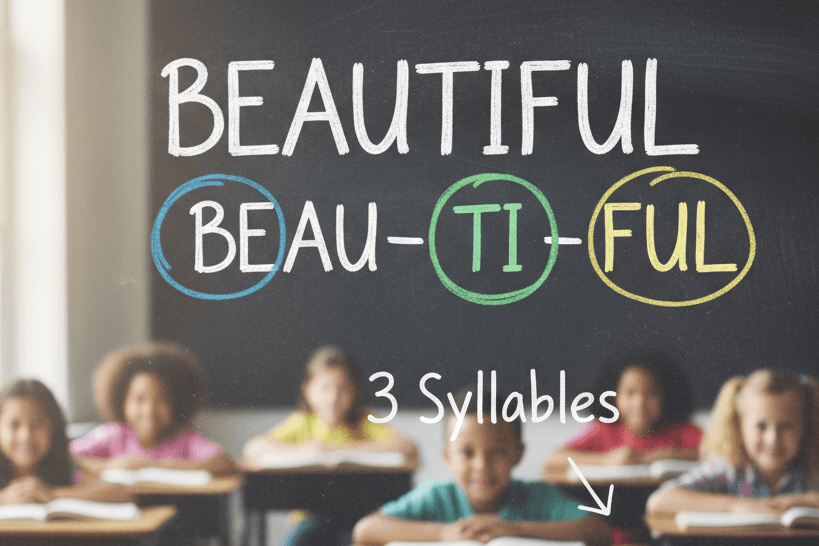
| Beautiful | 3 |
| Happiness | 3 |
| Celebration | 4 |
| Education | 4 |
| Responsibility | 6 |
| PlanetSpark | 3 |
| Wonderful | 3 |
What Are Stressed and Unstressed Syllables?
When we speak, some syllables are stronger (stressed) and others are softer (unstressed).
Example:
TA-ble → “TA” is stressed, “ble” is unstressed.
Com-PU-ter → “PU” is stressed.
Try this!
Say: “PLAN-et-SPARK!”
Which part sounds stronger? That’s your stressed syllable!
What Are the 6 Types of Syllables?
Let’s explore the 6 main types that help in reading and spelling:
| Type | Example | Explanation |
| 1. Closed Syllable | Cat, Jump | Ends with a consonant (short vowel sound) |
| 2. Open Syllable | Go, Me | Ends with a vowel (long vowel sound) |
| 3. Magic ‘e’ (Silent e) | Cake, Bike | Final ‘e’ makes the vowel long |
| 4. Vowel Team | Boat, Rain | Two vowels work together |
| 5. R-Controlled | Car, Bird | ‘r’ changes the vowel sound |
| 6. Consonant-le | Ta-ble, Lit-tle | Ends with “le” sound |
Fun Fact for Kids
Did you know?
The word “supercalifragilisticexpialidocious” (from Mary Poppins) has 14 syllables!
4 Common Types of Syllables (Simplified for Beginners)
| Type | Rule | Example |
| Closed | Ends with a consonant | cat, dog |
| Open | Ends with a vowel | go, hi |
| Magic e | Ends with ‘e’ that’s silent | name, ride |
| Vowel Team | Two vowels together | rain, team |
What Are Consonants and Vowels?
Before learning syllables deeply, you must know this:
| Type | Letters | Example |
| Vowels | A, E, I, O, U | apple, ice, open |
| Consonants | All other letters | b, c, d, f, g, h... |
Each syllable must include at least one vowel sound!
Help your child master reading and speaking with ease! Discover how syllables shape confident communication start your free PlanetSpark class now.
Activity: Count the Syllables Challenge!
Let’s play a quick game:
Read the word aloud
Clap for each sound
| Word | Your Guess | Correct Answer |
| PlanetSpark | ? | 3 |
| Happy | ? | 2 |
| Elephant | ? | 3 |
| Jump | ? | 1 |
| Education | ? | 4 |
How many did you get right?
What Are 20 Examples of Syllables?
Here’s a big list for practice:
| Word | Syllables | Type |
| Dog | 1 | Closed |
| Tree | 1 | Open |
| Water | 2 | Open-Closed |
| Rabbit | 2 | Closed-Closed |
| Tiger | 2 | Open-R |
| Banana | 3 | Open |
| Family | 3 | Consonant-le |
| Chocolate | 3 | Closed |
| Beautiful | 3 | Vowel Team |
| Animal | 3 | Closed |
| Adventure | 3 | R-controlled |
| Elephant | 3 | Closed |
| Computer | 3 | Open |
| Butterfly | 3 | Open |
| Celebration | 4 | Open |
| Responsibility | 6 | Mixed |
| Education | 4 | Open |
| PlanetSpark | 3 | Mixed |
| Wonderful | 3 | Closed |
| Delicious | 3 | Open |
How to Count Syllables (Easy Steps)
- Say the word slowly.
- Listen for vowel sounds (a, e, i, o, u).
- Clap each time your mouth opens.
- Count your claps that’s your syllable count!
Example:
“Ap-ple” → 2 vowel sounds → 2 claps → 2 syllables
Quick Tip for Parents
Encourage your child to clap, tap, or jump for each syllable.
Use songs, rhymes, or flashcards for practice.
Divide tricky words using color or blocks (e.g., pla-net, com-pu-ter).
Learning becomes fun when it’s hands-on!
Syllables in Daily Life
Syllables are everywhere in songs, poems, and even your name!
Try saying your name slowly how many parts can you hear?
Example:
- A-mi-ta → 3 syllables
- Sam → 1 syllable
- Ro-han → 2 syllables
Isn’t that cool?
Recap Table : Let’s Revise Together!
| Concept | Meaning | Example |
| Syllable | Sound unit in a word | Ti-ger |
| One-Syllable Word | One beat | Dog |
| Two-Syllable Word | Two beats | Apple |
| Stressed Syllable | Strong sound | TA-ble |
| Unstressed Syllable | Soft sound | ta-BLE |
| Vowel | a, e, i, o, u | cat |
| Consonant | Non-vowel letters | b, c, d, f |
Build strong language skills with PlanetSpark’s engaging syllable activities. Book a free demo today and see your child learn words the smart way!
Practice Time : Try This!
Fill in the blanks
- The word “Butterfly” has ____ syllables.
- The word “Sun” has ____ syllable.
- A syllable must have one ________ sound.
- The word “PlanetSpark” has ____ syllables.
- “Com-pu-ter” has a stressed syllable on “____.”
(Answers: 3, 1, vowel, 3, PU)
Final Thoughts from PlanetSpark
PlanetSpark helps children become confident, expressive, and fluent communicators through personalised live classes and AI-powered learning. Our program blends expert mentorship, engaging activities, and real-world practice to build lifelong speaking, writing, and presentation skills.
1. 1:1 Personal Coaching for Every Child
Every learner is guided by a certified communication expert who tailors each session to their pace, style, and goals ensuring focused attention and faster growth.
2. AI-Enabled Feedback for Real Progress
With SparkX and AI-led practice sessions, kids get instant, detailed insights on speech, clarity, confidence, and delivery making every performance better than the last.
3. Personalised Learning Journey
A customised roadmap tracks your child’s unique skill gaps and milestones, ensuring steady progress from grammar basics to confident public speaking.
4. Gamified, Fun, and Engaging Learning
Interactive quizzes, storytelling challenges, and grammar games keep children motivated, making English learning exciting and habit-forming.
5. Confidence & Communication for Life
Through real-world speaking activities, showcases, and clubs, kids build fluency, stage confidence, and emotional intelligence that shine beyond the classroom.
So next time you say a big word, remember
You’re not just speaking
You’re playing music with syllables!
Frequently Asked Questions
A syllable is a single sound part of a word that always has one vowel sound.
Example: Ti-ger → has 2 syllables (ti / ger).
Every syllable must have at least one vowel sound (a, e, i, o, u).
Consonants come before or after the vowel to complete the word.
Example: Cat → vowel = a, consonants = c, t.
Say the word slowly and clap each time you hear a vowel sound.
Example: Ap-ple → (2 claps = 2 syllables).
When you speak, some syllables sound stronger (stressed) and others sound softer (unstressed).
Example: TA-ble → “TA” is stressed.
Learning syllables helps children read, spell, and speak clearly. It also improves poetry rhythm, pronunciation, and confidence in communication — which is exactly what PlanetSpark focuses on through its fun, interactive English classes.