
Top 10 Work Goal Examples for Evaluation | PlanetSpark


Table of Contents
- Why Goal Setting at the Workplace Matters
- Understanding Examples of SMART Goals for Work
- Weak Goals vs SMART Goals
- Why SMART Goals Are Powerful
- Top 10 Work Goal Examples for Evaluation
- Why These Goals Work So Well
- Workplace Goals Example for Different Roles
- Professional Development Goals for Employees
- How to Set Measurable Work Goals
- Common Mistakes in Employee Evaluation Goals
- Tips to Achieve Career Growth Goals: Examples
- How Goal Setting Improves Performance Reviews
- PlanetSpark helps you Build Confidence, Communication, and L
- Conclusion: Build Goals That Build Your Future
Ever felt stuck during a performance review, unsure of what goals truly reflect your growth? Many professionals struggle during evaluations because they cannot define clear, measurable goals that showcase their performance. Without structured goals, even hard work can go unnoticed.
This blog provides a complete guide to choosing the right work goal example for evaluation. You will explore examples of workplace goals, learn SMART goals for work, and understand how to align your goals with career growth.
We will also cover performance-review goals, examples of mistakes to avoid, and actionable strategies to help you succeed.
By the end, you will not just set goals, you will set goals that get noticed.

Why Goal Setting at the Workplace Matters
Goal-setting in the workplace is not just about writing tasks. It is about creating a clear roadmap for success. Let’s break down each benefit so you understand how it impacts your performance and evaluation.
1. Provides Clarity in Roles and Expectations
When you set clear goals, you know exactly what is expected from you. This removes confusion and helps you focus on the right priorities.
For example, If your goal is “increase client engagement by 15 per cent,” you understand that your focus should be on communication, follow-ups, and relationship building.
Without clear goals, you might work hard but on the wrong tasks, which reduces your impact.
2. Helps Track Measurable Work Goals
Measurable goals allow you to track your progress easily. You can see whether you are improving or need to adjust your approach.
For example, instead of saying “do better work,” a measurable goal like “complete 10 projects per month” gives you a clear benchmark.
This makes it easier during evaluations because you can show actual results rather than general effort.
3. Aligns Individual Performance with Company Success
When your goals match your company’s objectives, your work becomes more valuable. You are not just completing tasks; you are contributing to bigger business outcomes.
For example, If your company wants to improve customer satisfaction, your goal could be “reduce response time to under 24 hours.”
This alignment shows that you understand the organisation’s priorities, which is highly valued by managers.
4. Builds Accountability and Discipline
Goals make you responsible for your own progress. When you set a target, you are more likely to stay focused and disciplined.
For example, If your goal is to complete a certification in three months, you will plan your time and track your learning consistently.
This habit of accountability helps you become more reliable and professional over time.
5. Improves Confidence During Evaluations
When you have clear goals and measurable results, you feel more confident during performance reviews.
Instead of feeling unsure, you can confidently say:
“I increased productivity by 20 per cent” or “I completed all assigned targets within deadlines.”
This confidence makes a strong impression and improves your chances of recognition, promotions, or salary growth.
Still unsure what goals to set for your next review? Book a FREE demo class now and learn how to build powerful career goals before your next evaluation cycle closes.
Understanding Examples of SMART Goals for Work
SMART goals are a structured way to set goals that are easy to understand, track, and achieve. Instead of vague intentions, they turn your goals into clear action plans. Let’s understand each part in detail.
1. Specific
A goal should clearly define what you want to achieve. It should answer the question: What exactly am I working on?
Example: Instead of saying “improve communication,” say “improve presentation skills.”
Being specific removes confusion and gives you a clear direction.
2. Measurable
A goal must include a way to track progress. You should be able to measure success using numbers, percentages, or outcomes.
Example: “Deliver two presentations per month” is measurable because you can track how many you completed.
This helps during evaluations because you can show concrete results.
3. Achievable
Your goal should be realistic based on your current skills, resources, and time.
Example: Setting a goal to “learn five new skills in one week” is unrealistic, but “complete one certification in 60 days” is achievable.
Achievable goals keep you motivated instead of overwhelmed.
4. Relevant
The goal should align with your job role and career growth. It should contribute to your professional development or your company’s objectives.
Example: If your role involves client interaction, improving communication skills is relevant.
Irrelevant goals waste time and add no value during evaluations.
5. Time-bound
Every goal should have a deadline. This creates urgency and helps you stay focused.
Example: “Complete a certification within 60 days” gives you a clear timeline.
Without a deadline, goals often get delayed or ignored.
Weak Goals vs SMART Goals
Let’s simplify the difference:
- Weak goal: Improve communication
- SMART goal: Deliver two presentations per month for the next quarter
- Weak goal: Learn new skills
- SMART goal: Complete a professional certification within 60 days
SMART goals clearly define what to do, how much to do, and by when to do it.
Why SMART Goals Are Powerful
SMART goals improve your performance in several ways:
- Remove confusion by giving clear directions
- Help track measurable work goals
- Make employee evaluation goals data-driven
- Increase accountability and consistency
- Improve confidence during performance reviews
When you use SMART goals, you are not just working hard. You are working strategically with a clear roadmap in place.

Top 10 Work Goal Examples for Evaluation
Here are real, actionable goals that professionals can use during performance reviews. The key strength of these goals is that they are measurable, time-bound, and aligned with business outcomes, making them highly effective in evaluations.
Let’s break down each category and understand it in depth.
1. Performance and Productivity Goals
These goals focus on how efficiently and effectively you perform your core job responsibilities. They directly impact business results.
Example 1: Increase sales revenue by 15 per cent within six months
This goal focuses on business growth and revenue generation.
- It shows your ability to bring measurable value to the company
- It includes a clear metric (15 per cent) and timeline (six months)
Why it matters: Revenue is one of the most important indicators of success, so achieving this goal makes you highly valuable.
Example 2: Reduce customer response time to under 24 hours
This goal improves customer experience and service quality.
- Faster responses lead to higher customer satisfaction
- It shows efficiency and responsiveness
Why it matters: Companies prioritise customer retention, and quick service plays a big role in that.
Want to impress your manager in your next review? Book your FREE trial today and master communication that gets you noticed.
Example 3: Improve project completion rate by 20 per cent
This goal focuses on productivity and time management.
- It ensures tasks are completed faster and more efficiently
- It reflects your ability to manage workload effectively
Why it matters: Timely project completion improves team performance and company output.
2. Skill Development Goals
These goals focus on learning new skills and improving existing ones, which helps in long-term career growth.
Example 4: Complete a certification in project management within six months
This goal shows commitment to professional growth.
- Certifications increase your credibility
- They enhance your expertise in your field
Why it matters: Employers value employees who continuously upgrade their skills.
Example 5: Improve public speaking by delivering three presentations per quarter
This goal improves communication and confidence.
- Helps you express ideas clearly
- Increases your visibility in the workplace
Why it matters: Strong communication skills are essential for leadership and career advancement.
3. Leadership and Team Goals
These goals focus on your ability to lead, guide, and collaborate with others.
Example 6: Mentor two junior employees
This goal shows leadership and responsibility.
- You help others grow
- You build a strong team environment
Why it matters: Mentorship is a key trait of future leaders.
Example 7: Lead a cross-functional project
This goal demonstrates initiative and teamwork.
- You collaborate with different departments
- You manage complex tasks
Why it matters: Cross-functional work shows you can handle bigger responsibilities.
4. Efficiency and Innovation Goals
These goals focus on working smarter, improving processes, and saving time or costs.
Example 8: Automate two repetitive tasks
This goal improves efficiency and productivity.
- Saves time
- Reduces manual effort
Why it matters: Automation increases productivity and allows you to focus on high-value work.
Example 9: Reduce operational costs by 10 per cent
This goal focuses on financial efficiency.
- Helps the company save money
- Shows strategic thinking
Why it matters: Employees who contribute to cost savings are highly valued.
5. Customer and Business Goals
These goals focus on customer satisfaction and overall business performance.
Example 10: Improve customer satisfaction score from 85 per cent to 92 per cent
This goal enhances customer experience and loyalty.
- Higher satisfaction leads to repeat business
- Reflects quality service
Why it matters: Customer satisfaction directly impacts company reputation and growth.
Feeling stuck despite working hard every day? Take a FREE class and unlock skills that accelerate your career growth. Limited seats.
Why These Goals Work So Well
These performance review goals examples are effective because they follow key principles:
1. They Are Measurable
Each goal includes numbers, percentages, or timelines
2. They Are Actionable
You know exactly what needs to be done
3. They Align with Business Objectives
They contribute directly to company success
4. They Show Impact
They clearly demonstrate your value as an employee
Workplace Goals Example for Different Roles
A workplace goal example becomes truly effective only when it aligns with your specific role, responsibilities, and expectations. Generic goals often fail because they do not reflect what success looks like in your job. On the other hand, personalised goals help you demonstrate measurable impact and make your evaluation stronger.
Let’s break this down role by role:
For Managers
Managers are responsible for leading teams and driving results. Their goals should focus on leadership, team performance, and strategic growth.
For example:
- Improving team productivity by 25 per cent shows your ability to drive results
- Conducting monthly feedback sessions highlights your leadership and people management skills
- Building leadership pipelines reflects long-term vision and succession planning
These goals prove that you are not just managing tasks but also developing people and improving team efficiency.
For Freshers
Freshers are in the learning phase, so their goals should focus on skill-building and adaptability.
For example:
- Learning core tools within three months shows your ability to adapt quickly
- Improving communication through presentations builds confidence
- Completing onboarding milestones reflects discipline and commitment
These goals help freshers show growth potential, which is more important than immediate results.
For Sales Professionals
Sales roles are performance-driven, so goals must be measurable and revenue-focused.
For example:
- Increasing conversion rates by 10 per cent shows effectiveness in closing deals
- Acquiring new clients reflects the business growth contribution
- Strengthening client relationships highlights long-term value creation
These goals directly impact company revenue, making them highly valuable during evaluations.
For Technical Professionals
Technical roles require precision, efficiency, and continuous learning.
For example:
- Reducing system errors by 20 per cent shows problem-solving ability
- Improving coding efficiency highlights productivity
- Learning new technologies reflects adaptability in a fast-changing field
These goals demonstrate both technical expertise and a growth mindset.
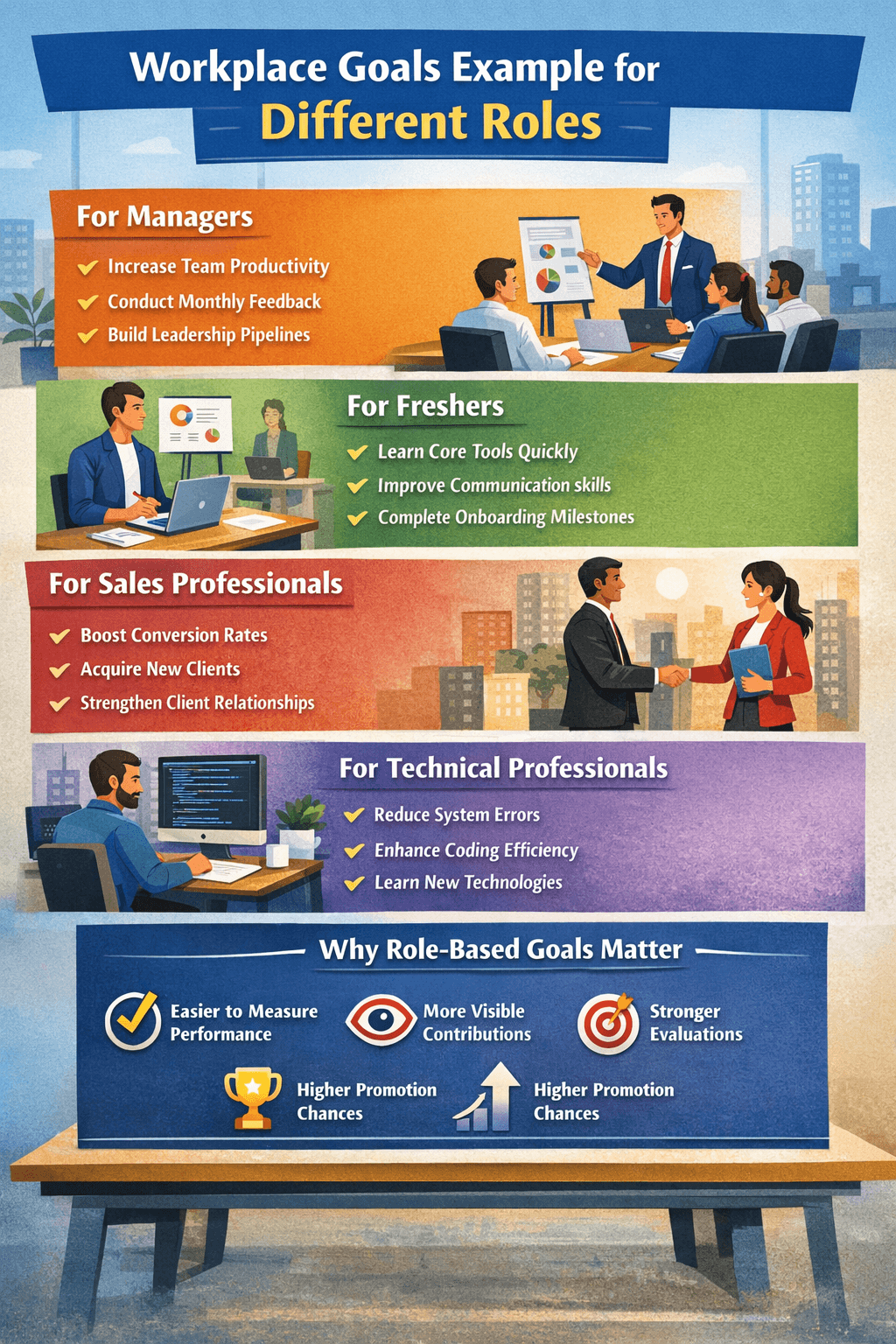
Why Role-Based Goals Matter
When your goals are aligned with your role:
- Your performance becomes easier to measure
- Your contributions become more visible
- Your evaluation becomes stronger and more objective
- Your chances of promotion increase
In simple terms, the more relevant your goals, the more powerful your evaluation becomes.
Professional Development Goals for Employees
Professional development goals for employees focus on long-term career growth and skill enhancement. These goals show your commitment to continuous learning.
Examples include:
- Learning leadership and management skills
- Improving communication and presentation abilities
- Attending workshops and training programs
- Expanding industry knowledge
For example:
Instead of “improve leadership,” say “lead one project and mentor two team members within six months.”
These career growth goals examples help you move beyond routine tasks and position yourself as a future leader.
Organisations value employees who invest in self-development because they contribute more effectively to business success.
How to Set Measurable Work Goals
Setting measurable work goals requires planning and strategy. It is not just about writing goals but defining how success will be measured.
Follow these steps:
Step 1: Identify Key Areas
Focus on areas where improvement is needed
Step 2: Define Metrics
Use numbers, percentages, or timelines
Step 3: Align with Company Goals
Ensure your goals support business objectives
Step 4: Break Goals into Tasks
Divide goals into smaller achievable steps
Step 5: Track Progress
Review performance regularly
Example:
Increase project completion rate by 20 per cent in three months
Tracking progress helps you stay accountable and improve continuously.
Want to confidently present your goals in meetings and reviews? Secure your FREE trial session today and start building communication skills that get you promoted faster.
Common Mistakes in Employee Evaluation Goals
Many professionals fail to create effective goals due to common mistakes. Avoiding these can significantly improve your evaluation results.
Common mistakes include:
- Setting vague goals
- Ignoring measurable outcomes
- Choosing unrealistic targets
- Not aligning goals with job roles
- Failing to track progress
For example, saying “improve teamwork” is unclear. Instead, define how you will measure improvement.
Another mistake is ignoring soft skills. Communication, leadership, and collaboration are equally important for career growth.
Clear, focused, and measurable goals always perform better in evaluations.
Tips to Achieve Career Growth Goals: Examples
Setting goals is only the beginning. Achieving them requires discipline and consistency.
Here are practical tips:
- Track your progress weekly
- Seek regular feedback
- Stay adaptable
- Focus on continuous learning
- Celebrate small wins
For example, improving communication starts with speaking more in meetings and practising presentations.
Consistency transforms small efforts into big achievements over time.
Struggling to communicate your achievements confidently? Book your trial class now and gain the confidence to present your success like a leader. Limited slots available.
How Goal Setting Improves Performance Reviews
Performance reviews become more effective when supported by measurable work goals. They provide clear evidence of your contributions.
Employee evaluation goals help you:
- Showcase measurable achievements
- Highlight skill development
- Improve manager communication
- Increase promotion chances
When you present structured goals, you demonstrate professionalism and accountability.
This builds trust and positions you as a valuable team member.
PlanetSpark helps you Build Confidence, Communication, and Leadership Skills for Career Growth
PlanetSpark personality development programs are designed for both working professionals and learners who want to improve communication, confidence, and workplace effectiveness. These programs focus on real-world skills such as public speaking, leadership, and structured thinking, which directly impact performance evaluations and career growth.
The curriculum is built on social-emotional learning principles and practical application. Learners participate in live sessions, mock presentations, and real-life scenario training to build confidence and clarity.
These classes are ideal for professionals who struggle with communication, anxiety about presentations, or expressing their ideas in evaluations and meetings.
Key Features:
- Live 1:1 interactive classes with expert trainers
- Real-world communication and presentation practice
- Structured curriculum focused on workplace skills
- Personalised feedback and improvement tracking
- Confidence-building framework with measurable outcomes
- Leadership and self-expression training
- Practical activities like mock interviews and presentations

Conclusion: Build Goals That Build Your Future
Success at work is not just about working hard. It is about working with clarity and purpose. Setting structured and measurable goals helps you take control of your career and move forward with confidence.
When you consistently improve your skills, track your progress, and communicate effectively, you create opportunities for growth and recognition. Over time, these small efforts lead to meaningful success and a strong professional identity.
Frequently Asked Questions
Use SMART criteria, align goals with your role, and track your progress regularly.
These include skill-building, leadership development, and continuous learning goals.
They provide clear metrics to track progress and make performance reviews more objective.
Beginners can focus on communication skills, learning new tools, and improving time management.
Ideally, 3 to 5 well-defined goals are enough to demonstrate performance and growth.
SMART goals include clear targets, such as completing a certification course within 60 days or improving sales by 15 per cent.
A good goal is specific and measurable, such as increasing productivity by 20 per cent within a set timeframe.
Personalized Communication Roadmaps
Record a video to get a AI generated personalized communication reports