
Poem Titles: Find The Perfect Title For Your Poem

Table of Contents
- Top Poem Title Ideas for Students
- Titles of Famous Poems Students Should Know
- What Makes a Good Poem Title?
- Do You Italicize Poem Titles?
- Are Poem Titles Italicized? (The Simple Answer)
- How to Format Poem Titles in MLA, APA & Chicago
- How to Come Up with Poem Title Ideas for Students
- How Students Can Practice Creating Poem Titles
- Why PlanetSpark Is the Best Place to Build Exceptional Skill
- Step Into Your Power and Write Fearlessly With PlanetSpark
Poem titles may seem small, but they shape the first impression of your writing and guide readers into the emotions you want to express. This guide will help you understand how to name poems with confidence, format titles correctly, and find creative ideas. With the right guidance and support from PlanetSpark, students can strengthen their writing skills and express their thoughts with clarity and creativity.
Top Poem Title Ideas for Students
Creative poem titles help students spark imagination and explore meaningful themes. From emotions to nature, mystery, and motivation, each category offers simple prompts that inspire expressive and original writing.
A. Emotional Titles
Echoes of Yesterday
Unsaid Words
Paper-Thin Heart
When Tears Grow Wings
Threads of Hope
B. Nature-Inspired Titles
Midnight Rain
Sunflowers in the Dark
Forest of Quiet Thoughts
Autumn’s Secret
Sea Made of Dreams

C. Motivational Titles for Students
Rise Again
The Edge of Courage
Steps No One Sees
Beyond the Wall
The Spark Within
D. Mysterious Titles
The Door of Shadows
Letters from Tomorrow
The Room Without Clocks
Lost Map
Whispers Behind the Moon
E. Short & Aesthetic Titles
Drift
Bloom
Gravity
Paper Boats
Skylines
Titles of Famous Poems Students Should Know
Studying famous poem titles can help you understand how poets create impact with just a few words. Here are well-known poem titles to inspire you:
A. Classics
“The Road Not Taken” — Robert Frost
“Daffodils” — William Wordsworth
“Ozymandias” — P. B. Shelley
“Annabel Lee” — Edgar Allan Poe
“If—” — Rudyard Kipling
“Because I Could Not Stop for Death” — Emily Dickinson
“She Walks in Beauty” — Lord Byron
“How Do I Love Thee?” — Elizabeth Barrett Browning
B. Modern Favorites
“Still I Rise” — Maya Angelou
“Do Not Go Gentle into That Good Night” — Dylan Thomas
“The Love Song of J. Alfred Prufrock” — T. S. Eliot
“Hope Is the Thing with Feathers” — Emily Dickinson
“Daddy” — Sylvia Plath
“A Blessing” — James Wright
Indian Poets
“Where the Mind is Without Fear” — Rabindranath Tagore
“The Golden Threshold” — Sarojini Naidu
“A River” — A. K. Ramanujan
“The Soul’s Prayer” — Sarojini Naidu
“An Introduction” — Kamala Das
Studying these titles teaches students how great poets use imagery, emotion, and minimal words to make readers curious.
Watch your child write confidently as they explore genres, prompts, and storytelling techniques with PlanetSpark experts.
What Makes a Good Poem Title?
Students often struggle to name their poems, especially during deadlines. These qualities help create titles that capture attention, spark curiosity, and reflect the poem’s essence.
A. Clarity
A clear title guides readers by offering a simple, understandable entry point. It sets expectations without revealing everything, helping the poem feel focused and purposeful from the very beginning.
Examples:
Hope, Winter Morning, The Last Letter, Silent Streets
B. Emotion
Emotional titles create an immediate connection by hinting at the feelings expressed in the poem. They prepare readers for the tone, whether it’s joy, sorrow, longing, or nostalgia.
Examples:
When Loneliness Speaks, A Heart Without Echo, The Weight of Goodbye
C. Imagery
Imagery-based titles paint a quick picture in the reader’s mind. These titles spark imagination, making the poem feel vivid and visually engaging even before the first line is read.
Examples:
Clouds on My Window, Footprints in the Sand, Lanterns on the Water
D. Mystery
Mysterious titles attract curiosity by making readers wonder what the poem is about. They offer just enough intrigue to pull the audience into a deeper emotional or symbolic journey.
Examples:
The Door That Never Opens, Unwritten Chapters, The Shadow’s Promise
E. Symbolism
Symbolic titles hint at deeper meanings using objects, ideas, or metaphors. They encourage readers to think, interpret, and uncover the layers of significance behind the poet’s message.
Examples:
Red Feathers, Broken Compass, Glass Wings
When choosing poem titles, experiment freely, brainstorm multiple versions, and let your emotions guide your creativity. Interested students can click this link to reach English poems for guidance.
Do You Italicize Poem Titles?
This is one of the most searched questions especially by students preparing school essays, literary analysis papers, or assignments. So let’s answer it clearly.
Do You Italicize Poem Titles?
No—poem titles are not italicized.
Instead, they are placed inside quotation marks.
This rule applies to short poems. According to standard style guides like MLA and APA:
Short poems → use quotation marks
Example: “The Road Not Taken”Long poems or book-length poems → italicize
Example: Paradise Lost
Students commonly get confused because some titles are italicized in textbooks, but for school writing, remember:
Short poem titles = “quotation marks”, not italics.
PlanetSpark teaches children to observe, imagine, and express creatively through proven writing frameworks and activities.
Are Poem Titles Italicized? (The Simple Answer)
If you’re still wondering, “Are poem titles italicized?”, the answer is:
Short poem titles → NO (use quotation marks).
Long epic poems → YES (use italics).
Examples:
Short Poem Titles in Essays
“Ode to Autumn”
“Daffodils”
“If—”
Long Poem Titles in Essays
The Odyssey
The Divine Comedy
Beowulf
This formatting rule is extremely important for academic writing, and following it helps you avoid common marking mistakes. Click this link to learn creative poems starters prompts to begin it.
How to Format Poem Titles in MLA, APA & Chicago
Students often deal with different writing formats, and poem titles follow specific rules in each style. Here’s a clear, student-friendly explanation of how to format them correctly.
MLA Format
MLA separates poem titles based on length and emphasizes how poems are cited within the text. Short poems are placed in quotation marks, while long or book-length poems are italicized.
MLA also prefers line numbers instead of page numbers when quoting poetry.
Short poems → quotation marks
Long poems → italics
In-text citation uses line number
Example:
In “O Captain! My Captain!”, Whitman expresses…
APA Format
APA follows a similar rule for short and long poems but focuses on the year of publication. Short poem titles use quotation marks, long poem titles use italics, and the in-text citation includes the poet’s last name and year.
Short poems → quotation marks
Long poems → italics
Use author and year
Example:
Frost’s “Fire and Ice” (1920) explores…
Chicago Style
Chicago keeps things simple with the same basic rules: short poems go in quotation marks, while long poems are italicized. Chicago often appears in humanities writing and allows flexibility in formatting long quotations.
Same rules: short poems in quotes, long poems italicized
Example:
In “Still I Rise,” Angelou writes…
PlanetSpark’s personalised program strengthens every writing element through fun, interactive learning.
How to Come Up with Poem Title Ideas for Students
If you’re stuck searching for the perfect name, these strategies can help spark creativity and guide you toward a meaningful poem title.
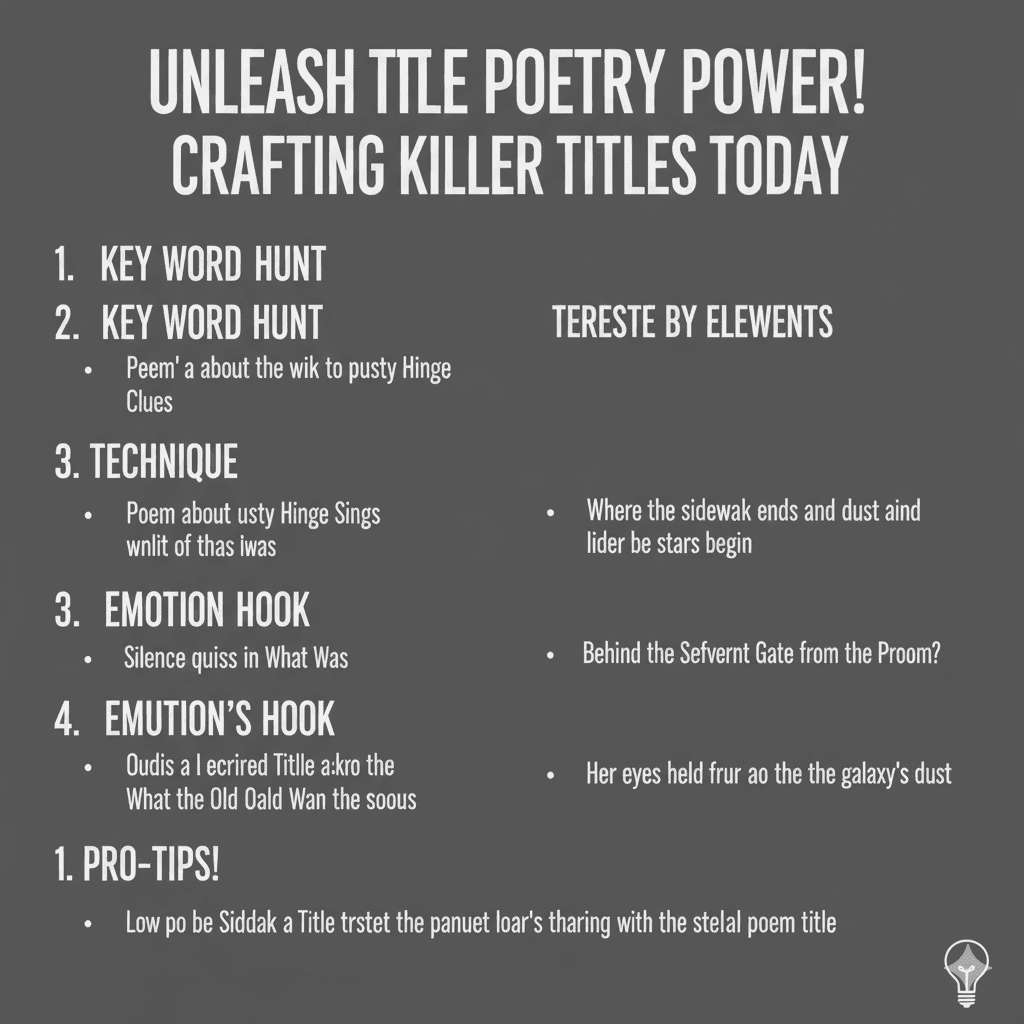
A. Use a Theme Word
Start by identifying the central idea in your poem such as love, silence, memory, fear, or growth. Turning your main theme into a title keeps the poem focused and instantly tells readers what emotion or subject they can expect.
Examples:
Memories of June, The Shape of Time
B. Use a First Line Fragment
Sometimes the opening lines of your poem already hold a powerful phrase. Taking a meaningful fragment from your first stanza can create a title that feels natural, poetic, and closely tied to your message.
Example:
If your poem starts with “In the quiet of dawn…”, you can title it Quiet Dawn.
C. Use Contrast
Opposites add drama and interest. When you pair conflicting ideas like light/dark, silence/noise, warmth/cold which create a title that immediately grabs attention and hints at deeper meaning inside the poem.
Examples:
Shouting in Silence, Frozen Fire
Give students the tools, guidance, and inspiration they need to craft vivid, sensory-rich narratives.
D. Ask a Question
Question-based titles draw readers in by sparking curiosity. They work well when your poem explores uncertainty, reflection, or wonder, encouraging the reader to seek answers within your lines.
Examples:
Where Do Dreams Go?, Who Waits for the Stars?
E. Use Metaphors
Metaphorical titles add artistry and depth. Instead of naming the topic directly, use symbolic images that represent your poem’s message, making the title feel creative and competition-ready.
Examples:
The Paper Wings, The Ocean in My Chest
How Students Can Practice Creating Poem Titles
Here are simple and effective exercises that help students think creatively and develop strong poem titles.
Exercise 1: Title from a Theme
Choose a theme such as love, fear, hope, or growth, and create three different titles from it. This helps students explore how many directions a single idea can take, strengthening creative flexibility.
Exercise 2: Reverse Writing
Start by writing a title first, then build a poem that fits it. This technique encourages students to think about tone, imagery, and message before writing, which improves planning and poetic structure.
Exercise 3: One-Word Titles
Challenge yourself to express a big feeling or idea using just one word. This exercise improves precision and teaches students how powerful minimalism can be in poetry.
Exercise 4: Symbol Swap
Pick a symbol like rain, fire, moon, or wings and experiment with unique combinations. This pushes students to use imagination and symbolism creatively.
Examples: Rain of Echoes, Fire Without Heat
These steps help students boost creativity, think more deeply about expression, and grow stronger in poetic writing.
Why PlanetSpark Is the Best Place to Build Exceptional Skills
PlanetSpark offers a complete learning ecosystem that helps children become confident, expressive, and imaginative writers. With expert-led classes, AI-powered tools, and engaging activities, students don’t just learn writing—they master the art of storytelling, clarity, structure, and creativity. Here’s how PlanetSpark transforms every child into a skilled young author:
What PlanetSpark Offers for Creative Writing Excellence
1:1 Personal Trainers who guide children through grammar, storytelling, vocabulary, and expression
Personalised Writing Curriculum tailored to your child’s level, goals, and pace
Spark Diary for daily writing practice that builds consistency and creativity
Genre-Based Learning covering stories, poems, essays, book reviews, speeches, and more
Creative Stimulus Activities like story dice, picture prompts, and imagination games
Real Publishing Opportunities through blogs, e-magazines, anthologies, and showcases
SparkX AI Video Analysis to refine delivery when presenting written work
Gamified Tools like SparkBee and quizzes that strengthen grammar, vocabulary, and spelling
PlanetSpark ensures your child not only writes better but thinks sharper, imagines deeper, and communicates with confidence that lasts a lifetime.
Step Into Your Power and Write Fearlessly With PlanetSpark
A good poem title is more than a simple name. It creates a pause before the reader enters your poem and it shapes the first impression of what is waiting inside. As students you have the space to explore language, test new ideas, and choose words that feel honest and expressive. A title can be gentle or powerful, mysterious or clear. What matters is that it connects with the heart of your poem.
So give yourself time to experiment. Try different titles, say them aloud, and notice which one feels right. Each attempt helps you understand your own style a little better. Keep writing, keep learning, and let your titles become the inviting doorway to your creative world.
Frequently Asked Questions
A good poem title captures the theme, emotion, or main idea of your poem. It should create interest, connect with the message, and prepare readers for the tone or experience your poem offers.
Poem titles do not always need strict grammar rules, but they should be clear and meaningful. Students can use fragments, questions, or symbolic words as long as the title supports the poem’s purpose.
Short poem titles should be placed in quotation marks, while long or book length poems are italicized. These formatting rules help maintain clarity and proper presentation in school essays and academic writing.
Students can brainstorm keywords, explore emotions, use metaphors, or pick memorable phrases from the poem. Experimenting with different options often helps find a title that best represents the poem’s theme and mood.
Yes, PlanetSpark offers friendly learning methods that simplify poetry for beginners. Students get individual attention, practical exercises, and creative techniques to craft strong poem titles and develop polished writing skills over time.
PlanetSpark guides students through creative writing skills, including poem structure, title creation, and expression. Its expert mentors help students build confidence, clarity, and originality in every piece they write.