
Stage Fright in Kids: How to Help Them Speak Bravely


Table of Contents
- Simple Ways on How to Overcome Stage Fright in Children
- Is It Shyness or Stage Fright? Know the Difference
- Why It’s Important to Overcome Stage Fright Early
- Common Mistakes Parents Make While Addressing Stage Fright
- Daily Activities to Reduce Stage Fright at Home
- How to Overcome Stage Fright During Public Speaking
- How PlanetSpark Supports Kids in Overcoming Stage Fright
- Conclusion
- Frequently Asked Questions
Does your child freeze up during
school recitations, avoid participating in class events, or shy away from storytelling at family functions? You're not alone. Many urban Indian parents are searching for practical ways to help their kids overcome stage fright and become confident communicators.
The good news: stage fright can be overcome with the right mix of practice, support, and expert guidance.
At PlanetSpark, we help children aged 4 to 14 build public speaking, creative writing, and communication skills, all from the safety of home. With the right tools and coaching, your child can go from nervous to natural on stage.
Simple Ways on How to Overcome Stage Fright in Children
Stage fright doesn’t just affect performers. Even the most talkative children can freeze up when asked to speak in front of a crowd. But like any skill, confidence can be built with the right steps. Here are five practical ways to help your child face an audience without fear.
- Create a Safe Practice Space at Home
Start with familiar faces. Ask your child to perform a short poem or a school recitation in the living room for you and a few family members. Treat it like a fun show, not a test. Clap, cheer, and make it exciting. This safe space helps your child associate speaking with joy, not pressure.
- Use Storytelling as a Confidence Tool
Children love stories, so turn that into a speaking opportunity. Ask your child to retell a story from a cartoon, a book, or their own imagination. When they talk about something they love, they feel more relaxed and confident.
- Encourage Role-play Games
Make speaking part of playtime. Role-play is a natural and pressure-free way for kids to talk without feeling judged. It also lets them explore different tones, expressions, and body language.
- Practice One Minute a Day
Confidence grows with consistency. Set aside just one minute every day where your child speaks on a topic. It could be anything from “my favourite snack” to “what I did today.” The goal is regular, low-pressure practice.
- Focus on Encouragement, Not Perfection
It’s easy to correct mistakes, but what kids need more is praise. Applaud their effort even if they forget a word or stumble. Positive reinforcement gives them the courage to try again.

Give your child a head start with expert-led public speaking classes.
Book a free demo with PlanetSpark today!
Is It Shyness or Stage Fright? Know the Difference
Not all kids who avoid the stage are “shy.” Some may just lack the right kind of preparation or confidence. Understanding the difference helps in choosing the right approach. Here’s a breakdown to make it clearer:
| Type of Behaviour | Shy Child | Underconfident Child | Child with Stage Fright |
|---|---|---|---|
| General Personality | Quiet in most situations | Talks freely at home but hesitates in public | Social otherwise, nervous only before performing |
| Social Comfort | Avoids new people or large groups | Talks to familiar people only | Comfortable socially, avoids public speaking |
| Reactions to Performing | Likely to say no without trying | May try, but gives up quickly | Tries, but becomes anxious right before or during |
| Confidence Level | Low across all areas | Varies depending on the task | Confident in general, but drops when on stage |
| Needs Most | Gentle social exposure | Encouragement and small wins | Repeated stage practice and support |
Why It’s Important to Overcome Stage Fright Early
Stage fright may seem small, but it affects a child’s performance in school and life. Helping kids speak confidently prepares them for real-world success.
- Better in School: Children who speak without fear do better in class presentations, group work, and discussions. They’re more involved and curious.
Example: A shy child starts asking questions in class after learning how to manage stage fear.
- Clearer Communication: As kids grow comfortable on stage, they learn how to structure thoughts, use expressions, and engage listeners.
Example: A regular storyteller becomes more confident during classroom interactions.
- Stronger Confidence: Each small success on stage builds self-belief. Kids start trusting themselves in other activities too.
Example: A child who once froze during recitation now volunteers for hosting school events.
- Early Leadership: Good communication helps kids lead, share ideas, and take initiative in group tasks.
- Emotional Control: Facing stage fright teaches kids how to stay calm under pressure which is useful far beyond school.
Common Mistakes Parents Make While Addressing Stage Fright
It’s natural to want to help, but some well-meant actions can actually add to a child’s anxiety.
- Forcing Them to Perform Too Soon: Making a child get on stage before they’re ready can backfire. It builds resistance, not confidence. Instead, encourage small wins like speaking in front of family or a mirror.
- Comparing Them to Other Kids: Saying things like “Look how confident your cousin is” adds pressure. Every child learns at their own pace. Celebrate effort, not comparison.
- Ignoring the Emotional Side: Stage fright often starts with fear of embarrassment. If your child is scared, listen calmly before giving advice. Acknowledge how they feel, then help them work on the skill.

Let your child take that first bold step in a supportive, one-to-one environment.
Schedule your free trial session now.
Daily Activities to Reduce Stage Fright at Home
Overcoming stage fright doesn’t require a spotlight. It begins with simple habits at home that build confidence gradually.
| Activity | What It Builds | How to Do It |
|---|---|---|
| Storytime with Expression | Confidence and storytelling skills | Let your child narrate a bedtime story with voice and gestures |
| Mirror Speeches | Self-awareness and body language | Ask them to give a short speech in front of a mirror |
| Dinner Table Discussions | Quick thinking and clear speech | Start a daily “question of the day” at dinner |
| Role-Playing Games | Emotional control and improvisation | Pretend to be teacher and student, news anchor and guest, etc. |
| Recording and Playback | Self-assessment and speech clarity | Record them reading or speaking, then watch together |
How to Overcome Stage Fright During Public Speaking
Stage fright doesn’t always come with shaking knees and frozen silence. Sometimes, it’s just a quickening heartbeat, a dry mouth, or the urge to avoid speaking altogether. But public speaking is a powerful skill, and learning to face that fear early can shape a child's confidence for life. Here's how to guide them through it step by step.
Start with Topics They Care About
Confidence begins with familiarity. Help your child pick speech topics that actually excite them. When they care about what they’re saying, their voice becomes stronger, more natural, and less forced.
- A favourite book or movie
- A hobby they enjoy
- A personal story or memory
Let them talk freely first, then shape it into a proper speech. This keeps the tone conversational and less stressful.
Practice in Comfortable Spaces First
Before your child speaks in a classroom or on a stage, let them get used to speaking in smaller, low-pressure situations.
- Start with family members or close friends
- Move to practicing in front of a mirror or camera
- Gradually increase the audience size
This slow build helps reduce the fear of being watched and judged.
Focus on Structure, Not Perfection
Memorising entire speeches can create more anxiety. Instead, teach them how to build a basic structure with clear points:
- Introduction: What is the topic?
- Main Point 1: Why is it important?
- Main Point 2: What’s a personal example or story?
- Conclusion: Wrap it up with a message or takeaway
Encourage using cue cards with key points rather than full sentences. It keeps the speech natural and makes recovery easier if they forget something.

From stage fright to stage presence, we guide every step.
Book your free PlanetSpark class.
Replace Fearful Thoughts with Supportive Ones
Stage fright often grows from negative “what if” thinking. Help your child notice these thoughts and challenge them.
- Instead of:
“What if everyone laughs at me?”
Try:
“Most people want me to do well. They’re not here to judge.” - Instead of:
“I’ll forget everything.”
Try:
“Even if I pause, I can take a breath and continue.”
This practice builds mental resilience and keeps their confidence intact.
Create a Pre-Speaking Ritual
Rituals can calm nerves and create a sense of control. Find what works for your child:
- Taking three deep breaths
- Squeezing a small stress ball
- Repeating a short mantra like, “I’ve got this.”
Even simple actions, like adjusting the mic or sipping water before speaking, can anchor them and signal that it’s time to begin.
Let Them Reflect After Every Speech
After each public speaking experience, talk about what went well. Don’t focus on flaws. Instead, celebrate progress:
- “You spoke louder this time.”
- “Your opening was really clear.”
- “You handled that tough question so well.”
These small affirmations shape a positive mindset and help children internalise their growth.
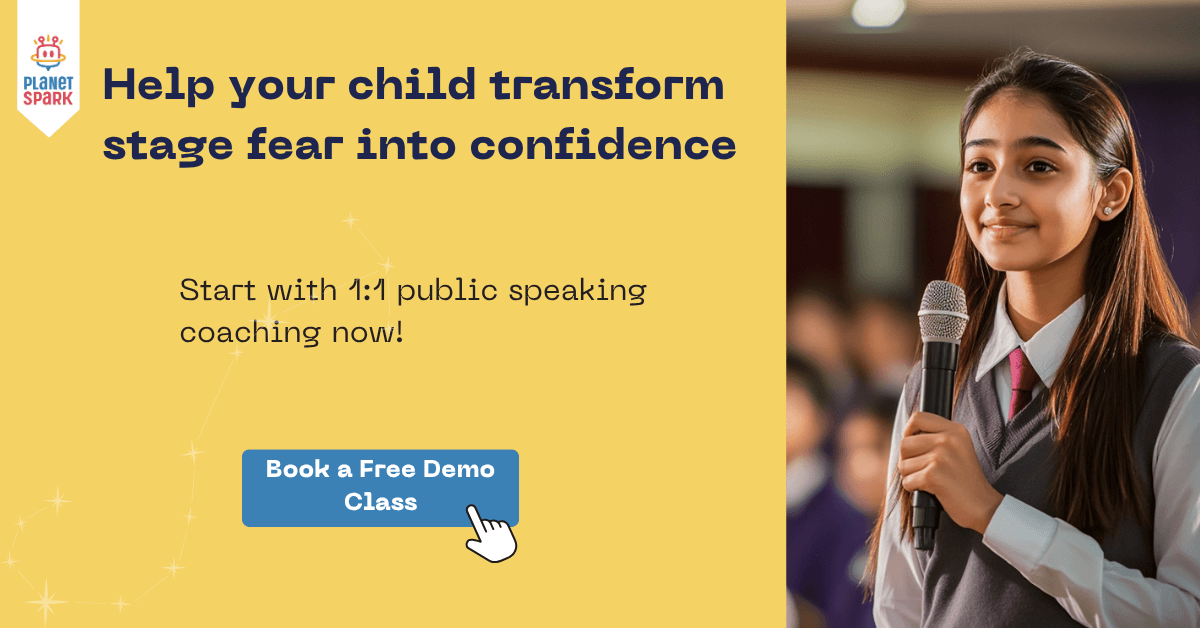
How PlanetSpark Supports Kids in Overcoming Stage Fright
Overcoming stage fright takes more than just a few rehearsals. It needs consistent guidance, a nurturing environment, and structured practice. That is exactly where PlanetSpark steps in.
Personalised Attention from Expert Trainers: Every child has a unique pace and personality. PlanetSpark’s one-on-one classes ensure your child isn’t just another face in a group. Trainers identify individual blocks, whether it’s fear of making mistakes, lack of vocabulary, or hesitation to speak, and work steadily to dissolve them.
Real-World Public Speaking Practice: From storytelling sessions and debates to live speech events, kids at PlanetSpark regularly participate in activities that build real confidence, not just theoretical skills. These sessions gradually stretch their comfort zone in a supportive way.
Safe and Supportive Environment: A major part of overcoming stage fright is feeling safe to express without judgment. Whether your child is speaking to their trainer or joining a peer session, the environment at PlanetSpark is built to encourage effort, not perfection.
Skill Building with Fun: Confidence blooms when learning feels like play. Through fun speaking games, expressive language tools, and interactive lessons, children start to enjoy the process. They don’t just learn how to speak. They learn to love it.
Progress You Can See: Parents often notice visible changes in just a few weeks. Children begin participating more in class, expressing thoughts clearly at home, and even volunteering for school events. These are signs that they’re leaving their fear behind.
Conclusion
Stage fright can feel overwhelming, especially for young children. But with the right mix of encouragement, consistent practice, and a supportive environment, even the most hesitant child can learn to speak with confidence. Public speaking is not about perfection.
It is about expression, connection, and growth. Every small step your child takes on stage builds their courage off stage too. Support them early and you will see the difference, not just in school events but in how they carry themselves through life.
People Also Read
If you're curious to see how these strategies unfold in real life, check out From Shy to Confident, a blog that shares real stories of kids who transformed their fear into confidence through public speaking.
You might also find Confidence Building for Kids: Class 6 helpful, this piece breaks down simple ways to nurture self-assurance in young speakers.
Frequently Asked Questions
What causes stage fright in kids?
Stage fright often comes from fear of making mistakes, being judged, or standing in front of a crowd. Kids may feel pressure during school events or competitions, especially if they lack experience with public speaking.
How can I help my child overcome stage fright at home?
Start small. Let them practice speeches or stories in front of family. Record their videos and show them how well they’re doing. Praise their effort, not just the result. You can also encourage them to join fun speaking activities online.
Are online public speaking classes effective for children?
Yes, especially when they include interactive practice. Platforms like PlanetSpark offer one-to-one coaching, AI feedback, and stage-style events that give kids regular exposure in a safe and structured way.
What age is right to start public speaking training?
Children as young as 4 can begin with basic storytelling and speaking games. By ages 7 to 10, they can handle structured speeches, debates, and presentations. The earlier they start, the more confident they become.
My child is good at writing but shy to speak. What should I do?
That’s a great strength to build on. Use creative writing for kids as a bridge. Let them read their stories aloud, record voiceovers, or perform short skits based on what they write. Storytelling for kids is a fun, low-pressure way to build speaking skills naturally.