
Impromptu Speaking for Kids: Build Quick Thinking


Last Updated At: 15 Jan 2026
9 min read
Table of Contents
- Impromptu Speaking for Kids
- Common Real-Life Scenarios for Impromptu Speaking
- Popular Impromptu Speaking Topics for Kids
- Simple Framework Kids Can Use to Answer Any Impromptu Questi
- 10 Steps to Improve Impromptu Speaking Skills
- Mistakes Kids Make During Impromptu Speaking and How to Fix
- Fun Impromptu Speaking Practice Activities for Home and Clas
- How PlanetSpark Trains Kids to Think Fast and Speak Clearly
- Conclusion: Turning Quick Thoughts into Confident Speech
Imagine a child standing in class when the teacher suddenly asks, “Tell us about your favourite hero.” There is no notebook, no preparation time, and no second chance. The child has only a few seconds to think and speak. This is where impromptu speaking becomes powerful.
Impromptu speaking helps children think quickly, organise ideas, and speak clearly without fear. It builds confidence for classrooms, competitions, and real-life conversations. Through regular impromptu speech practice, children learn how to express their thoughts naturally and confidently.
The PlanetSpark Public Speaking Program helps children transform quick thoughts into confident speech using proven frameworks and engaging practice.
Impromptu Speaking for Kids
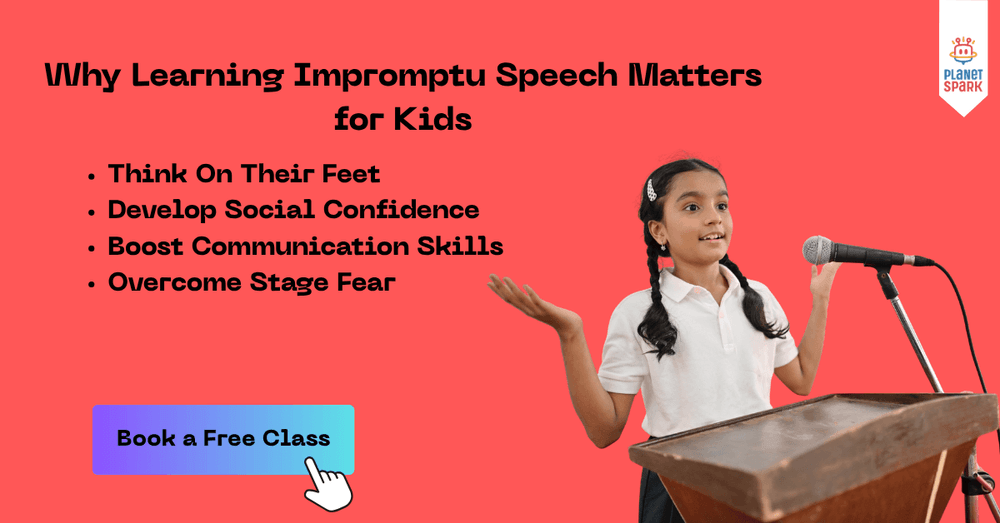
Impromptu speaking is the skill of speaking confidently on a topic without any prior preparation. For kids, it means thinking quickly, organising thoughts in the moment, and expressing ideas clearly in front of others.
The teacher suddenly asks, “What would you do if you found a wallet on the playground?” The child has no time to prepare an answer. Still, the child speaks for a few seconds, sharing honest thoughts and reasons. This is a real-life impromptu speaking example.
Children face such moments often. During class discussions, a teacher may ask for opinions. In competitions, judges may ask follow-up questions. Even in daily conversations, children are expected to respond quickly. All these situations involve impromptu speaking.
For example:
When a child says, “If I were a superhero, I would help people who feel lonely,” that response is an impromptu speech example.
When a student explains why they like a book without planning, it becomes part of regular impromptu speech practice.
What makes impromptu speaking powerful is that it trains the brain to think fast while staying calm. Children learn to choose words quickly, form sentences clearly, and express emotions honestly. Over time, they stop fearing sudden questions and start enjoying speaking.
With regular exposure to impromptu speaking topics, children learn how to structure answers even without preparation. They understand how to begin clearly, add a simple example, and close their response confidently. This skill supports public speaking, storytelling, debates, and everyday communication.
At its core, impromptu speaking helps children trust their thoughts and voice. It teaches them that they do not always need perfect preparation to speak well. With the right guidance and consistent impromptu speech practice, every child can learn to respond confidently, clearly, and creatively in any situation.
Common Real-Life Scenarios for Impromptu Speaking
Children face impromptu speaking situations more often than parents realise. These moments test clarity, confidence, and quick thinking.
Answering unexpected questions in class
Speaking during morning assembly or circle time
Sharing opinions during group discussions
Participating in debates or quiz rounds
Responding to judges during competitions
Introducing themselves in new classrooms
Speaking during storytelling or show-and-tell
Reacting to real-life situations and social conversations
Each situation becomes easier with regular impromptu speech practice and guidance.
Popular Impromptu Speaking Topics for Kids
Here are 50 carefully curated impromptu speaking topics that encourage creativity, logic, and expression. These include good impromptu speech topics and engaging impromptu speech prompts.
My favourite place to visit
If I could be a superhero
My best friend and why
A day without homework
My favourite food
If animals could talk
My favourite teacher
A lesson I learned from a mistake
If I could travel anywhere
My dream job
A book I enjoyed reading
My favourite festival
A memorable school day
If I were a leader
My favourite sport
A time I helped someone
If I could invent something
My favourite cartoon character
A skill I want to learn
My favourite game
If I could change one rule at school
My favourite family tradition
A time I felt proud
My favourite hobby
If I could meet someone famous
My favourite holiday memory
A challenge I overcame
If I could talk to my future self
My favourite subject
A kind act I witnessed
My favourite animal
If I could design a school
A time I felt brave
My favourite movie scene
A lesson from my parents
If I could fly
My favourite outdoor activity
A time I learned teamwork
If I were a teacher
My favourite invention
A moment that made me happy
My favourite story character
If I could change the world
A goal I want to achieve
My favourite memory with friends
If I could live in another country
My favourite holiday
A person I admire
If I had a magic wand
My idea of a perfect day

Simple Framework Kids Can Use to Answer Any Impromptu Question
A clear framework removes fear and confusion during impromptu speaking. When children know what to do first, next, and last, they feel more confident and speak more clearly. This simple structure works for beginners as well as advanced speakers and can be used across all impromptu speaking examples.
1. Pause and Think
Before speaking, take two calm seconds to understand the question. This short pause helps the brain organise ideas instead of rushing into random words.
Children often think pausing means forgetting, but it actually shows confidence. A brief pause allows them to decide what the question is really asking and choose the right direction for their response. This step is essential in every impromptu speech practice session.
2. Start with a Clear Opening
Begin with one simple sentence that states the main idea.
For example, if the topic is “My favourite hobby,” a clear opening could be:
“My favourite hobby is drawing because it helps me relax.”
A strong opening gives the listener clarity and helps the speaker stay focused. This technique is commonly used in good impromptu speech examples to avoid hesitation and repetition.
3. Add One Example or Reason
After the opening, support the idea with one personal example or a simple reason.
Children can share a short story, a feeling, or a real-life experience. For instance:
“I draw after school, and it makes me feel happy and calm.”
Using examples makes impromptu speaking topics easier to handle and helps listeners connect emotionally with the speaker.
4. End with a Strong Closing Line
Finish with a closing sentence that completes the thought.
This could be a conclusion, a feeling, or a message. For example:
“That is why drawing is my favourite hobby.”
A clear ending prevents the speech from fading out and leaves a confident impression. Strong closings are a key feature of effective impromptu speech prompts and responses.
This simple four-step framework helps children organise thoughts quickly, speak logically, and express ideas with confidence. With regular practice, it becomes a natural habit, turning hesitation into clarity and helping children handle any impromptu speaking situation with ease.
10 Steps to Improve Impromptu Speaking Skills
Practise speaking daily, even for one minute
Read stories and articles to build ideas
Learn common impromptu speaking topics
Think in simple points before speaking
Use examples from daily life
Speak slowly and clearly
Maintain eye contact
Control body language and posture
Accept mistakes as part of learning
Practise with feedback and reflection
Consistent impromptu speech practice leads to visible improvement.

Mistakes Kids Make During Impromptu Speaking and How to Fix Them
Speaking too fast- Fix by slowing down and pausing
Using filler words- Fix by thinking silently instead of saying um or uh
Going off topic- Fix by following a simple structure
Fear of mistakes- Fix by practising regularly in a safe environment
Weak endings- Fix by preparing a strong closing sentence
Fun Impromptu Speaking Practice Activities for Home and Class
Regular impromptu speech practice becomes enjoyable when children learn through games and interactive activities. These activities help children respond quickly, organise thoughts, and speak confidently without fear.
Topic Jar Game
Write different impromptu speech prompts on small slips of paper and place them in a jar. Each child picks one topic and speaks for 30 to 60 seconds. This activity encourages quick thinking and helps children practise a variety of impromptu speaking topics in a fun way.
One-Minute Speech Challenge
Give a child a random topic and ask them to speak for one minute. The goal is not perfection but clarity. This activity strengthens impromptu speaking skills by teaching children how to manage time, stay focused, and complete a thought confidently.
Picture-Based Speaking
Show a picture of a scene, character, or situation. Ask the child to describe what they see, what might be happening, and what could happen next. This method improves imagination and provides strong impromptu speaking examples based on visual cues.
Family Debate Night
Choose simple, age-appropriate topics like “Books are better than movies.” Each family member shares their opinion. This activity builds confidence, reasoning skills, and helps children practise structured impromptu speech in a supportive environment.
Classroom Storytelling Circles
One child begins a story with a sentence, and each child adds a line without preparation. This exercise strengthens creativity, listening skills, and spontaneous thinking. It also exposes children to diverse impromptu speech prompts in a collaborative setting.
These activities turn speaking practice into play. With consistent use, children become comfortable responding to new situations, expressing ideas clearly, and enjoying the process of impromptu speaking both at home and in class.
How PlanetSpark Trains Kids to Think Fast and Speak Clearly
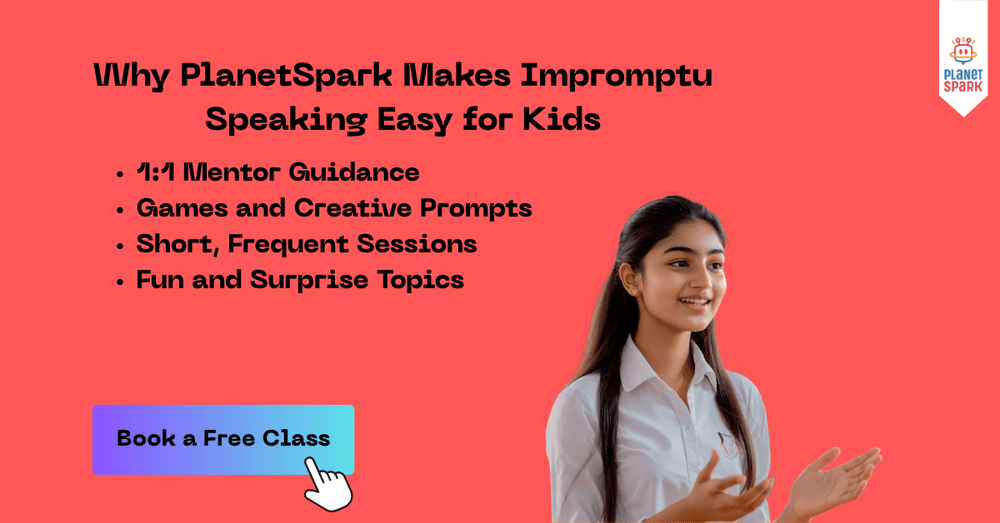
PlanetSpark offers structured and personalised public speaking training.
1:1 Public Speaking Coaching: Individual coaching by certified communication experts trained in child psychology.
Step-by-Step Skill Building: Covers body language, voice modulation, speech structure, storytelling, persuasion, extempore, and debating.
TED-Style Training Modules: Children learn to speak using hook, message, story, and call-to-action models.
Real-Time Practice with Global Peers: Live debates and discussions with learners from over 13 countries.
Public Speaking League and Competitions: Opportunities to apply skills in real performance settings.
Video Feedback Loop: Children review recorded speeches with coaches for detailed improvement.
Conclusion: Turning Quick Thoughts into Confident Speech
Strong impromptu speaking skills help children think clearly, speak confidently, and express ideas without fear. With the right impromptu speech practice, engaging impromptu speaking topics, and guided feedback, children grow into confident speakers.
PlanetSpark helps children master impromptu speaking examples, practise with real impromptu speech prompts, and build lifelong communication skills that matter in school and beyond.
Frequently Asked Questions
Impromptu speaking is speaking on a topic without preparation. It helps children think quickly and express ideas clearly.
Children can use simple impromptu speech prompts, one-minute speaking games, and daily conversation challenges.
PlanetSpark combines expert coaching, structured frameworks, live practice, and feedback to strengthen impromptu speech practice effectively.