Oration is more than speaking before
an audience; it is the art of persuasive, structured, and emotionally impactful speech. Learners exploring oration often seek its definition, historical significance, and timeless examples such as Pericles’ Funeral Oration or the Oration on the Dignity of Man. This blog addresses that intent by explaining how oration blends logic, emotion, and delivery to inspire audiences. From ancient public forums to modern classrooms and global stages, oration has shaped societies and ideas. Beyond theory, this guide also focuses on practical skill-building, showing how structured practice and expert guidance help learners develop confidence, clarity, and persuasive speaking as lifelong communication skills.
Understanding Oration: Meaning, Definition, and Core Purpose
The oration definition refers to a formal, well-structured speech delivered with the clear intention to inform, persuade, inspire, or move an audience. Unlike everyday conversation, oration is purposeful and planned. Every word, pause, gesture, and change in tone is used intentionally to guide the listener’s thinking and emotional response. Oration combines intellectual clarity with emotional depth, making it one of the most powerful forms of human communication.
At its core, oration is about influence. From ancient public assemblies to modern TED-style talks, strong oration has shaped opinions, motivated communities, and inspired action. A well-delivered oration does not simply share information,it leaves a lasting impression on the audience by appealing to both reason and emotion.
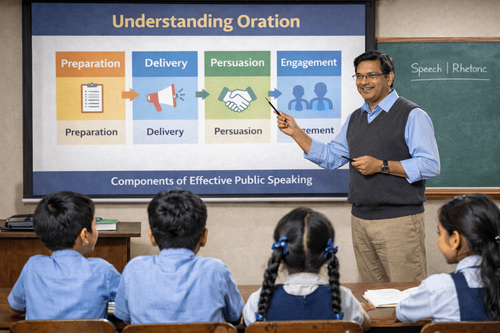
An effective oration stands on three essential pillars that work together seamlessly:
Content – what is being said: The ideas, arguments, and messages must be clear, relevant, and well-researched. Strong content ensures the speech has substance and credibility.
Delivery – how it is being said: Voice modulation, pace, pauses, facial expressions, gestures, and posture all play a crucial role in making the speech engaging and impactful.
Intent – why it is being said: Every oration has a purpose,whether to inspire change, honour someone, educate, or persuade. Clear intent helps the speaker stay focused and authentic.
When these three elements align, the oration shapes audience perception, builds trust, and encourages meaningful responses.
Classical Roots of Oration
Historically, oration played a central role in democracy, philosophy, and public life. In ancient societies, leaders and thinkers relied on oration to communicate laws, values, and ideas to large audiences. The Pericles funeral oration remains a timeless example of how a speaker can honour the fallen while simultaneously reinforcing shared values, unity, and civic pride. Its power lies not only in what was said, but in how emotion and logic were balanced.
Similarly, the oration on the dignity of man argued for human potential, freedom of thought, and intellectual independence. It demonstrated how speeches could challenge existing beliefs and redefine how people view themselves and society. These historic examples show that oration is not about memorising lines,it is about persuasion grounded in clarity, logic, and emotional resonance.
Types of Oration and Their Relevance Today
Oration appears in many forms, each serving a distinct purpose and requiring specific skills:
Funeral Oration: Centres on empathy, remembrance, and emotional balance. It teaches speakers how to handle sensitive topics with respect and sincerity.
Ceremonial Oration: Used during significant events such as inaugurations or celebrations, it inspires audiences and reinforces shared values.
Persuasive Oration: Aims to influence opinions, decisions, or actions through logical arguments and emotional appeal.
Educational Oration: Focuses on explaining concepts clearly while keeping the audience engaged and attentive.
Each form demands precise tone control, structured content, and strong audience awareness. These skills do not develop automatically,they must be taught, practised, and refined over time. When learners understand these types of oration, they gain the ability to adapt their speaking style to any situation, making them confident and effective communicators in both academic and real-world settings.
Oration forms the backbone of effective public speaking. It is not merely about standing on a stage and delivering memorised lines; it is about expressing ideas with clarity, conviction, and intent. When children are introduced to oration at an early age, they begin to develop essential communication habits that shape how they speak, think, and present themselves. Early exposure helps them build confidence, sharpen logical reasoning, and communicate ideas in a structured and impactful manner.
Unlike rote speech learning,where children memorise content without understanding,structured oration focuses on thinking while speaking. It trains learners to organise their thoughts quickly, adapt to audience reactions, and speak with purpose. This ability becomes especially important in real-life situations such as classroom discussions, debates, presentations, and later in professional environments where spontaneous and persuasive communication is required.
Key abilities developed through oration include:
Clear articulation of ideas: Children learn to choose the right words, form complete thoughts, and express them fluently without hesitation or confusion.
Logical sequencing of arguments: Oration teaches learners how to build a strong opening, support ideas with reasoning or examples, and conclude effectively.
Emotional engagement through storytelling: By using stories, examples, and relatable situations, children learn how to connect emotionally with their audience.
Confident stage presence: Regular practice improves posture, eye contact, voice modulation, and body language, helping children appear confident and composed while speaking.
Why Children Struggle Without Structured Oration Training
Many children have strong ideas and opinions but struggle to express them clearly. Without proper guidance, their speeches often lack structure, sound monotone, or fail to engage listeners. Nervousness, fear of judgment, and limited vocabulary further reduce confidence. In the absence of structured oration training, children may rely on memorisation, leading to anxiety when they forget lines or face unexpected questions.
This is where expert-led oration programmes become critical. Guided training helps children understand how to speak, not just what to say. With consistent feedback, practice, and encouragement, they learn to communicate with clarity, confidence, and purpose,skills that form the foundation of strong public speaking for life.
PlanetSpark’s Approach to Teaching Oration and Public Speaking
PlanetSpark integrates classical oration principles with modern pedagogy, ensuring children learn both what to say and how to deliver it powerfully.
1:1 Public Speaking Coaching by Communication Experts
Every child receives personalised coaching from certified trainers skilled in communication and child psychology. This ensures:
Customised feedback
Confidence building at the child’s pace
Immediate correction and guidance
Step-by-Step Skill Building
The curriculum covers:
Body language and posture
Voice modulation and intonation
Speech structuring and storytelling
Persuasive techniques and debating
Children learn to master facial expressions, gestures, emphasis, and logical flow. Debating modules include rebuttals, counterarguments, mock parliaments, and ethical persuasion using ethos, pathos, and logos.
TED-Style Training Modules
Inspired by TEDx talks, children learn the “hook, message, story, call-to-action” model—turning speeches into memorable experiences.
Real-Time Practice with Global Peers
Learners participate in live debates, storytelling circles, and panel discussions with peers from over 13 countries, gaining exposure and confidence.
Video Feedback Loop and AI Tools
Children record speeches and receive detailed AI-driven feedback on pauses, keyword emphasis, and delivery. Parents receive progress reports after each activity.
Personalised Learning, AI Tools, and Continuous Growth
Gamified tools like vocabulary quizzes, grammar challenges, and daily activities keep learning engaging. Structured PTMs, progress reports, and exclusive clubs such as Debate Club, Story Writing Club, and Podcasting Club further enhance communication skills.
Turning Oration into Lifelong Confidence
Oration is more than a speaking skill, it is a lifelong asset that shapes how children think, express themselves, and lead. By learning from timeless examples such as the Pericles’ Funeral Oration and understanding the empathy required in a meaningful funeral oration, children realise that impactful communication is rooted in clarity, emotional intelligence, and purposeful delivery. These principles remain relevant across classrooms, leadership discussions, presentations, and public platforms.
When children master oration, they gain much more than fluency. They learn to organise ideas logically, adapt language for different audiences, and communicate with confidence and authenticity. Over time, these abilities build self-belief, active listening, and respectful expression, skills essential for academic success and future careers.
Most importantly, oration empowers children to use their voice with purpose. With structured guidance, PlanetSpark helps transform oration into a measurable life skill, enabling children to inspire, persuade, and lead with clarity, confidence, and conviction throughout their lives.
Oration is a structured and purposeful speech delivered to inform, persuade, or inspire an audience using clear language, emotion, and confident delivery.
It demonstrates how emotional appeal, civic values, and structured arguments can unite and inspire audiences—principles still used in modern speeches.
Oration improves confidence, critical thinking, vocabulary, and the ability to express ideas clearly in classrooms and social settings.
When taught correctly, it helps children learn empathy, tone control, and respectful communication.
PlanetSpark combines 1:1 expert coaching, AI feedback, personalised curriculum, and real-world practice to help children confidently master oration and spoken English.