
Build Better Speech with Professional Vocabulary


Table of Contents
- Why Professional Vocabulary Improves Speech
- Best Professional Vocabulary Words to Use at Work
- Professional Phrases for Meetings, Calls, and Conversations
- How to Practice Professional Vocabulary for Better Speech
- Common Speaking Mistakes That Weaken Professional Speech
- Vocabulary Upgrades That Instantly Improve Speech
- Daily Routine and PlanetSpark Support for Better Speech
- Build Your Voice, Build Your Future
What if stronger words could instantly make you sound smarter, clearer, and more confident at work?
Many professionals have valuable ideas but struggle to express them effectively in meetings, presentations, interviews, or workplace conversations. Often, the challenge is not lack of skill or knowledge. It is limited professional vocabulary. When you do not know the right words, you may hesitate, repeat basic language, or sound unsure.
Professional vocabulary helps you speak with confidence, clarity, and authority. It allows you to present ideas better, participate in meetings comfortably, and create a stronger impression at work.
This blog focuses specifically on how professional vocabulary improves speech. You will learn practical workplace words, speaking phrases, pronunciation tips, common mistakes to avoid, and daily habits that help you sound more polished. If your goal is better speech at work, this guide will help you start today.
Why Professional Vocabulary Improves Speech
Professional vocabulary means using clear, appropriate, and effective words in workplace communication. It is not about using difficult language. It is about using the best words to express your thoughts confidently.
When professionals improve vocabulary, their speech becomes stronger because they spend less time searching for words. This creates smoother communication and reduces hesitation.
How It Helps Your Speech
- Improves clarity: Better words help listeners understand your ideas quickly. Instead of using vague words like “thing” or “stuff,” you use precise words that communicate meaning clearly.
- Builds confidence: When you know the right words, you speak with less fear and more certainty. Confidence often comes from preparation and language control.
- Creates a professional image: People often judge professionalism through speech. Clear and polished language can make you appear capable and trustworthy.
- Reduces filler words: Many people use words like “umm,” “like,” or “you know” because they are searching for vocabulary. Better vocabulary reduces this habit.
Example
Instead of saying: “I think this is okay.”
Say: “I believe this is an effective solution.”
The second sentence sounds stronger, more confident, and more professional.
Professional vocabulary also helps in fast workplace discussions where quick responses matter. If you know useful words already, you can respond calmly and clearly.

Best Professional Vocabulary Words to Use at Work
You do not need thousands of words to improve speech. You need the right words that are useful in real conversations. Start with practical vocabulary that you can use daily.
Words for Sharing Opinions
- Recommend
- Suggest
- Believe
- Prefer
- Propose
Example:
Instead of “I think we should try this,” say “I recommend we try this approach.”
Words for Problem Solving
- Resolve
- Improve
- Address
- Optimize
- Correct
Example:
Instead of “We need to fix this,” say “We need to resolve this issue.”
Words for Teamwork
- Collaborate
- Support
- Coordinate
- Contribute
- Assist
Example:
Instead of “We worked together,” say “We collaborated successfully.”
Words for Leadership
- Prioritize
- Execute
- Deliver
- Strategize
- Guide
Example:
Instead of “Let us do this first,” say “Let us prioritize this task.”
Words for Positive Results
- Effective
- Valuable
- Productive
- Successful
- Efficient
Example:
Instead of “This worked well,” say “This was highly effective.”
Why These Words Matter
These words are common in workplaces because they sound clear and professional. They also help you speak with maturity and confidence.
Choose five words each week and start using them in meetings, emails, and conversations.
Struggling to find the right words in meetings? Book your FREE trial class today and start speaking with confidence. Limited seats available.
Professional Phrases for Meetings, Calls, and Conversations
Knowing single words is useful, but complete phrases improve speech faster. Ready-made professional phrases help you speak smoothly without long pauses.
Starting a Meeting
- Thank you everyone for joining.
- Let us begin with today’s agenda.
- I would like to discuss three key points.
- Let us get started.
These phrases sound organized and professional.
Sharing Ideas
- I would like to suggest an idea.
- One possible solution is this.
- We may consider another option.
- I believe this can improve results.
These phrases help you express ideas politely and confidently.
Asking Questions
- Could you please clarify that point?
- May I ask a question?
- Can you explain further?
- What would be the next step?
Professional questions show confidence and interest.
Agreeing Politely
- I agree with that point.
- That makes sense.
- I support this suggestion.
- Good point.
Ending a Discussion
- Thank you for your time.
- I appreciate your input.
- Let us stay aligned on this.
- Looking forward to the next update.
Using these phrases regularly helps you sound polished and prepared.
Do your emails sound unclear or unprofessional? Learn to write impactful emails. Book your demo class now before slots fill up.
How to Practice Professional Vocabulary for Better Speech
Learning vocabulary without speaking practice does not create real improvement. You must actively use words to make them natural.
1. Speak New Words Daily
Choose three to five new words and use them in sentences aloud.
Example:
- Collaborate
- Effective
- Priority
Say: “We need to collaborate on this priority task.”
This builds comfort with pronunciation and usage.
2. Read and Repeat
Read business articles or LinkedIn posts aloud. Repeat useful lines.
Example:
“Our objective is to improve customer experience.”
This helps you learn natural speaking rhythm.
3. Record Yourself
Use your phone to record one minute of speaking on any topic.
Listen for:
- Repetition
- Fillers
- Weak vocabulary
- Unclear pronunciation
Then improve and record again.
4. Mirror Practice
Speak in front of a mirror for two minutes daily. This improves:
- Eye contact
- Body language
- Confidence
- Facial expression
5. Use Vocabulary in Real Situations
Use new words during:
- Team meetings
- Calls
- Presentations
- Office conversations
Real use creates lasting confidence.

Common Speaking Mistakes That Weaken Professional Speech
Many professionals know English but still sound less confident because of small speaking mistakes.
Using Basic Repetitive Words
Repeating words like good, nice, thing, stuff, okay weakens communication.
Instead of “good,” use:
- Effective
- Strong
- Useful
- Valuable
Speaking Too Fast
Fast speech can make you sound nervous and unclear. Speak at a steady pace with natural pauses.
Overusing Fillers
Avoid:
- Umm
- Like
- Actually
- Basically
Silent pauses are better than fillers.
Sounding Unsure
Instead of:
“Maybe this might work.”
Say:
“This approach can work effectively.”
No Structure
Before speaking, organize your thoughts:
- Main point
- Reason
- Example
- Next step
Structured speech sounds intelligent and professional.
Ignoring Pronunciation
Even strong vocabulary loses impact if pronunciation is unclear. Practice speaking words aloud regularly.
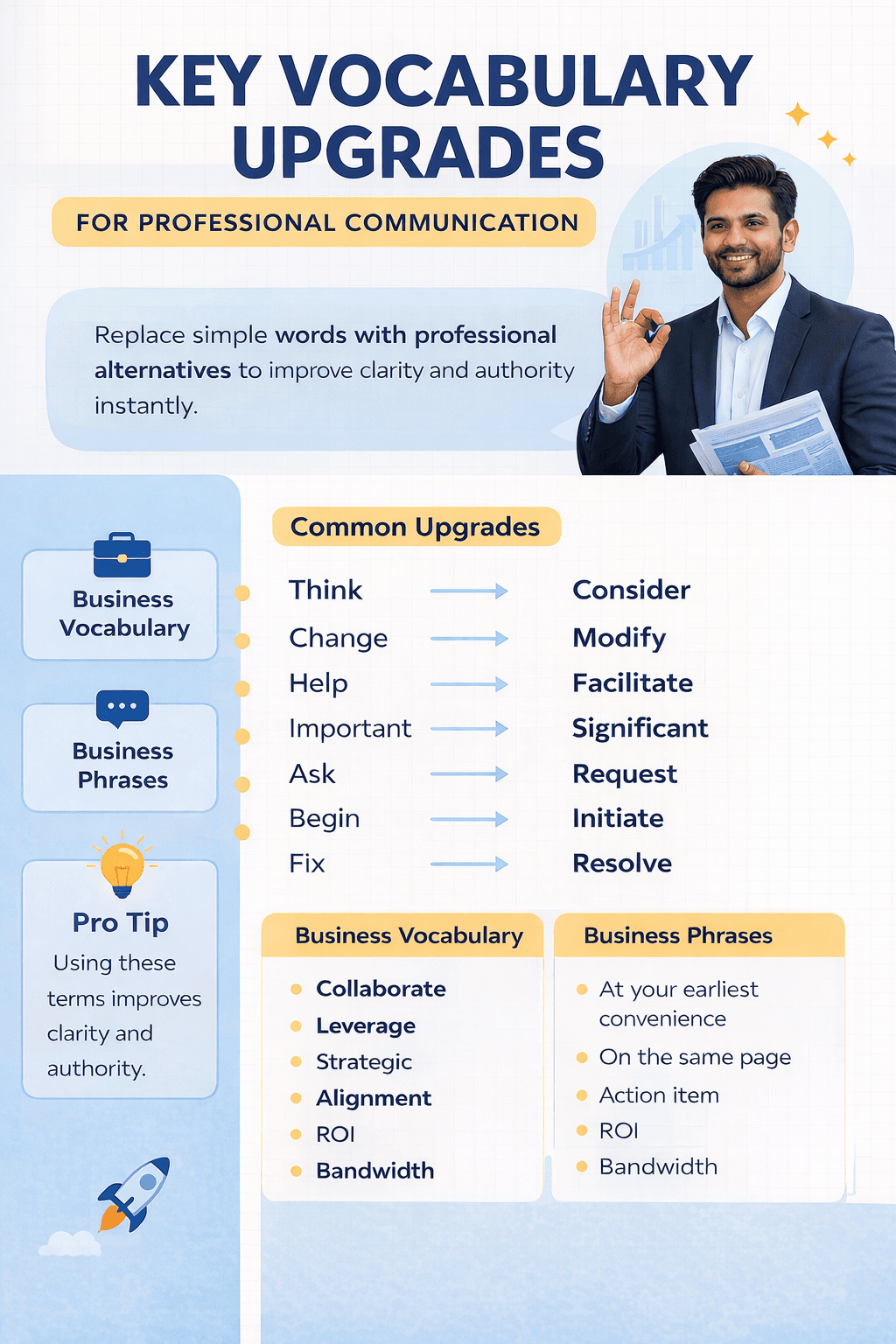
Vocabulary Upgrades That Instantly Improve Speech
Simple word changes can transform how you sound.
Real Examples
Instead of: “We need to fix this.”
Say: “We need to resolve this issue.”
Instead of: “Let us talk about sales.”
Say: “Let us discuss sales performance.”
Instead of: “This is good.”
Say: “This is highly effective.”
Why These Upgrades Work
They make speech sound:
- More mature
- More polished
- More confident
- More business-ready
Use one or two upgrades daily instead of changing everything at once.
How Professional Vocabulary Helps in Interviews and Presentations
Two of the most important workplace speaking situations are interviews and presentations. Vocabulary plays a major role in both.
In Interviews
Employers notice how clearly you speak.
Instead of:
“I am hardworking.”
Say:
“I am proactive, disciplined, and result-oriented.”
Instead of:
“I work with people well.”
Say:
“I collaborate effectively across teams.”
This sounds stronger and more memorable.
In Presentations
Use phrases such as:
- Let me walk you through this.
- The key takeaway is this.
- Our objective is clear.
- Based on current data.
- Moving to the next point.
- In conclusion.
These phrases create flow and confidence.
Why It Matters
Better vocabulary helps you:
- Sound prepared
- Keep audience attention
- Explain ideas clearly
- Build authority
Unsure about your communication level? Take a guided assessment. Book your FREE trial now and get expert feedback.
Daily Routine and PlanetSpark Support for Better Speech
Consistency creates improvement. Even ten focused minutes daily can transform your speech over time.
10-Minute Daily Routine
Minute 1 to 3
Learn three professional words.
Minute 4 to 6
Speak each word in a sentence.
Minute 7 to 8
Read one paragraph aloud.
Minute 9
Record yourself speaking.
Minute 10
Review and improve one mistake.
Follow this routine daily for visible progress.
PlanetSpark Public Speaking Classes
PlanetSpark Public Speaking classes help professionals improve speech through structured coaching.
Key Benefits
- 1:1 Live Coaching with Experts: Get personalized guidance from experienced communication trainers who focus on your specific speaking challenges. One-on-one sessions help improve faster through customized feedback and practice.
- Vocabulary Building for Workplace Speech: Learn practical professional words and phrases that can be used in meetings, interviews, presentations, and daily office conversations. This helps you sound more polished and confident at work.
- Meeting and Presentation Speaking Practice: Practice real workplace scenarios such as team meetings, client discussions, and presentations. This prepares you to speak clearly and confidently in high-pressure situations.
- Personalized Fluency Feedback: Receive detailed feedback on pronunciation, clarity, pace, and speaking flow. This helps you identify weak areas and improve your fluency step by step.
- Confidence-Building Exercises: Take part in structured speaking activities designed to reduce hesitation and fear. Regular practice helps you become more comfortable and self-assured while speaking.
- Mock Interview Practice: Prepare for job interviews through realistic mock interview sessions with expert guidance. Learn how to answer confidently using strong and professional vocabulary.
- Progress Tracking Tools: Track your improvement through regular assessments, trainer feedback, and measurable milestones. This helps you stay motivated and clearly see your growth over time.
Structured learning can help you improve faster than practicing alone.

Build Your Voice, Build Your Future
Strong professional vocabulary is not just a skill, it is a career advantage. When you communicate clearly, you stand out, influence decisions, and create opportunities. Improvement takes consistent effort, but every step brings you closer to confidence and clarity.
Keep learning, keep practicing, and trust the process. Your words have the power to shape your success.
Also Read: How to Build a Better Vocabulary in Just 10 Minutes Daily
Improving Speech Skills – Effective Techniques for Clear Communication
Frequently Asked Questions
At PlanetSpark, we recommend daily reading, vocabulary journals, and active speaking practice for fast improvement.
It involves reading professional content to understand vocabulary, tone, and communication structure used in workplaces.
It ensures your emails are clear, error-free, and professional, which builds credibility.
It is a standard used to evaluate your ability to communicate effectively in international environments.
It identifies your strengths and weaknesses so you can improve systematically.
With consistent practice, noticeable improvement can be seen in a few weeks.
Yes, but structured programs like PlanetSpark accelerate learning and provide expert guidance.
Personalized Communication Roadmaps
Record a video to get a AI generated personalized communication reports