
Mastering Self-Introduction Skills for Kids: A Complete Guide


Self-introduction skills for kids help express who they are, with clarity and confidence. It is the first step toward better communication, stronger social skills, and a positive personality. Many parents look for ways to teach self-introduction to kids because it plays an important role in school, activities, and daily interactions. In this blog, you will find easy tips, age-appropriate examples, and simple templates that help kids talk about themselves clearly and confidently.
The Planet Spark Public Speaking Program helps children build strong communication foundations through simple techniques, structured speaking practice, and guided confidence-building exercises.
Self-Introduction Skills for Kids
Self-introduction skills for kids include the ability to say their name, age, interests, and other basic details in a simple and confident way. These skills help children develop communication, social interaction, clarity of thought, and early public speaking abilities.
Self-Introduction for 3-5 years
My name is Riya. I am four years old. I live with my parents, and I love drawing and playing with colours. My favourite food is Pizza, and my favourite animal is a rabbit. Thank You.
Self-Introduction for 6 to 9 years
My name is Aara, and I am seven years old. I study in Grade 2. I enjoy reading storybooks, solving small puzzles, and playing football with my friends. I live with my parents and younger sister. So this is my short introduction in English. Thank you for listening to me!

Self-Introduction for 10 to 12 years
Good morning, everyone. My name is Anaya. I am eleven years old, and I study in Grade 6 at Bright Future School. One of my favourite hobbies is painting, and I especially enjoy drawing animals and nature scenes. Last week, I participated in our school art competition, and my painting received appreciation from the teachers. Besides painting, I enjoy reading adventure books and solving puzzles. I also help my younger brother with his homework at home. Thank you for listening to me. I am excited to meet all of you and make new friends.
Self-Introduction for 13 to 15 years
Hi everyone, my name is Rohan Mehta. I am fourteen years old and currently studying in Grade 9 at Horizon Academy. I have a strong interest in coding and technology. Recently, I developed a small mobile app for our school project that helps students track their homework. This experience taught me teamwork, problem-solving, and time management. Apart from coding, I enjoy playing basketball, reading biographies, and learning about space. I believe clear communication helps us share ideas and grow together. Thank you for listening.
Key Elements of a Good Self-Introduction for Kids
When children learn how to introduce themselves in a simple and structured way, they find it easier to speak in classrooms, meet new people, and share their interests. Here are age-wise key elements that make a self-introduction in English easy and effective. These ideas also support self-introduction in English for students across different grades.
Key Elements for 3-5 Years
Children at this age need very simple guidance. They understand basic questions and respond with short sentences.
Key elements:
Name
Age
One favourite activity or toy
One simple detail about family
A short closing line
These elements help create easy kids ' self-introduction examples that match the child’s language ability.
Key Elements for 6 to 9 Years
Children in this age group can speak in full sentences and share more details. They start understanding how to introduce themselves in school or with new friends.
Key elements:
Name and age
Grade and school name
Hobbies and interests
A simple strength or something the child enjoys learning
One personal detail, like a favourite book, sport, or subject
These ideas help build stronger self-introduction skills for kids while keeping the content simple.
Key Elements for 10 to 12 Years
Children develop clearer thoughts and better communication skills at this age. Their self-introduction in English can include personal qualities and small goals.
Key elements:
Name, age, and grade
Interests linked to academics or hobbies
Strengths such as teamwork, creativity, or curiosity
A short goal, for example, is learning music or improving in a sport.
One unique fact that makes the introduction memorable
Key Elements for 13 to 15 Years
Teenagers can express deeper thoughts and communicate more mature ideas. Their self-introduction in English for students should reflect personality and clarity.
Key elements:
Name, class, and area of interest
Skills they are developing, such as writing, coding, sports, or leadership
Personal achievements or important activities
Future aims that are simple and realistic.
A polite conclusion that shows confidence
This structure helps teenagers introduce themselves with clarity, purpose, and better public speaking skills.

Step-by-Step Format of Self-Introduction for Kids
When students understand what comes first and what comes next, they feel more confident to introduce themselves in school and in everyday situations. This step-by-step guide is helpful for self-introduction in English for students of different age groups.
Step 1: Start with Name
Every introduction begins with a clear name.
Children should start by saying My name is followed by their full name.
This builds early self-introduction skills for kids and creates a strong opening.
Step 2: Mention Age
After the name, the child can share their age.
This teaches them how to introduce themselves simply and familiarly.
Young children can stop at this point, but older children can continue with more details.
Step 3: Add Class or Grade
School-age children should mention their grade and school name.
It helps listeners understand the child’s learning level and makes the introduction structured.
This step is important for self-introduction in English for students who speak in classrooms and group activities.
Step 4: Share Hobbies and Interests
Once the basic details are complete, children can talk about hobbies.
This includes activities they enjoy, like reading, drawing, sports, music, or puzzles.
This step helps create engaging kids' self-introduction examples that feel natural and personal.
Step 5: Mention Strengths or Skills
Older children can add one or two strengths such as teamwork, creativity, discipline, or curiosity.
This builds confidence and helps them learn how to introduce themselves with clarity and purpose.
Step 6: Add a Simple Goal or Aim
Children aged ten and above can share a small goal.
It can be about improving in a subject, learning a musical instrument, or doing better in a sport.
This makes the introduction meaningful and realistic.
Step 7: Include a Unique or Interesting Fact
A short and simple interesting fact helps the introduction stand out.
For example, a child may share a favourite science experiment, a fun hobby, or a personal achievement.
This adds personality to the format.
Step 8: End with a Polite Closing Line
A short closing line completes the introduction smoothly.
Examples include Thank you for listening or This is my introduction.
This helps children finish with confidence and calmness.
This stepwise format helps children create a structured self-introduction in English. It also supports parents and teachers who want practical guidance on how to teach self-introduction to kids.
Common Mistakes in Self-Introduction
Understanding these mistakes helps you guide children to develop stronger self-introduction in English for students of all ages.
Using Incorrect Sentence Structures
Young children often mix words or copy incorrect speech from their surroundings.
For example, instead of saying My father is a businessman, some children say My father is Mr Roy because they have heard adults introduce someone else in this format.
This happens because self-introduction skills for kids are still developing, and they may not understand the difference between introducing themselves and describing others.
Clear modelling and repeated practice help avoid this mistake.
Sharing Too Many Details
Children sometimes speak for too long or include unrelated information.
They may start talking about pets, friends, or long stories.
While this shows excitement, it makes the introduction confusing.
Kids ' introduction examples should stay simple, short, and structured so the child learns how to introduce themselves with focus.
Speaking Too Softly or Too Quickly
Many children speak very softly due to nervousness.
Others speak too fast because they want to finish quickly.
Both reduce clarity and confidence.
Parents and teachers can guide children to speak slowly, take small pauses, and maintain a steady voice while they introduce themselves in class or group settings.
Forgetting Key Details
Children often skip important parts such as grades, hobbies, or strengths.
This usually happens when they try to memorise long introductions.
A simple structure makes self-introduction in English easier and more natural.
Using Baby Language or Nicknames
Younger children may use baby words or introduce themselves with a nickname only.
This can make the introduction unclear.
Encourage them to share their full name first and then mention a nickname if needed.
Mixing Languages Unnecessarily
Some children switch between two languages in the same introduction.
This happens when they do not know the correct word in English.
Encouraging daily conversations in simple English helps build better self-introduction skills for kids.
Looking Away While Speaking
Many children avoid eye contact due to shyness.
They look at the floor, at their parents, or at their hands.
Eye contact is a small but powerful skill that improves presence during self-introduction in English for students.
Copying Adult Style Introductions
Some children try to speak like adults and use formal or complicated phrases.
For example, a child may say I reside in Chennai instead of I live in Chennai.
Simple language makes the introduction more natural and relatable.
Memorising Without Understanding
A very common mistake is learning a long introduction word-for-word.
When asked a simple question, the child becomes confused because they only memorised and did not understand the flow.
Teaching the format step by step makes kids' introduction examples easier and more meaningful.
Learn More on Self-Introduction Skills.

How to Teach Self-Introduction Skills to Kids
Start with Simple Language
Use basic words like My name is, I am, I live in, and I study in to build a clear foundation.
Use Age-Appropriate Examples
Show kids self-introduction examples suitable for their age. Short sentences for younger children, longer ones for older.
Teach Step by Step
Start with name, then add age, grade, hobbies, and strengths. Stepwise learning improves clarity and confidence.
Practice Daily
Encourage short daily introductions at home or in class to strengthen memory and smooth delivery.
Apply in Real Situations
Let children introduce themselves at events or gatherings to build confidence.
Clear Voice and Body Language
Teach slow, clear speech, standing straight, smiling, and eye contact for effective introductions.
Correct Gently
Fix errors patiently, e.g., My father is a doctor instead of My father is Mr Arun.
Make It Fun
Use games, flashcards, or short videos to reduce pressure and make learning enjoyable.
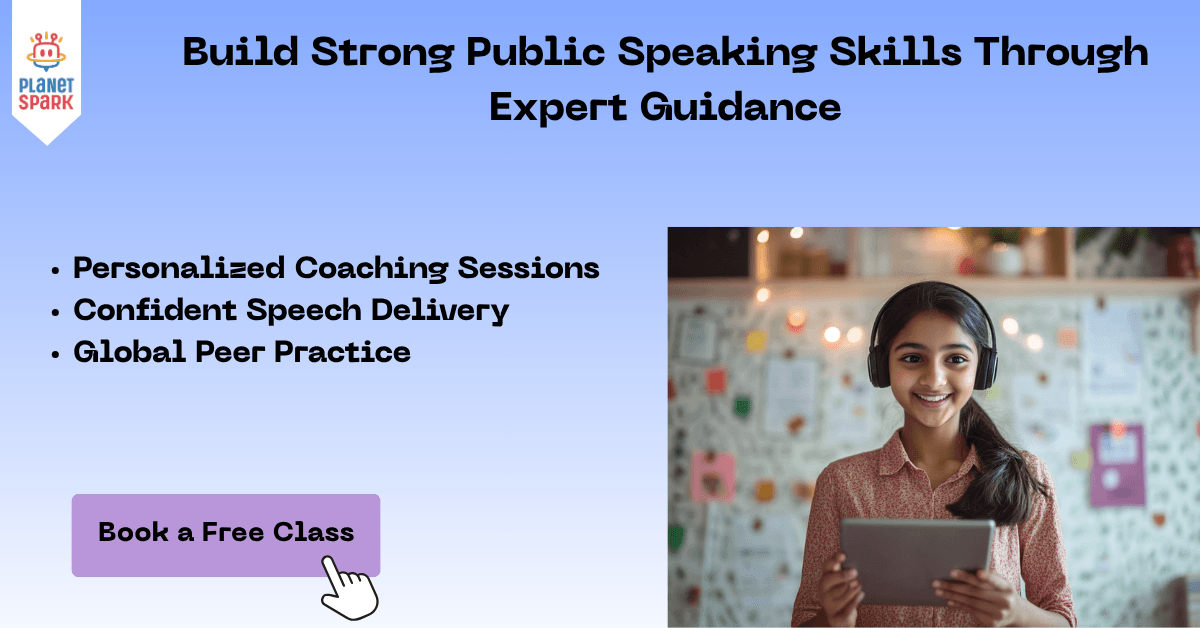
Why Kids Love Planet Spark’s Public Speaking Program
Core Goal: Build stage confidence, articulation, persuasive speech, and audience engagement.
Key Features:
1:1 Coaching by Experts: Individual guidance from certified trainers in communication and child psychology.
Step-by-Step Skill Building: Covers body language, voice modulation, speech structuring, storytelling, persuasive techniques, extempore, and debating.
TED-Style Training Modules: Learn the “hook, message, story, call-to-action” model for powerful speeches.
Real-Time Practice with Global Peers: Participate in live debates, panel discussions, storytelling circles, and group activities with kids from 13+ countries.
Competitions and Public Speaking League: Frequent internal competitions and national-level league events for real performance experience.
Video Feedback Loop: Review recorded speeches with coaches for detailed feedback and improvement.
Mastering self-introduction skills is the first step to building confident communication, social skills, and stage presence. With Planet Spark’s Public Speaking program, your child can practice, perform, and shine in every introduction, every conversation, and every audience.
Frequently Asked Questions
Self introduction in English for kids is the ability to confidently say their name, age, interests, and basic details in a clear and structured way. It helps children improve communication, build social skills, and gain confidence in school, activities, and public speaking.
To teach self-introduction to kids, start with simple sentences like My name is, I am, and I study in. Use age-appropriate examples, follow a step-by-step format, encourage daily practice, and provide gentle corrections. Fun activities and real-life situations also help children develop strong self-introduction skills.
Yes. Planet Spark’s Public Speaking program focuses on building self-introduction skills for kids through one-on-one coaching, structured exercises, live practice with peers, and personalized feedback. Children learn to introduce themselves clearly, confidently, and in an engaging way.