
Daily Fun and Easy Public Speaking Challenges for Kids

Table of Contents
- Simple Public Speaking Challenges for Kids
- Why Public Speaking Is Important for Children
- Benefits of Public Speaking for Kids
- How to Begin Public Speaking at Home
- Step 1: Create a Comfortable Speaking Environment
- Step 2: Start with Small Speaking Tasks
- Step 3: Encourage Daily Practice
- Simple Public Speaking Challenges for Kids
- Challenge 2: Show and Speak
- Challenge 3: Story Starter Challenge
- Challenge 4: Picture Description
- Challenge 5: Daily English Diary Speaking
- Challenge 6: Five-Word Building Challenge
- Challenge 7: Two-Minute Debate
- Challenge 8: Recite and Act
- Fun Icebreaker Activities for Public Speaking
- Funny Public Speaking Activities for Kids
- Public Speaking Activity Topics
- Weekly Public Speaking Schedule for Kids
- How Parents Can Help Children Practise Public Speaking
- Checkpoints for Parents
- Common Public Speaking Problems and How to Fix Them
- Help Children Speak Confidently
- About PlanetSpark : Public Speaking
Public speaking is not just about going on a stage. It is about sharing ideas clearly, thinking confidently, and learning how to communicate with others. Children are at the perfect age to build these skills. With simple tasks, fun games, and easy challenges, every child can learn to speak without fear.
This blog helps parents and children make public speaking simple and enjoyable. The activities here match the PlanetSpark learning style, where children grow through small daily steps.
Simple Public Speaking Challenges for Kids
Public speaking challenges help children practise in small, easy steps. When children try simple tasks like introducing themselves, describing an object, or sharing a short story, they slowly learn to speak without fear. These activities make speaking fun and help children become more confident in expressing their ideas.
With regular challenges, children learn to organise their thoughts, speak clearly, and use better vocabulary. These tasks are designed for children, so they are simple, enjoyable, and stress-free. Even a few minutes of practice every day can help children become strong and confident speakers.
Challenges for Kids:
1. 30-Second Talk Challenge
Kids speak on any topic for 30 seconds without stopping.
Why it works: Builds fluency and reduces hesitation.
2. Story Retell Challenge
Give children a short story and ask them to retell it in their own words.
Why it works: Improves memory, sequencing, and confidence.
3. Show & Tell Challenge
Kids bring any object and speak about:
– What it is
– Why they chose it
– A fun fact
Why it works: Encourages spontaneous speaking and creativity.
4. Describe This! Challenge
Show a picture and ask the child to describe what they see in 4–5 sentences.
Why it works: Enhances observation and descriptive vocabulary.
5. Role-Play Challenge
Let kids pretend to be a teacher, chef, doctor, or superhero and speak in that role.
Why it works: Makes speaking fun and removes pressure.
6. Q&A Hot Seat Challenge
One child sits in the “hot seat,” and others ask simple questions.
Why it works: Develops quick thinking and spontaneous speaking.
7. Speak With Emotion Challenge
Give kids a sentence and ask them to say it with different emotions happy, angry, surprised, sad.
Why it works: Improves voice modulation and expression.
8. 1-Minute News Reporter Challenge
Kids pretend to be news anchors and give a small update about weather, school, or home.
Why it works: Builds clarity, tone control, and structure.
9. What Happens Next? Challenge
Start a story and ask the child to continue it with their imagination.
Why it works: Boosts creativity and storytelling skills.
10. Mirror Speaking Challenge
Kids speak in front of a mirror to observe their expressions and posture.
Why it works: Improves body language and self-awareness.
“Every confident speaker starts with one tiny step.”
Help your child take that step — Book a Free Demo Class!
Why Public Speaking Is Important for Children
Children today need strong communication skills in school and real life. Public speaking helps them express thoughts clearly, answer questions confidently, and participate actively in class and group discussions.
Benefits of Public Speaking for Kids
Confidence
Public speaking helps children face their fear of speaking in front of others. With regular practice, they learn to stay calm, stand tall, and share their thoughts clearly. Each time they speak, their confidence grows. They begin to trust themselves more and feel comfortable expressing ideas in class, with friends, and in new situations.
Communication Skills
Speaking challenges train children to organise their thoughts before speaking. They learn how to start, explain, and end their ideas in a clear way. This improves their overall communication. They also learn to use the right words, maintain eye contact, and speak with proper voice control. These skills help them express themselves better in school and daily life.
Language Improvement
Public speaking naturally improves a child’s language skills. As they prepare speeches or practise activities, they learn new words and sentence structures. They get used to speaking in English without hesitation. Over time, their grammar, pronunciation, and fluency become stronger, helping them speak more smoothly and confidently.
Creativity
Public speaking encourages children to think beyond simple sentences. When they create stories, describe situations, or give presentations, their imagination grows. They learn to form unique ideas, use creative examples, and think quickly. This boosts their creativity and helps them become better storytellers and problem solvers.
Leadership Qualities
Children who speak well often become leaders in group activities. Public speaking teaches responsibility, teamwork, and decision-making. When children share ideas confidently, others listen to them. They become active participants in class, take initiative in tasks, and learn to guide or motivate others. These qualities help them grow into strong young leaders.
How to Begin Public Speaking at Home
Parents can easily introduce speaking practice at home with small tasks.
Step 1: Create a Comfortable Speaking Environment
Children speak better when they feel relaxed.
Ideas
• Choose a quiet corner of the room
• Allow children to stand or sit as they like
• Provide a small notebook for ideas
• Do not judge or interrupt while the child is speaking
Step 2: Start with Small Speaking Tasks
Not all children are ready to speak for long. Start with short, simple activities.
Small Tasks Examples
• One-line answers
• Describing a picture
• Talking about an object
• Reading aloud
• Speaking for 30 seconds
Step 3: Encourage Daily Practice
Public speaking becomes strong with daily use.
Suggested Routine
• Morning: Speak for 1 minute on any topic
• Evening: Read aloud for 2 minutes
• Before bed: Tell a short story
Simple Public Speaking Challenges for Kids
These challenges are easy, simple, and fun. They build confidence slowly and naturally.
Challenge 1: One-Minute Talk
This is one of the simplest public speaking activities for kids.
Instructions
• The child picks any topic
• Speaks for one full minute
• No stopping or restarting
• No reading from paper
Sample Topics
• My favourite game
• Why I like holidays
• The best snack in the world
• If I had a pet dragon
• One rule I would change at home
Skills Built
• Fluency
• Confidence
• Quick thinking
Challenge 2: Show and Speak
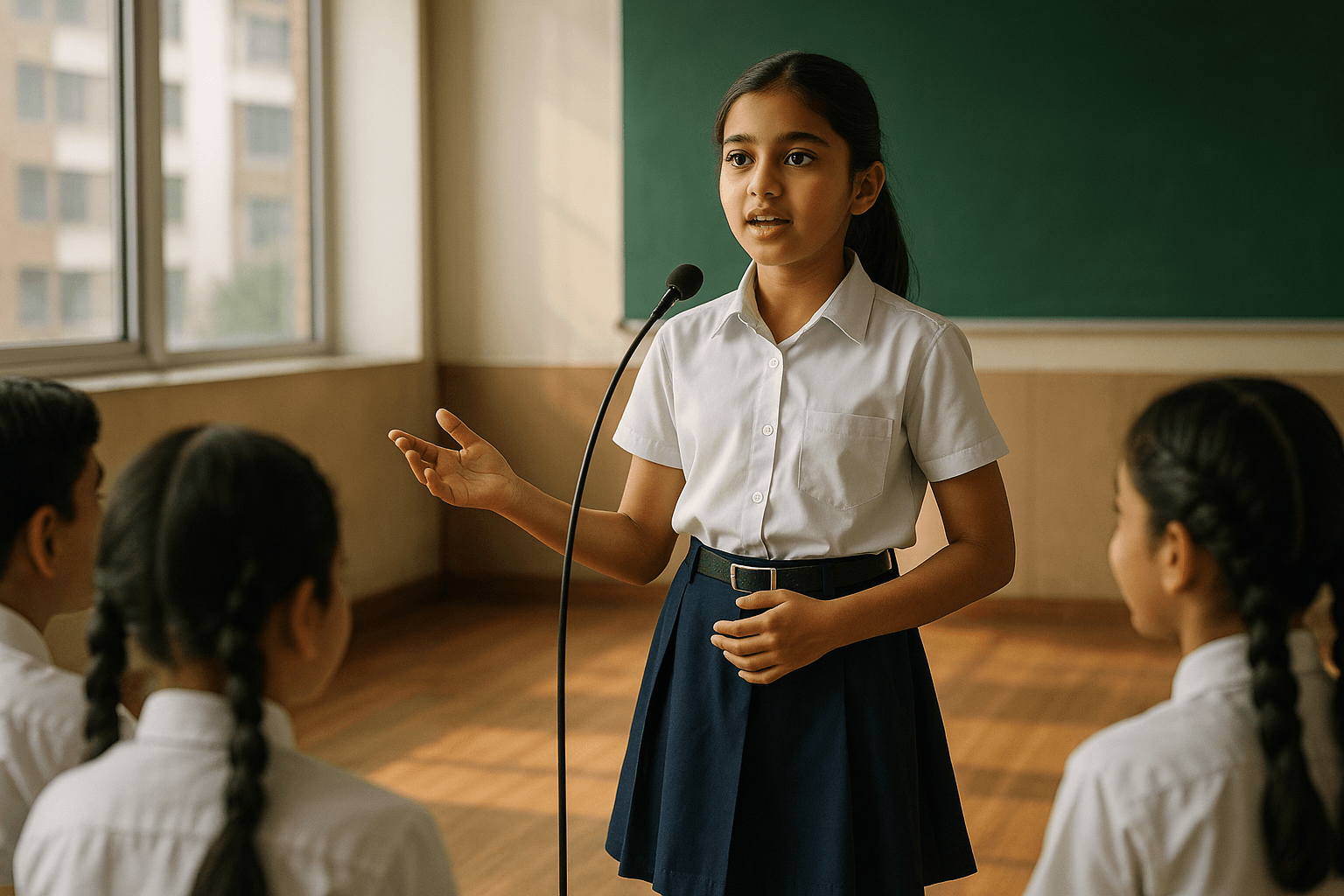
Children choose an object and talk about it. This is also known as show-and-tell.
How It Works
• Pick any object nearby
• Explain what it is
• Tell why it is special
• Share a memory related to it
Example Objects
• A toy
• A book
• A pencil box
• A water bottle
• A gift from a friend
Helpful Prompts
• What is it made of?
• Where did you get it from?
• Why do you like it?
Discover simple ways to boost your child’s speaking confidence — Read More
Challenge 3: Story Starter Challenge
Children begin with one sentence and build the story as they speak.
Story Starter Examples
• There was a strange sound outside my window
• I found a magical stone in the park
• My school announced a secret competition
• A talking cat came to my home
• We travelled to a new planet
Skills Developed
• Creativity
• Voice modulation
• Confidence
Challenge 4: Picture Description
This activity helps children think quickly and organise ideas.
How to Do It
• Show a picture from a book or the internet
• Give the child 30 seconds to observe
• The child describes everything they see
Helpful Questions
• Who is in the picture?
• What are they doing?
• Where are they?
• What might happen next?

Challenge 5: Daily English Diary Speaking
Children speak about their daily routine.
Structure
Children can follow this simple format:
| Section | Questions to Answer |
|---|---|
| Morning | What did you do after waking up? |
| Afternoon | What was your favourite part of the day? |
| Evening | What did you learn today? |
| Night | What will you do tomorrow? |
Benefits
• Builds simple sentence structure
• Improves fluency
• Encourages thinking in order
Challenge 6: Five-Word Building Challenge
Give the child five random words and ask them to make a short story.
Example Word Sets
Set 1: Tiger, Rain, School, Bag, River
Set 2: Rocket, Book, Mountain, Friend, Secret
Set 3: Music, Garden, Dog, Cake, Night
Skills Built
• Creativity
• Vocabulary
• Sentence formation
Strong communication builds strong futures.
Build that future today — Book a Free Demo Class!
Challenge 7: Two-Minute Debate
Debates help children learn how to build arguments and present opinions.
Debate Topics
• Should school homework be reduced?
• Is it good to watch TV every day?
• Are pets better than toys?
• Should children get pocket money?
• Is reading more useful than playing video games?
Debate Format
• 30 seconds for introduction
• 60 seconds for the main argument
• 30 seconds for conclusion
Challenge 8: Recite and Act
Children read a poem, short story, or speech and act it out.
Benefits
• Voice clarity
• Expression
• Confidence
Fun Icebreaker Activities for Public Speaking
Icebreakers help children warm up before speaking.
Icebreaker 1: Two Truths and One Lie
Children say two true things and one false thing.
Others guess the lie.
Icebreaker 2: The Name Game
Children introduce themselves with one interesting fact.
Icebreaker 3: If I Were...
Children complete sentences like:
• If I were a bird, I would…
• If I were invisible, I would…
Funny Public Speaking Activities for Kids
Humour makes speaking fun.
Activity: The Funny Object Challenge
Children pick a common object and describe it in a funny way.
Example: Describe a pillow as if it is alive.
Activity: Backward Day
Children explain their daily routine backwards, starting from night to morning.
Activity: Silly Speech
Give children a topic like:
• Why pizza should be the national food
• Why I think aliens love cartoons
Public Speaking Activity Topics
Here is a massive list of easy topics for children:
Personal Topics
• My best memory
• My favourite teacher
• A skill I want to learn
• The best place I visited
Fun Topics
• If animals could talk
• A day without electricity
• My dream invention
Academic Topics
• Why reading is important
• How planets move
• My science experiment
Creative Topics
• The secret life of trees
• My imaginary village
• If I could fly
Family Topics
• Why I love my family
• Responsibilities at home
Weekly Public Speaking Schedule for Kids
Here is a weekly plan parents can follow.
| Day | Activity | Time |
|---|---|---|
| Monday | One-minute talk | 10 minutes |
| Tuesday | Picture description | 10 minutes |
| Wednesday | Story starter | 15 minutes |
| Thursday | Debate practice | 10 minutes |
| Friday | Show and speak | 10 minutes |
| Saturday | Recite and act | 20 minutes |
| Sunday | Review and reflection | 10 minutes |
Give your child the voice that gets heard.
Start their journey today — Book a Free Demo Class!
How Parents Can Help Children Practise Public Speaking
Be Patient
Allow children to make mistakes.
Listen Actively
Show interest in what they say.
Encourage Natural Speaking
Do not force perfect grammar.
Celebrate Progress
Small improvements matter.
Checkpoints for Parents
Parents can use this checklist weekly:
Speaking Skills
• Is the child speaking more smoothly?
• Are sentences longer and clearer?
• Is the child thinking before speaking?
Confidence
• Is the child less nervous?
• Is the voice louder and clearer?
• Is the child ready to speak in class?
Creativity
• Are stories more interesting?
• Is the child using imagination?
Common Public Speaking Problems and How to Fix Them
Problem 1: Fear of speaking
Many children feel nervous when they speak in front of others. Their hands shake, their voice becomes soft, or they forget their words. This fear is normal and reduces only with practice. Starting with very small tasks like one-minute talks helps children feel safe and slowly build confidence.
Solution: Start with small tasks like one-minute talks
Short speaking tasks reduce pressure and help children realise that speaking is easy and not scary. One-minute talks train them to begin confidently, finish clearly, and get comfortable hearing their own voice. With daily practice, children become less afraid and slowly move to longer speeches.
Problem 2: Forgetting ideas
Children often begin speaking well but get stuck in the middle because they forget what to say next. This happens when they think too fast or try to speak without planning. Forgetting ideas can make them worried, causing more pauses and confusion during their speech.
Solution: Teach children to use simple outlines like beginning, middle, and end
A three-part outline helps children organise their thoughts quickly. They know how to start, what to say next, and how to end. This method reduces confusion and helps them stay on track. Even a simple outline gives them direction and makes their speech clear and steady.
Problem 3: Speaking too fast
Some children speak very fast because they feel nervous or want to finish quickly. Speaking too fast makes words unclear, reduces confidence, and makes the audience unable to understand. It also causes children to run out of breath, which affects fluency and voice quality.
Let your child shine in every conversation.
Start their confidence journey — Book a Free Demo Class!
Solution: Practise slow reading aloud daily
Reading aloud at a slow, steady pace teaches children to control their speed. It helps them pronounce words clearly and breathe properly. When children practise this daily for a few minutes, they learn how to slow down naturally during speeches, making their communication clearer and more confident.
Problem 4: Low voice
Many children speak too softly because they feel shy or unsure. Speaking in a low voice makes it hard for listeners to understand and affects the child’s confidence. A soft voice also makes the speaker seem less sure of themselves, even when they know their topic well.
Solution: Use the mirror practice method
Mirror speaking helps children see their posture, mouth movement, and expressions. When children practise speaking in front of a mirror, they naturally increase their volume and become more aware of their voice. This simple daily exercise builds confidence and helps them project their voice clearly.
Problem 5: Lack of vocabulary
Children often get stuck while speaking because they do not know enough words to express their thoughts. Limited vocabulary makes it hard to describe things, share ideas, or continue a speech smoothly. This can make speaking stressful and reduce fluency over time.
Solution: Introduce 3 new words daily
Learning just three useful words every day builds a strong vocabulary over time. Children can use these new words in sentences or small talks. Regular exposure to new words helps them speak more confidently, explain their thoughts better, and improve the quality of their speeches.
Help Children Speak Confidently
Activity-based learning and daily speaking tasks to build public speaking skills in children.
Features
• Daily speaking challenges
• Storytelling sessions
• Debate training
• Creative speech building
• Vocabulary and fluency development
• Personalised feedback
Make public speaking fun, easy, and powerful for every child.
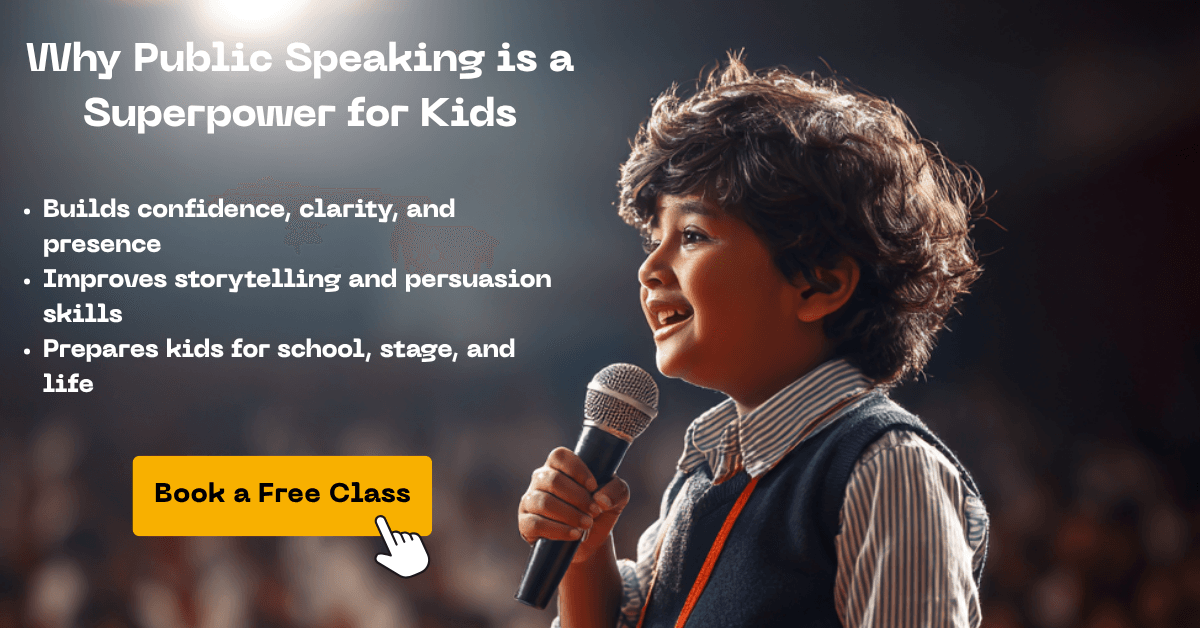
About PlanetSpark : Public Speaking
PlanetSpark helps children become confident, expressive, and impactful speakers through engaging 1:1 live public speaking classes. Our program strengthens clarity, voice modulation, stage presence, and structured expression empowering kids to speak with confidence in school, on stage, and in everyday conversations.
1. 1:1 Expert Public Speaking Coaching
Each child learns with a certified public speaking mentor who personalises sessions to their comfort level improving clarity, confidence, and delivery one skill at a time.
2. Personalised Communication Roadmap
A tailored curriculum builds essential speaking skills step by step including storytelling, presentation skills, body language, and persuasive communication.
3. AI-Driven Speech Analysis & Feedback
With SparkX video analysis and AI-led practice, students receive instant insights on clarity, tone, pauses, and expression helping them refine their stage presence rapidly.
4. Interactive & Gamified Speaking Activities
Activities like debate drills, storytelling games, impromptu speaking, and voice workouts make practice fun, engaging, and consistent.
5. Confidence for Every Stage & Situation
Through speeches, roleplays, and real-life conversation tasks, children learn to speak fearlessly whether in class discussions, competitions, interviews, or public events.
Frequently Asked Questions
Early practice helps children build confidence, reduce fear, and express their ideas clearly. It also improves communication and classroom participation.
Even five to ten minutes of speaking tasks every day can show strong improvement in fluency and confidence.
Start with very small tasks like reading aloud or introducing themselves. Slowly increase challenges as the child becomes comfortable.
Yes. Children who speak confidently perform better in class discussions, presentations, group work, and exams.
Parents can ask simple daily questions, listen patiently, encourage full sentences, and create a safe space for their child to speak.