
Speech Storyboard Templates for Kids: Plan a Talk Visually Before You Speak
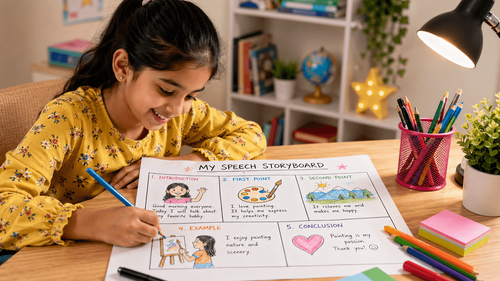

Table of Contents
- What are Speech Storyboard Templates for Kids and Why Do The
- How to Use a Storyboarding Template for Speech Planning?
- Best Storyboard Examples for Students to Learn From
- How Does a Storyboard Creator Help Kids Speak Better?
- Practical Tips to Make Storyboarding Effective for Kids
- Common Mistakes Kids Make While Using Storyboards
- How Can Kids Improve Over Time Using Storyboarding?
- How PlanetSpark Helps Kids Master Storyboarding and Speaking
Have you ever seen a child struggle to organize thoughts before speaking? Many kids know what they want to say but cannot structure it clearly. This is where speech storyboard templates for kids become powerful tools. They help children visually map ideas, build confidence, and speak with clarity.
In this blog, you will explore what storyboarding is, why it works, and how kids can use a storyboard creator effectively. You will also learn practical examples, templates, and step-by-step methods to create engaging speeches. By the end, your child will be able to plan and present ideas like a confident speaker. Let us begin by understanding what a storyboard really is.
What are Speech Storyboard Templates for Kids and Why Do They Matter?
Speech storyboard templates for kids are visual planning tools that break a speech into small, manageable parts. Instead of memorizing long paragraphs, children use pictures, boxes, or simple prompts to organize ideas.
Think of it like creating a comic strip before speaking. Each box represents one idea or part of the speech. This method makes speaking less stressful and more fun.
Why do kids benefit from storyboarding?
- Helps organize thoughts clearly
- Reduces fear of forgetting points
- Encourages creativity through visuals
- Improves logical flow of ideas
- Makes practice easier and more engaging
Children often feel overwhelmed when asked to “just speak.” A storyboard example gives them direction and structure.
How is it different from writing a speech?
- Writing focuses on sentences
- Storyboarding focuses on ideas
- Writing can feel rigid
- Storyboarding feels creative and flexible
Using storyboard examples for students, kids can visually connect ideas and build confidence step by step.
How to Use a Storyboarding Template for Speech Planning?
Using a storyboarding template is simple and effective. Kids do not need advanced tools. Even a blank sheet divided into boxes works well.
Step by step process
1. Start with the main idea
Ask the child: What is your speech about?
Write or draw it in the first box.
2. Break into key parts
Divide the speech into:
- Introduction
- Main points
- Conclusion
Each part gets its own box.
3. Add visuals or keywords
Instead of writing full sentences:
- Draw simple images
- Write short phrases
- Use symbols
Want to improve communication skills?
4. Arrange in sequence
Ensure ideas flow logically from one box to the next.
5. Practice using the storyboard
Kids should look at each box and speak naturally.
Example of a simple storyboard
- Box 1: Topic introduction
- Box 2: First point with example
- Box 3: Second point
- Box 4: Personal story
- Box 5: Conclusion
This method works well even with beginners. A storyboard creator can also be used digitally for better engagement.
Best Storyboard Examples for Students to Learn From
Learning becomes easier when kids see examples. Let us look at a few storyboard examples for students that can guide them.
Example 1: My Favorite Animal
- Box 1: Introduce the animal
- Box 2: Where it lives
- Box 3: What it eats
- Box 4: Why I like it
- Box 5: Fun fact
Example 2: My Best Friend
- Box 1: Who is your friend
- Box 2: How you met
- Box 3: What you enjoy together
- Box 4: A special memory
- Box 5: Why they matter
Example 3: Importance of Cleanliness
- Box 1: What is cleanliness
- Box 2: Why it is important
- Box 3: Daily habits
- Box 4: Impact on health
- Box 5: Conclusion
These storyboard examples help children understand how to structure ideas logically.
Why examples work?
- Provide clarity
- Reduce confusion
- Build confidence
- Encourage independent thinking
Children learn faster when they see patterns they can follow.
How Does a Storyboard Creator Help Kids Speak Better?
A storyboard creator is a digital tool that allows kids to design visual speech plans. It adds an element of fun and creativity to learning.
Benefits of using a storyboard creator
- Easy drag and drop features
- Use of images and icons
- Interactive learning experience
- Saves time compared to manual drawing
- Encourages independent learning
Digital tools also allow kids to edit and improve their storyboard easily.
When should kids use digital tools?
- For school presentations
- For competitions
- For creative storytelling tasks
- For practice sessions at home
However, beginners can start with paper templates before moving to digital platforms.
Tips for parents
- Let children choose visuals
- Encourage storytelling instead of memorizing
- Focus on ideas, not perfection
Using a storyboarding template 480 format ensures structured learning and consistency.
Help your child speak confidently with PlanetSpark English Speaking Classes.
Practical Tips to Make Storyboarding Effective for Kids
Storyboarding is simple, but a few strategies can make it more powerful.
Keep it simple
Do not overload the boxes with too much information. Stick to:
- One idea per box
- Short keywords
- Simple drawings
Encourage creativity
Let kids:
- Use colors
- Add symbols
- Draw freely
Creativity increases engagement and memory.
Practice aloud
After completing the storyboard:
- Ask kids to speak using it
- Avoid reading directly
- Focus on natural speaking
Use repetition
Practice multiple times using the same storyboard. This builds confidence and fluency.
Provide feedback
Parents and teachers should:
- Appreciate effort
- Suggest small improvements
- Encourage confidence
A strong foundation with speech storyboard templates for kids ensures long-term speaking skills.
Common Mistakes Kids Make While Using Storyboards
Even simple tools can be misused. Understanding mistakes helps avoid them.
Writing full sentences
Kids often try to write everything. This defeats the purpose.
Solution: Use keywords instead.
Overcomplicating the design
Too many colors or drawings can distract.
Solution: Keep it clean and focused.
Ignoring structure
Some kids jump between ideas randomly.
Solution: Follow a clear beginning, middle, and end.
Not practicing
Creating a storyboard is not enough.
Solution: Practice speaking regularly.
Depending too much on visuals
Kids may rely on drawings and forget to expand ideas.
Solution: Encourage explanation beyond visuals.
By avoiding these mistakes, children can fully benefit from storyboard examples for students.
How Can Kids Improve Over Time Using Storyboarding?
Storyboarding is not a one-time activity. It is a skill that improves with practice.
Start with simple topics
Begin with easy subjects like:
- My hobby
- My school
- My favorite food
Gradually increase complexity
Move to:
- Social topics
- Storytelling
- Opinion-based speeches
Track progress
Parents can observe:
- Improvement in clarity
- Better confidence
- Stronger vocabulary
Combine with speaking practice
Encourage:
- Mirror practice
- Recording videos
- Speaking in front of family
Make it a habit
Regular use of speech storyboard templates for kids builds long-term communication skills.
How PlanetSpark Helps Kids Master Storyboarding and Speaking
PlanetSpark Public Speaking Classes are designed for kids who want to become confident communicators. These classes help children move from idea confusion to structured speaking using proven methods like storyboarding.
Children often struggle with organizing thoughts and speaking fluently. PlanetSpark solves this through guided learning, expert mentoring, and real practice opportunities.
Key Features
- Live Interactive Classes
Students actively participate in real-time sessions instead of passive learning.
This ensures better engagement, immediate doubt resolution, and practical speaking practice. - Expert Teachers
Certified communication trainers guide students with proven techniques.
They identify individual gaps and help improve clarity, fluency, and confidence. - Real World Communication Practice
Kids practice through debates, storytelling, and presentations regularly.
This prepares them for real-life speaking situations beyond classrooms. - Personalized Feedback
Each child receives detailed feedback after every session.
This helps them improve specific areas like structure, delivery, and confidence. - Confidence Building Framework
Structured activities gradually reduce fear of speaking.
Children become comfortable expressing ideas in front of any audience. - Structured Curriculum
Lessons are designed according to age and skill levels.
This ensures systematic learning and steady improvement over time.
Turn Ideas into Confident Speech
Every confident speaker starts with clear thinking. Speech storyboard templates for kids make this process simple, structured, and enjoyable. They help children organize ideas, reduce fear, and express themselves effectively.
With consistent practice, children can transform from hesitant speakers into confident communicators. Encourage your child to start small, use visual planning, and practice regularly. Over time, these small steps will build strong communication skills that last a lifetime.

Also read: How to Solve Unseeen Passage- Top 10 Tricks
Frequently Asked Questions
An audience retention strategy in public speaking involves techniques used to keep listeners engaged, attentive, and interested throughout a speech or presentation.
With regular practice and expert guidance, many learners notice improvements in confidence and stakeholder management skills within a few weeks, making it easier to apply these skills at work immediately.
Storytelling is powerful because it creates emotion, builds connection, and helps listeners remember ideas more easily.
PlanetSpark builds confidence through live classes, interactive speaking activities, storytelling, debates, and personalised trainer feedback that helps children express ideas clearly and boldly.
Public speaking builds clarity, voice control, body language awareness, and emotional regulation, all of which strengthen confidence.