
Stuttering in Children: Stutter Meaning & How PlanetSpark Helps


Table of Contents
- Stutter Meaning (Easy Explanation for Parents)
- Stuttering While Speaking in Public or Conversations: Why It
- Does Stuttering Go Away? What Experts Say
- From Shy Speaker to Stage Star: Nirvana Mehta’s Journey
- Home Strategies to Support Children
- How Structured Public Speaking Training Can Help Reduce Stut
- PlanetSpark’s Unique Approach to Fluency and Confidence
- Conclusion & Encouragement for Parents
Many parents notice moments when their child struggles to say a word, repeats a sound, or pauses for too long. These moments often lead them to search for the stutter meaning or wonder whether it is normal. The truth is, stuttering in children is more common than most people realise, and it can appear during early speech development or during moments of excitement, stress, or pressure.
While occasional hesitation is normal, consistent stuttering can affect a child’s confidence, classroom performance, and willingness to speak in social settings. That is where structured speaking practice plays a powerful role. PlanetSpark’s guided public speaking approach helps children build fluency, reduce hesitation, and speak with ease in everyday situations. Before we explore how speaking training helps, let’s first understand the meaning of stuttering and why it occurs in children.
Stutter Meaning (Easy Explanation for Parents)
The simplest stutter meaning is this: a stutter happens when a child knows exactly what they want to say, but the words do not come out smoothly. They may repeat sounds, stretch certain words, or feel stuck on a syllable. It is a speech flow issue, not a thinking issue. Children who stutter have clear thoughts, but their speech muscles struggle to match their ideas.
Everyday Examples of Stuttering
Stuttering can show up in many common situations, such as:
Repetition of sounds:
“M–m–mummy, can I go outside?”Repeating whole words:
“Can I, can I, can I take my toy?”Prolonged sounds:
“Ssssschool was fun today.”Blocking or getting stuck:
The child opens their mouth to speak but no sound comes out for a few seconds.
These moments can be confusing for parents because the child may speak smoothly at home but stutter more at school or around new people.
Normal Pauses vs Actual Stuttering
It’s important to understand that all children pause or hesitate while speaking, especially when they are learning new words or forming longer sentences. These normal pauses happen because the child is thinking.
Normal pause example:
“Um… I want the red crayon.”
This is not stuttering. It is simply a thinking gap.
Stuttering example:
“I w-w-want the r-r-red crayon.”
Here, the child tries to say the word but gets stuck, repeats sounds, or struggles to move to the next word.
Understanding this basic difference helps parents identify whether their child is experiencing normal speech development or showing signs of a stutter.

Stuttering While Speaking in Public or Conversations: Why It Happens
Many children who speak comfortably at home may suddenly freeze, repeat words, or struggle to start a sentence when speaking in front of others. This is a common pattern, especially when parents are already noticing stuttering in children during everyday speech. Understanding why stuttering becomes more noticeable in public settings helps you support your child better.
1. Increased Pressure to Perform
When a child speaks on stage, in class, or in front of new people, their brain goes into “performance mode.” They focus not only on what they want to say but also on how others might react. This extra pressure can interrupt the natural speaking flow and worsen stuttering.
2. Fear of Judgement or Making Mistakes
Children sometimes worry about being laughed at or judged. This worry builds mental tension that affects the speech muscles. Even a child who speaks smoothly at home may get stuck or repeat sounds when asked to speak in public.
3. Faster Thoughts in High-Energy Situations
During speeches or group conversations, ideas come rushing in quickly. But speech muscles may not keep up with this speed. This gap between fast thoughts and slower speech movement increases the chances of blocks or repeated sounds, a classic sign linked to the stutter meaning.
4. New Environments Trigger Hesitation
A school assembly, a story-telling competition, or even a family gathering can feel unfamiliar and overwhelming for a child. New settings naturally increase nervousness, making stuttering more noticeable.
5. Limited Practice With Structured Speaking
Kids who do not often practise organised speaking tasks like reading aloud, storytelling, or structured speeches may feel unprepared when faced with a live audience. Without practice, speech flow becomes unstable, and stuttering becomes more visible.
Public speaking is a skill that grows with training and exposure. When children receive structured practice, guidance, and a safe space to speak, they gradually gain fluency and confidence, making stuttering less frequent over time.
Experience Personalized Coaching That Transforms Hesitant Speakers
Schedule a Demo Today!
Does Stuttering Go Away? What Experts Say
For many children, stuttering is a natural part of growing up. Speech experts agree that early childhood is a period of rapid language development, and the brain often needs time to sync thoughts with smooth speech. The positive news is that developmental stuttering improves for most children with the right support, practice, and environment.
1. Developmental Stuttering Improves With Practice
Children learn to speak fluently the same way they learn any other skill: through repetition. Regular speaking activities like storytelling, reading aloud, and guided conversations help strengthen speech muscles and improve rhythm. With consistent practice, many kids outgrow disfluency as their speaking system matures.
2. Stress-Free Communication Helps
A relaxed environment plays a huge role in reducing hesitation. When children feel safe, unhurried, and free from correction while talking, their speech becomes naturally smoother. Experts recommend patient listening, giving children time to finish sentences, and celebrating their efforts rather than focusing on mistakes.
3. Exposure Reduces Hesitation
The more a child speaks in different settings, home, school, group discussions, or small audiences—the more familiar and comfortable speech becomes. Real-world exposure slowly reduces nervousness, which is a major trigger for stuttering. Over time, this confidence helps children form clearer, more fluent speech patterns.
Although each child’s journey is unique, most children show great improvement with early intervention, consistent support, and structured speaking experiences.
From Shy Speaker to Stage Star: Nirvana Mehta’s Journey

Nirvana Mehta won First Prize in the Intersection Poem Recitation category, demonstrating remarkable confidence, expression, and voice control.
Through consistent practice, guided exercises, and personalised coaching at PlanetSpark, Nirvana strengthened her fluency, clarity, and stage presence. Her journey shows how structured public speaking training can help children communicate confidently and express themselves effectively in any situation.
Give Your Child the Skills to Express Themselves Clearly
Reserve Your Demo Today!
Home Strategies to Support Children
Parents play a key role in helping children improve fluency and manage stuttering in children. Small, consistent steps at home can make a big difference in building confidence and smooth speech. Here are some effective strategies:
1. Reading Aloud Together
Set aside time for reading sessions where your child reads aloud. This helps strengthen vocabulary, pacing, and pronunciation in a relaxed environment.
2. Practising Slow-Paced Speech
Encourage your child to speak slowly and clearly. Modelling calm, measured speech yourself can help them mirror the pace and reduce hesitations.
3. Encouraging Storytelling
Ask your child to share stories from their day or make up imaginative tales. Storytelling improves fluency, expression, and the ability to organise thoughts before speaking.
4. Positive Reinforcement and Patience
Celebrate every effort, no matter how small. Avoid interrupting or correcting mid-sentence. Gentle encouragement helps children feel safe and confident while speaking.
5. Creating Stress-Free Speaking Opportunities
Give your child low-pressure chances to speak, like family discussions, sharing ideas with friends, or participating in home activities. Reducing performance pressure helps speech become natural and smooth.
By integrating these strategies into daily routines, parents can provide consistent support that complements structured public speaking practice, helping children communicate confidently and fluently.
How Structured Public Speaking Training Can Help Reduce Stuttering
Structured public speaking training is more than just learning to deliver speeches, it helps children develop fluency, confidence, and control over their speech. For children experiencing stuttering in children, regular practice in a supportive environment can make a significant difference.
1. Builds Confidence in Speaking
Stage practice and guided speaking exercises gradually reduce fear and hesitation. When children gain confidence, the mental tension that often triggers stuttering decreases.
2. Strengthens Speech Muscles and Rhythm
Public speaking sessions involve reading aloud, storytelling, and voice exercises. These activities improve breath control, pacing, and articulation, which help smooth out pauses or repetitions in speech.
3. Encourages Consistent Practice in Safe Environments
Frequent, structured opportunities to speak—whether in small groups, debates, or storytelling circles help children become comfortable expressing themselves, reducing the likelihood of blocks or repeated sounds.
4. Provides Feedback for Improvement
Video reviews and coach feedback allow children to see their own progress, identify where they hesitate, and practice corrections. This self-awareness strengthens fluency over time.
By combining confidence-building, muscle training, repetition, and constructive feedback, structured public speaking training can help children manage and reduce stuttering, enabling them to communicate clearly and confidently in all situations.
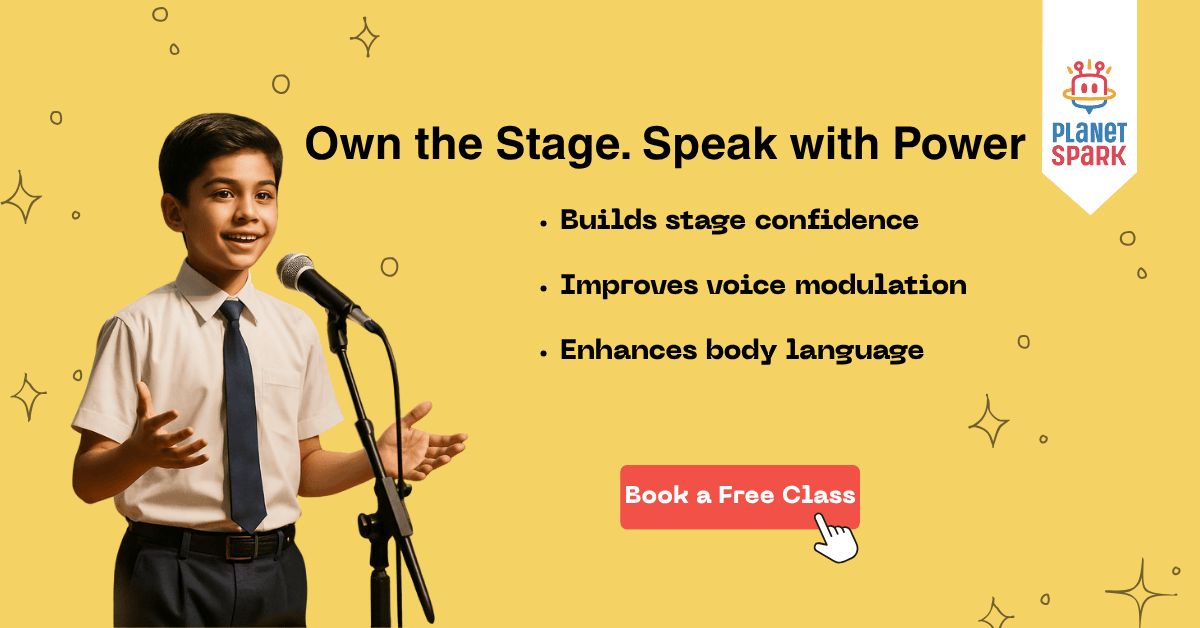
PlanetSpark’s Unique Approach to Fluency and Confidence
At PlanetSpark, we believe that every child can become a confident communicator with the right guidance and structured practice. Our Public Speaking Program is designed not just to teach children how to speak, but to help them overcome hesitation and strengthen fluency, making it an effective support for stuttering in children.
Here’s how our approach works:
1. 1:1 Public Speaking Coaching by Communication Experts
Every child receives personalised coaching from trainers skilled in communication and child psychology. This allows targeted feedback and focused guidance for each child’s speech development.
2. TED-Style Training Modules
Children learn to structure their thoughts and speeches like TEDx speakers, using the hook, message, story, and call-to-action model. This method promotes clear, confident, and smooth delivery.
3. Real-Time Practice With Global Peers
Interactive group activities, debates, and storytelling circles with learners from across the world give children safe, real-world speaking experience. Practising in a supportive setting helps reduce hesitation and improves fluency.
4. Public Speaking League & Competitions
Frequent internal competitions and national-level leagues provide children with opportunities to perform on stage, build stage confidence, and apply their speaking skills in real scenarios.
5. Video Feedback Loop for Speech Improvement
Every speech is recorded and reviewed with the coach. Children can visually see their progress, identify areas for improvement, and practise corrections, helping them gain smoother, more controlled speech over time.
By combining structured skill-building, personalised guidance, and regular real-world practice, PlanetSpark helps children not only speak clearly but also manage stuttering in children effectively, enabling them to communicate confidently in every situation.
Conclusion & Encouragement for Parents
Stuttering in children is common, and the good news is that it can improve with the right practice, guidance, and support. Early intervention, combined with consistent speaking practice, helps children build fluency, confidence, and clarity in their communication.
Structured programs like PlanetSpark’s Public Speaking Program provide a safe and supportive environment where children can practise, receive personalised feedback, and gradually overcome hesitation. By focusing on confidence-building, repetition, and real-world speaking opportunities, children gain the skills to express themselves clearly in any situation.
Frequently Asked Questions
Stuttering is a speech disorder where a child knows what they want to say but has difficulty expressing it smoothly. This can include repeating sounds, prolonging words, or experiencing pauses or blocks in speech. Understanding the stutter meaning helps parents identify whether a child may need guidance or support.
Stuttering in children can result from a combination of factors, including developmental stages, fast thoughts versus slower speech muscles, emotional triggers, environmental pressures, and hereditary influences. It is usually not linked to intelligence or comprehension.
Yes. Structured public speaking training helps children practise fluency, build confidence, and strengthen speech muscles. Repeated exposure to speaking tasks, combined with personalised feedback, gradually reduces hesitation and speech blocks.
Occasional pauses, repetitions, or slow speech can be normal as children develop language skills. However, persistent or frequent stuttering beyond age 5–6 may require guidance and practice to improve fluency.
Parents can encourage reading aloud, storytelling, slow-paced speech, and stress-free speaking opportunities. Positive reinforcement, patience, and avoiding interruptions help children practise speaking confidently in a supportive environment.