
Speak Confidently with PlanetSpark TED Public Speaking Course


Table of Contents
- What Do You Mean by TED Public Speaking?
- Why Public Speaking Skills Matter More Than Ever for Kids
- How a TED Public Speaking Course Transforms Children
- How to Give a TED Talk for Kids Step by Step
- Public Speaking Structure for Children That Builds Clarity
- Mastering Hook Message Story Call to Action
- Common Challenges Kids Face and How PlanetSpark Solves Them
- Why PlanetSpark TED Public Speaking Course is the Best Choic
- What Your Child Will Learn in PlanetSpark TED Public Speakin
- Build Confident Speakers with PlanetSpark TED Public Speakin
- Speak Today, Lead Tomorrow
Many children hesitate to speak in front of others. They may have ideas but struggle to express them clearly or confidently. What if your child could stand on stage, speak with clarity, and inspire others just like a TED speaker?
A ted public speaking course helps children overcome fear, organize their thoughts, and present ideas with confidence. In this blog, you will learn what TED-style public speaking means, how to give a TED talk for kids, understand the public speaking structure for children, and master the hook message story call to action method.
You will also discover how PlanetSpark’s expert-led program transforms children into confident communicators through structured learning and real-world practice.
What Do You Mean by TED Public Speaking?
TED public speaking refers to a style of communication inspired by TED Talks, where speakers present powerful ideas in a clear, engaging, and structured way. Unlike traditional speeches, TED-style speaking focuses on storytelling, simplicity, and emotional connection.
For children, TED public speaking is not about memorizing long speeches. It is about expressing ideas in a meaningful and impactful way.
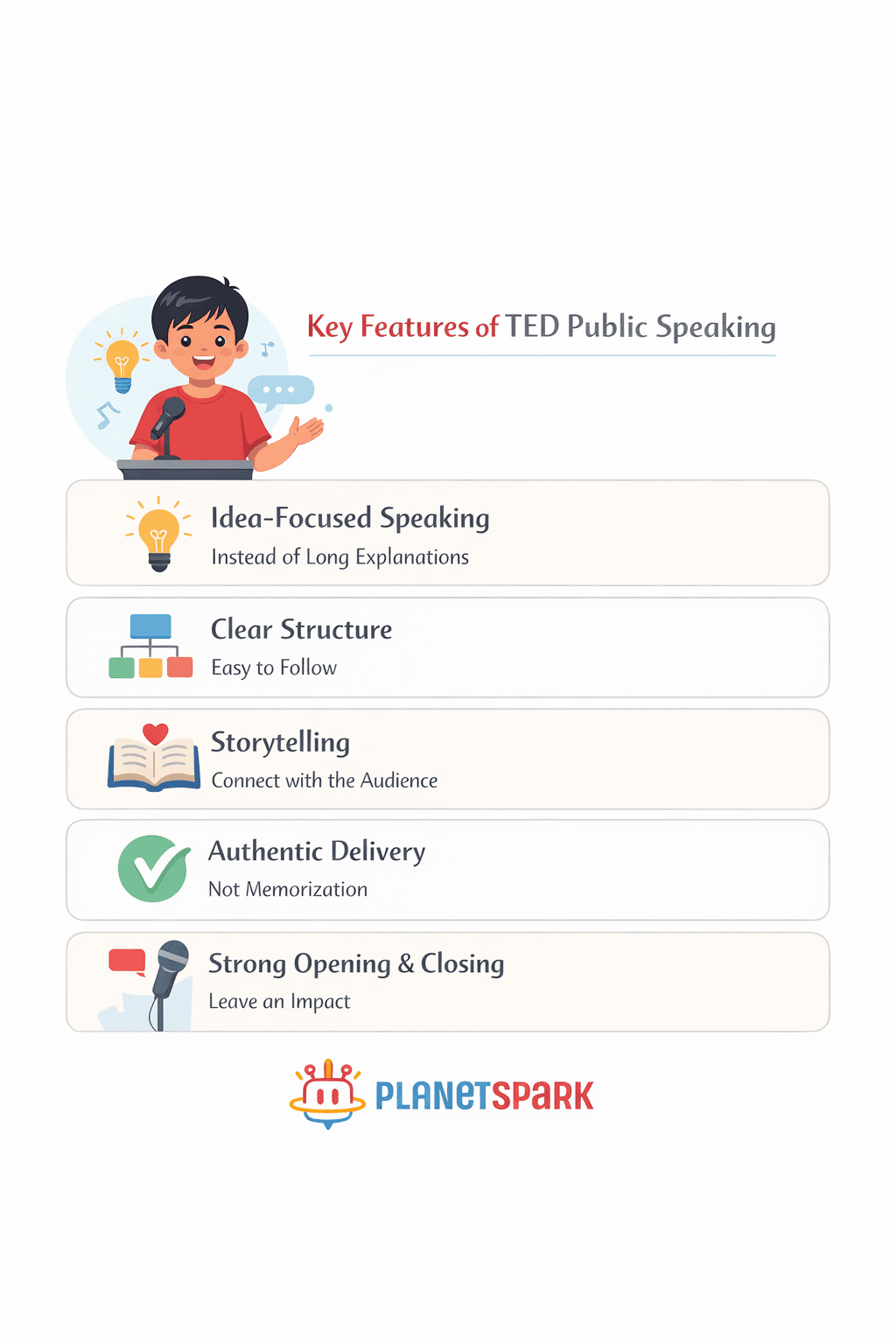
Key Features of TED Public Speaking
- Idea-focused speaking instead of long explanations
- Clear structure that is easy to follow
- Storytelling to connect with the audience
- Authentic delivery rather than memorization
- Strong opening and closing to leave an impact
For example, instead of saying many facts about climate change, a child might say: “I saw a park near my house filled with plastic waste. That day, I realized small actions matter.”
This approach makes speeches more relatable and memorable.
PlanetSpark integrates TED-style training into its curriculum so that children learn how to speak with clarity, confidence, and purpose. They are trained to focus on ideas, not just words.
Does your child struggle to express ideas clearly? Book a FREE PlanetSpark trial class now and see the transformation yourself.
Why Public Speaking Skills Matter More Than Ever for Kids
Public speaking is a core life skill in today’s world. It impacts academic performance, social confidence, and future career success.
Children who communicate well are more confident in classrooms, participate actively, and express ideas without hesitation. On the other hand, children who lack speaking skills may feel overlooked despite having strong knowledge.
A ted public speaking course helps children bridge this gap by focusing on both confidence and clarity.
Benefits of Public Speaking for Kids
- Builds confidence and self-expression
- Improves classroom participation
- Enhances social communication
- Develops leadership skills
- Strengthens critical thinking
Public speaking also supports emotional intelligence. Children learn to express thoughts clearly instead of suppressing them.
At PlanetSpark, children are trained in real-life scenarios such as presentations, storytelling, debates, and discussions. This ensures that learning is practical and applicable.
Over time, children stop fearing speaking situations and start enjoying them. This transformation builds lifelong confidence.
How a TED Public Speaking Course Transforms Children
A TED public speaking course creates a structured journey from fear to confidence. Instead of expecting children to suddenly become confident speakers, it guides them step by step, helping them build skills gradually and naturally.
Stage 1: Comfort Building
Children begin with simple speaking tasks such as introducing themselves, talking about their favorite hobby, or sharing a short story. These topics are familiar and easy, which reduces pressure.
At this stage, the goal is not perfection but comfort. Children start speaking without fear of being judged. Over time, this repeated exposure helps them feel safe and relaxed while expressing their thoughts.
Stage 2: Structured Thinking
Once children are comfortable speaking, the next step is organizing their thoughts. They learn the public speaking structure for children, which includes a clear beginning, middle, and end.
This stage is important because many children struggle not with ideas, but with arranging those ideas. When they learn structure, their speech becomes clearer, more logical, and easier to follow.
Stage 3: Storytelling Skills
After learning structure, children are introduced to storytelling. This is where their speeches become interesting and engaging.
They learn how to add personal experiences, examples, and emotions to their ideas. Storytelling helps children connect with their audience instead of just speaking facts. It also boosts creativity and imagination.
Stage 4: Delivery Techniques
Now that children know what to say and how to say it, they focus on how they present it.
They practice:
- Voice modulation to avoid sounding flat
- Eye contact to connect with listeners
- Gestures and body language to support their message
This stage builds stage presence and confidence. Children start to look and feel like confident speakers.
Stage 5: Practice and Feedback
The final stage focuses on consistent practice and improvement. Children participate in regular speaking activities such as storytelling, presentations, and discussions.
They receive feedback from experts, which helps them understand their strengths and areas of improvement. This feedback loop is essential for growth.
Worried your child avoids speaking in class? Book a FREE demo today and help them speak confidently before it’s too late.
How to Give a TED Talk for Kids Step by Step
Understanding how to give a TED talk for kids becomes easy when the process is broken down into simple, practical steps. Children do not need complex techniques. They need clarity, structure, and guided practice to express their ideas confidently.
Step 1: Choose a Topic They Love
The foundation of a great TED-style talk is choosing the right topic. Children speak more confidently when they talk about something they genuinely care about.
This could be:
- A favorite hobby like drawing or sports
- A personal experience or lesson
- A problem they want to solve
When children feel connected to the topic, their speech becomes natural, expressive, and engaging. They do not need to memorize because they already understand what they are saying.
Step 2: Define One Clear Message
A strong TED-style talk focuses on one central idea. Many children try to include too many points, which makes the speech confusing.
Encourage them to answer one simple question: “What is the one thing I want my audience to remember?”
This clarity helps them stay focused and ensures the audience understands the message easily.
Step 3: Use Hook Message Story Call to Action
This is one of the most effective frameworks for structuring a TED-style talk.
- Hook: Start with something interesting like a question, fact, or surprising statement to grab attention
- Message: Clearly explain the main idea in simple words
- Story: Add a personal experience or example to make the idea relatable
- Call to Action: End with a takeaway that inspires the audience to think or act
For example, instead of just saying “Reading is important,” a child can say:
“Last year, I read one book that changed how I think. That is when I realized reading can change your life too.”
This approach makes the speech more memorable and impactful.
Step 4: Practice Regularly
Practice is the key to confidence. Children should rehearse their speech multiple times in a relaxed environment.
Helpful ways to practice include:
- Speaking in front of a mirror
- Practicing with parents or friends
- Recording and watching their speech
Regular practice helps improve fluency, reduces nervousness, and builds confidence over time.
Step 5: Focus on Delivery
Delivery is what brings the speech to life. Even a good speech can feel dull without proper delivery.
Children should focus on:
- Maintaining eye contact to connect with the audience
- Using natural hand gestures to support their words
- Speaking clearly with proper pace and pauses
These small elements make a big difference in how the speech is received.
Want your child to deliver a TED-style speech confidently? Secure your FREE PlanetSpark class today before slots close.
Public Speaking Structure for Children That Builds Clarity
The public speaking structure for children is the foundation of confident and effective communication. Many children struggle not because they lack ideas, but because they do not know how to organize those ideas in a clear and logical way. A structured approach solves this problem and makes speaking easier, smoother, and more impactful.
1. Simple Structure Every Child Can Follow
Children can master public speaking by following a simple four-step structure:
- Introduction: This is where the child introduces the topic and sets the context. A strong introduction grabs attention and tells the audience what the speech is about.
- Main Idea: This is the core message of the speech. Children learn to focus on one clear idea instead of trying to say too many things at once.
- Supporting Points: These are examples, reasons, or small stories that explain and strengthen the main idea. This makes the speech more convincing and engaging.
- Conclusion: The conclusion summarizes the idea and leaves the audience with a clear takeaway or message.
2. Why Structure Matters
A clear structure is essential because it helps children think and speak with clarity. Without structure, even a good idea can sound confusing.
Structure helps children:
- Organize their thoughts before speaking
- Speak with confidence instead of hesitation
- Deliver ideas in a logical sequence
- Make it easier for the audience to understand
- Stay on track without forgetting points
For example, when a child speaks about “Importance of Kindness,” structure helps them explain what kindness is, why it matters, and how people can practice it in daily life.
At PlanetSpark, children are trained to think in structured formats from the beginning. Through guided exercises, speech planning techniques, and live practice sessions, they develop the ability to organize ideas naturally. Over time, this structure becomes a habit, allowing them to speak confidently in any situation.
Mastering Hook Message Story Call to Action
The hook message story call to action method is one of the most powerful frameworks used in TED-style speaking. It helps children transform simple ideas into impactful speeches that capture attention and leave a lasting impression.
1. Hook
The hook is the opening line that grabs attention instantly. It sets the tone for the speech and makes the audience curious.
Examples of hooks include:
- A surprising fact
- A thought-provoking question
- A short relatable statement
A strong hook ensures that the audience listens from the very beginning.
2. Message
The message is the central idea of the speech. Children are trained to keep it simple, clear, and focused.
Instead of explaining too many ideas, they learn to communicate one strong message effectively.
3. Story
The story is what makes the speech memorable. Children learn to add personal experiences, examples, or short narratives that help the audience connect emotionally.
Stories make speeches more engaging and easier to understand.
4. Call to Action
This is the closing part of the speech where the speaker encourages the audience to think, feel, or act differently.
For example:
“Start helping someone every day” or “Read one book this week.”
Why This Method Works
- Keeps speeches structured and engaging
- Helps children connect with the audience
- Makes ideas more memorable
- Builds confidence in delivery
PlanetSpark uses TED-style storytelling frameworks to train children in this method through live practice, guided speech building, and expert feedback. Children do not just learn the framework, they apply it in real speaking situations until it becomes natural.
Finding it hard to teach storytelling at home? Book a FREE PlanetSpark trial class and let expert coaches guide your child before seats fill up.
Common Challenges Kids Face and How PlanetSpark Solves Them
Public speaking can feel overwhelming for children, especially without proper guidance. Many children face similar challenges when they begin their speaking journey.
Common Challenges
- Fear of speaking in front of others: Children worry about making mistakes or being judged
- Lack of structure: They have ideas but struggle to organize them
- Limited practice opportunities: Without regular speaking practice, confidence does not improve
- Low confidence and hesitation: Fear leads to avoidance of speaking situations
How PlanetSpark Solves These Challenges
PlanetSpark provides a structured and supportive learning environment that addresses each of these problems effectively.
- 1:1 live coaching with expert trainers: Personalized attention ensures that each child progresses at their own pace
- Safe and encouraging practice environment: Children feel comfortable expressing themselves without fear
- Structured curriculum with clear milestones: Step-by-step learning ensures steady improvement
- Real-world speaking opportunities: Activities like debates, storytelling, and presentations build practical skills
- Video feedback and AI-powered performance reports: Children can see their progress and improve continuously
This structured approach ensures that children do not just overcome fear but develop lasting confidence and communication skills that stay with them for life.
Why PlanetSpark TED Public Speaking Course is the Best Choice for Your Child
PlanetSpark stands out because it combines expert coaching, structured learning, and real-world practice into one comprehensive program.
1. Personalized 1:1 Coaching
Every child receives individual attention, allowing trainers to focus on their strengths and areas of improvement. This leads to faster and more effective learning.
2. TED-Style Curriculum
Children learn how to structure speeches, tell stories, and deliver impactful messages using globally recognized TED-style frameworks.
3. Real-World Practice
Learning is not limited to theory. Children actively participate in debates, storytelling sessions, presentations, and discussions.
4. Video Feedback System
Children watch their own recorded speeches, which helps them identify areas of improvement and build self-awareness.
5. AI-Powered Progress Reports
Parents receive detailed insights into their child’s performance, making progress measurable and transparent.
6. Confidence-Building Activities
Special exercises focus on reducing stage fear and building self-confidence gradually.
7. Global Exposure
Students interact with peers from over 13 countries, giving them global communication exposure and confidence.
With over 1 million classes conducted and a 4.8 rating from 20,000+ reviews, PlanetSpark has established itself as a trusted leader in communication skills training.
Ready to give your child a powerful communication advantage? Book your FREE PlanetSpark demo class now before limited seats are filled.
What Your Child Will Learn in PlanetSpark TED Public Speaking Course
PlanetSpark’s curriculum is designed to develop communication skills step by step, ensuring children gain both confidence and clarity.
Core Skills Developed
1. Voice Modulation for Expressive Speaking
Voice modulation means changing the tone, pitch, speed, and volume of your voice while speaking. It helps children avoid sounding flat or monotonous.
When children learn voice modulation, they can:
- Speak louder for important points
- Slow down to create emphasis
- Change tone to express emotions like excitement or seriousness
For example, saying “This was the most exciting day of my life!” with energy sounds far more engaging than saying it in a flat tone.
Voice modulation makes speeches lively and keeps the audience interested. PlanetSpark trains children through guided exercises where they practice speaking with different tones and expressions.
2. Body Language and Gestures for Better Presentation
Body language includes posture, hand movements, facial expressions, and overall physical presence while speaking. It plays a major role in how confident a speaker appears.
Children learn to:
- Stand straight and maintain a confident posture
- Use hand gestures to explain ideas
- Smile and use facial expressions to match their message
For example, when explaining something big or exciting, using open hand gestures makes the speech more expressive.
Good body language supports spoken words and makes communication more effective. At PlanetSpark, children practice these techniques through live sessions and role-based activities.
3. Eye Contact to Connect with the Audience
Eye contact helps build a connection between the speaker and the audience. It shows confidence and makes the speech feel personal.
Children are taught to:
- Look at different people while speaking
- Avoid looking down or away
- Maintain natural and comfortable eye contact
When a child makes eye contact, the audience feels more involved and attentive. It also helps the speaker stay focused and confident.
PlanetSpark trains children to develop this skill through practice sessions where they learn to engage with listeners naturally.
4. Speech Structure for Clear Communication
Speech structure helps children organize their ideas in a clear and logical way. Without structure, even a good idea can sound confusing.
Children learn a simple format:
- Beginning to introduce the topic
- Middle to explain ideas
- End to conclude with a takeaway
For example, if a child talks about “Healthy Eating,” they start with why it matters, explain benefits, and end with a suggestion.
Structured speaking improves clarity, confidence, and understanding. PlanetSpark ensures children practice structured speaking regularly until it becomes natural.
Want your child to speak confidently in school and beyond? Book a FREE trial class today and start their transformation journey now.
5. Storytelling for Engaging Delivery
Storytelling makes speeches interesting and memorable. Instead of just sharing facts, children learn to explain ideas through stories.
They learn to:
- Share personal experiences
- Use simple examples
- Add emotions to their speech
For example, instead of saying “Helping others is important,” a child can share a short story about helping a friend.
Stories help the audience connect emotionally and understand the message better. PlanetSpark focuses strongly on storytelling through TED-style training modules.
6. Confidence Building Through Regular Practice
Confidence does not come instantly. It develops with consistent practice and positive reinforcement.
Children build confidence by:
- Speaking regularly in safe environments
- Receiving constructive feedback
- Gradually speaking in front of larger groups
Each small success builds self-belief. Over time, children move from hesitation to confidence.
PlanetSpark ensures regular speaking opportunities through live classes, activities, and feedback sessions. This consistent practice helps children become confident communicators who can express themselves clearly in any situation.
Learning Journey
- Initial Assessment: Understanding the child’s current skill level
- Personalized Learning Plan: Tailored roadmap based on individual needs
- Core Skill Development: Building fundamentals like structure and clarity
- Advanced Speaking Techniques: Learning storytelling, voice modulation, and audience engagement
- Practice and Feedback: Regular speaking sessions with expert feedback
- Final Showcase: Children present their learning in a confident and structured way
PlanetSpark ensures that children gain real-world speaking experience through continuous practice, not just theoretical knowledge.
Build Confident Speakers with PlanetSpark TED Public Speaking Course
PlanetSpark Public Speaking classes are designed for children aged 4 to 14 who want to become confident communicators. These classes focus on building clarity, creativity, and confidence through structured and engaging learning.
The program helps children overcome stage fear, organize their thoughts, and express ideas confidently in real-life situations such as school presentations, debates, storytelling sessions, and competitions.
What Makes These Classes Effective
- Live 1:1 interactive classes that ensure personal attention
- Expert certified trainers who guide and mentor students
- TED-style curriculum focused on storytelling and structured speaking
- Real-world speaking practice through engaging activities
- Personalized feedback for continuous improvement
- AI-powered performance tracking for measurable growth
- Confidence-building framework that reduces fear step by step
With consistent practice, expert guidance, and a structured approach, PlanetSpark helps children transform into confident speakers who can express ideas clearly and make a lasting impression.

Speak Today, Lead Tomorrow
Public speaking is a skill that shapes a child’s future. It builds confidence, clarity, and creativity. When children learn to express themselves clearly, they unlock new opportunities in academics and life.
Encourage your child to practice consistently and embrace learning. With the right guidance, every child can become a confident speaker who inspires others and leads with confidence.
Frequently Asked Questions
Yes, all classes are live 1:1 sessions.
At PlanetSpark you can do it through AI reports and recorded feedback.
Children aged 4 to 14 can enroll at PlanetSpark TED public speaking course.
It is a structured program by PlanetSpark that teaches children to speak confidently using storytelling and structured frameworks.
At PlanetSpark we use TED-style modules, live practice, and expert feedback to train children effectively.
At PlanetSpark It includes introduction, main idea, supporting points, and conclusion.
It is a framework that helps children create engaging and structured speeches at PlanetSpark.